จำนวน Repository ( 121 )
Solid waste management from BTS Sky train construction (a perspective of contractors)
The purpose of this research paper is to study the solid waste management to the following 3 lines of BTS Sky train construction projects: blue linered line and violet line.The study was carried out by distributing questionnaires to 22 randomly selected contractors on the site from Sino-Thai Engineering and Construction Plc. CKTC Joint Venture Co. SH-UN Joint Venture Co. and Unique Engineering and Construction Plc. The results of the survey showed that an average quantity of solid waste during the commencement ot the project and reached to x=2.54SD=0.80 during construction period. However the quantity lf solid waste was higher upon the termination of the project X=1.97 SD=0.72. For some managers the problems of solid waste were caused by planning and policy maling such as too much rush work unsuitable material management area and misleading materials planning. The other contributors to the problem were traced from operators material transportation to the site. Workers have a lack ot the expertise to work. Supervisors have a lack of monitoring and supervisory work. Supervisors training on waste management played a vital role in promoting solid waste management(X = 3.44 SD = 0.73).
พัฒนาดินซีเมนต์ลูกรังผสมวัสดุเถ้าทิ้งจากผลผลิตอุตสาหกรรมและเกษตรกรรมเป็นอิฐประสาน
จากการทดลองวิจัยพบว่าตัวอย่างดินลูกรังผสมเถ้าทิ้งจากอุตสาหกรรมและเกษตรกรรมสามารถเป็นวัสดุก่อสร้างอิฐประสานได้ตามความเหมาะสมตามอัตราส่วนและกาลังที่ต้องการ โดยมีองค์ประกอบทางเคมีของดินลูกรัง เถ้าแกลบและเถ้าชานอ้อย พบว่าดินลูกรังมีซิลิกอน ออกไซด์ (SiO2) อลูมิน่า ออกไซด์ (Al2O3) ไอรอน ออกไซด์ (Fe2O3) เป็น 58.60 % 25.50% 13.00% ตามลาดับและพบสารประกอบ Silicon Oxide (SiO2) : Quartz เถ้าแกลบมีซิลิกอน ออกไซด์ (SiO2) แคลเซียม ออกไซด์ (CaO) โพแทสเซียม ออกไซด์ (K2O) เป็น 94.00% 2.00% 2.80% ตามลาดับและพบสารประกอบ Silicon Oxide (SiO2) : Cristobalite เถ้าชานอ้อยมีซิลิกอน ออกไซด์ (SiO2) แคลเซียม ออกไซด์ (CaO) โพแทสเซียม ออกไซด์ (K2O) เป็น 74.7% 07.8% 5.4% ตามลาดับและพบสารประกอบ Silicon Oxide (SiO2) : Quartz ผลการทดสอบกาลังอัดพบว่าตัวอย่างทดสอบเถ้าแกลบที่มีกาลังอัดน้อยกว่า 70 ksc. 34 ตัวอย่างระหว่าง 70-100 ksc. 7 ตัวอย่าง และมากกว่า 100 ksc. 24 ตัวอย่าง ตัวอย่างทดสอบเถ้าชานอ้อยที่มีกาลังอัดน้อยกว่า 70 ksc. 25 ตัวอย่างระหว่าง 70-100 ksc. 8 ตัวอย่างและมากกว่า 100 ksc. 32 ตัวอย่าง ซึ้งพบว่าดินลูกรังและเถ้าทิ้งเมื่อเพิ่มปริมาณปูนมากขึ้นกาลังรับแรงเพิ่มตามสาดับผู้ใช้ควรเลือกใช้ตามความเหมาะสมกับงาน ผลการทดสอบการดดูดซึมน้าพบว่าอิฐประสานจากเถ้าแกลบและเถ้าชานอ้อยหลังการแช่น้าไม่สามารคงรูปอยู่ได้ 11 ตัวอย่างซึ่งเห็นว่าไม่มีวัสดุที่ก่อให้เกิดการแข็งตัว อิฐประสานจากเถ้าแกลบและเถ้าชานอ้อยสามารถดูซึมน้าได้น้อยกว่า 30% จานวน 51 ตัวอย่างและ 53 ตัวอย่าง ตามลาดับ ซึ้งสามารถนาไปใช้ในงานก่อสร้างได้ผลการทดสอบการเปลี่ยนแปลงปริมาตรจากความชื้นพบว่าอิฐประสานจากเถ้าแกลบและเถ้าชานอ้อยไม่เกิดการเปลี่ยนแปลงปริมาตรหรือเกิดน้อยมากจานวน 10 และ14 ตัวอย่างตามลาดับซึ้งเป็นคุณสมบัติที่ดีของวัสดุก่อสร้าง
The Development of New Mixed Fiber from Waste Cocoon and Other Plant Fibers
The purpose of this project is to develop the production Process of the blend fibers from the remnants of waste cocoons and plant fibers by the experiment of the handicraft products. The result showed that the remnants of cocoons and 5 types of blends and the other plant fibers were mixed; namely cotton fibers linen fibers ramie fibers pineapple fibers and the hemp fibers. The physical properties were performed as follow: the first breaking strength the breaking strength of the woven fabric from the remnants of cocoons and linen fibers were 155 CN/tex. The second breaking strength of the woven fabric from the remnants of waste cocoons and the Indian hemps were 149 CN/tex. The third breaking strength of woven fabric from the remnants of waste cocoons and cotton fibers were 142 CN/tex. The forth breaking strength of woven fabric from the remnants of cocoons and pineapple fibers was 108 CN/tex. The result showed that the woven fabric from the 5 types of these blends had the potential to be applied in the household textile products
The Improvement Of Carbon Black From Waste Tires For Offset Printing Ink Using Coupling Agent
This work was aimed to improve the carbon black from waste tires for printing ink using coupling agent to disperse carbon black particle for making an oil-based offset ink. This experiment used 2 coupling agent these were silane coupling and derivative fatty acid and used to produce offset inks for the 7 formulas. Formula 1 Commercail carbon blackFormula 2 carbon black was not washed by Nitric acid formula 3 carbon black was not washed by Nitric acid and was added silane coupling agent formula 4 carbon black was not washed by Nitric acid and was added fatty acid modified emulsifier formula 5 carbon black was washed by nitric acid formula 6 carbon black was washed by nitric acid and was added silane coupling formula 7 carbon black was washed by nitric acid and was added fatty acid modified emulsifier. Bring all 6 formulas to test property to compare with offset ink commercial. First find the smallest particle of carbon black for 90 minutes. It was found that formula 4 took 20 minutes to make particles 12 micron and it is smalles particle of all. Then measured ink flow by Spread-O-Meter and measured diameter after 1 minute. It was found that formula 3 and 3 were 77 mm. and approximate commercial ink. Then measured tack of ink with Ink-O-Meter it was found that formula 2 3 4 6 and 7 were 2.4 and formula 5 was 2. Then measured viscosity and yield value of ink by Lary viscometer. It was found that formula 2 had 77 poise of ink viscosity and 670 dyne.s/cm2 of ink yield value that was approximate commercial ink. Finally measured Emulsification capacity (%) by Kershaw Water Pick up Tester. It was found that formula 6 had 74% and it was approximate commercial ink.
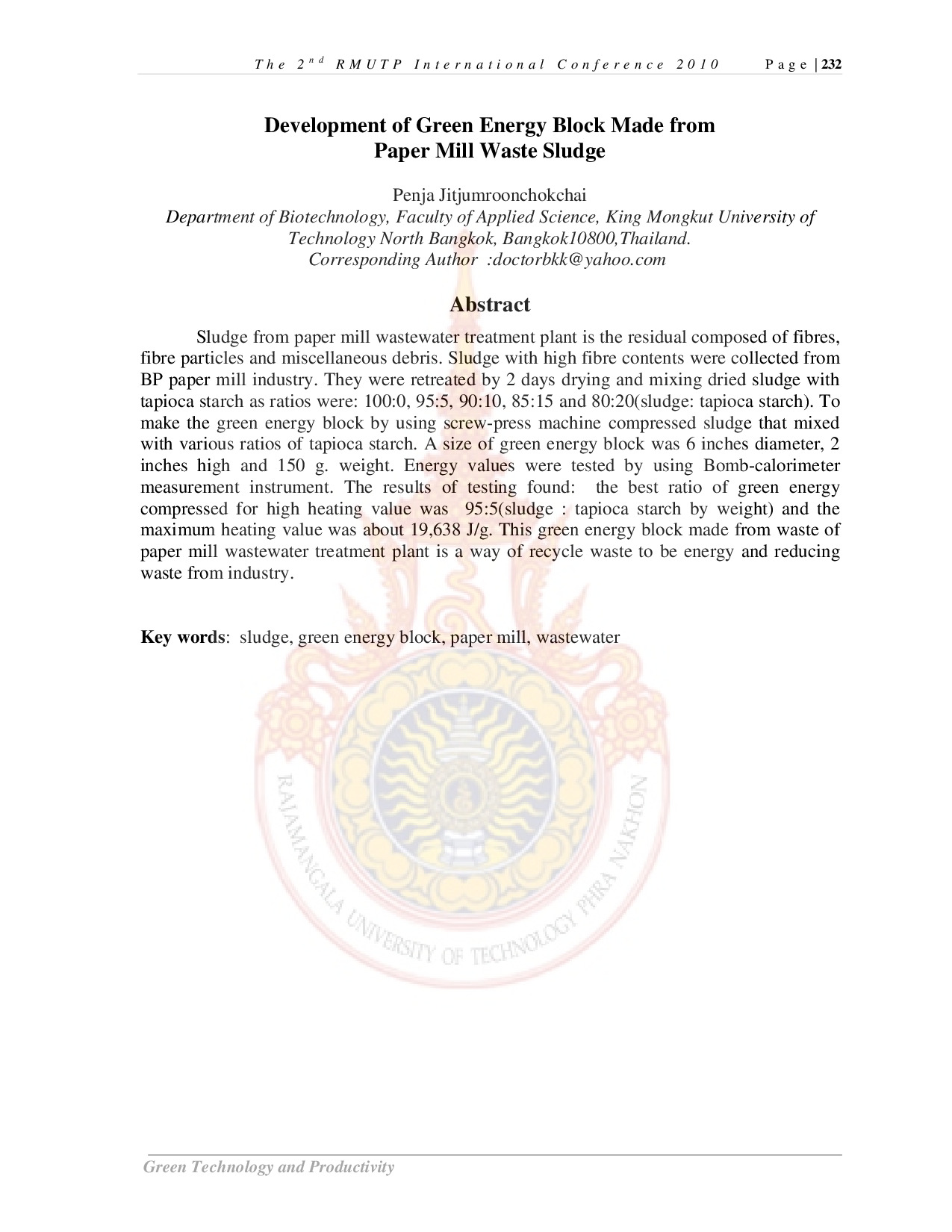
Development of Green Energy Block Made from Paper Mill Waste Sludge
Sludge from paper mill wastewater treatment plant is the residual composed of fibres fibre particles and miscellaneous debris. Sludge with high fibre contents were collected from BP paper mill industry. They were retreated by 2 days drying and mixing dried sludge with tapioca starch as ratios were: 100:0 95:5 90:10 85:15 and 80:20(sludge: tapioca starch). To make the green energy block by using screw-press machine compressed sludge that mixed with various ratios of tapioca starch. A size of green energy block was 6 inches diameter 2 inches high and 150 g. weight. Energy values were tested by using Bomb-calorimeter measurement instrument. The results of testing found: the best ratio of green energy compressed for high heating value was 95:5(sludge : tapioca starch by weight) and the maximum heating value was about 19638 J/g. This green energy block made from waste of paper mill wastewater treatment plant is a way of recycle waste to be energy and reducing waste from industry.