จำนวน Repository ( 1574 )
A System Dynamics Model to Analyze Behavior of Manufacturing in Supply Chain
This research offers. The system dynamics study of supply chain processes in the manufacturing industry. The production is made-up of make to order from the building stock and flow with the fourth cycle and parameters define to test the behavior by using Vensim program to simulation situation by the time 50 weeks showed that the response to increases in the order of 20% in the production process made the amplification behavior. The process resulted in levels of inventory bog down. The reduction of inventory conflicts with the desire to keep the inventory caused by delays of customer change. The organizational behavior is not balance the products backlog and made the level of order fulfillment ratio lower than 100%
A Study of Coconut Oil Pressing Machine
The technology development has been continuing to solve the cost problem aiming to reduce work time to streamline the existing machines to be more efficient and productive including designing the devices to replace human labor. In present paper the author has an idea to develop and transform the old press machine which has faced the issues of the deteriorated helix core bunt motor when overloaded less productivity to hydraulic cylinder. This paper examined the development of the coconut oil pressing machine from old model to hydraulic cylinder system. In operating principles the developed machine uses the motor pumping the hydraulic oil into hydraulic pump the oil fuel was restricted by hydraulic pump to increase the pressure transmitted to the solenoid valve which is responsible for changing the direction of the oil flow resulting that the cylinder moves up and down under the control system. The cylinder presses the coconut pulp The study of the development of coconut oil press machine was initiated by drying the 3 kg coconut pulp in the sun to obtain the 0.2038 kg (or 160 ml) coconut oil. In this study the hydraulic cylinder presses 3 kg dried coconut pulp into 1.1858 kg (or 946 ml) coconut oil or accounted for 83.08% as compared the old machine. The payback period is within 29 days.
Marketing Factors, Sociological Effects, and Attitudes upon Sufficiency Economy’s Book Purchase of People in Bangkok Metropolitan
The research of the factors influencing people’s purchase of the book about sufficiency economy in Bangkok was aimed at studying 1) attitudes towards sufficiency economy 2) marketing factors and book purchasing behavior about sufficiency economy 3) sociological effects upon sufficient economy and 4) factors influencing people’s purchase of the book about sufficiency economy in Bangkok. The questionnaires were constructed as a tool for collecting data from 400 samples of the people in Bangkok who used to purchase the book about sufficiency economy. The results of hypotheses tests at the statistical significance of 0.05 showed that 1) awareness knowledge liking and preference in attitudes towards sufficiency economy had no influence upon a purchase of the book about sufficient economy 2) marketing factors including product price promotion and place had influence upon purchase of the book about sufficiency economy 3) sufficiency economy book purchasing behavior the number of the books about sufficiency economy had influence upon book purchasing behavior 4) morality and sufficiency aspect in sociological effects had influence on sufficiency economy book purchasing behaviors.
The Improvement Of Carbon Black From Waste Tires For Offset Printing Ink Using Coupling Agent
This work was aimed to improve the carbon black from waste tires for printing ink using coupling agent to disperse carbon black particle for making an oil-based offset ink. This experiment used 2 coupling agent these were silane coupling and derivative fatty acid and used to produce offset inks for the 7 formulas. Formula 1 Commercail carbon blackFormula 2 carbon black was not washed by Nitric acid formula 3 carbon black was not washed by Nitric acid and was added silane coupling agent formula 4 carbon black was not washed by Nitric acid and was added fatty acid modified emulsifier formula 5 carbon black was washed by nitric acid formula 6 carbon black was washed by nitric acid and was added silane coupling formula 7 carbon black was washed by nitric acid and was added fatty acid modified emulsifier. Bring all 6 formulas to test property to compare with offset ink commercial. First find the smallest particle of carbon black for 90 minutes. It was found that formula 4 took 20 minutes to make particles 12 micron and it is smalles particle of all. Then measured ink flow by Spread-O-Meter and measured diameter after 1 minute. It was found that formula 3 and 3 were 77 mm. and approximate commercial ink. Then measured tack of ink with Ink-O-Meter it was found that formula 2 3 4 6 and 7 were 2.4 and formula 5 was 2. Then measured viscosity and yield value of ink by Lary viscometer. It was found that formula 2 had 77 poise of ink viscosity and 670 dyne.s/cm2 of ink yield value that was approximate commercial ink. Finally measured Emulsification capacity (%) by Kershaw Water Pick up Tester. It was found that formula 6 had 74% and it was approximate commercial ink.
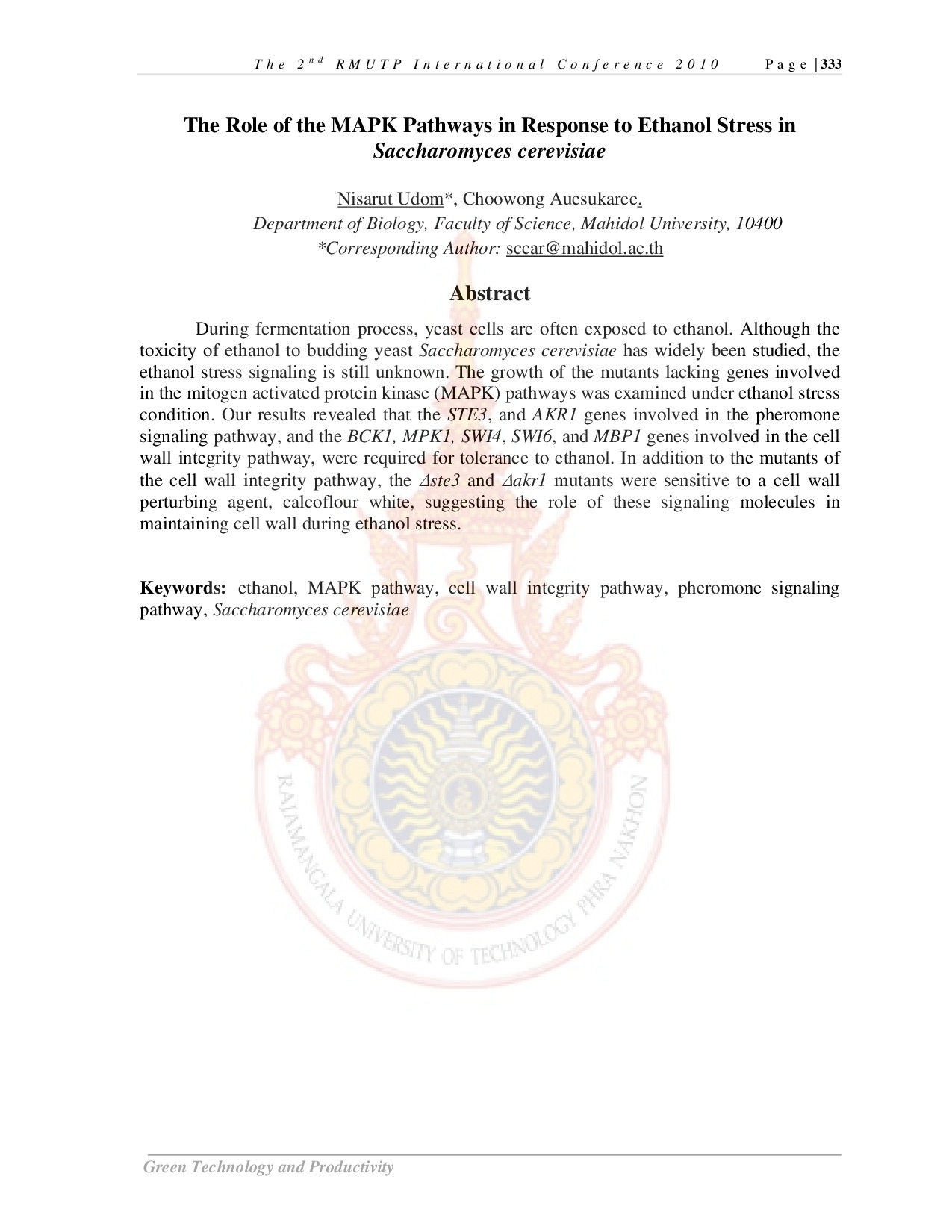
The Role of the MAPK Pathways in Response to Ethanol Stress in Saccharomyces cerevisiae
During fermentation process yeast cells are often exposed to ethanol. Although the toxicity of ethanol to budding yeast Saccharomyces cerevisiae has widely been studied the ethanol stress signaling is still unknown. The growth of the mutants lacking genes involved in the mitogen activated protein kinase (MAPK) pathways was examined under ethanol stress condition. Our results revealed that the STE3 and AKR1 genes involved in the pheromone signaling pathway and the BCK1 MPK1 SWI4 SWI6 and MBP1 genes involved in the cell wall integrity pathway were required for tolerance to ethanol. In addition to the mutants of the cell wall integrity pathway the Δste3 and Δakr1 mutants were sensitive to a cell wall perturbing agent calcoflour white suggesting the role of these signaling molecules in maintaining cell wall during ethanol stress.