จำนวน Repository ( 2131 )
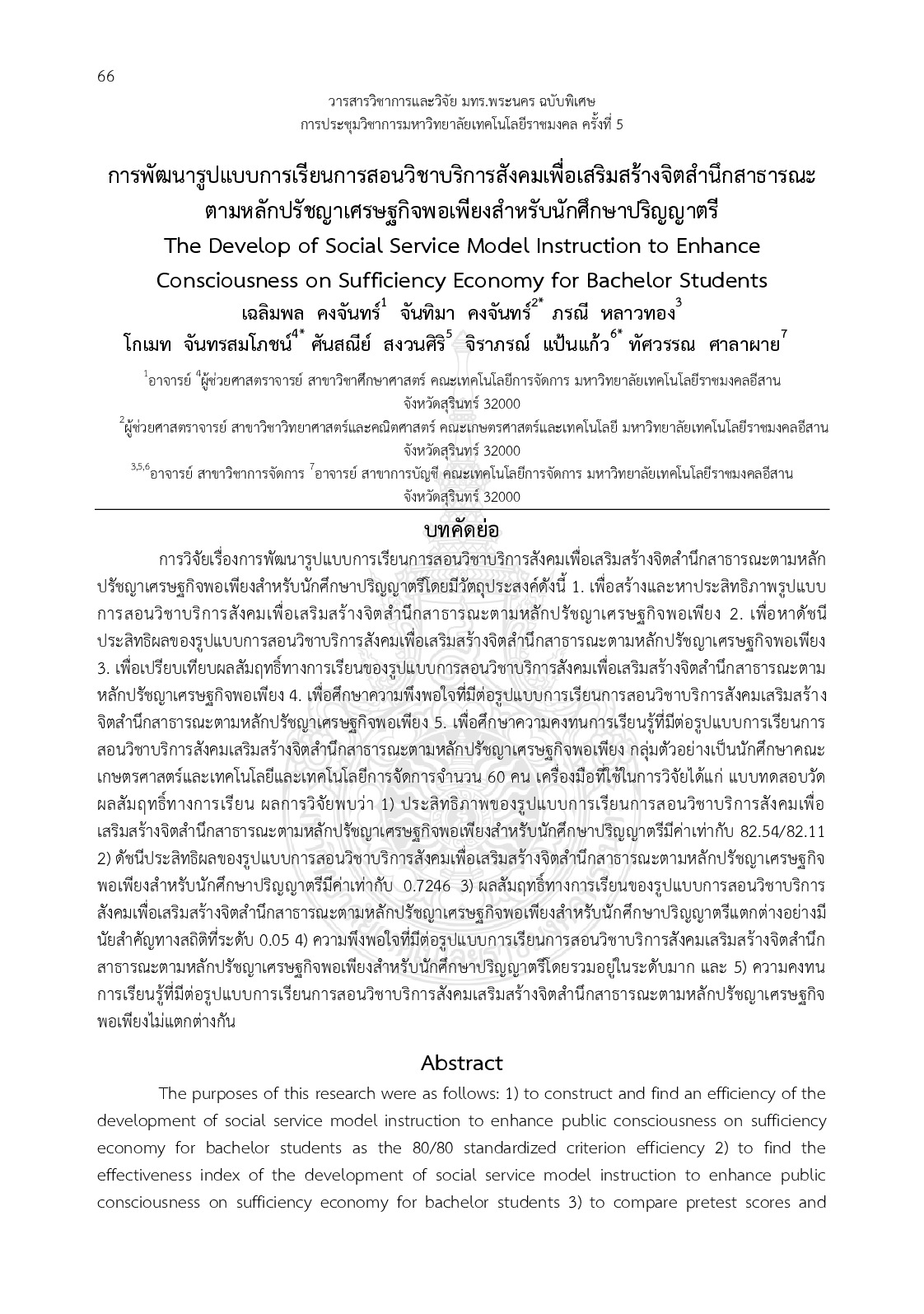
The develop of social service model instruction to enhance consciousness on sufficiency economy for bachelor students
The purposes of this research were as follows: 1) to construct and find an efficiency of the development of social service model instruction to enhance public consciousness on sufficiency economy for bachelor students as the 80/80 standardized criterion efficiency 2) to find the effectiveness index of the development of social service model instruction to enhance public consciousness on sufficiency economy for bachelor students 3) to compare pretest scores and post-test scores all lessons 4) to study the satisfaction of students after they join the class 5) to study the attitude of students after they join the class and 6) to find the retention of students after join the class in two weeks. The sixty students were area on simple random sampling selected from students in Rajamangala Technology University. The results the study was as follows: 1) An efficiency of the development of social service model instruction to enhance public consciousness on sufficiency economy for bachelor students was 82.54/82.11 which higher than the 80/80 standardized criterion efficiency. 2) The efficiency index of the development of social service model instruction to enhance public consciousness on sufficiency economy for bachelor students was 0.7246. 3) The results of the comparisons of pre-test scores and post-test scores all lesson significantly different at 0.05. 4) The results of the satisfaction of the development of social service model instruction to enhance public consciousness on sufficiency economy for bachelor students was found to be a high level. 5) The retention of the teachers after join the class in two was no significantly different.
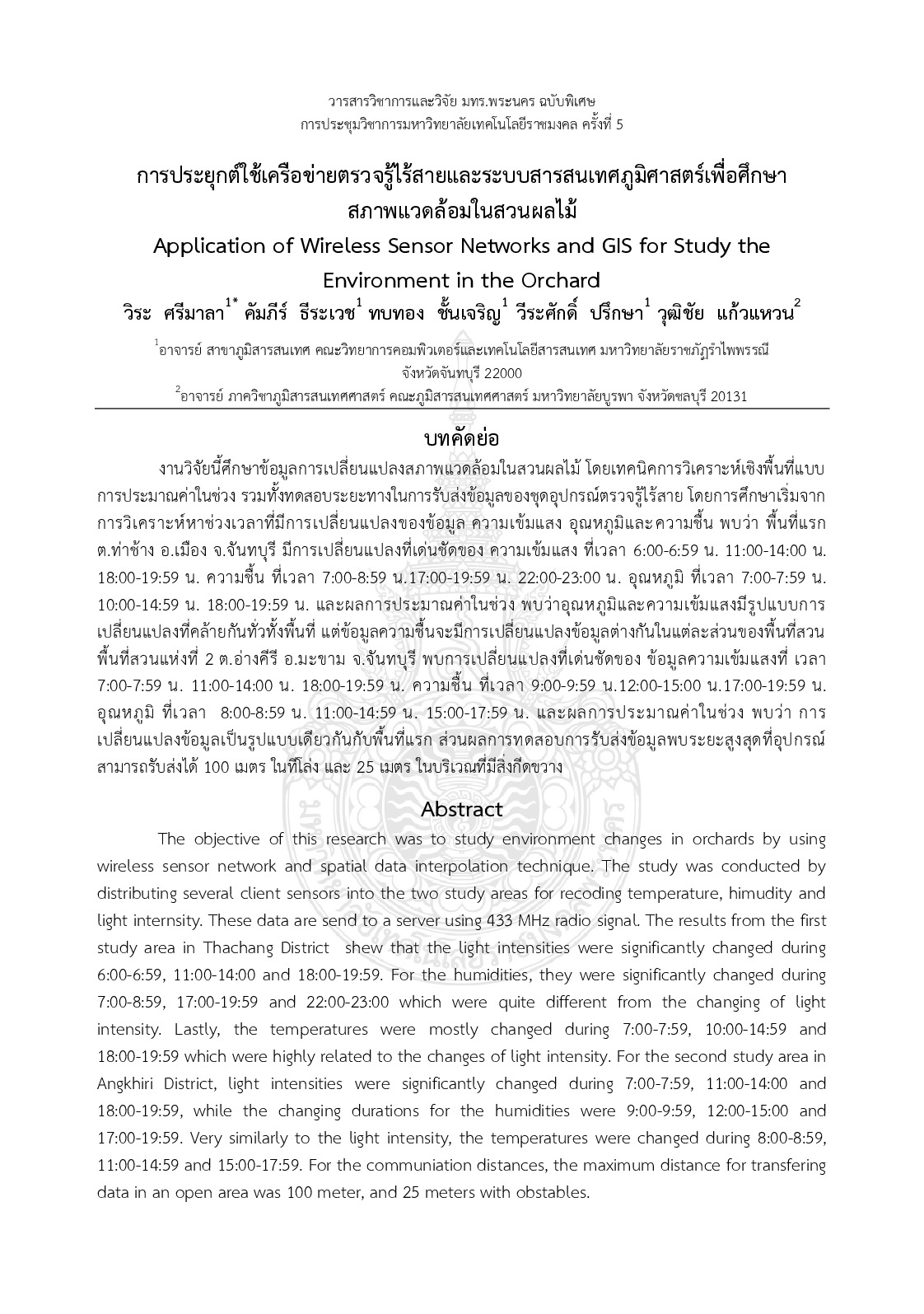
Application of wireless sensor networks and gis for study the environment in the orchard
The objective of this research was to study environment changes in orchards by using wireless sensor network and spatial data interpolation technique. The study was conducted by distributing several client sensors into the two study areas for recoding temperature himudity and light internsity. These data are send to a server using 433 MHz radio signal. The results from the first study area in Thachang District shew that the light intensities were significantly changed during 6:00-6:59 11:00-14:00 and 18:00-19:59. For the humidities they were significantly changed during 7:00-8:59 17:00-19:59 and 22:00-23:00 which were quite different from the changing of light intensity. Lastly the temperatures were mostly changed during 7:00-7:59 10:00-14:59 and 18:00-19:59 which were highly related to the changes of light intensity. For the second study area in Angkhiri District light intensities were significantly changed during 7:00-7:59 11:00-14:00 and 18:00-19:59 while the changing durations for the humidities were 9:00-9:59 12:00-15:00 and 17:00-19:59. Very similarly to the light intensity the temperatures were changed during 8:00-8:59 11:00-14:59 and 15:00-17:59. For the communiation distances the maximum distance for transfering data in an open area was 100 meter and 25 meters with obstables.
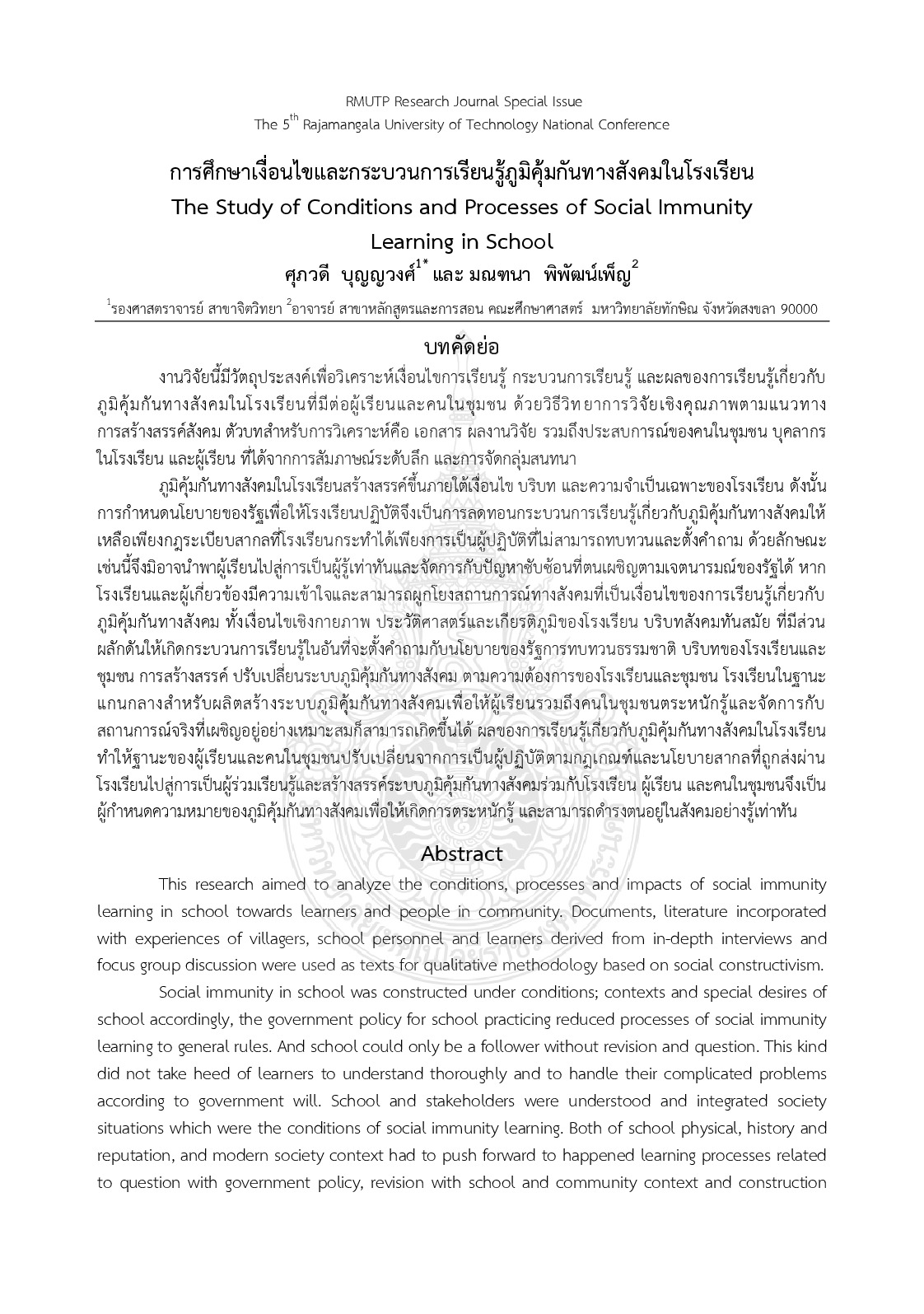
The study of conditions and processes of social immunity learning in school
This research aimed to analyze the conditions processes and impacts of social immunity learning in school towards learners and people in community. Documents literature incorporated with experiences of villagers school personnel and learners derived from in-depth interviews and focus group discussion were used as texts for qualitative methodology based on social constructivism. Social immunity in school was constructed under conditions; contexts and special desires of school accordingly the government policy for school practicing reduced processes of social immunity learning to general rules. And school could only be a follower without revision and question. This kind did not take heed of learners to understand thoroughly and to handle their complicated problems according to government will. School and stakeholders were understood and integrated society situations which were the conditions of social immunity learning. Both of school physical history and reputation and modern society context had to push forward to happened learning processes related to question with government policy revision with school and community context and construction social immunity. Therefore school as a core to construct social immunity for awareness and coping with real situations of learners and people in community was able to occur. The impact of this learning replaced the learners and villagers whom were the followers of passed general rules and policy to the participants of cooperative learning and constructing social immunity processes. Hence learners and villagers determined meaning of social immunity for awareness and having abilities to exist in society with understanding thoroughly.
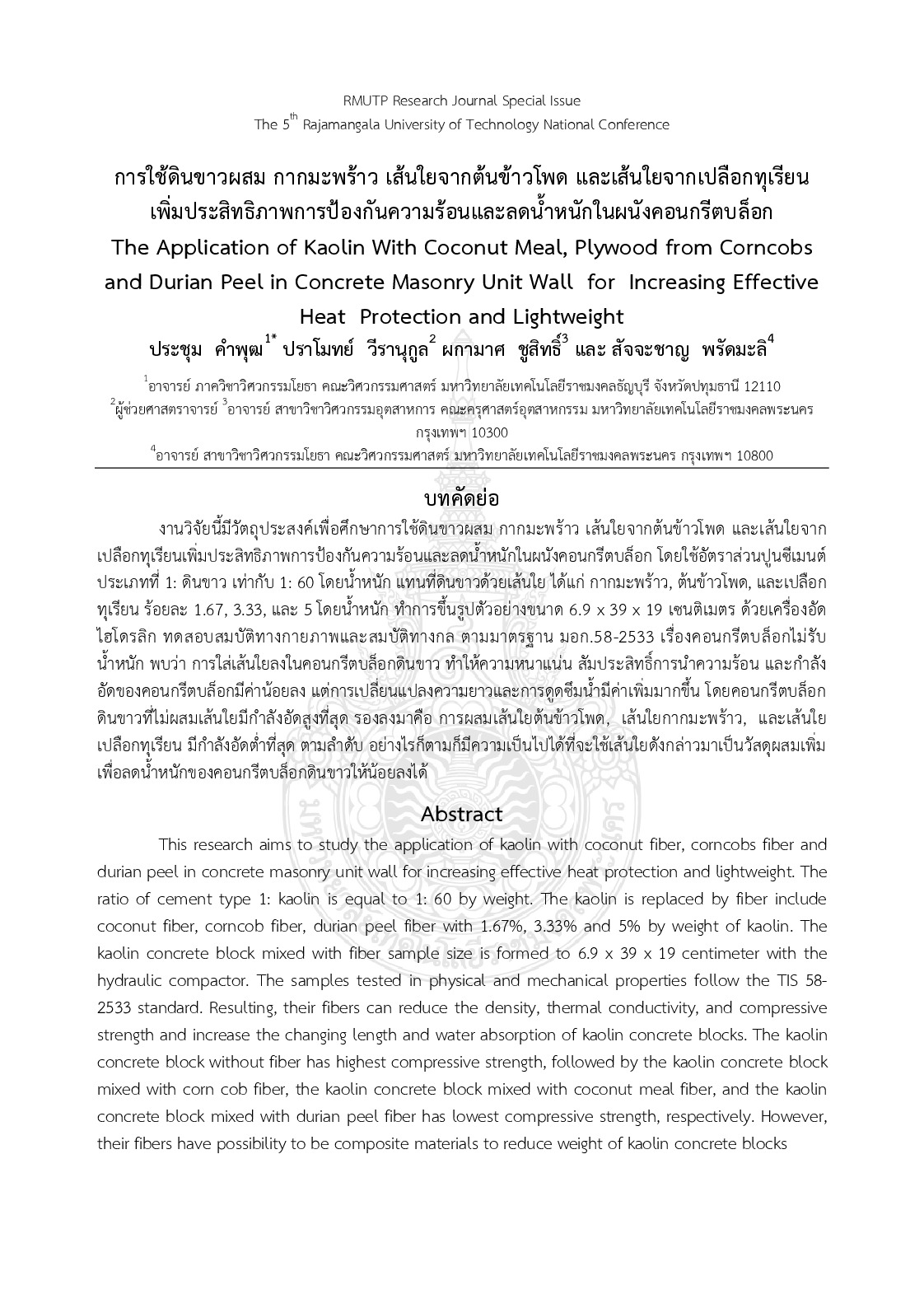
The application of kaolin with coconut meal, plywood from corncobs and durian peel in concrete masonry unit wall for increasing effective heat protection and lightweight
This research aims to study the application of kaolin with coconut fiber corncobs fiber and durian peel in concrete masonry unit wall for increasing effective heat protection and lightweight. The ratio of cement type 1: kaolin is equal to 1: 60 by weight. The kaolin is replaced by fiber include coconut fiber corncob fiber durian peel fiber with 1.67% 3.33% and 5% by weight of kaolin. The kaolin concrete block mixed with fiber sample size is formed to 6.9 x 39 x 19 centimeter with the hydraulic compactor. The samples tested in physical and mechanical properties follow the TIS 58-2533 standard. Resulting their fibers can reduce the density thermal conductivity and compressive strength and increase the changing length and water absorption of kaolin concrete blocks. The kaolin concrete block without fiber has highest compressive strength followed by the kaolin concrete block mixed with corn cob fiber the kaolin concrete block mixed with coconut meal fiber and the kaolin concrete block mixed with durian peel fiber has lowest compressive strength respectively. However their fibers have possibility to be composite materials to reduce weight of kaolin concrete blocks
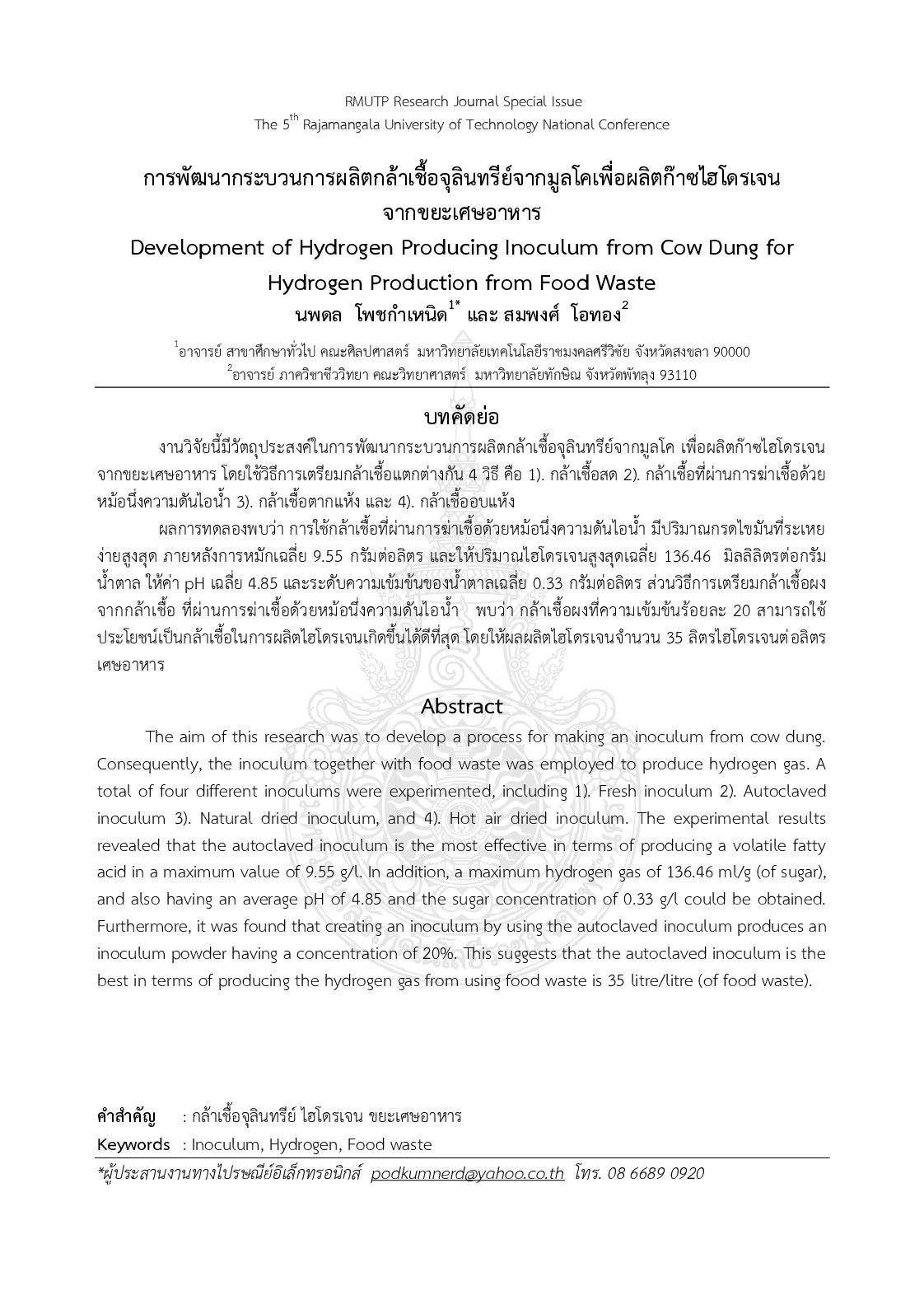
Development of hydrogen producing inoculum from cow dung for hydrogen production from food waste
The aim of this research was to develop a process for making an inoculum from cow dung. Consequently the inoculum together with food waste was employed to produce hydrogen gas. A total of four different inoculums were experimented including 1). Fresh inoculum 2). Autoclaved inoculum 3). Natural dried inoculum and 4). Hot air dried inoculum. The experimental results revealed that the autoclaved inoculum is the most effective in terms of producing a volatile fatty acid in a maximum value of 9.55 g/l. In addition a maximum hydrogen gas of 136.46 ml/g (of sugar) and also having an average pH of 4.85 and the sugar concentration of 0.33 g/l could be obtained. Furthermore it was found that creating an inoculum by using the autoclaved inoculum produces an inoculum powder having a concentration of 20%. This suggests that the autoclaved inoculum is the best in terms of producing the hydrogen gas from using food waste is 35 litre/litre (of food waste).