จำนวน Repository ( 33 )

การพัฒนาผลิตภัณฑ์สายบัวแผ่นอบกรอบจากบัวพันธุ์บัวสาย โดยกระบวนการอบแห้งแบบอบลมร้อน
The study of Crispy Lotus-Stem bakesby drying oven. The purpises of this study were to create create crispy lotus-stem recipe and the production process of crispy lotus-stem by drying oven. This study was to quantify amount of lotus-stem and Stabilizing agent that appropriate to produces crispy lotus-stem. Was conducted in 3 recipes (depend on ratio (%) of quantity lotus-stem: Stabilizing agent) are following 1) 95:5 2) 95:5 and 3) 95:5. Our study found that the ratio of lotus-stem: Tapiocastarch which appropriate to produces crispy lotus-stem were 95:5.Moreover this ratio was accepted mostly and after tasted the water activity aw values= 0.349the Crispyness values= 1753 and the Spectrophotometer values = (L*) 34.39(a*) 4.12 and (b*) 8.31 the chemical analysis found that fiber = 31.89% protein = 3.87% fat = 23.98% moisture = 2.65% and ash = 4.35% The study of temperature and duration to bake crispy lotus-stem by drying oven at 60 70 and 80 degree Our showed the appropriate temperature and duration to bake crispy lotus-stem by drying oven was 1 hour 30 minutes crispy Lotus-stem products by Drying Oven can Keep at room temperature degree Celsius for a period of 30 days.
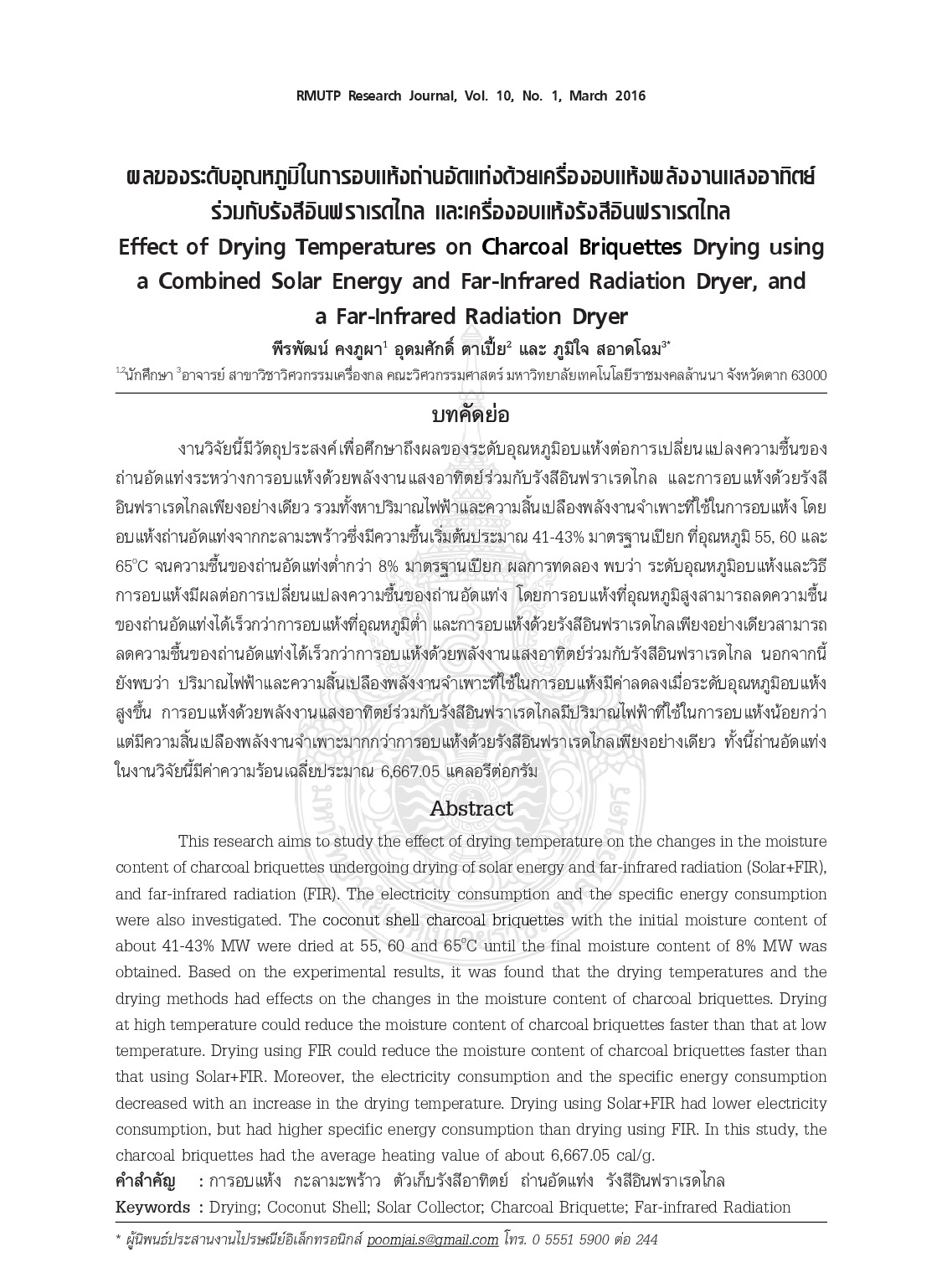
ผลของระดับอุณหภูมิในการอบแห้งถ่านอัดแท่งด้วยเครื่องอบแห้งพลังงานแสงอาทิตย์ร่วมกับรังสีอินฟราเรดไกล และเครื่องอบแห้งรังสีอินฟราเรดไกล
This research aims to study the effect of drying temperature on the changes in the moisture content of charcoal briquettes undergoing drying of solar energy and far-infrared radiation (Solar+FIR) and far-infrared radiation (FIR). The electricity consumption and the specific energy consumption were also investigated. The coconut shell charcoal briquettes with the initial moisture content of about 41-43% MW were dried at 55 60 and 65oC until the final moisture content of 8% MW was obtained. Based on the experimental results it was found that the drying temperatures and the drying methods had effects on the changes in the moisture content of charcoal briquettes. Drying at high temperature could reduce the moisture content of charcoal briquettes faster than that at low temperature. Drying using FIR could reduce the moisture content of charcoal briquettes faster than that using Solar+FIR. Moreover the electricity consumption and the specific energy consumption decreased with an increase in the drying temperature. Drying using Solar+FIR had lower electricity consumption but had higher specific energy consumption than drying using FIR. In this study the charcoal briquettes had the average heating value of about 6667.05 cal/g.
การพัฒนากระบวนการอบผนึกชิ้นงานความแข็งสูงพิเศษเพื่อเพิ่มประสิทธิภาพ การต้านทานการสึกหรอตามแนวทางการจัดการวัสดุเพื่อความยั่งยืน
This study aims to development of production process of hard metal by tungsten carbide powder with the particle sized of 0.1 - 0.35 µm. This carbide powder were made of recycling cemented carbide tool scraps so it is mixed with Ta = 2.82 % Mo = 0.45 % Nb = 1.22 % Ti = 4.56 % Zr = 0.37 % The shape of the carbide powder are roughly round due to ball milling for 300 hours. It was mixing cobalt 10 % and Paraffin wax 2 % which is found the work piece that running through the process of sintering with a temperature of 1400 °c and 1430 °c have the hardness of 1368.5 and 1346.3 HV respectively. In one hour of holding time process the work piece with 1430 °c of the sintering causes less wear. After the test of turning operation it can be concluded that the tungsten carbide cutting tool provides the equivalent quality as a standard cutting tool.
การศึกษาวิเคราะห์พฤติกรรมการอบชุบด้วยกระบวนการทางความร้อนของโลหะเงินเจือต่ำ 58.33 wt% AgCuSn
การวิจัยนี้เป็นการศึกษาพฤติกรรมการอบชุบด้วยกระบวนการทางความร้อนของโลหะเงิน เจือต่ำ58.45wt%Ag +41.55wt%Cu โดยทำการเปรียบเทียบกับสมบัติของโลหะเงินสเตอร์ลิง 925 และโลหะเงินเจือต่ำ 58.33% เพื่อศึกษาสภาวะที่เหมาะในหาการปรับปรุงคุณสมบัติเชิงกลและโครงสร้าง จุลภาคของโลหะเงินเจือต่ำที่เป็นไปตามมาตรฐานผลิตเครื่องประดับ ผลจากการศึกษาโลหะเงิน 58.33 % ที่อัตราส่วนผสม 58.33Ag+36.66Cu+5.01Sn ซึ่งมี ค่าคุณสมบัติเชิงกลจากการทดสอบเบื้องต้นมีค่าเหมาะสมที่สุด จากนั้นท่าการศึกษาค่าความแข็งแรงดึง สูงสุดแบบเส้นลวดพบว่ามีค่าความต้านทานแรงดึงสูงสุดเท่ากับ 0.36 MPa ค่าเปอร์เซ็นต์การยืดตัว 0.11% เมื่อท่าการอบที่อุณหภูมิ 650 °C เวลาในการอบ 10 นาที ซึ่งปล่อยให้ชิ้นงานเย็นตัวในอากาศที่ อุณหภูมิห้องปกติ และค่าความแข็งจากการทดสอบมีค่าสูงสุดเท่ากับ 105.12 HV อบที่อุณหภูมิ 600 °C เวลาในการอบ 10 นาที ซึ่งปล่อยให้ชิ้นงานเย็นตัวในอากาศที่อุณหภูมิห้องปกติ ศึกษาโครงสร้างจุลภาค ของโลหะเงินเจือต่ำ 58.33Ag+41.57Cu+0.10Sn เมื่อท่าการอบปรับปรุงคุณสมบัติทางความร้อนและการ ชุบแข็งแบต่างๆ พบว่าโครงสร้างจุลภาคของชิ้นงานทดสอบหลังปล่อยให้เย็นตัวในอากาศ เกิดการ เปลี่ยนแปลงจาก β phase ที่มีขนาดเล็กลงเป็นโครงสร้าง Eutectic phase ที่มี α -phase และ β - phase ขนาดเล็กและละเอียด ซึ่งมีลักษณะสอดคล้องกับโครงสร้างจุลภาคของเฟสไดอะแกรมสมดุลโลหะ เงิน-ทองแดง ผลจากการทดลองและวิเคราะห์หาค่าคุณสมบัติเชิงกลของชิ้นงานทดสอบและโครงสร้างจุลภาค ที่ได้จากการทดลองในสภาวะต่างๆ มีค่าที่เป็นไปตามมาตรฐานของเครื่องประดับเงินตามมาตรฐาน อุตสาหกรรมการผลิตเครื่องประดับ ทั้งของในประเทศและต่างประเทศ