จำนวน Repository ( 16 )

องค์ประกอบที่มีผลต่อความสามารถในการเรียนวิชาคอมพิวเตอร์กราฟิกส์
การวิจัยเรื่อง องค์ประกอบที่มีส่งผลต่อความสามารถในการเรียนวิชาคอมพิวเตอร์กราฟิกส์ ครั้งนี้ โดยมีวัตถุประสงค์เพื่อ 1) เพื่อศึกษาความสัมพันธ์ระหว่างสมรรถภาพทางสมอง แรงจูงใจภายในของตนเอง ลักษณะนิสัย และการรับรู้ความสามารถของตนเองกับความสามารถในการเรียนวิชาคอมพิวเตอร์กราฟิกส์ และ 2) เพื่อสร้างสมการพยากรณ์ความสามารถในการเรียนวิชาคอมพิวเตอร์กราฟิกส์ ของนักศึกษาสาขาวิชาไฟฟ้า แขนงวิชาวิศวกรรมคอมพิวเตอร์ มหาวิทยาลัยเทคโนโลยีราชมงคลพระนคร กลุ่มตัวอย่างได้แก่ นักศึกษาสาขาวิชาไฟฟ้า แขนงวิชาวิศวกรรมคอมพิวเตอร์ มหาวิทยาลัยเทคโนโลยีราชมงคลพระนคร จำนวน 15 คน ซึ่งได้มาโดยการสุ่มกลุ่มตัวอย่างแบบเจาะจง (Purposive Sampling) เครื่องมือที่ใช้ในการเก็บรวบรวมข้อมูลในครั้งนี้ประกอบด้วย 1) แบบทดสอบสมรรถภาพทางสมอง 2) แบบวัดแรงจูงใจภายในของตนเอง 3) แบบ ทดสอบวัดลักษณะนิสัย 4) แบบวัดการรับรู้ความสามารถของตนเอง และ 5) แบบทดสอบวัดความ สามารถด้านการเรียนวิชาคอมพิวเตอร์กราฟิกส์ สถิติที่ใช้ในการวิเคราะห์ข้อมูล ได้แก่ ค่าเฉลี่ย ค่าร้อยละ ส่วนเบี่ยงเบนมาตรฐาน และการวิเคราะห์ค่าสัมประสิทธิ์สหสัมพันธ์แบบพหุคูณ
องค์ประกอบที่มีผลต่อการใช้งานระบบ E-Learning ของมหาวิทยาลัยเทคโนโลยีราชมงคลพระนคร
การวิจัยเรื่ององค์ประกอบที่มีผลต่อการใช้งานระบบ E-Learning ของมหาวิทยาลัยเทคโนโลยีราชมงคลพระนคร มีวัตถุประสงค์เพื่อวิเคราะห์องค์ประกอบที่มีผลต่อการใช้งานระบบ E-Learning ของมหาวิทยาลัยเทคโนโลยีราชมงคลพระนคร และศึกษาลักษณะของตัวประกอบสำคัญที่มีต่อการใช้งานระบบ E-Learning ของมหาวิทยาลัยเทคโนโลยีราชมงคลพระนคร กลุ่มตัวอย่างเป็นอาจารย์และนักศึกษา มหาวิทยาลัยเทคโนโลยีราชมงคลพระนคร ทั้ง 9 คณะ โดยแบ่งเป็นอาจารย์ จำนวน 226 คน และนักศึกษา จำนวน 300 คน ซึ่งกำหนดขนาดตัวอย่างตาราง Krejcie&Morgan ผลการวิจัยพบว่า 1. การประเมินตัวแปรรายข้อเกี่ยวกับองค์ประกอบที่มีผลต่อการใช้งานระบบ E-Learning ของมหาวิทยาลัยเทคโนโลยีราชมงคลพระนคร ตัวแปรทั้งหมด 20 ตัวแปร มีค่าเฉลี่ยระหว่าง 6.10 – 6.04 และส่วนเบี่ยงเบนมาตรฐานระหว่าง 0.67 – 0.66 แสดงว่าตัวแปรมีผลต่อการใช้งานระบบ E-Learning ของมหาวิทยาลัยเทคโนโลยีราชมงคลพระนครอยู่ในระดับมาก และแต่ละตัวแปรมีการกระจายของข้อมูล ที่แตกต่างกันมาก 2. การวิเคราะห์ตัวแปรที่สำคัญเกี่ยวกับองค์ประกอบที่มีผลต่อการใช้งานระบบ E-Learning ของมหาวิทยาลัยเทคโนโลยีราชมงคลพระนคร 1. คุณลักษณะเฉพาะของระบบ 2. การบริหารจัดการการเรียน 3. การส่งเสริมความรู้ 4. เนื้อหาของบทเรียน 5. ความสามารถของคอมพิวเตอร์ 6. การติดต่อสื่อสาร 7. การพัฒนาสื่อมัลติมีเดีย ผลของการวิเคราะห์ข้อมูลพบว่า ตัวแปรอิสระหรือตัวพยากรณ์ทั้ง 7 องค์ประกอบดังกล่าว มีความสัมพันธ์ต่อการใช้งานระบบ E-Learning ของมหาวิทยาลัยเทคโนโลยีราชมงคลพระนคร ระหว่าง 2.69–1.33 ซึ่งมีค่าสัมพันธ์กันในระดับสูง โดยทั้ง 7 องค์ประกอบ มีอำนาจการพยากรณ์ร่วมกันได้ร้อยละ 44 และมีความคลาดเคลื่อนของการพยากรณ์ (Error) เท่ากับ 11.11 จากนั้นนำค่าสัมประสิทธิ์สหสัมพันธ์ที่ได้จากการวิเคราะห์องค์ประกอบนี้ไปสร้างเป็นสมการขององค์ประกอบมาตรฐานทั้ง 7 องค์ประกอบ
การใช้ไม้พฤาษ์และไม้จามจุรีเป็นองค์ประกอบในโครงสร้างไม้
The Research of this paper to propose the usage of Albizia lebbeck (L.) Benth. and Samanea saman Merill are fast-growing commonly found in Thailand. However these species of wood could not be utilized as structural components either economically or safely due to the lack of recommended values for their engineering properties. Therefore the objective of this research was to study their physical and mechanical properties based on statistical data obtained from 11 series of tests in accordance with ASTM 0-143. 0-198 and 0-1037. The number of samples for each test was large enough to ensure 99% interval of confidence. Then goodness-of-fit tests were performed for each set of data to achieve at least 95% level of confidence. Buildings analyzed included residences offices and schools. The buildings were limited to two-storeyed buildings with f1oor-to-f1oor height of 3.00 meters. Given to joists and beams were simply supported. Values of structural reliability were obtained by using accurate methods. Results from testing showed that engineering properties of both species of wood could be represented well by normal distribution. Reliability analyses and designs of wood sections for joists. beams and columns showed that designs of Joists and beams wWe controlled by deflection; whereas those of columns were controlled by buckling. Based on these reasons the governing basic variable for designs of wood sections was the modulus of elasticity (E). If the accepted value of failure probability (P) for serviceability limit states was set to be 10-4. the corresponding upper limit coefficient of variation (COV) of E would be 0.269. Similarty if the accepted value of P for Ultimate limit states was set to be 10~. the corresponding upper limit COY of E would be 0.210. Since COY of E for both species of wood were lower than limit COY mentioned above. they could be used safely as structural components. Proposed design procedures were similar to Working Stress Methods. The only difference from E.I.T. standard was live load. Instead of nominal live loads for residence. office and school as stated In the Municipal law. mean Ifve loads based on data gathered in Thailand were recommended. Wood sections obtalnec from numerical procedures proposed were as large as those obtained from WCCAL Software. Furthennore recommended wood sections and factor of safety (FS) were summarized in appendices. It was also interesting to note that the value of E for compression and tension parallel to grain of both species of wood could be used to predict the corresponding value of E for bending.
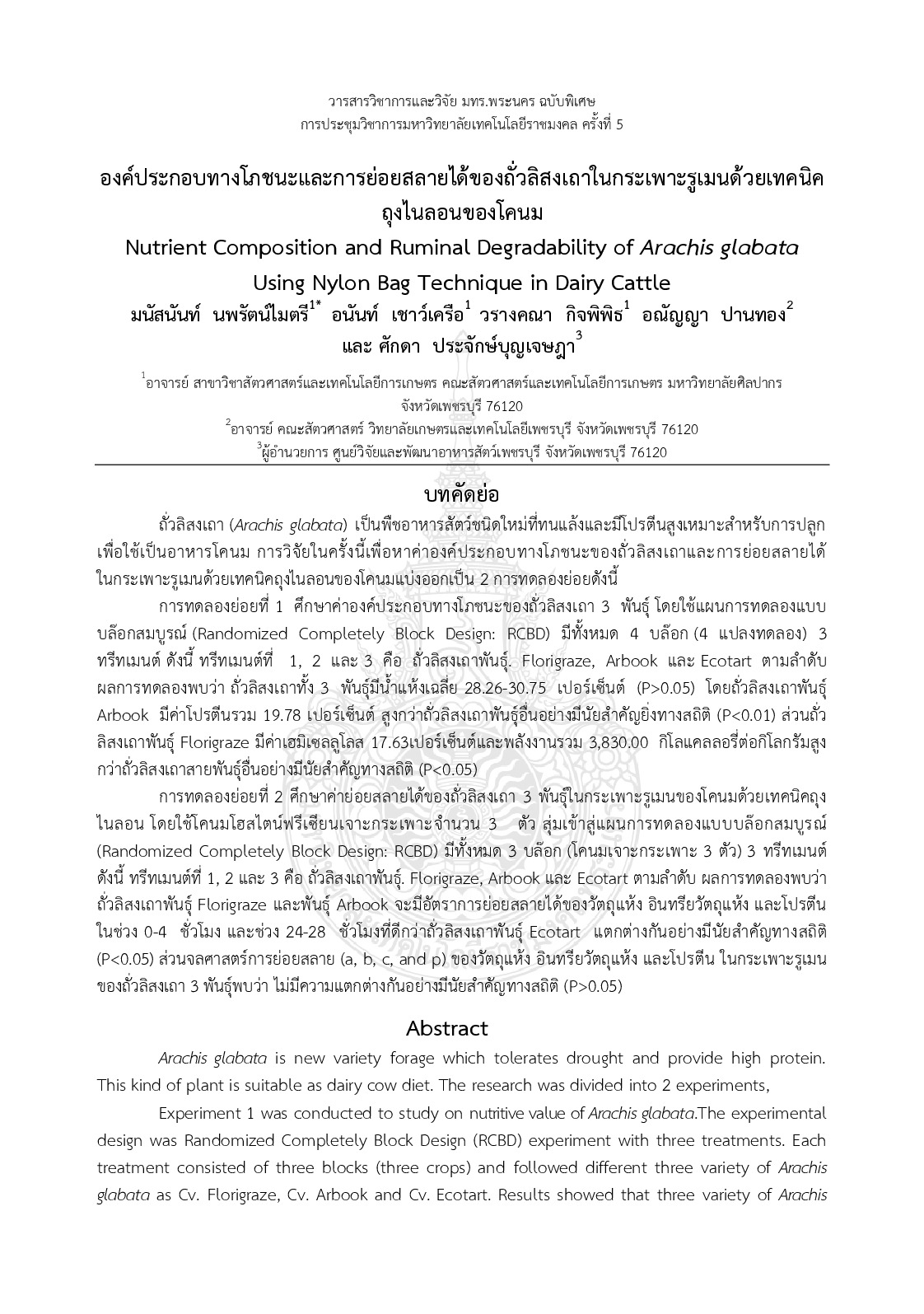
Nutrient composition and ruminal degradability of arachis glabata using nylon bag technique in dairy cattle
Arachis glabata is new variety forage which tolerates drought and provide high protein.This kind of plant is suitable as dairy cow diet. The research was divided into 2 experiments Experiment 1 was conducted to study on nutritive value of Arachis glabata.The experimental design was Randomized Completely Block Design (RCBD) experiment with three treatments. Each treatment consisted of three blocks (three crops) and followed different three variety of Arachis glabata as Cv. Florigraze Cv. Arbook and Cv. Ecotart. Results showed that three variety of Arachis glabata were 28.26-30.75 % of dry matter (P>0.05). In addition Arachis glabata Cv. Arbook was grater 19.78 % of protein than other group of Arachis glabata (P<0.01). Furthermore Arachis glabata Cv. Florigraze was grater 17.63 of hemicelluloses and 3830.00 kcal/kg of gross energy significant different among other group of Arachis glabata (P<0.05). Experiment 2 was conducted to study on ruminal degradability of Arachis glabata using In situ technique in dairy cattle. The experimental design was Randomized Completely Block Design (RCBD) experiment with three treatments. Each treatment consisted of three blocks (three ruminally fistulated dairy cattle) and followed different three variety of Arachis glabata as Cv. Florigraze Cv. Arbook and Cv. Ecotart. Results showed that Arachis glabata Cv. Florigraze and Arachis glabata Cv. Arbook was grater dry matter organic matter and protein degradability at 0-4 hour and 24-28 hour than Arachis glabata Cv Ecotart (P<0.05). In addition kinetic of degradation (a b c and p) of dry matter organic matter and protein were not significant different (P>0.05) among three variety of Arachis glabata.
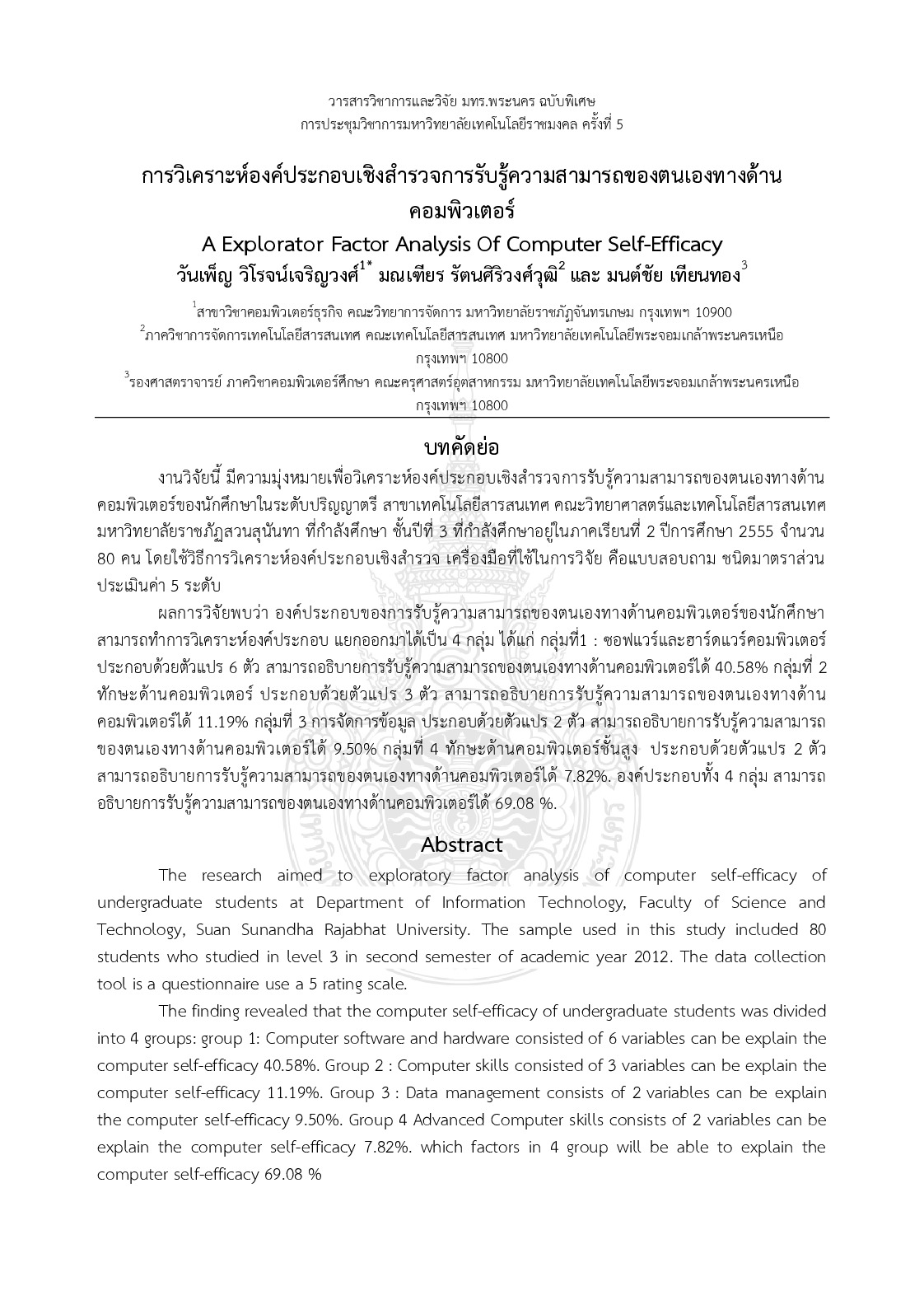
A explorator factor analysis Of computer self-efficacy
The research aimed to exploratory factor analysis of computer self-efficacy of undergraduate students at Department of Information Technology Faculty of Science and Technology Suan Sunandha Rajabhat University. The sample used in this study included 80 students who studied in level 3 in second semester of academic year 2012. The data collection tool is a questionnaire use a 5 rating scale. The finding revealed that the computer self-efficacy of undergraduate students was divided into 4 groups: group 1: Computer software and hardware consisted of 6 variables can be explain the computer self-efficacy 40.58%. Group 2 : Computer skills consisted of 3 variables can be explain the computer self-efficacy 11.19%. Group 3 : Data management consists of 2 variables can be explain the computer self-efficacy 9.50%. Group 4 Advanced Computer skills consists of 2 variables can be explain the computer self-efficacy 7.82%. which factors in 4 group will be able to explain the computer self-efficacy 69.08 %