จำนวน Repository ( 35 )
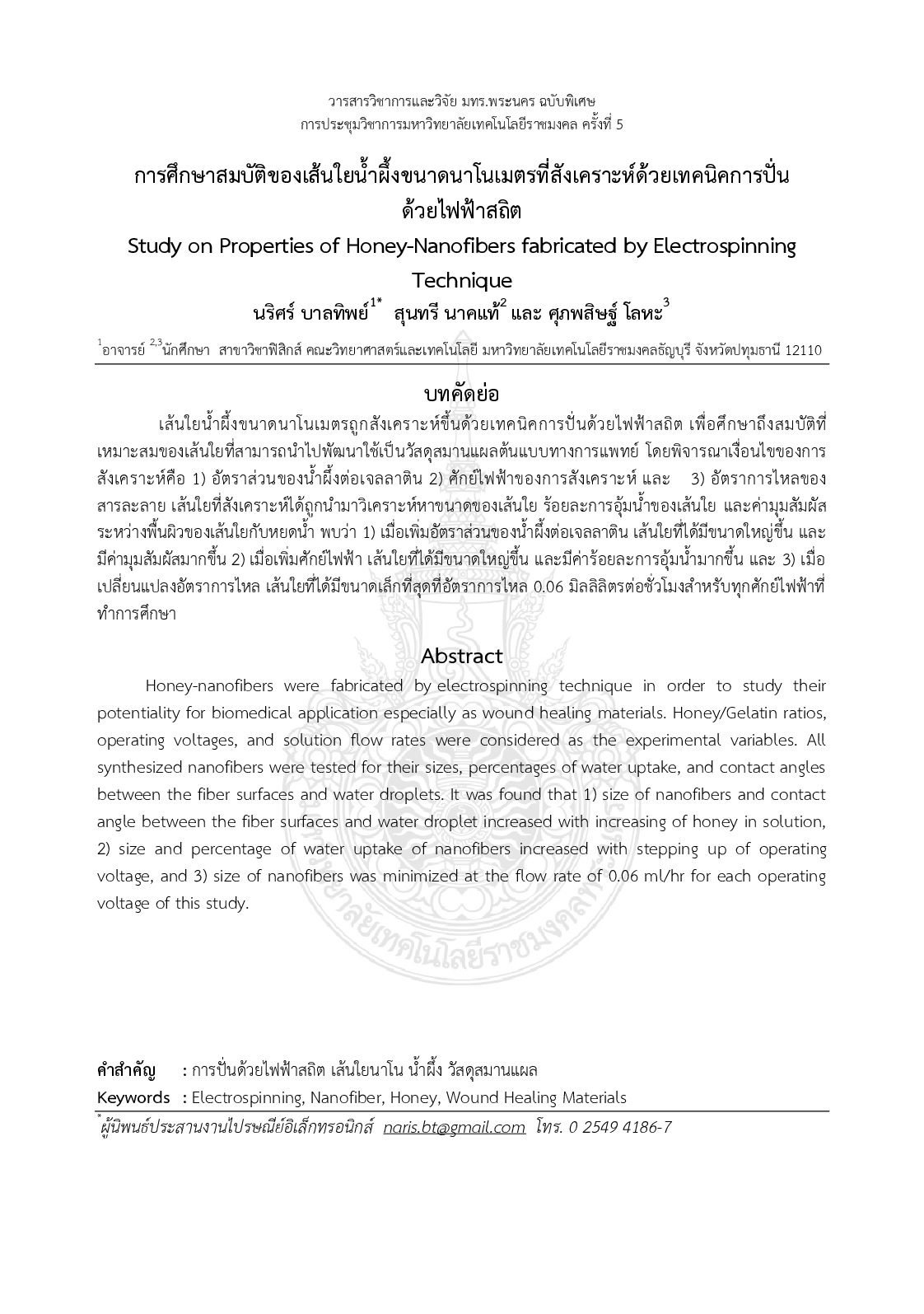
Study on properties of honey-nanofibers fabricated by electrospinning technique
Honey-nanofibers were fabricated by electrospinning technique in order to study their potentiality for biomedical application especially as wound healing materials. Honey/Gelatin ratios operating voltages and solution flow rates were considered as the experimental variables. All synthesized nanofibers were tested for their sizes percentages of water uptake and contact angles between the fiber surfaces and water droplets. It was found that 1) size of nanofibers and contact angle between the fiber surfaces and water droplet increased with increasing of honey in solution 2) size and percentage of water uptake of nanofibers increased with stepping up of operating voltage and 3) size of nanofibers was minimized at the flow rate of 0.06 ml/hr for each operating voltage of this study.

การพัฒนาแผ่นใยไม้อัดซีเมนต์จากการประยุกต์ใช้เส้นใยธรรมชาติจากกากมะพร้าวและต้นข้าวโพด
This research aims to study the application of coconut meal and corncob fiber as high density cement-bonded fiberboard. The cement: fine sand: coconut meal and corncob fiber: water ratio is equal to 1: 0.2: 0.05: 0.3. The fibers are taken from coconut meal and corncob that 5 ratios are used to all of fiber mixing. The fiberboard production use casting in normal temperature. Resulting the CN75 ratio (coconut meal and corncob fiber is equal to 0.0125: 0.0375) is suitable ratio which pass TIS 878- 2537 standard (cement bonded particle board) and has good physicalproperties mechanical properties and thermal insulation.
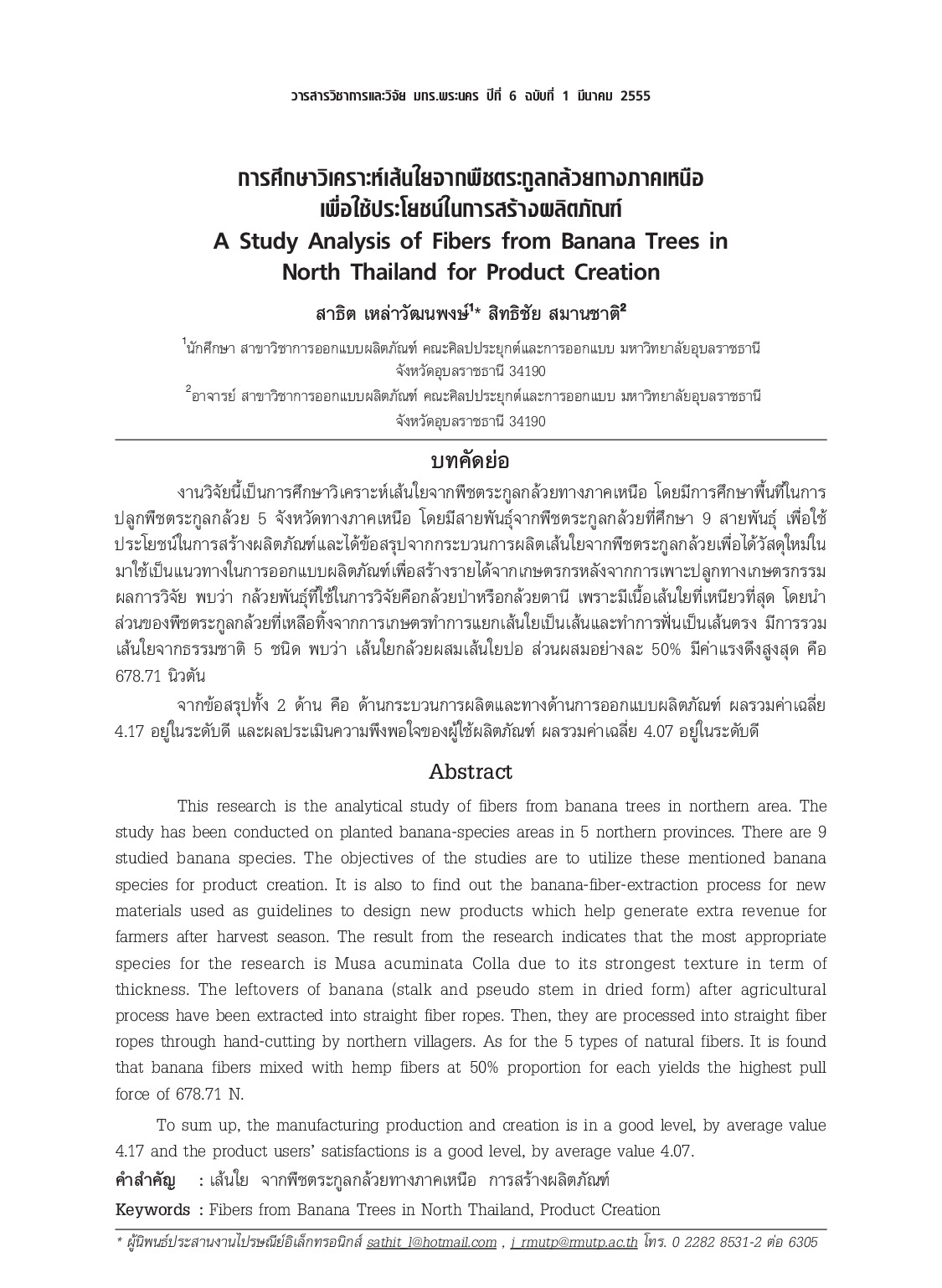
A Study Analysis of Fibers from Banana Trees in North Thailand for Product Creation
This research is the analytical study of fibers from banana trees in northern area. The study has been conducted on planted banana-species areas in 5 northern provinces. There are 9 studied banana species. The objectives of the studies are to utilize these mentioned banana species for product creation. It is also to find out the banana-fiber-extraction process for new materials used as guidelines to design new products which help generate extra revenue for farmers after harvest season. The result from the research indicates that the most appropriate species for the research is Musa acuminata Colla due to its strongest texture in term of thickness. The leftovers of banana (stalk and pseudo stem in dried form) after agricultural process have been extracted into straight fiber ropes. Then they are processed into straight fiber ropes through hand-cutting by northern villagers. As for the 5 types of natural fibers. It is found that banana fibers mixed with hemp fibers at 50% proportion for each yields the highest pull force of 678.71 N. To sum up the manufacturing production and creation is in a good level by average value 4.17 and the product users’ satisfactions is a good level by average value 4.07.
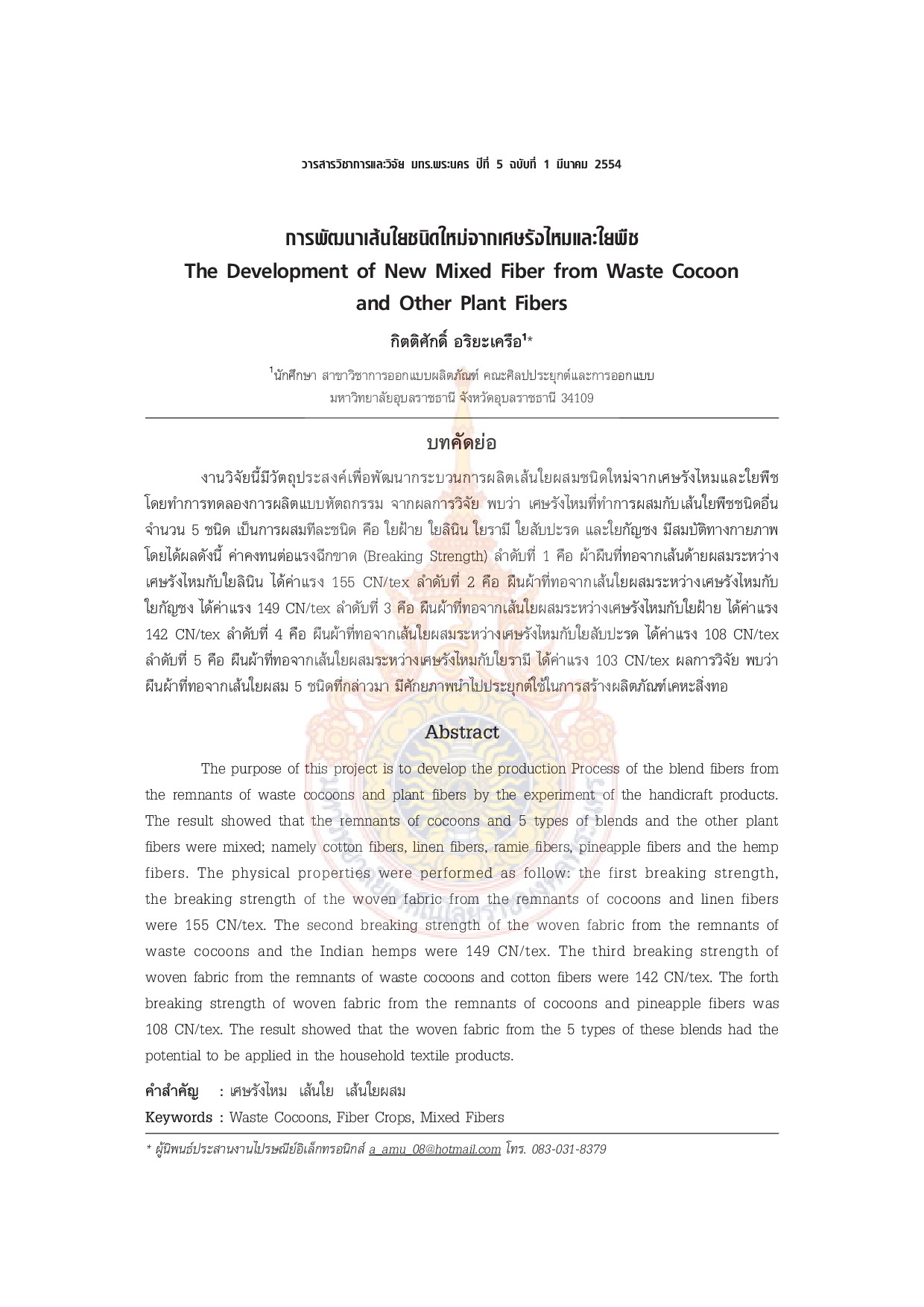
The Development of New Mixed Fiber from Waste Cocoon and Other Plant Fibers
The purpose of this project is to develop the production Process of the blend fibers from the remnants of waste cocoons and plant fibers by the experiment of the handicraft products. The result showed that the remnants of cocoons and 5 types of blends and the other plant fibers were mixed; namely cotton fibers linen fibers ramie fibers pineapple fibers and the hemp fibers. The physical properties were performed as follow: the first breaking strength the breaking strength of the woven fabric from the remnants of cocoons and linen fibers were 155 CN/tex. The second breaking strength of the woven fabric from the remnants of waste cocoons and the Indian hemps were 149 CN/tex. The third breaking strength of woven fabric from the remnants of waste cocoons and cotton fibers were 142 CN/tex. The forth breaking strength of woven fabric from the remnants of cocoons and pineapple fibers was 108 CN/tex. The result showed that the woven fabric from the 5 types of these blends had the potential to be applied in the household textile products
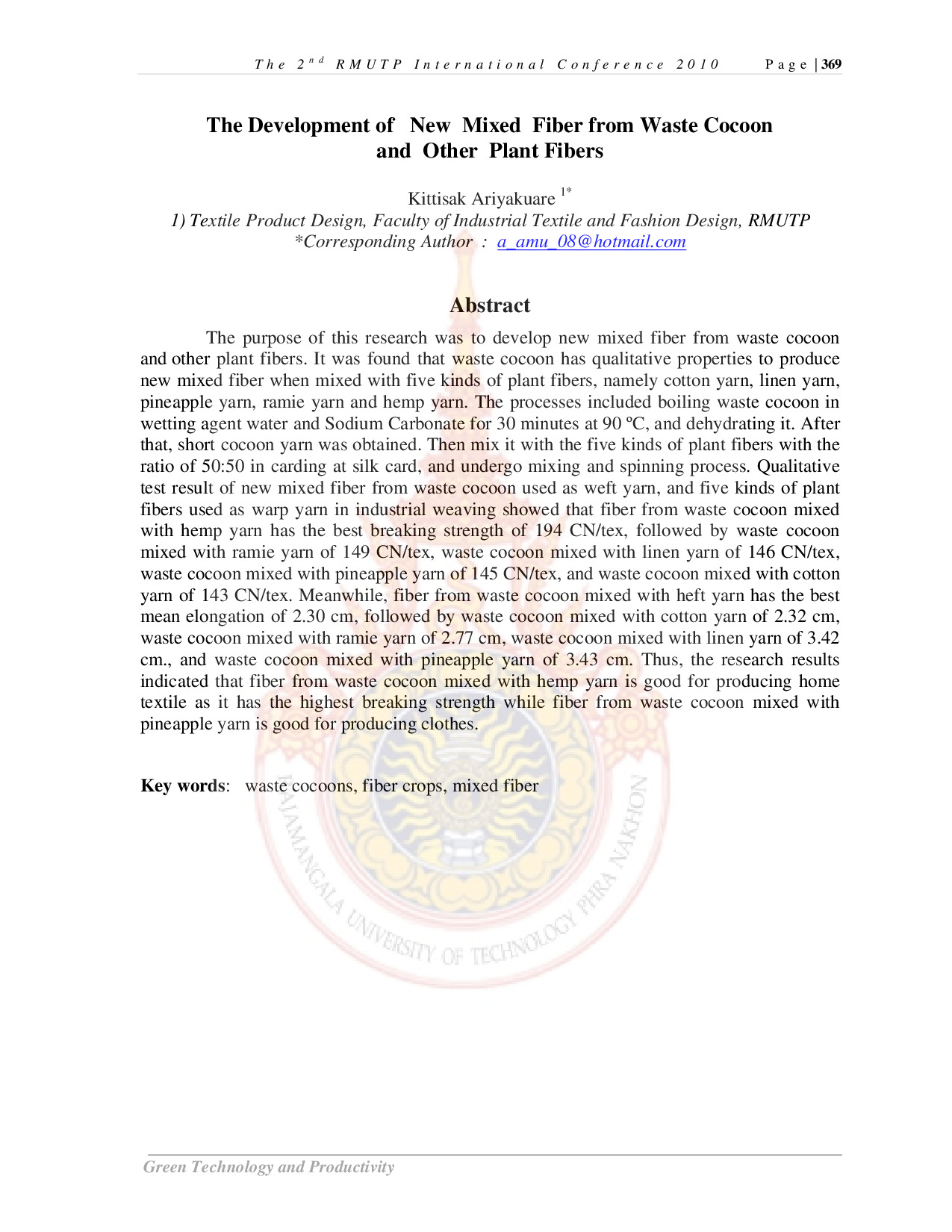
The Development of New Mixed Fiber from Waste Cocoon and Other Plant Fibers
The purpose of this research was to develop new mixed fiber from waste cocoon and other plant fibers. It was found that waste cocoon has qualitative properties to produce new mixed fiber when mixed with five kinds of plant fibers namely cotton yarn linen yarn pineapple yarn ramie yarn and hemp yarn. The processes included boiling waste cocoon in wetting agent water and Sodium Carbonate for 30 minutes at 90 ºC and dehydrating it. After that short cocoon yarn was obtained. Then mix it with the five kinds of plant fibers with the ratio of 50:50 in carding at silk card and undergo mixing and spinning process. Qualitative test result of new mixed fiber from waste cocoon used as weft yarn and five kinds of plant fibers used as warp yarn in industrial weaving showed that fiber from waste cocoon mixed with hemp yarn has the best breaking strength of 194 CN/tex followed by waste cocoon mixed with ramie yarn of 149 CN/tex waste cocoon mixed with linen yarn of 146 CN/tex waste cocoon mixed with pineapple yarn of 145 CN/tex and waste cocoon mixed with cotton yarn of 143 CN/tex. Meanwhile fiber from waste cocoon mixed with heft yarn has the best mean elongation of 2.30 cm followed by waste cocoon mixed with cotton yarn of 2.32 cm waste cocoon mixed with ramie yarn of 2.77 cm waste cocoon mixed with linen yarn of 3.42 cm. and waste cocoon mixed with pineapple yarn of 3.43 cm. Thus the research results indicated that fiber from waste cocoon mixed with hemp yarn is good for producing home textile as it has the highest breaking strength while fiber from waste cocoon mixed with pineapple yarn is good for producing clothes.