จำนวน Repository ( 22 )

Forecasting agricultural Products Prices by Exponential Smoothing
The objective of this study is to compare three forecasting methods on three agricultural products consisting of fresh whole chicken (include bone no entrails) red meat pork hip section and Jasmine rice. These methods are Simple Exponential Smoothing method Holt’s method and Winter’s method. Data are colleced for a period of 60 months from January 2007 to December 2011. The most suitable forecasting method are the one that shows no residual autocorrelation and gives the lowest MSE MAPE. The results show that Simple Exponential Smoothing method is the most suitable method on three agricultural products due to this method reveals no residual autocorrelation and displays the lowest MSE MAPE.
Forecasting model for the export quantity of concentrated latex
The objective of this research is to construct the appropriate forecasting model for the export quantity of concentrated latex by the three time series analysis methods which are Box-Jenkins method Winters’ multiplicative exponential smoothing method and combined forecasting method. Time series data from the website of Office of Agricultural Economics during January 1998 to February 2014 (194 values) are used and divided into two series. The first 182 values from January 1998 until February 2013 for the models prediction and the last 12 values from March 2013 until February 2014 for comparison the performance of forecasting models via the criterion of the lowest root mean squared error and the criterion of the highest correlation coefficient between existing values and forecasted values. Research findings indicated that for all forecasting methods that have been studied the most powerful method is the combined forecasting and the forecasting model is where and represent the single forecasts at time t from Box-Jenkins method and Winters’ multiplicative exponential smoothing method respectively.
Comparison of statistical techniques for forecasting The Stock Exchange of Thailand index
The purpose of this study is to compare four forecasting methods on SET Index SET 50 Index and SET 100 index. These methods are Simple Exponential Smoothing Holt’s Method Box-Jenkins Method and Regression Analysis. Two sets of Index data were used in this study. The first one used as a training set was collected at the end of each day from January 2 2008 to September 30 2011. The other one used as a testing set was collected at the end of each day from October 3 2011 to October 14 2011. The diagnostic check was used to test each method. The MAE MSE and MAPE from each method shows that Box-Jenkins is more appropriate to the forecasting of SET Index SET 50 Index and SET 100 Index because its MAE MSE and MAPE are fairly low and have no autocorrelations. This leads to the conclusion that the appropriate models for forecasting of SET Index SET 50 Index and SET 100 Index are ARIMA (212) ARIMA (213) and ARIMA (213) respectively. The most stock market indices are correlated to SET Index SET 50 Index and SET 100 Index is Composite Index of Indonesia
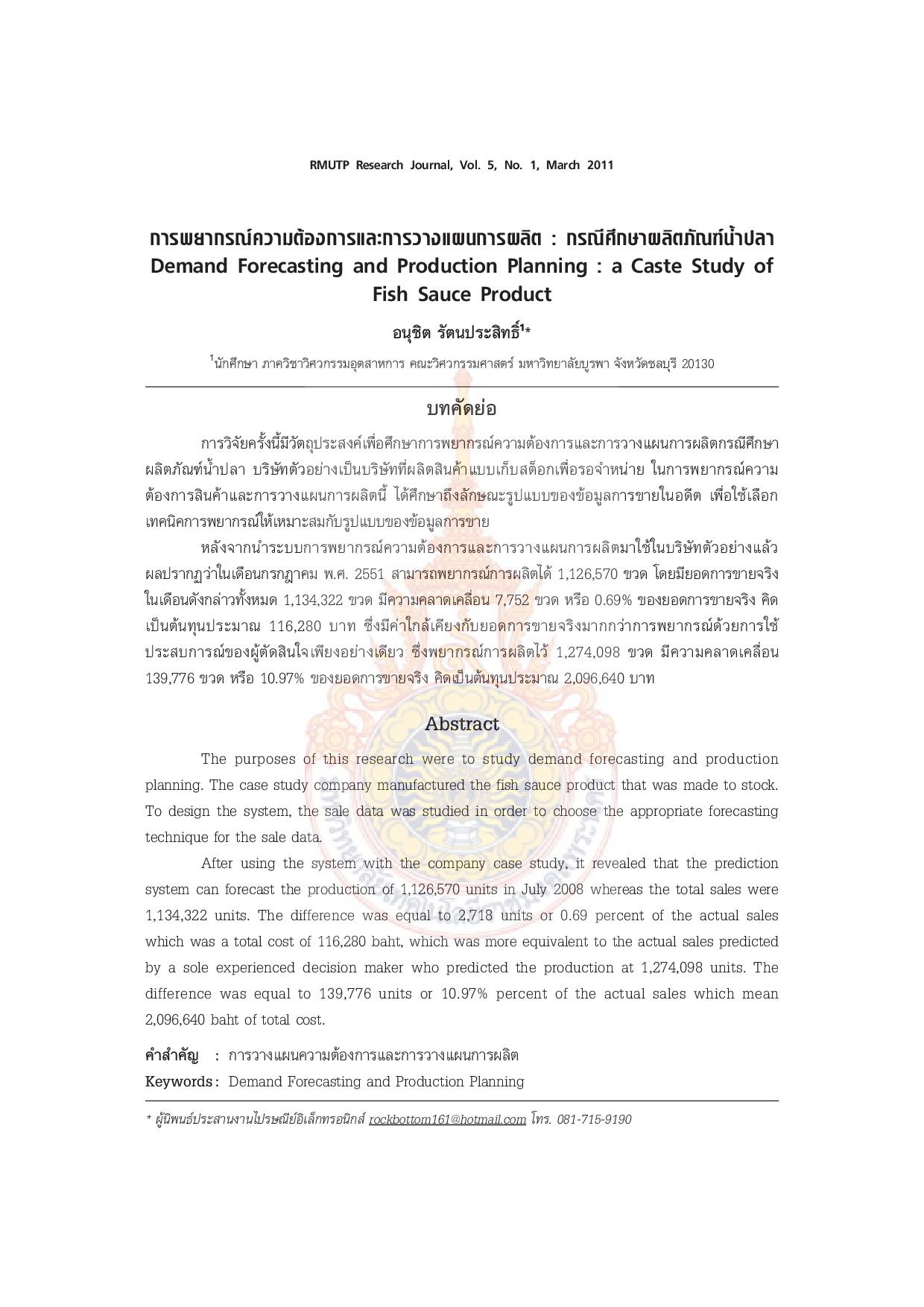
Demand Forecasting and Production Planning
The purposes of this research were to study demand forecasting and production planning. The case study company manufactured the fish sauce product that was made to stock. To design the system the sale data was studied in order to choose the appropriate forecasting technique for the sale data. After using the system with the company case study it revealed that the prediction system can forecast the production of 1126570 units in July 2008 whereas the total sales were 1134322 units. The difference was equal to 2718 units or 0.69 percent of the actual sales which was a total cost of 116280 baht which was more equivalent to the actual sales predicted by a sole experienced decision maker who predicted the production at 1274098 units. The difference was equal to 139776 units or 10.97% percent of the actual sales which mean 2096640 baht of total cost
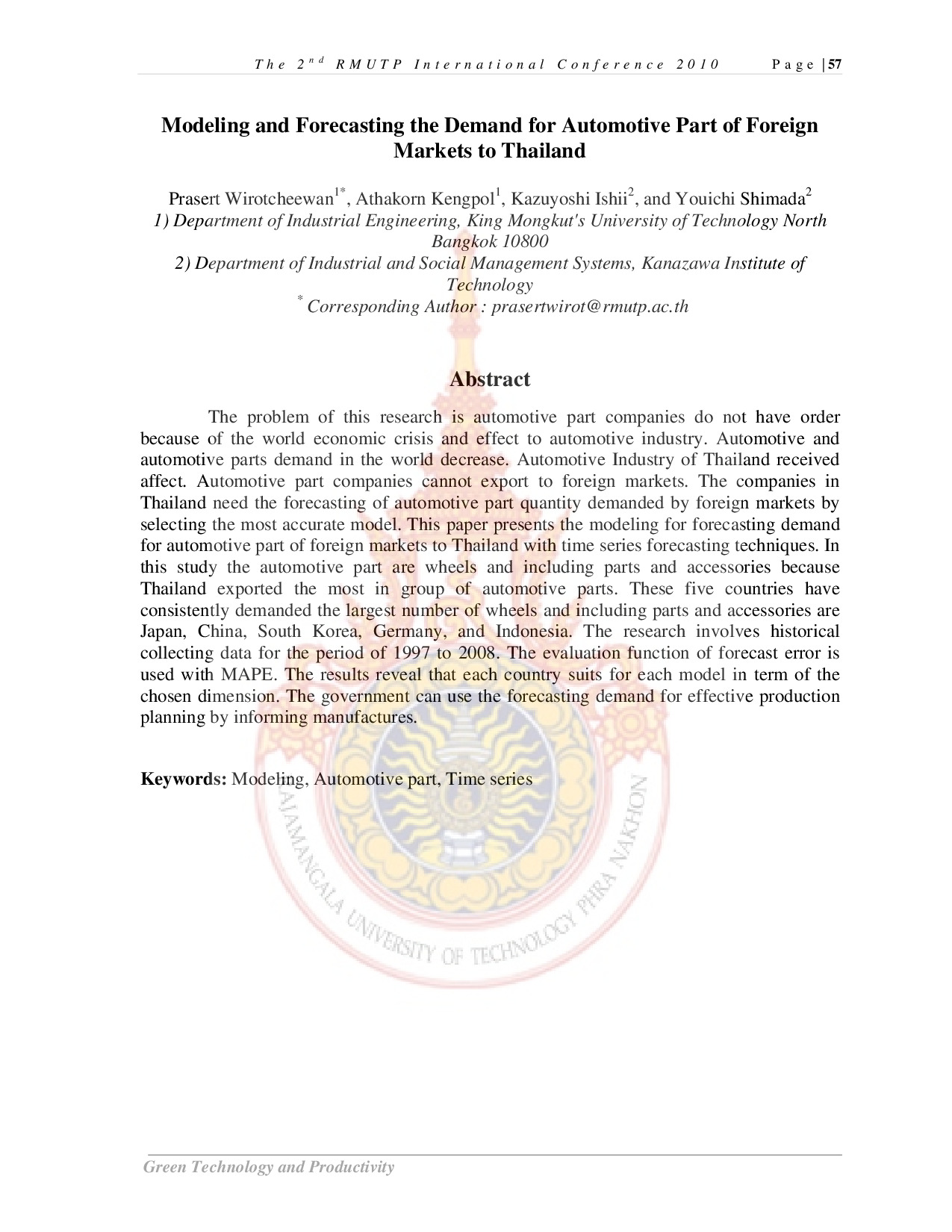
Modeling and Forecasting the Demand for Automotive Part of Foreign Markets to Thailand
The problem of this research is automotive part companies do not have order because of the world economic crisis and effect to automotive industry. Automotive and automotive parts demand in the world decrease. Automotive Industry of Thailand received affect. Automotive part companies cannot export to foreign markets. The companies in Thailand need the forecasting of automotive part quantity demanded by foreign markets by selecting the most accurate model. This paper presents the modeling for forecasting demand for automotive part of foreign markets to Thailand with time series forecasting techniques. In this study the automotive part are wheels and including parts and accessories because Thailand exported the most in group of automotive parts. These five countries have consistently demanded the largest number of wheels and including parts and accessories are Japan China South Korea Germany and Indonesia. The research involves historical collecting data for the period of 1997 to 2008. The evaluation function of forecast error is used with MAPE. The results reveal that each country suits for each model in term of the chosen dimension. The government can use the forecasting demand for effective production planning by informing manufactures.