จำนวน Repository ( 39 )

การยับยั้งเชื้อแบคทีเรียของกระดาษผสมสารสกัดใบฝรั่งเพื่องานบรรจุภัณฑ์อาหาร
In this study The paper aims to produce extracts from guava leaves. For use in food packaging. And to test their ability to inhibit bacteria. Staphylococcus aureus paper extracts from guava leaves. Because the bacteria Staphylococcus aureus to live in the air dust waste water food and milk supplies. The strain also grows well in climates with oxygen. The test extracts from guava leaves. A chemical properties of guava leaf extract has a pH of 5.4 + 0.02 acid content (% citric acid) was 1.2 ± 0.1 and the amount of phenolic total (mg gallic acid / g) levels. 63.1: 1.9 The performance of guava leaf extract in inhibiting bacteria. Staphylococcus aureus by means paper disc diffusion on agar Nutrient agar at 36 ° C for 24 hours diameter clear zone (cm.) Was 1.3 ± 0.5 and tested for the Minimum Inhibitory Concentration (MIC) by Broth Dilution Technique with. equal to 1.56% of extract of guava leaves
การเตรียมกระดาษคราฟท์จากผักตบชวา ใบสับปะรด และกาบกล้วย
This research had a main purpose for studying the utilization of water hyacinth as the key component of paper production mixed with the agricultural waste as pineapple leaves and leaf sheath of banana tree. The paper pulps were prepared from 5 g/l NaOH at 90-95oC for 3 hours then bleaching with 5 g/l Hydrogen peroxide at 90-95oC for 30 minutes. The whole pulps were detached improvement with 5g/l Acramine 3187 before paper establishment production. Finally the strength of obtaining papers was consideration and competition to any craft paper type. As the results the appropriate ratio of paper was 70% water hyacinth (stem) 10% pineapple leaves and 20% leaf sheath of banana tree. It had 31.19 kN/m2 for bursting strength tearing strength as 309.17 mN and 0.49 mm thickness. The basis weight was 183±5 g/m2. The achieved paper was equivalent as KI craft paper. It was presented for packaging boxes and other procedures.
กระดาษจากต้นกะทือด้วยเทคนิคบาติก
The study of Batik paper from Shampoo Ginger tree objectives are to understand the production process and the target market satisfaction. The researchers did a study and have made three batik paper formulas from Shampoo Ginger tree. Five batik paper specialists have been asked to comment and choose the preferable one. After their advices and adjusted the completed version of Shampoo Ginger tree batik is introduced to a sample of 50 people to find their satisfaction and interest. The study shows that The process of making Shampoo Ginger tree batik are as follow. First boil the trunk with sodium hydroxide in ratio of 1 kilogram of trunk to 200 grams of sodium hydroxide with 3 litres of water for 1 hour until it softs.Then blend the boiled pulp for 20 minutes after that drain them on the 20 inches’ width 25 inches’ length grate spread them equally at the preferable thickness. Then let them dry in a sunlight or wind. Until it is completely dry then can remove it from the grate. For the drawing batik design start with black pencil drawing. Then re-draw it with melting wax. The wax formula is 10% paraffin and 90% wax (KeeRee Wong village). Then paint a natural color inside the wax lines wait until it all dries and then remove the wax lines. The overall results of target market satisfaction is in the highest level with mean 4.50 The range of most to the least levels of satisfaction are as follow:The highest satisfaction is adding value to Arts and Crafts products with mean 4.70 The size standard of the product with mean 4.62 The natural color paints with mean 4.52 The drawing on the papers help adding value to theproduct with mean 4.52 The batik drawing designs with mean 4.50 The beautiful natural color batik painting with mean 4.48 The equally thinness of the batik papers with 4.36 The thinness of paper that suitable to make batik technique with 4.34 And the least satisfaction is the durable of the final product with mean 4.30
บายศรีพรหมจากกระดาษฟางข้าว
The purposes of the research were to study the process of making bai Sri Phrom from rice-straw paper and to investigate the participants’ satisfaction on the product. By studying and collecting the information related the title the researchers drew 3 sketch-designs of the product which were commented from 5 experts. The chosen design was used to make Bai Sri Phrom and determined the product satisfaction from 50 to the participants. Data were analyzed statistically by frequency percentage and mean. And the results of the study were found as follows :Most of the experts chosen the sketch C. Owing to properly making the product fine proportion and elaborate composition. For the participants’ satisfaction on the product it was found that as a whole the product’s material were satisfied at high level with the mean value of 3.91. The product creativity was satisfied at the highest level with the mean value of 4.32. The delicacy of the product was satisfied at high level with the mean value of 4.18. The Product’s utilization was appropriate for instructional media at the highest level with the mean value of 4.42. The product prize of more than Bht 5000 was satisfied at high level with the mean value of 4.10. And product should be sold at the artificial-flower shop. lt was satisfied at the highest level with the mean value of 4.60.
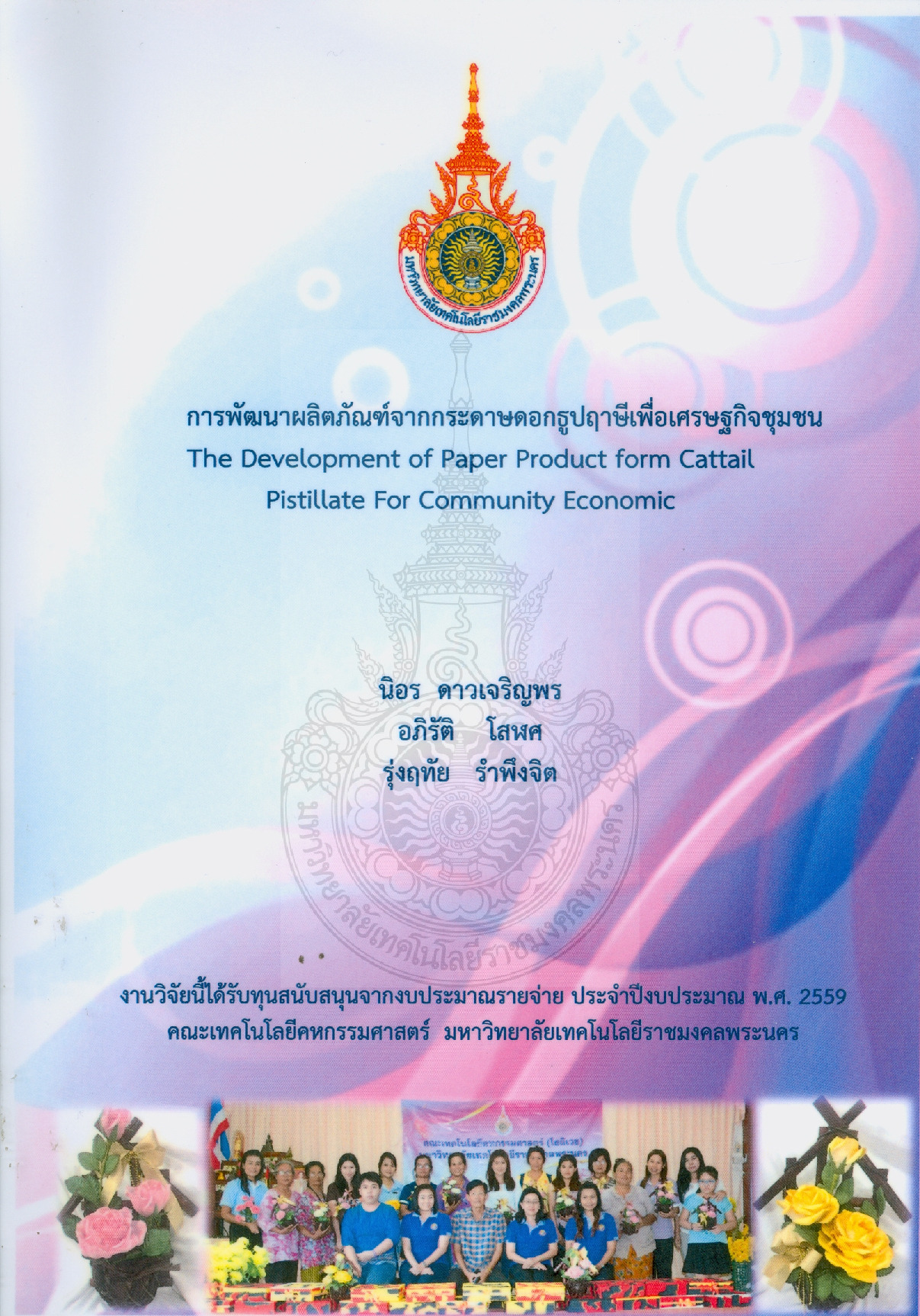
การพัฒนาผลิตภัณฑ์จากกระดาษดอกธูปฤาษีเพื่อเศรษฐกิจชุมชน
This research aims at studying the product development from Cattail flower paper for community economy by (1) studying the paper making process from Cattail flower (2) testing the efficiency of the paper made of Cattail flower (3) studying the product development process of Cattail flower paper and (4) propagating the knowledge on product made of Cattail flower paper for the community economy to the Women Group for Basketry Product Development in Laem Phak Bia sub-district Ban Laem district Phetchcburi province. The process of paper making from Cattail flower in its mature stage uses soda method in pulping process and hydrogen peroxide in bleaching process. Paper formation process has to be done on grate by (1) using 38 kilograms of fresh Cattail flower which requires pulp separation from the core of Cattail flower providing; 34.2 kilograms of fresh pulp considered as 90%—its average humidity at 51.04%; 3.8 kilograms of fresh core considered as 10% of the total weight (2) boiling in open system at 100 ºC for 3 hours with sodium hydroxide with the intensity at 4% 6% and 8% of its weight (3) bleaching with hydrogen peroxide with the intensity at 10% 20% and 30% of the weight of dried pulp; 2% of sodium silicate; 0.05% of magnesium sulfate; and 1.5% of sodium hydroxide at 100 ºC for 2 hours with the ratio of pulp and water at 1:15 (4) making paper with Thai traditional handmade method with the size of 72×84 centimeters then drying paper in indoor place in order to prevent paper contraction due to short pulp. The efficiency of the paper made of Cattail flower shows that the paper has average standard weight at 168.88 g2/m; average tensile strength at 26.40 N.m/g2; average tearing strength at 3.14 mN.m2/g; average bursting strength at 1.37 kPa.m2/g; average folding strength at 605; average luminance at 39.05%; average water holding capacity of dry weight at 395.65%; and total used bleach pulp at 69.90% of the bleached amount. The product development from Cattail flower paper has 3 types which are designed evaluated and suggested by the experts in accordance with the requirement of community on product development as follows: (1) Paper made of Cattail flower with various patterns; (2) Multi-purpose box made of Cattail flower and; (3) Flower made of Cattail flower paper. During 2 days of the training program the satisfaction of the 30 participants concerning the knowledge on product made of Cattail flower paper for the community economy of the Women Group for Basketry Product Development in Laem Phak Bia sub-district Ban Laem district Phetchaburi province shows that the participants who answer the questionnaire are extremely satisfied.