จำนวน Repository ( 20 )

Preparation of Thickener from Dry Dioscorea hispida powder for Textile Printing
The objective of this research was to study the feasibility for producing the dry Dioscorea hispida powder as a thickener. The product was investigated in their properties the compatibility with dye and chemicals in print paste color appearance by indicated with color hue value the time durability storage the residual substance after washing treatment and the color fastness in washing and rubbing methods. The results shown the dry Dioscorea hispida powder was used as thickener that it was the good characteristic like the famous textile printing thickener as alginate. The dry Dioscorea hispida powder thickener was 10%w/w had the equivalent viscosity as 8%w/w alginate. It had 3 days stability storage and good compatibility for direct dye reactive dye acid dye and disperse dye print pastes. The color appearances were corresponding with owned hue in color index databases. The thickener was completely in washing process. And the washing and rubbing fastness were good to excellent.

The effects of pulp and fiber crops that affect the printing surface through for packaging
The study researches the effects of pulp and fiber crops that affect the printing surface through For packaging. The purpose of the study of plant fiber pulp.Compare the quality of the pulp fiber of plants that affect the printing surface throughThe data can be used in the design of appropriate packaging. And to compare the effects of the packaging structure of plant fiber pulp. Population and sample used in the study include the printing surface through Pulp and paper plants 5 types of equipment used in fiber research. The pulp and fiber crops. By manufacturers or those with knowledge of print. A uniform test. Clarity and completeness of the printing sector. Spec with a photometer in a satisfactory printing on pulp fibers through the plant by the manufacturers or those with knowledge of print. And the satisfaction of the pulp fiber packaging plant. By manufacturers or those with knowledge of the packaging. The research concluded that. Comparison of pulp fibers from plant samples 40 of them are featured on pulp paper suitable for printing in the most average of 4.6. The analysis compared the print quality of the pulp through a fiber plant. The test is simple and consistent. Clarity and completeness of the printing sector. The colors that appear on printed material including five kinds of color have always been smooth with differences not exceeding 5 shows the results in a value that can be seen as well. Comparison of satisfaction on the pulp paper and printing through the most appropriate. Is satisfactory in most average 4.65. Comparison of satisfaction packaging pulp paper plant fiber 5 and found that the packaging 1 and Type 3 are the scores remained level. The packaging is an average of 4.08 and packaging Type 3 has an average of 4.04. This research concluded that Pulp paper and print quality on the most appropriate.Is satisfactory in most The properties of the pulp. Print quality. As well as satisfaction with the quality printing. While pulp and pineapple pulp the elephant has a surface that is not strong. I withdrew the paper fibers of the time. Should improve the quality of pre-printed paper surface. While pulp and pulp of banana skin healthy grass.
การพัฒนาลวดลายพิมพ์จากศิลปะอาร์ตนูโวบผ้าใยกัญชง เพื่อออกแบบชุดทำงานสตรี
The objectives of this research are 1) to develop the printing pattern from Art Nouveau on hemp fabric by way of screen printing 2) to design the womanfs working attires by using hemp fabrics for printing the pattern from Art Nouveau 3) to study the satisfactions of samples who are women in working age in Bangkok Metropolitan area: Sat horn and Bangkok toward the womanfs working attires with Art Nouveau pattern printed on hemp fabrics. The sampling group is women in working age ranging from 25 to 35 years in Sat horn and Bangruk Areas Bangkok Metropolis in number of 384 persons. Instruments used are Questionnaires and womanfs working attire prototype in number of 9 models. Data analysis statistics are percentage mean and standard deviation. Actions are carried out by studying the concept of Art Nouveau in order to design the printing patterns in 3 designs consisting of butterfly design flower design and creeper design for screening on hemp fabrics and tailoring them into womanfs working attires in the style of dress jacket and skirt of 9 models.
การพัฒนาอุปกรณ์พิมพ์สกรีนต้นแบบเพื่องานอุตสาหกรรมสิ่งทอ
Devlopment of Screen Printign Devices Prototypes for Textile lndustry was a research project which it was established to solve the practical learning of the faculty of industrial textile and fashhion desing students at Rajamangala University of Technology Phra Nakhon. This set had 3 important machines such as a self assembly aluminum block screen an automatic aluminum screen could saved the saved the screen fabric1.76 m2 reduced the chemical usageand waste minimization in the process.The practical time reduced from 16 minutes to 1 minute using the automatic aluminum screen coating. The efficiency time was 97.81. The 400 gram emulsion consumed obtained the thin film layer on the screen fabricand evenness.The sharpen pattern displayed when the exposed time was 3minutes.Moreoverthe drying and fixation machine was completely for natural fiber and synthetic fibers at 80-180 C. Therefore the Screen Printing Devices Prototypes was effectively used in textile industrialdispose of the practical learning problemraw material savingand waste minimization adjacent to clean technology process.The prototype set was produced by house equipmentsand extended for textile industrial.
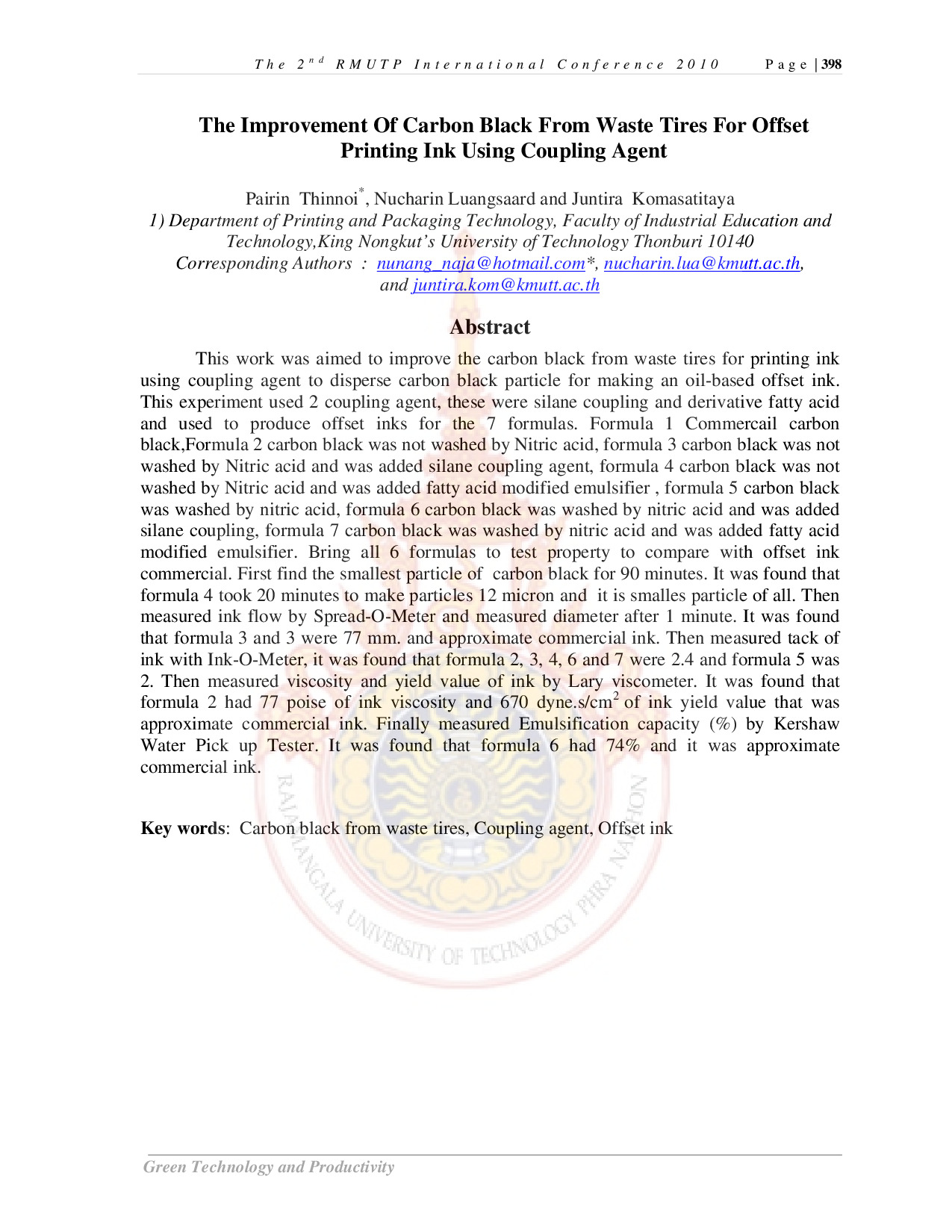
The Improvement Of Carbon Black From Waste Tires For Offset Printing Ink Using Coupling Agent
This work was aimed to improve the carbon black from waste tires for printing ink using coupling agent to disperse carbon black particle for making an oil-based offset ink. This experiment used 2 coupling agent these were silane coupling and derivative fatty acid and used to produce offset inks for the 7 formulas. Formula 1 Commercail carbon blackFormula 2 carbon black was not washed by Nitric acid formula 3 carbon black was not washed by Nitric acid and was added silane coupling agent formula 4 carbon black was not washed by Nitric acid and was added fatty acid modified emulsifier formula 5 carbon black was washed by nitric acid formula 6 carbon black was washed by nitric acid and was added silane coupling formula 7 carbon black was washed by nitric acid and was added fatty acid modified emulsifier. Bring all 6 formulas to test property to compare with offset ink commercial. First find the smallest particle of carbon black for 90 minutes. It was found that formula 4 took 20 minutes to make particles 12 micron and it is smalles particle of all. Then measured ink flow by Spread-O-Meter and measured diameter after 1 minute. It was found that formula 3 and 3 were 77 mm. and approximate commercial ink. Then measured tack of ink with Ink-O-Meter it was found that formula 2 3 4 6 and 7 were 2.4 and formula 5 was 2. Then measured viscosity and yield value of ink by Lary viscometer. It was found that formula 2 had 77 poise of ink viscosity and 670 dyne.s/cm2 of ink yield value that was approximate commercial ink. Finally measured Emulsification capacity (%) by Kershaw Water Pick up Tester. It was found that formula 6 had 74% and it was approximate commercial ink.