จำนวน Repository ( 23 )

การยับยั้งเชื้อแบคทีเรียของกระดาษผสมสารสกัดใบฝรั่งเพื่องานบรรจุภัณฑ์อาหาร
In this study The paper aims to produce extracts from guava leaves. For use in food packaging. And to test their ability to inhibit bacteria. Staphylococcus aureus paper extracts from guava leaves. Because the bacteria Staphylococcus aureus to live in the air dust waste water food and milk supplies. The strain also grows well in climates with oxygen. The test extracts from guava leaves. A chemical properties of guava leaf extract has a pH of 5.4 + 0.02 acid content (% citric acid) was 1.2 ± 0.1 and the amount of phenolic total (mg gallic acid / g) levels. 63.1: 1.9 The performance of guava leaf extract in inhibiting bacteria. Staphylococcus aureus by means paper disc diffusion on agar Nutrient agar at 36 ° C for 24 hours diameter clear zone (cm.) Was 1.3 ± 0.5 and tested for the Minimum Inhibitory Concentration (MIC) by Broth Dilution Technique with. equal to 1.56% of extract of guava leaves
Screening and identification of lactic acid bacteria with antimicrobial activity against food-borne pathogen
This study focused on screening and identification of lactic acid bacteria with antimicrobial activity against Escherichia coli from milk samples. There were 250 isolates showing different antimicrobial activities. Five isolates with predominant anti-E. coli efficiency were chosen for the study of bacteria identification bacterial growth as well as the stability in pH change heating and proteolytic treatment. The sequences of 16s rDNA indicated that selected isolates were Lactobacillus sp.. The antimicrobial efficiency described in the term of Antimicrobial Index (AI) ranged from 0.63 to 0.84. However the anti-E coli activity did not change when performing the test under proteinase-treated condition and high temperature-treated condition. Conversely the pH adjustment of cell-free bacterial culture to 7.0 demolished their antimicrobial activity. This data implied that their antimicrobial activities were results of acidic condition produced by lactic acid bacteria. From this study the selected lactic acid bacteria showed their potential as a starter culture for fermented foods.
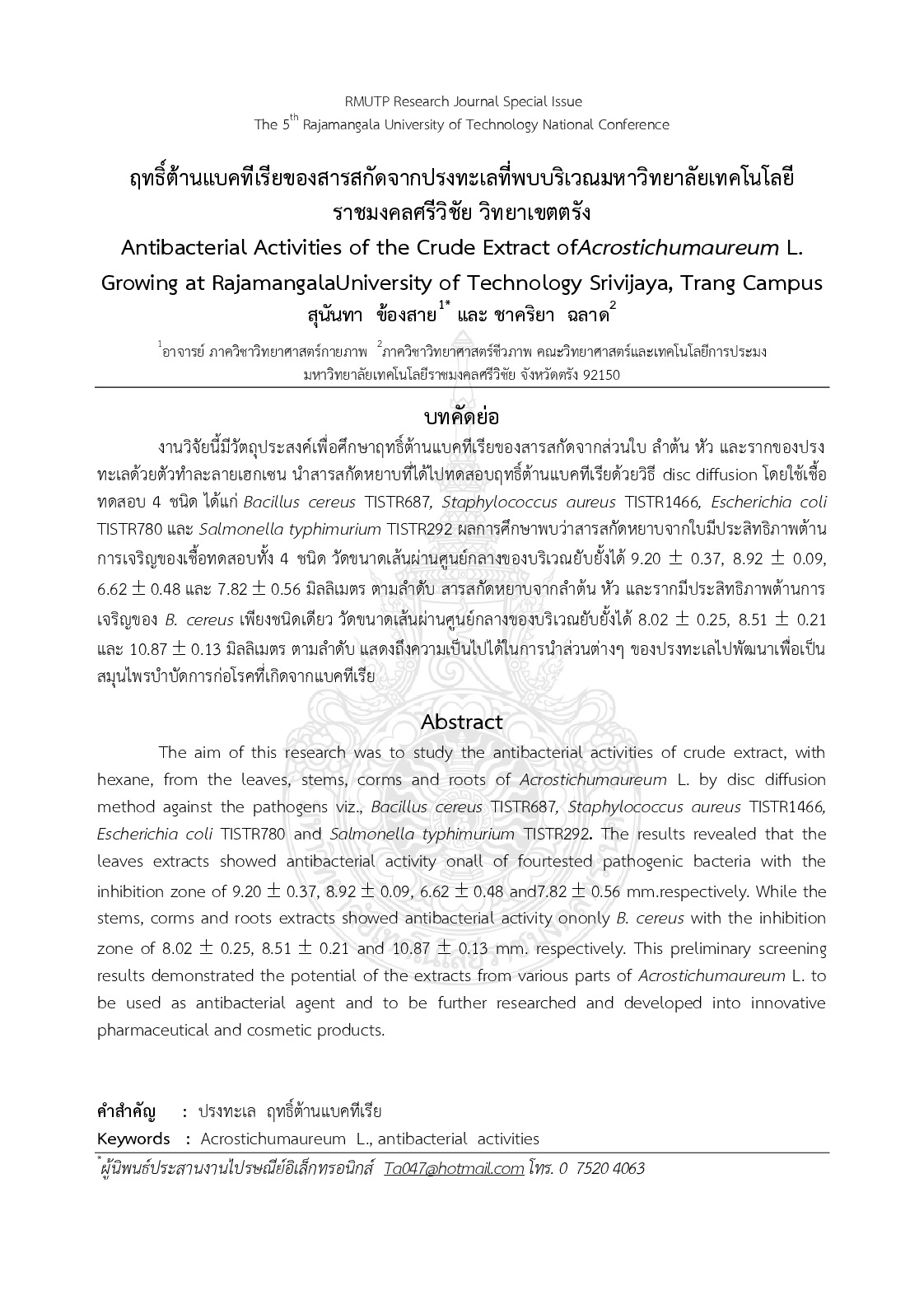
Antibacterial activities of the crude extract of acrostichumaureum l. growing at Rajamangala University of Technology Srivijaya, Trang Campus
The aim of this research was to study the antibacterial activities of crude extract with hexane from the leaves stems corms and roots of Acrostichumaureum L. by disc diffusion method against the pathogens viz. Bacillus cereus TISTR687 Staphylococcus aureus TISTR1466 Escherichia coli TISTR780 and Salmonella typhimurium TISTR292. The results revealed that the leaves extracts showed antibacterial activity onall of fourtested pathogenic bacteria with the inhibition zone of 9.20 0.37 8.92 0.09 6.62 0.48 and7.82 0.56 mm.respectively. While the stems corms and roots extracts showed antibacterial activity ononly B. cereus with the inhibition zone of 8.02 0.25 8.51 0.21 and 10.87 0.13 mm. respectively. This preliminary screening results demonstrated the potential of the extracts from various parts of Acrostichumaureum L. to be used as antibacterial agent and to be further researched and developed into innovative pharmaceutical and cosmetic products.
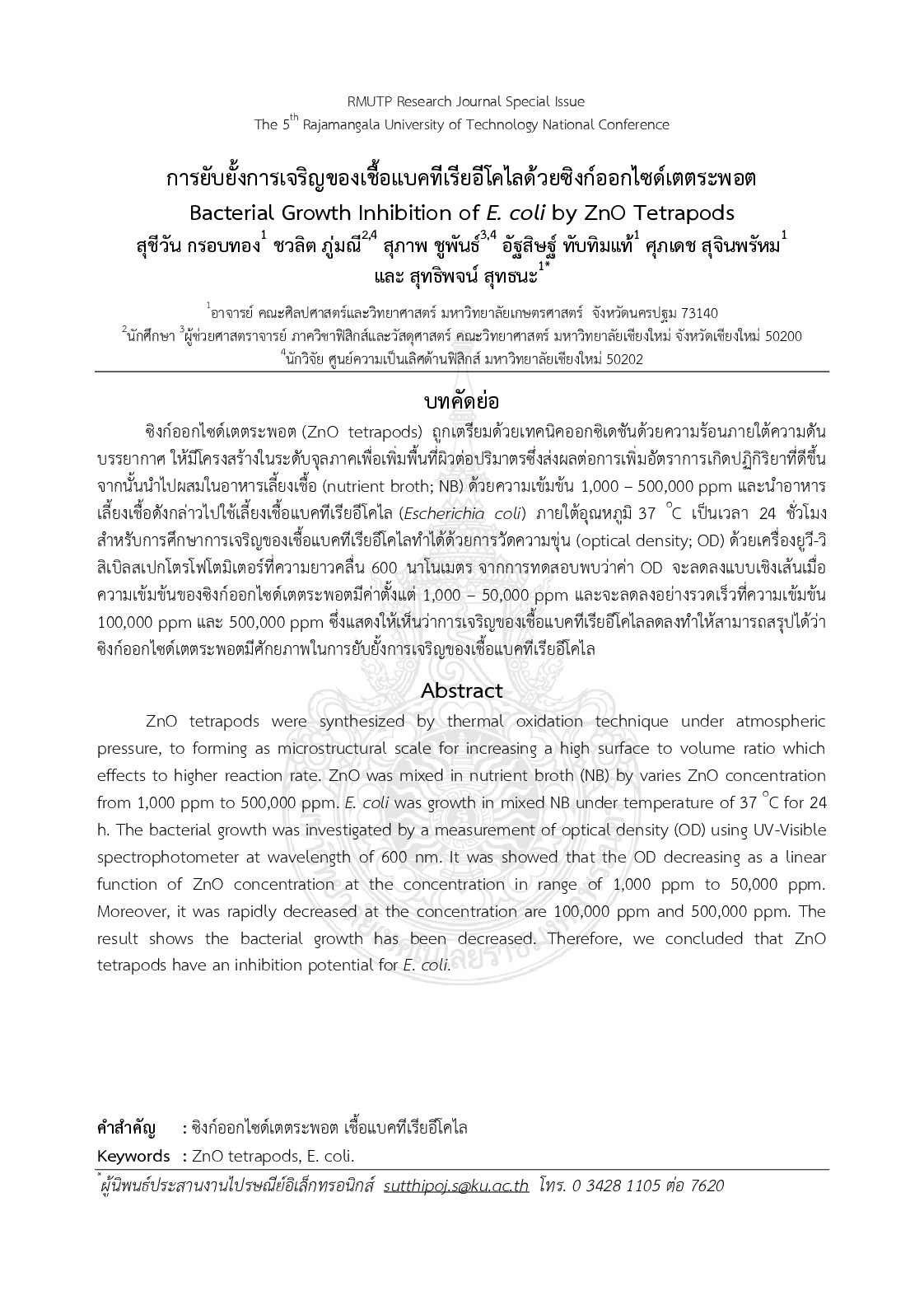
Bacterial growth inhibition of e. coli by zno tetrapods
ZnO tetrapods were synthesized by thermal oxidation technique under atmospheric pressure to forming as microstructural scale for increasing a high surface to volume ratio which effects to higher reaction rate. ZnO was mixed in nutrient broth (NB) by varies ZnO concentration from 1000 ppm to 500000 ppm. E. coli was growth in mixed NB under temperature of 37 oC for 24 h. The bacterial growth was investigated by a measurement of optical density (OD) using UV-Visible spectrophotometer at wavelength of 600 nm. It was showed that the OD decreasing as a linear function of ZnO concentration at the concentration in range of 1000 ppm to 50000 ppm. Moreover it was rapidly decreased at the concentration are 100000 ppm and 500000 ppm. The result shows the bacterial growth has been decreased. Therefore we concluded that ZnO tetrapods have an inhibition potential for E. coli.
อิทธิพลของสารทดแทนไขมันที่มีผลต่อการเหลือรอดของเชื่อโพรไบโอติคในไอศกรีมดยเกิร์ต
Probiotic is a micro organism that is useful for human bodies and can help creating balances for human intestinal system. The objective of this research is to compare amounts of fat substitutes supplied in the industries in order to determine their ability to encapsulate Probiotic microbes in the production of yoghurt ice cream to ensure maximum survived Probiotic microbes. In this research two fat substitutes Purity SM 100 and CRYSTAL texTM 648 were used to substitute skim milk in the standard formulas in order to study numbers of survived Probiotic microbes and to test the sensory acceptance. For the sensory acceptance it was found that the Probiotic yoghurt ice cream containing 20% Purity SM100 is acceptable at the maximum significance (p ≤ 0.05) because its flavor and taste was better than other samples as well as the best overrun with statistical significant differences (p ≤ 0.05). However by addition of both fat substitutes at different concentrations pH values of Probiotic yoghurt ice cream products did not have statistical significant differences (p ≥ 0.05). When Lactobacilluss acidophilus Bifidobacterium and Streptococcus thermophilus microbial starters were added into the Probiotic yoghurt ice cream using both fat substitutes in place of skim milk at ratios of 10% 15% and 20% respectively under a storage condition of -20oC for 4 weeks it was found that types and amounts of fat substitutes affected the surviving rate of Probiotic microbes in the product with a statistical significance (p ≤ 0.05). The addition of fat substitutes Purity SM100 and CRYSTAL texTM 648 at all concentration levels made Probiotic microbes survive in the product which illustrated that both fat substitutes used in above experiments could encapsulate Probiotic microbe cells. The survived Probiotic microbes were in the range of 108 – 109 CFU/ml in comparison to the Probiotic yoghurt ice cream with the standard formula without the addition of fat substitutes that has survived Probiotic microbes of only 106 CFU/ml.