จำนวน Repository ( 1574 )
ฤทธิ์ต้านอนุมูลอิสระและปริมาณสารประกอบโพลีฟีนอลในผลิตภัณฑ์อาหารว่างเสริมผงใบหม่อน
The potential health benefits attributed to mulberry leaf and its bioactive compounds have led to a huge increase of mulberry leaf products in the food market. The objective of this research was to determine total antioxidant activities ( FRAP and DPPH assays) and polyphenol compounds in 4 snack products i.e. loaf-bread puifai (Thai steamed cupcakes) peakpoon (Green coconut sweet pudding) and snow skin mooncake fortified with 10% mulberry leaf powder from “ Buri Rum 60” cultivar. The result showed that antioxidant activities and polyphenol contents increased in 4 products fortified with mulberry leaf powder. Ferulic acid was the only phenolic compound found in all original products. Kaempferol quercetin and caffeic acid were significantly increased whereas ferulic acid was reduced in the modified formulas. Therefore these bioactive compounds properties of mulberry leaf powder suggested their possible use for fortifying the healthy foods.
การตรวจวัดปริมาณฟอสเฟตในน้ำผิวดินจังหวัดลพบุรี ด้วยระบบวิเคราะห์แบบไหลชนิดโฟลอินเจคชันอย่างง่าย
A simple flow injection analytical system for an automatic determination of phosphate in water samples using the molybdenum blue method was developed. Samples were injected and mixed with ascorbic acid used as a reducing agent. The absorbance of the resulting molybdenum blue complex was measured at 880 nm by a spectrophotometer. The optimal conditions of this system were 2 mL/min of carrier flow rate 1000 μL of sample volume 60 centimeters of mixing tube length and 0.020 mol/L of ascorbic acid. The proposed method showed reliability high sensitivity spend small amount of reagents and samples and fast sample throughput (52 samples/hour). The limit of detection (LOD) was 0.015 mg P/L of phosphate. Precision obtained injecting a phosphate standard solution of 0.50 mg P/L (n=10) was 1.81%. This system can be applied to determination of phosphate content in surface water samples in Lopburi province by comparing with a standard method. It was found that obtained from the developed system agreed well with the standard method using the pair t-test (tstat 0.04 < tcrit 2.36). This flow injection analysis system has no effect from arsenate and silicate interference for the analysis of natural water samples.
ผลของจิ้งหรีดผงโปรตีนถั่วเหลืองสกัด และแซนแทนกัมที่มีต่อคุณภาพคุกกี้แป้งข้าวเจ้า
Rice flour-based cookies are gluten-free products. Cricket powder and isolated soy protein are alternative protein sources which can provide desirable nutrition. Xanthan gum is one of the hydrocolloids affecting the texture of cookies. This study investigated the effect of cricket powder (CP) isolated soy protein (ISP) and xanthan gum on the physical chemical and sensory qualities of rice flour-based cookies. The substitution of rice flour with two protein sources CP (25 and 35%) and ISP (0 25 and 35%) in the cookie formulations which were evaluated for their qualities using a 2x3 factorial arrangement in a completely randomized design. The result showed that when CP increased or ISP decreased the diameter of the product significantly (p≤0.05) increased but the hardness of the product significantly (p≤0.05) decreased. The effect of xanthan gum (0 0.14 0.28 and 0.42%) on the quality of products was also evaluated. It indicated that the increase in xanthan gum content significantly (p≤0.05) increased water activity moisture content and hardness of product while the liking score for hardness and overall liking significantly (p≤0.05) decreased. Therefore the optimal formula of rice flour cookies was 25% CP and 35% ISP for rice flour replacement without xanthan gum.
การวิเคราะห์การผสมพลาสติกชีวภาพพอลิแลคติกแอซิดและเทอร์โมพลาสติกสตาร์ช
This research was concentrated on characterized mechanical properties and adjusted compatibility of poly (lactic acid) (PLA) with thermoplastic starch (TPS) as biodegradable polymers composites. PLA was blended with TPS at the proportion of 10 20 30 50 and 70 wt% as well as 2 phr chain extender by an internal mixer at 200°C. The blended materials were then injection molded at 230°C. Tensile testing showed that as the amount of TPS increase the elongation at break tended to increase but the tensile strength and modulus tended to decrease. The morphology was investigated by scanning electron microscope. It was found that distinct phase between PLA and TPS was observed. Yet adding the chain extender clearly improved the compatibility between PLA and TPS. The blended materials were also analyzed by differential scanning calorimetry method to study thermal properties. It was found that as the amount of TPS increased the glass transition temperature (Tg) melting temperature (Tm) and cold crystallization temperature (Tcc) deceased. Additionally chain extenders did not affect thermal properties. The thermal stability of the composites decreased when increasing the amount of TPS because of the degradation of TPS in PLA. However when heated at 100ºC for 1 hr the PLA sample bent while TPS did not bend. When PLA was mixed with TPS the composite was bent according to adding TPS.
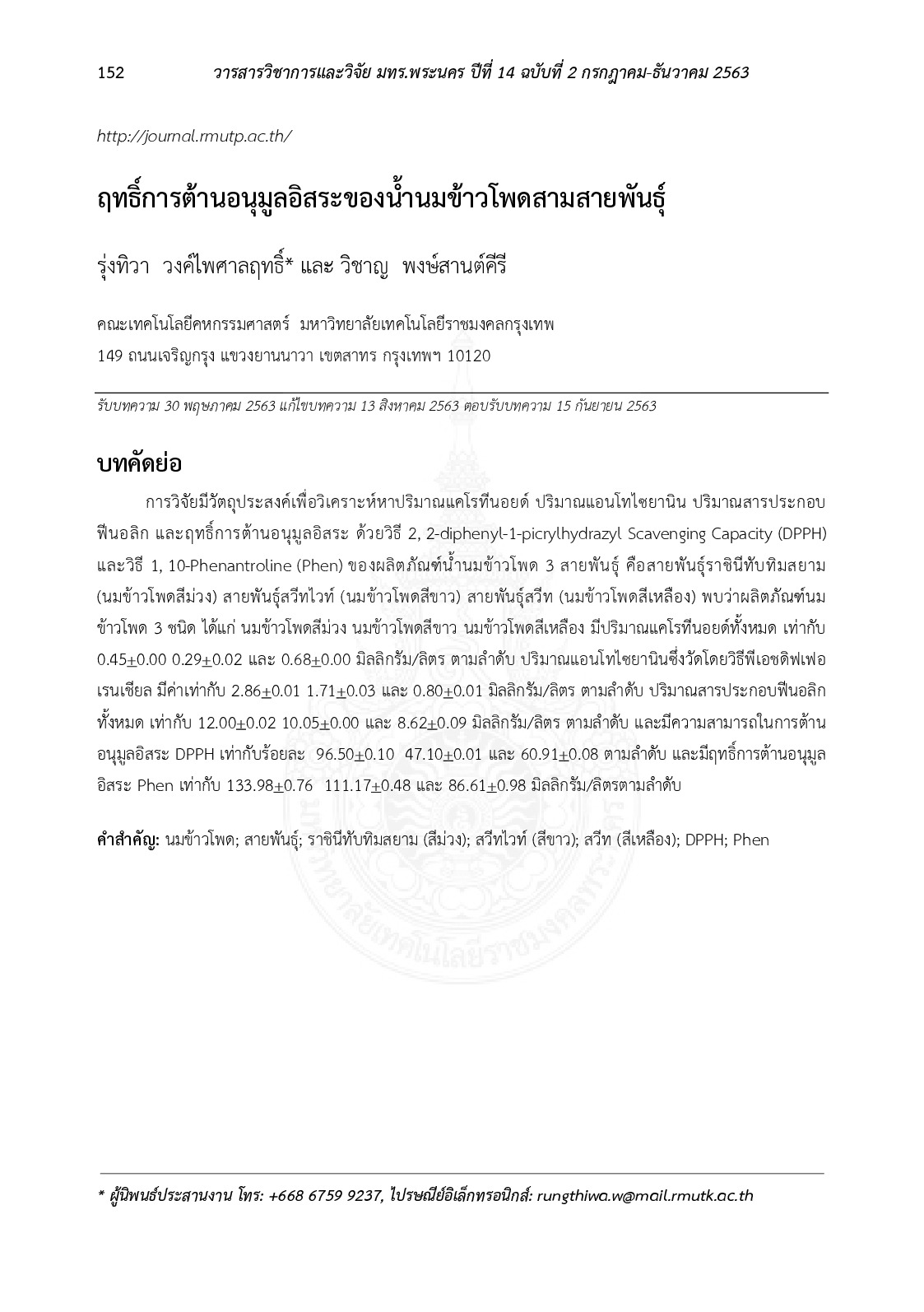
ฤทธิ์การต้านอนุมูลอิสระของน้ำนมข้าวโพดสามสายพันธ์
The purpose of this research was to analyze carotenoid content anthocyanin content phenolic compound content and the antioxidant activity by 2 2-diphenyl-1-picrylhydrazyl scavenging capacity (DPPH) and 1 10-Phenantroline (Phen). In the 3 varieties of corn milk which were the Queen Ruby Siam strain (Purple corn milk) (White corn milk) Sweet strain (Yellow corn milk). It was found that the samples of 3 types of corn milk have total carotenoid content were 0.45+0.00 0.29+0.02 and 0.68+0.00mg/l respectively. Anthocyanin content measured by pH-differential method were 2.86+0.01 1.71+0.03 and 0.80+0.01 mg/l respectively. The total amount of phenolic compounds were 12.00+0.02 10.05+0.00 and 8.62+0.09 mg/l respectively. The ability to resist free radicals by DPPH method were equal to 96.50+0.10 47.10+0.01 and 60.91+0.08 respectively. The antioxidant activity using Phen method were 133.98+0.76 111.17+0.48 and 86.61+0.98 mg/l respectively.