จำนวน Repository ( 1852 )
การปั่นเส้นด้ายจากเส้นใยผลตาลสุก ด้วยกระบวนการปั่นด้ายแกนกลาง
The research aims to investigate on the yarn spinning production using processed Borassus fruit fibres bleached and soaked in water before arranging into fibres of proper size in preparation for the yarn spinning from Borassus fruit fibres using handspun core-spinning technique. The study found that yarns produced by such method are uneven with loose and tight twists and multiple knots along the threads. Furthermore Borassus fruit yarns have rough and coarse texture. Scientifically tested the properties of the yarns indicate that the highest yarn count of this Borassus fruit yarns is at 665.00 Tex while the lowest is at 383.33 Tex. Its tensile strength counts at the maximum level of 24.33 Newton with the elongation level of 21.90 Newton. The average tenacity comparing with yarn count is 0.04 Newton/Tex. The produced yarns consist of blending Borassus fruit fibres and Polyester at the proportion of 83: 18. After the spinning process Borassus fruit yarns are developed into textile weaving together using cotton as warp and Borassus fruit fibres as weft. The finished product was analysed showing that the warp and weft’s tension strength are at 581 Newton and 595 Newton respectively while the tenacity are at 65.05 Newton and 78.95 Newton in consecutive order. The blending proportion of woven textile is 49:45:6 of cotton Borassus fruit fibres and Polyester accordingly. Hence the study shows that the production of Borassus yarns is promisingly producible and the woven textile from such yarns could be used for further product development such as household textile.
การพัฒนาหลักสูตรฝึกอบรมเพื่อเสริมสร้างทักษะด้านความรู้ความสามารถทั่วไป
This research aims to: (1) develop the training curriculum development for enhancing skills in general ability ( 2) evaluate the effectiveness index of the training curriculum development for enhancing skills in general ability and 3) study the samples’ levels of satisfaction. The samples in to study were 10 senior students in regular program. The research instruments included the training curriculum development for enhancing skills in general ability an evaluation of congruence a knowledge and skill test a questionnaire on training satisfaction. The statistics used were the effectiveness index percentages mean standard deviation and paired – sample T test. The results revealed that the training curriculum development for enhancing skills in general ability were highest level appropriation ( X = 4. 67) showing that it was possible for further use. From the pre and post tests on the knowledge and skill testing the trainees different score showed that there was improvement among the trainees at the significant level of . 05. The questionnaire result showed that the trainees were highest satisfied.
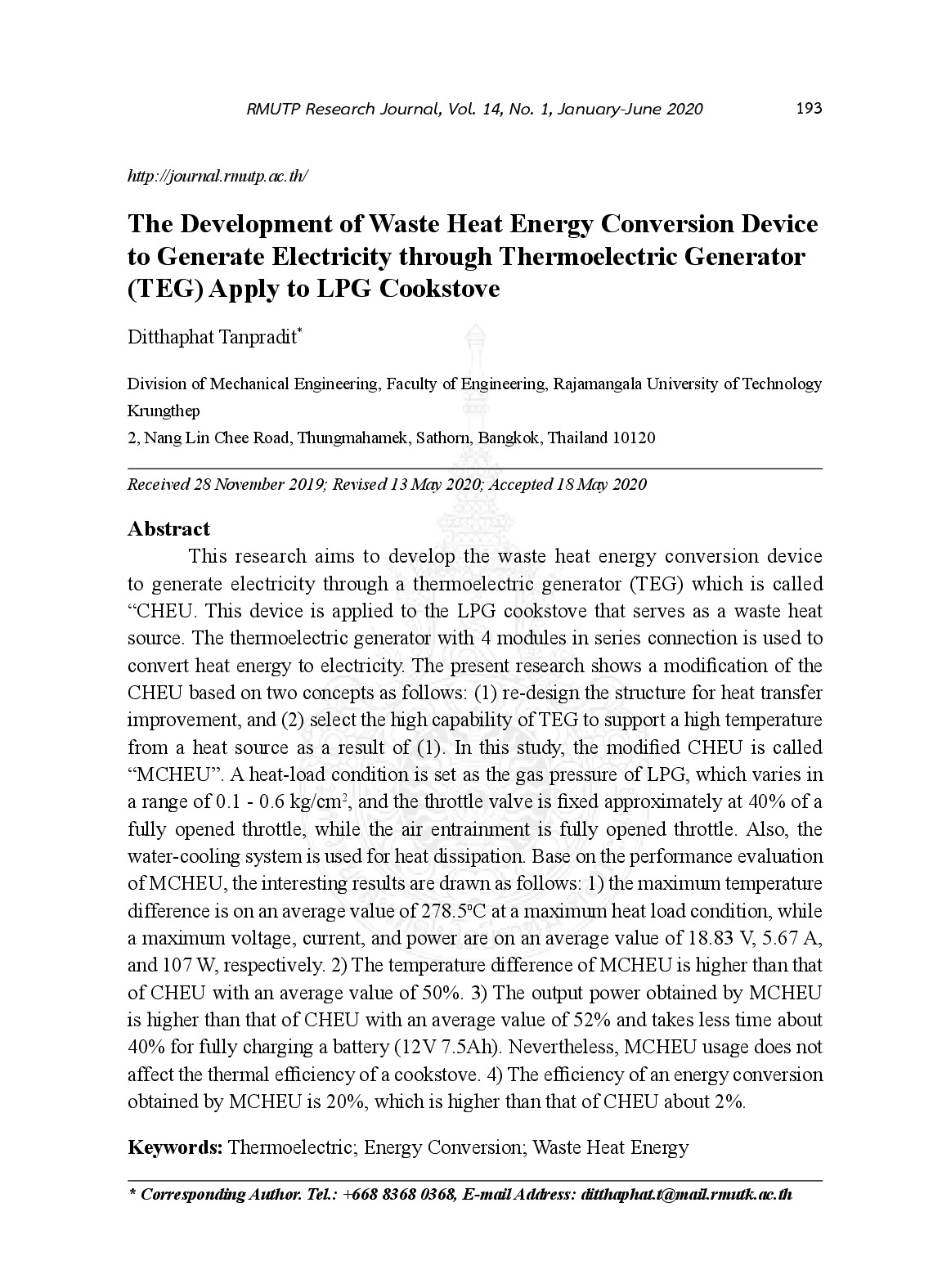
The development of waste heat energy conversion device to generate electricity through hermoelectric generator (TEG) apply to LPG cookstove
This research aims to develop the waste heat energy conversion device to generate electricity through a thermoelectric generator (TEG) which is called “CHEU. This device is applied to the LPG cookstove that serves as a waste heat source. The thermoelectric generator with 4 modules in series connection is used to convert heat energy to electricity. The present research shows a modification of the CHEU based on two concepts as follows: (1) re-design the structure for heat transfer improvement and (2) select the high capability of TEG to support a high temperature from a heat source as a result of (1). In this study the modified CHEU is called “MCHEU”. A heat-load condition is set as the gas pressure of LPG which varies in a range of 0.1 - 0.6 kg/cm2 and the throttle valve is fixed approximately at 40% of a fully opened throttle while the air entrainment is fully opened throttle. Also the water-cooling system is used for heat dissipation. Base on the performance evaluation of MCHEU the interesting results are drawn as follows: 1) the maximum temperature difference is on an average value of 278.5oC at a maximum heat load condition while a maximum voltage current and power are on an average value of 18.83 V 5.67 A and 107 W respectively. 2) The temperature difference of MCHEU is higher than that of CHEU with an average value of 50%. 3) The output power obtained by MCHEU is higher than that of CHEU with an average value of 52% and takes less time about 40% for fully charging a battery (12V 7.5Ah). Nevertheless MCHEU usage does not affect the thermal efficiency of a cookstove. 4) The efficiency of an energy conversion obtained by MCHEU is 20% which is higher than that of CHEU about 2%.
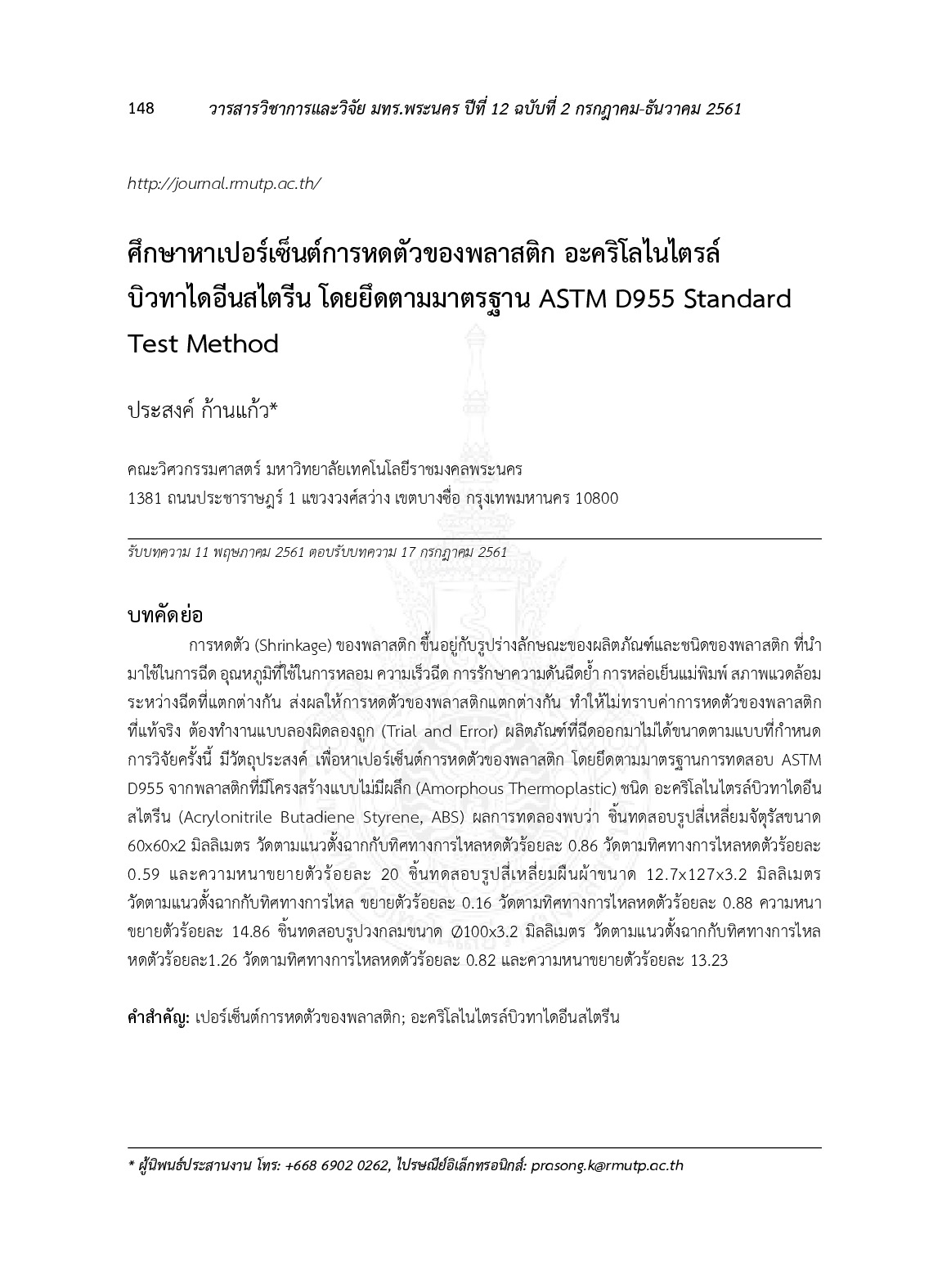
การศึกษาหาเปอร์เซ็นต์การหดตัวของพลาสติก อะคริโลไตรล์บิวทาไออีนสไตรีน โดยยึดตามาตรฐาน ASTM D955 standard test method
The shrinkage of plastic was caused by the shape of the product and the type of plastic used in the injection. The plastic shrinkage difference was resulted from the temperature used in melting the injection speed mold cooling and different injection surroundings. These led to unknown exact value of plastic shrinkage and the trial and error work has been done. As a result of trial and error work the injection products were not in the determined size. This research aims to find the percentage of plastic shrinkage according to standard test ASTM D955 from (Amorphous Thermoplastic) (Acrylonitrile Butadiene Styrene ABS). The findings showed that square specimen size 60x60x2 mm measured from vertical perpendicular to flowing direction the shrinkage was at 0.86% the shrinkage was at 0.59% when measured from flowing direction and the thickness expanded at 20%. For the rectangular specimen size 12.7x127x3.2 mm measured from vertical perpendicular to flowing direction the expanding was at 0.16% the shrinkage was at 0.88% when measured from flowing direction and the thickness expanded at 14.86%. The circular specimen size 100x3.2 mm the shrinkage was at 1.26 when measured from vertical perpendicular to flowing direction the shrinkage measured from flowing direction was at 0.82% and the thickness expanded at 13.23%
Surface modification of perlite by using silane for the enhancement of heat aging resistance of natural rubber vulcanisates
The enhancement of mechanical properties of natural rubber vulcanisates was expected by surface modification of perlite particles. Thus the objective of the present study was to investigate the cure properties and the heat aging resistance properties in terms of stress at 100% elongation tensile strength and percentage elongation at break after surface modification. Furthermore the rebound resilience and abrasion resistance of perlite treated with silane filled in NR vulcanisates were investigated. In a comparison the properties of clay-filled NR vulcanisates were determined. The results reveal that surface modification by using silane caused a reduction of scorch time and cure time but an increase in torque difference and swelling resistance. Also surface modification gives better perlite-NR interactions before and after aging. The better heat resistance properties of perlite-filled NR vulcanisates than those of clay-filled vulcanisates is detected from relative property data. Nevertheless a lower percentage of rebound resilience and abrasion resistance of perlite-filled vulcanisates before and after surface modification than those of clay-filled vulcanisates are observed. This is owing to the large particle size low specific surface area poor dispersion and agglomeration of perlite in NR vulcanisates.