จำนวน Repository ( 2131 )

Simulations in Sheet Metal Forming Industry for the 21st Century
High petroleum cost nowadays and expectedly in the future is a major force driving the cost up in every industrial sector. In metal forming industry tooling design is a very important and costly process in the design and development phase. By a traditional means trial-and-error approach requires continuous corrections causing many problems to manufacturers since tooling corrections and real scale experiments are very costly and inefficient consumption of limited natural resources. As a result simulations via computer models play an important role in the present time. An important tool to this problem solving in the sheet metal forming industry is a nonlinear finite element method. When it works together with proper material models it has potential and is suitable for applications in the current 21st century to efficiently analyze and design manufacturing processes especially in sheet metal forming.
Technology Transfer to Community for Existing Career Development and New Career Creation
This project has three main purposes: to provide training courses for producing and packaging of food textile craft and handicraft community products; to conduct a workshop for initial quality evaluation of community products and their packages; and to encourage the community to develop its products according to Thai Community Product Standard. The methodology of the project included assessing need for technology transfer; preparing the project; appointing the committee; recruiting trainees; inviting speakers; preparing instructors documents place and facilities; conducting the training course; and following up project achievement. Results from the 20 training courses with 204 target trainees revealed satisfaction in training at the level of 83.20%. About 46.15% of the trainees were ready for the community product standard guarantee and 33.17% were able to create new careers.
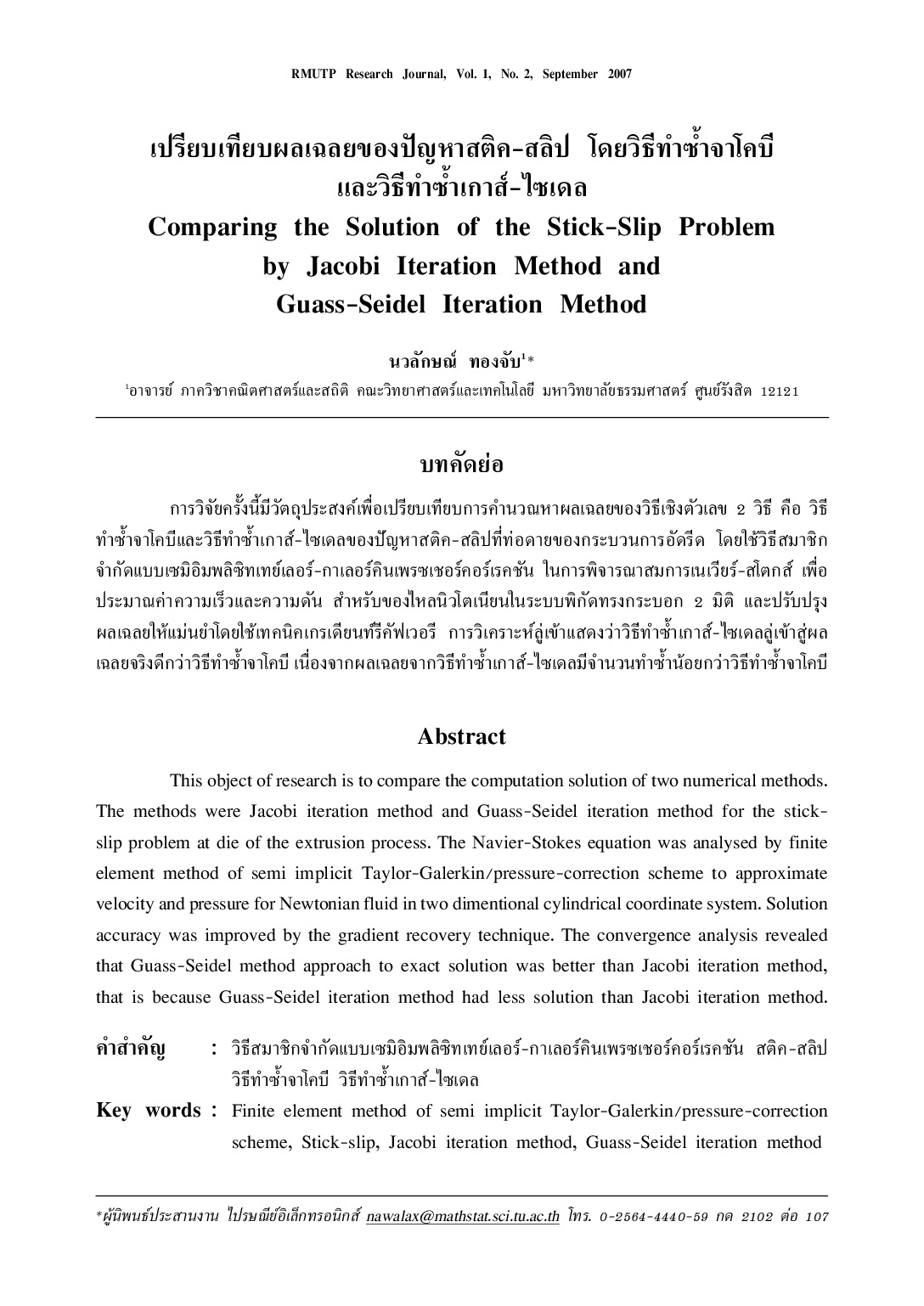
Comparing the Solution of the Stick-Slip Problem by Jacobi Iteration Method and Guass-Seidel Iteration Method
This object of research is to compare the computation solution of two numerical methods. The methods were Jacobi iteration method and Guass-Seidel iteration method for the stickslip problem at die of the extrusion process. The Navier-Stokes equation was analysed by finite element method of semi implicit Taylor-Galerkin/pressure-correction scheme to approximate velocity and pressure for Newtonian fluid in two dimentional cylindrical coordinate system. Solution accuracy was improved by the gradient recovery technique. The convergence analysis revealed that Guass-Seidel method approach to exact solution was better than Jacobi iteration method that is because Guass-Seidel iteration method had less solution than Jacobi iteration method.
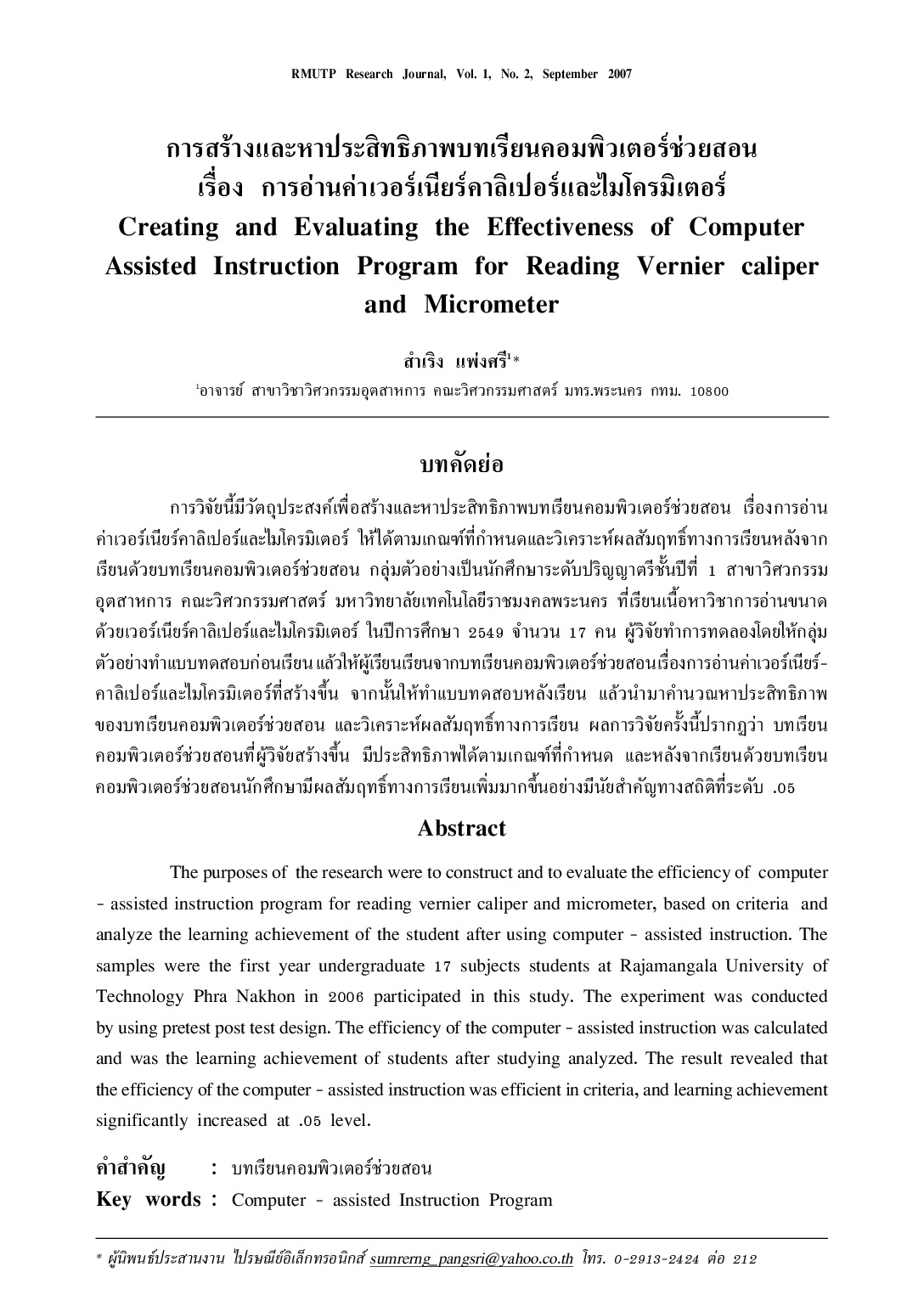
Creating and Evaluating the Effectiveness of Computer Assisted Instruction Program for Reading Vernier caliper and Micrometer
The purposes of the research were to construct and to evaluate the efficiency of computer- assisted instruction program for reading vernier caliper and micrometer based on criteria and analyze the learning achievement of the student after using computer - assisted instruction. The samples were the first year undergraduate 17 subjects students at Rajamangala University of Technology Phra Nakhon in 2006 participated in this study. The experiment was conducted by using pretest post test design. The efficiency of the computer - assisted instruction was calculated and was the learning achievement of students after studying analyzed. The result revealed that the efficiency of the computer - assisted instruction was efficient in criteria and learning achievement significantly increased at .05 level.
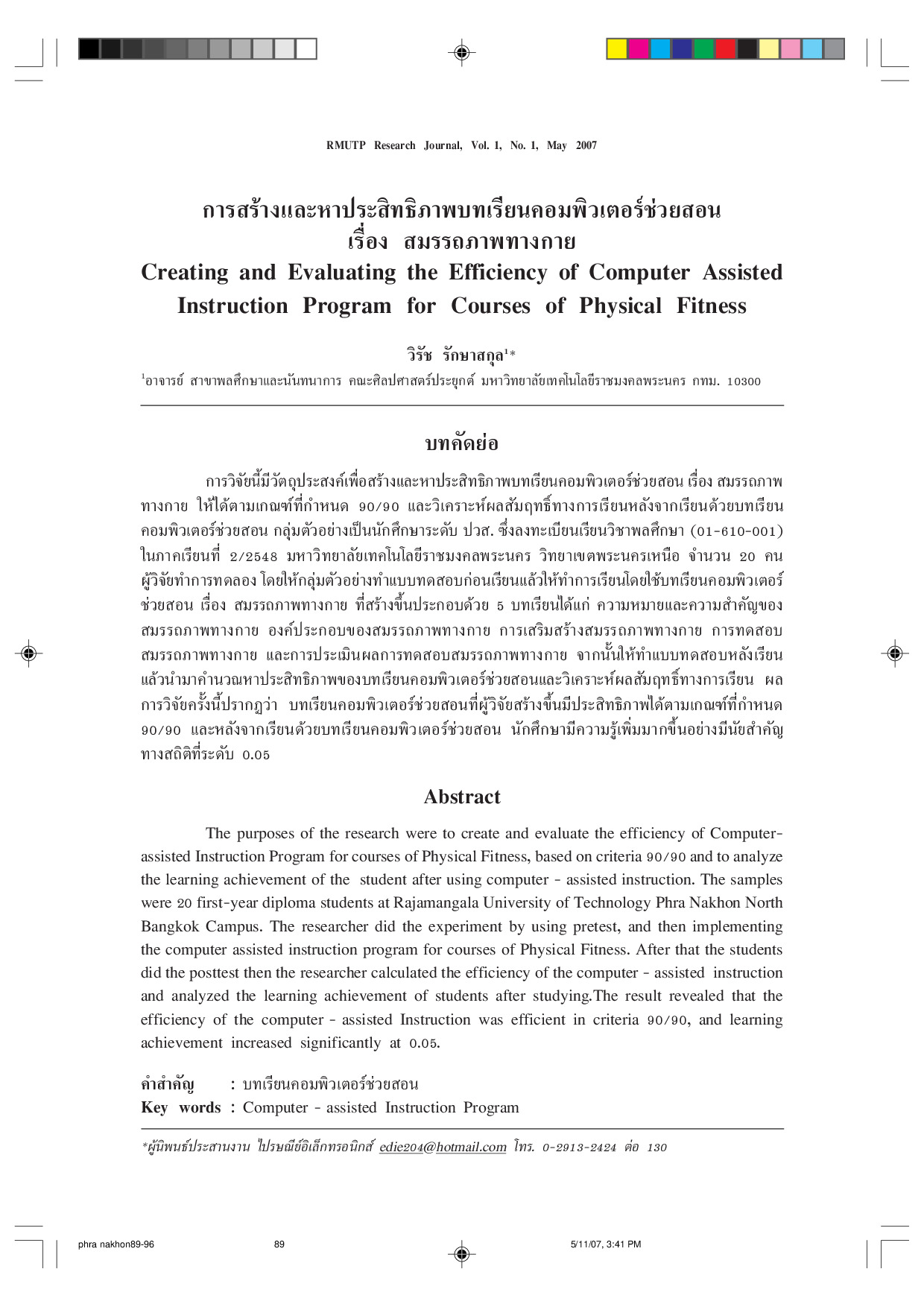
Creating and Evaluating the Efficiency of Computer Assisted Instruction Program for Courses of Physical Fitness
The purposes of the research were to create and evaluate the efficiency of Computerassisted Instruction Program for courses of Physical Fitness based on criteria 90/90 and to analyze the learning achievement of the student after using computer - assisted instruction. The samples were 20 first-year diploma students at Rajamangala University of Technology Phra Nakhon North Bangkok Campus. The researcher did the experiment by using pretest and then implementing the computer assisted instruction program for courses of Physical Fitness. After that the students did the posttest then the researcher calculated the efficiency of the computer - assisted instruction and analyzed the learning achievement of students after studying.The result revealed that the efficiency of the computer - assisted Instruction was efficient in criteria 90/90 and learning achievement increased significantly at 0.05.