จำนวน Repository ( 284 )

Students' problems and needs for educational management of science and technology faculty, rajamangala university of technology
The objectives of this research were to 1) study perceived problems of students for educational management of Science and Technology Faculty Rajamangala University of Technology Phra Nakhon 2) compare perceived problems of students for educational management classified by gender students year and field of study and 3) study needs of students for educational management of Science and Technology Faculty. The sample studied were 140 undergraduate students selected by proportional stratified random sampling categorized by students year of study and simple random sampling was also used. The data was collected through questionnaires constructed by researcher. The statistics used for data analysis were mean standard deviation one way analysis of variance and Scheffes multiple comparison method.
Variables affecting to learning achievement in Bio-organic chemistry of students on Rajamangala University of Technology Phra Nakhon
The purposes of this research were to study of Variables Affecting to Learning Achievement in Bio-organic chemistry and construct the prediction equation models ofstudents Bio-organic chemistry Leaming Achievement in Rajamangala University of Technology Phra Nakhon(RMUTP). The sample consisted of60 students ofRMUTP Sampling by Quota Sampling method. The instnunents used in this research were the questionnaire of 5-rated rating scales of those II categories. The reliability of the questionnaire was that the Bio-organic chemistry attitude 0.688 Achievement motivation in Bio-organic chemistry 0.766 Students learning behavior 0.742 Attitude towards University 0.80 I Personality ofchemistry teacher 0.851 Teaching behavior ofchemistry teacher 0.869 Parents support 0.796 University surrounding 0.719 Facilities of University 0.834 with the total average of 0.911 and the test of 4 choices Bio-organic chemistry Learning Achievement consisted of 50 items. The level ofdifficulty was between 0.27 -0.53 the power ofdiscrimination was between 0.35 -0.69 The reliability was 0.79 .The data were analyzed through statistical techniques of percentage mean standard deviation and multiple regression. The results were as follows: The Variables Affecting on students Bio-organic chemistry Learning Achievement at .05 level of significant were the Bio-organic chemistry attitude(xl) Achievement motivation in Bio-organic chemistry (-2) predicted at the rate of 15.50 Percent The raw score prediction equation was : A Y = 9.493 + 2.202 Xl + 0.730 X2 The standard score prediction equation was : A Zy = 0.380 ZXI + 0.123 Zx2
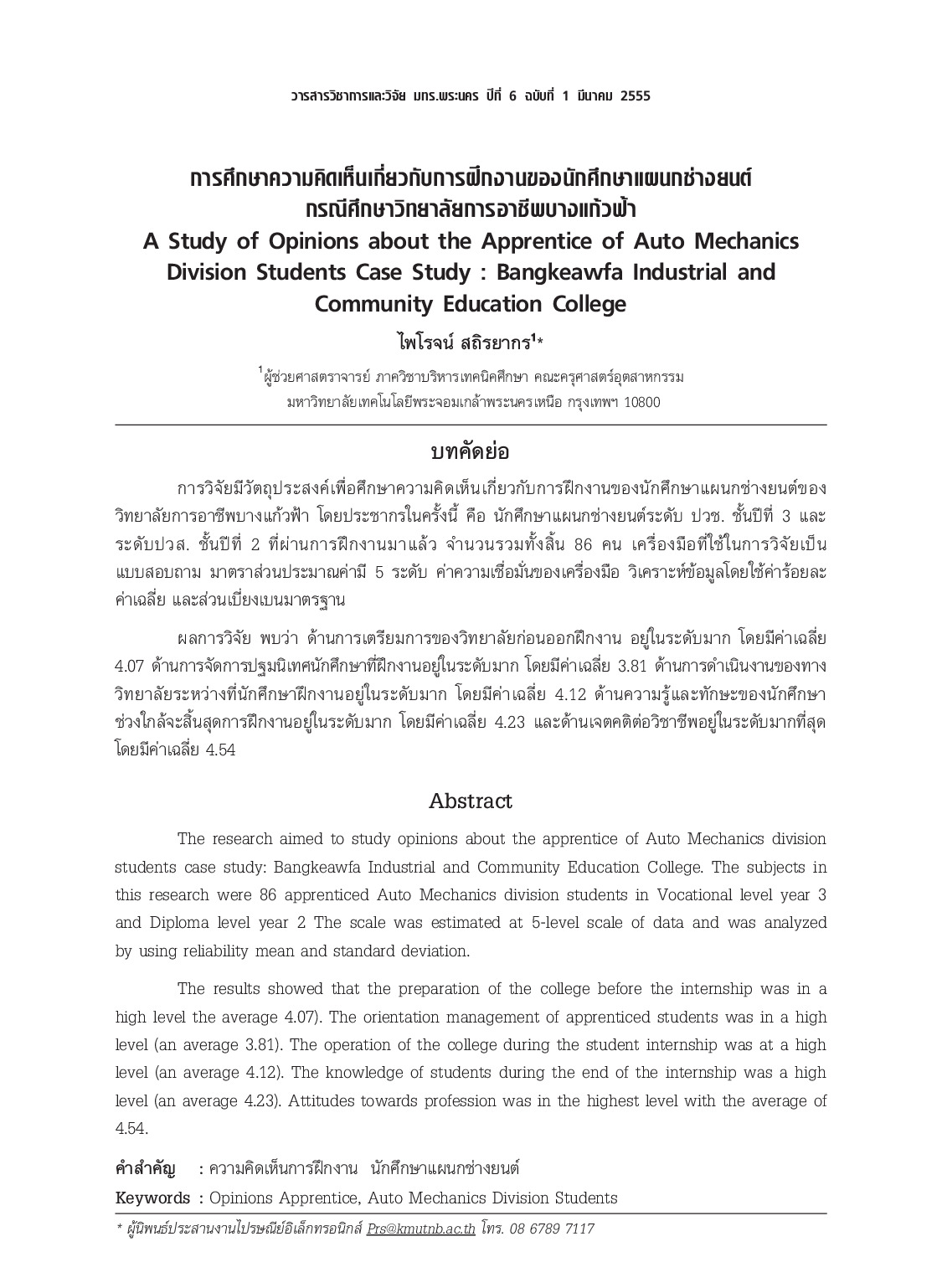
A Study of Opinions about the Apprentice of Auto Mechanics Division Students Case Study : Bangkeawfa Industrial and Community Education College
The research aimed to study opinions about the apprentice of Auto Mechanics division students case study: Bangkeawfa Industrial and Community Education College. The subjects in this research were 86 apprenticed Auto Mechanics division students in Vocational level year 3 and Diploma level year 2 The scale was estimated at 5-level scale of data and was analyzed by using reliability mean and standard deviation. The results showed that the preparation of the college before the internship was in a high level the average 4.07). The orientation management of apprenticed students was in a high level (an average 3.81). The operation of the college during the student internship was at a high level (an average 4.12). The knowledge of students during the end of the internship was a high level (an average 4.23). Attitudes towards profession was in the highest level with the average of 4.54.
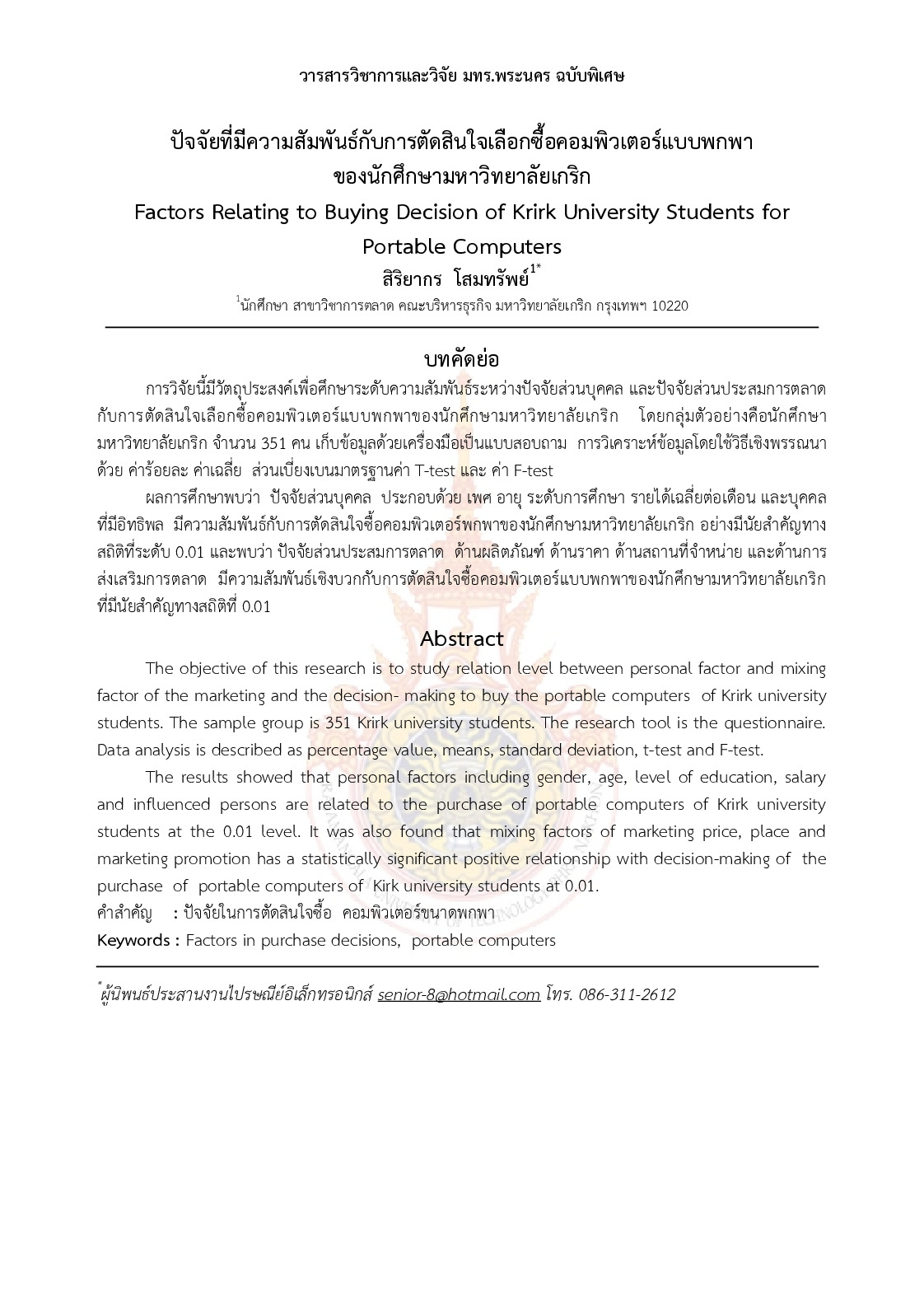
Factors Relating to Buying Decision of Krirk University Students for Portable Computers
The objective of this research is to study relation level between personal factor and mixing factor of the marketing and the decision- making to buy the portable computers of Krirk university students. The sample group is 351 Krirk university students. The research tool is the questionnaire. Data analysis is described as percentage value means standard deviation t-test and F-test. The results showed that personal factors including gender age level of education salary and influenced persons are related to the purchase of portable computers of Krirk university students at the 0.01 level. It was also found that mixing factors of marketing price place and marketing promotion has a statistically significant positive relationship with decision-making of the purchase of portable computers of Kirk university students at 0.01.
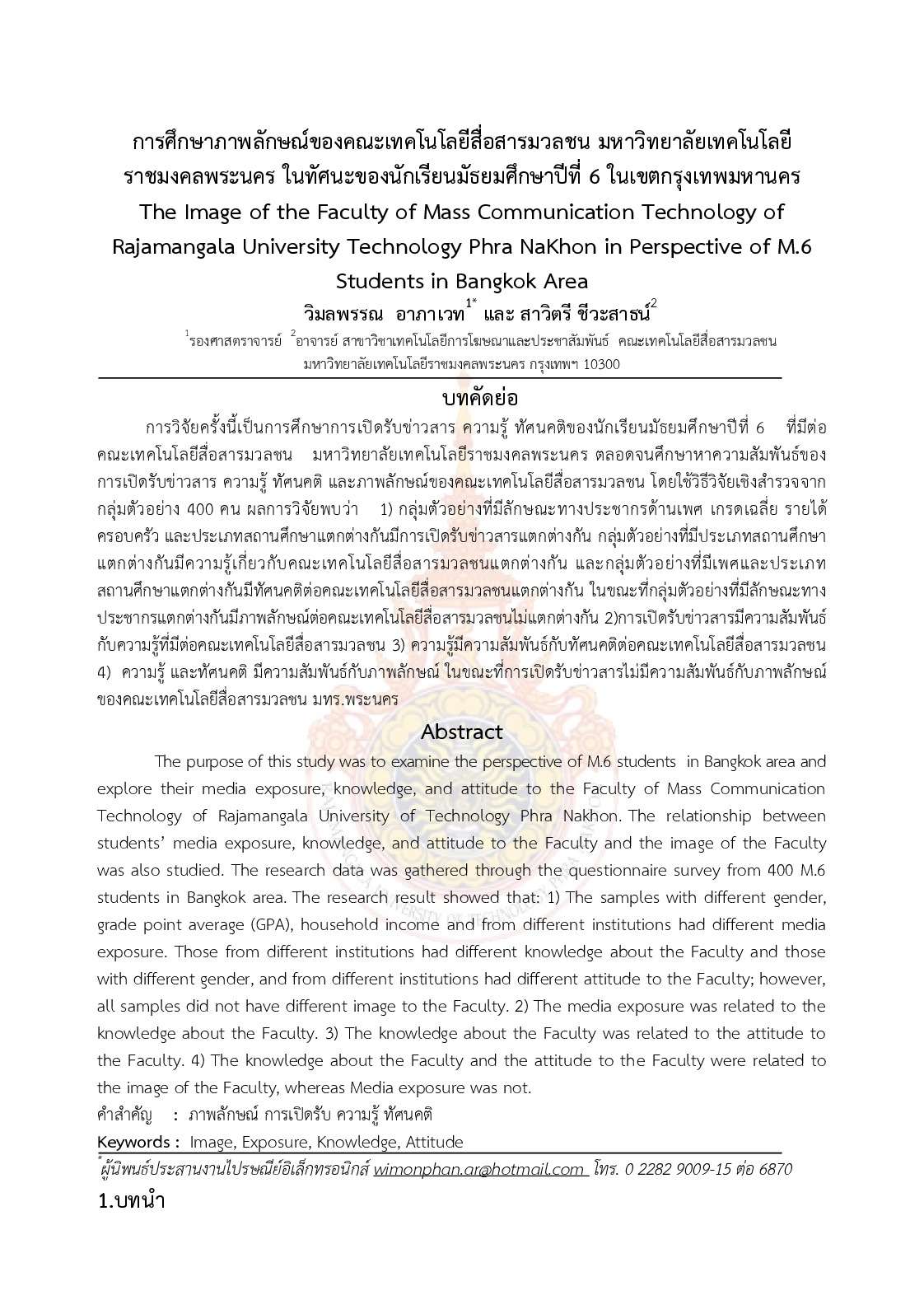
The Image of the Faculty of Mass Communication Technology of Rajamangala University Technology Phra NaKhon in Perspective of M.6 Students in Bangkok Area
The purpose of this study was to examine the perspective of M.6 students in Bangkok area and explore their media exposure knowledge and attitude to the Faculty of Mass Communication Technology of Rajamangala University of Technology Phra Nakhon. The relationship between students’ media exposure knowledge and attitude to the Faculty and the image of the Faculty was also studied. The research data was gathered through the questionnaire survey from 400 M.6 students in Bangkok area. The research result showed that: 1) The samples with different gender grade point average (GPA) household income and from different institutions had different media exposure. Those from different institutions had different knowledge about the Faculty and those with different gender and from different institutions had different attitude to the Faculty; however all samples did not have different image to the Faculty. 2) The media exposure was related to the knowledge about the Faculty. 3) The knowledge about the Faculty was related to the attitude to the Faculty. 4) The knowledge about the Faculty and the attitude to the Faculty were related to the image of the Faculty whereas Media exposure was not.