จำนวน Repository ( 23 )
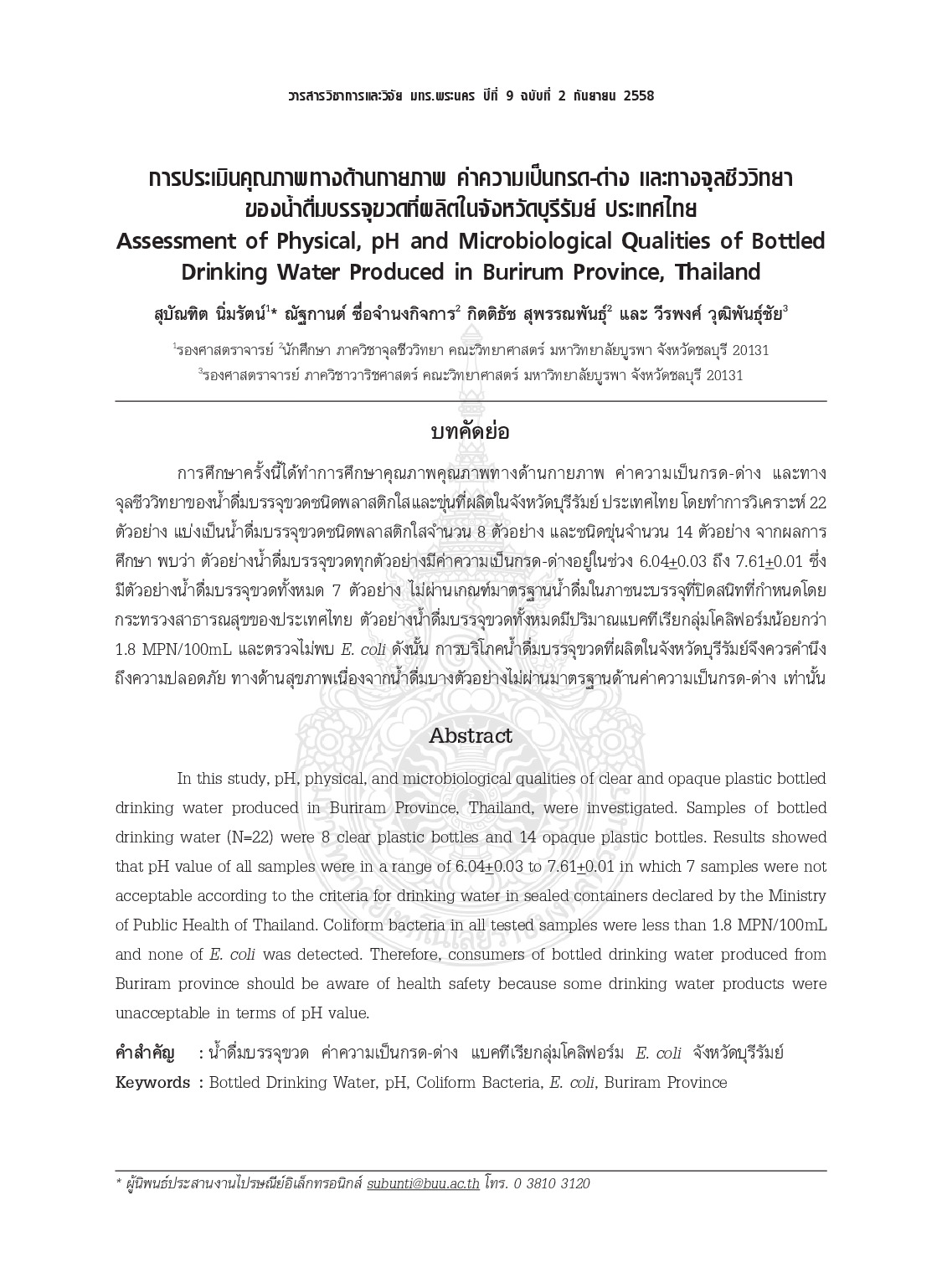
การประเมินคุณภาพทางด้านกายภาพ ค่าความเป็นกรด-ด่าง และทางจุลชีววิทยา ของน้ำดื่มบรรจุขวดที่ผลิตในจังหวัดบุรีรัมย์ ประเทศไทย
In this study pH physical and microbiological qualities of clear and opaque plastic bottled drinking water produced in Buriram Province Thailand were investigated. Samples of bottled drinking water (N=22) were 8 clear plastic bottles and 14 opaque plastic bottles. Results showed that pH value of all samples were in a range of 6.04 ± 0.03 to 7.61 ± 0.01 in which 7 samples were not acceptable according to the criteria for drinking water in sealed containers declared by the Ministry of Public Health of Thailand. Coliform bacteria in all tested samples were less than 1.8 MPN/100mL and none of E. coli was detected. Therefore consumers of bottled drinking water produced from Buriram province should be aware of health safety because some drinking water products were unacceptable in terms of pH value.
การเปรียบเทียบวัสดุที่ใช้ทำแม่พิมพ์ฉีดที่ทำจากอลูมิเนียมเกรด A7075 กับ เหล็กเกรด P20
Material selection for mold making are not only material prices wages but also there are other factors such as thermal strength shine and resistance to temperature changing that caused distortion and cracks. Preform injection molding from Polyethylene Terephthalate (PET) consumes time for drying granulated plastic in 4 – 6 hours at 140 - 160°C and injects at 280 – 300 °C. This is a very high temperature to inject into mold at 10 – 15°C in cool area. The material for mold making must be able to resist to thermal shock. Today molding machines are made of grade P20 steel (Standard JIS) to produce preform that takes long cycle time due to poor cooling. The research aims to compare the pricing time in mold making to preform injection time that made of aluminum -A7075 grade and grade P20 steel. The experiment is to make a mold that made of aluminum A7075 grade and grade P20 steel injects 15 gram preform. The PET is used to blow into a blow mold with pressure at 30 – 35 bar (Two – Stage) that are 2 bottles of 350 ML. The results of material selection for preform mold making showed that aluminum A7075 grade is cheaper 27.04% the mold price is cheaper 23.6% and consumes less cycle time than grade P20 steel.
การศึกษาช่วงตัวแปรที่เหมาะสมในการชุบแข็งและบำบัดเย็นเหล็กกล้าพีเอ็มเกรด เพื่อพัฒนาประสิทธิภาพแม่พิมพ์ตัดสำหรับการผลิตชิ้นส่วนในอุตสาหกรรม
การวิจัยนี้เป็นการชุบแข็งเหล็กกล้าผงอัดรีด ส่วนผสม 1.50%C 100%Si 8.00%Cr 1.50%Mo 0.40%Mn 4.0%V ภายใต้กระบวนการทางความร้อนและบำบัดเย็นต่างกัน 3 ตัวแปร เพื่อศึกษาประสิทธิภาพการต้านทานการสึกหรอของแม่พิมพ์ตัด โดยอบเหล็กกล้าให้ร้อนถึงอุณหภูมิออสเทนไนท์ที่อุณหภูมิ 1030°C คงอุณหภูมิ 30 นาที จากนั้นชุบแข็งด้วยแก๊สไนโตรเจนความดัน 3 บาร์ เย็นตัวลงถึงอุณหภูมิต่างกัน ประกอบด้วยที่อุณหภูมิ 35°C (ห้อง) ที่อุณหภูมิ -147°C และ -192°C โดยคงอุณหภูมิไว้ 4.0 ชั่วโมง จากนั้นอบคืนตัวที่อุณหภูมิ 525°C จำนวน 2 ครั้ง เจียนระไนขึ้นรูปเป็นชิ้นส่วนแม่พิมพ์ตัด (Banking Die) ขนาดเส้นผ่านศูนย์กลางของพั้นซ์ 10 มม. สำหรับตัดเหล็กแผ่น SUS 304 ความหนา 1.13 มม. จำนวน 20000 ครั้ง ผลการวิจัยปรากฏว่า มีความแข็ง 61.0 HRC. 61.0 HRC. และ 60.2 HRC. ตามลำดับ ไม่ต่างกันมากนัก ส่วนดายเป็น 59.9 HRC. 60.6 HRC. และ60.4 HRC. ตามลำดับ สำหรับแม่พิมพ์ที่ใช้ตัวแปรการเย็นตัวหลังชุบแข็งถึงอุณหภูมิห้องพั้นซ์มีน้ำหนักลดลง 0.0179 กรัม ขนาดเส้นผ่านศูนย์กลางลดลงเป็น 9.835 มม. ชิ้นงาน (Blank) มีขนาดของ Cut Band ช่วงเริ่มตัด 0.460 มม. เมื่อตัดถึง 20000 ครั้ง มีค่าเป็น 0.646 มม. สำหรับแม่พิมพ์ที่เย็นตัวหลังชุบแข็งถึงอุณหภูมิ -147°C ผลการตัดปรากฏว่าพั้นซ์น้ำหนักลดลง 0.0079 กรัม ขนาดเส้นผ่านศูนย์กลางลดลงเป็น 9.907 มม. ขนาด Cut Band ช่วงเริ่มตัด มีค่า 0.659 มม. และช่วงการตัดที่ 20000 ครั้ง มีค่าเป็น 0.448 มม. ส่วนแม่พิมพ์ที่เย็นตัวหลังชุบแข็งถึงอุณหภูมิ -192°C ผลการตัดปรากฎว่าพันซ์น้ำหนักลดลง 0.0173 กรัม ขนาดเส้นผ่านศูนย์กลางลดลงเป็น 9.886 มม. ขนาด Cut Band ช่วงเริ่มตัด มีค่า 0.633 มม. และช่วงการตัดที่ 20000 ครั้ง มีค่าเป็น 0.530 มม. ผลการวิจัยสรุปได้ว่าชิ้นงานที่ผ่านการชุบเย็นเมื่อเริ่มตัดจะมีการสึกหรอมากกว่า หลังจากจำนวนครั้งในการตัดเพิ่มขึ้นอัตราการสึกหรอจะช้าลง และพฤติกรรมการสึกหรอของคมตัดจากลักษณะการกระแทกของพั้นซ์และดายสำหรับตัดชิ้นงานพบว่าเป็นการสึกหรอแบบ Abrasive wear การบำบัดเย็นแต่เพียงครั้งเดียวหลังจากการเย็นตัวจากอุณหภูมิออสเทนไนท์ยังไม่สามารถลดออสเทนไนท์ตกค้างได้ทั้งหมด ควรบำบัดเย็นระหว่างการอบคืนตัวแต่ละครั้งและเวลานานขึ้นกว่า 20 ชั่วโมง และหลังจากการเจียระไนขั้นสุดท้าย (Finish to size) แล้วควรลดความเค้นอีกครั้ง จะสามารถคงสภาพคมตัดได้นานกว่า
การศึกษาการยืดอายุการเก็บรักษาของผลิตภัณฑ์ขนมปังด้วย calcium propionate, acetic acid และ sorbic acid
White bread has a short shelf life thus the loses its desired charcteracteristics upon storage and its also subject to spoilage by fungi. To avoid this spoilage and increase shelf life the addition of different levels of acidulants (calcium propionate acetic acid and sorbic acid at 0.1 0.2 and 0.3%) were evaluated for their quality characteristics contributing with acidulants as well as their microbial shelf life during 12 days of storage. In addition the mathematical model (GAB and BET) were applied to study the storage condition of bread. From the experiment it was found that bread with calcium propionate addition had the highest specific volume and springiness followed by bread with acetic acid and sorbic acid adding. On the other hand bread contained sorbic acid had the highest density hardness chewiness and color values (L* a*b*) followed by acetic acid and calcium propionate addition in order. Bread contained calcium propionate had the longest shelf life (12 days) followed by bread with acetic acid (8 days) and sorbic acid (6 days) adding respectively. The increase in acidulants levels result in an increase of bread shelf life. From the sorption isotherm curves bread contained 0.3% calcium propionate had the highest monolayer moisture content indicating that it was the most effective against microbrial spoilage of white bread studied.
การคัดแยกแบคทีเรียส่งเสริมการเจริญเติมโตของพืชจากดินบริเวณรอบรากต้นกระดุมทองเลื้อย (Wedelia trilobata (L.) A.S. hitchcock)
The objective of this research was to isolate plant growth promoting rhizobacteria from Wedelia trilobata (L.) A.S. Hitchcock rhizosphere and preliminarily test their plant growth promoting properties such as nitrogen fixation siderophore production phosphate solubilization and indole-3-acetic acid production. Forty-seven bacterial isolates were obtained including 26 isolates of gram positive 18 isolates of gram negative and 3 isolates of actinobacteria. After that 8 isolates (including BWTM1_MSU BWTM2_MSU BWTM5_MSU BWTM6_MSU BWWM6_MSU BWWM8_MSU BWWM9_MSU and BWWM16_MSU) were selected for studying on root colonization and plant growth promoting properties under aseptic condition. The results showed that BWTM5_MSU had the evident on the promotion of plant growth with the most percentage of rice seed germination (63.33%) high level of root and shoot length with 6.11 cm and 3.89 cm respectively. As a result the root and shoot fresh weight was as high as 9.56 mg and 11.33 mg respectively. It also correlated with the highest production of indole-3-acetic acid up to 421.29 ug/ml. The root colonization was studied by counting rhizobacteria isolate BWTM5_MSU from rice rhizoplane and rhizosphere with presented bacterial number at 9.67x10⁶ CFU/g root and 1.64x10 10 CFU/g soil respectively.