จำนวน Repository ( 18 )

The study of correlation between electromyography and Back-Pain Levels
The study aimed to investigate and compare the back-pain level peak-to-peak voltage and period time of Electromyography (EMG). The sample of this study was 31 patients of Yasothon Hospital. The instrument consisted of an electrocardiography (EKG monitor). For statistical analysis t-test and f-test were employed. The findings revealed that mean is The Back-Pain level of most patients was 2 (35.5 %). The peak-to-peak voltage of Back-Pain levels (1-5) were 0.11 0.12 0.21 0.25 and 0.20 mV. While period time of Back-Pain levels (1-5) were 0.85 0.86 0.86 0.62 and 0.68 s. respectively. The peak-to-peak voltage of Back-Pain levels (1 and 2) were different levels (3 and 4) at .05 level of significant. In addition the period time of Back-Pain level (4) was different levels (1 2 and 3) at .05 level of significant
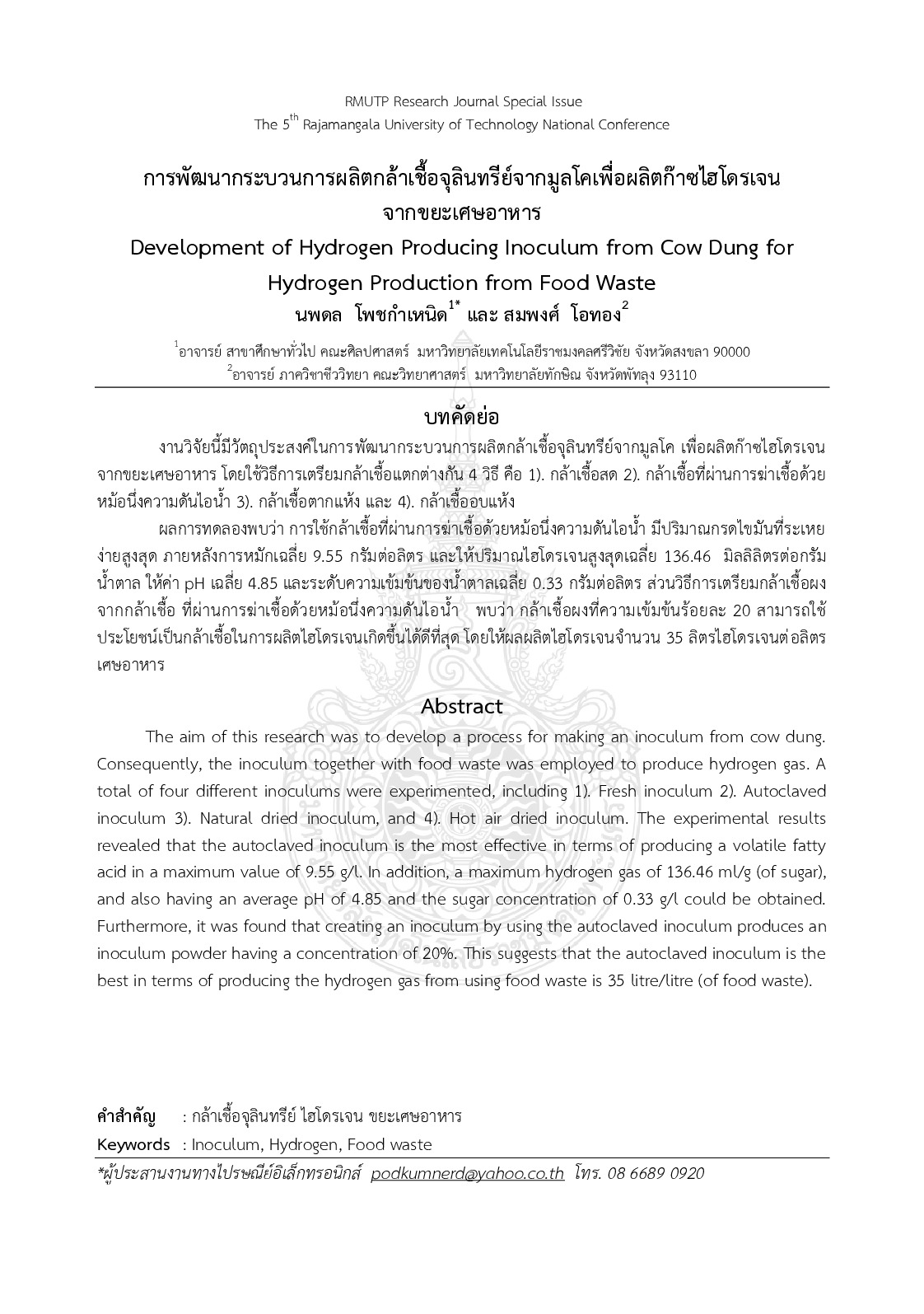
Development of hydrogen producing inoculum from cow dung for hydrogen production from food waste
The aim of this research was to develop a process for making an inoculum from cow dung. Consequently the inoculum together with food waste was employed to produce hydrogen gas. A total of four different inoculums were experimented including 1). Fresh inoculum 2). Autoclaved inoculum 3). Natural dried inoculum and 4). Hot air dried inoculum. The experimental results revealed that the autoclaved inoculum is the most effective in terms of producing a volatile fatty acid in a maximum value of 9.55 g/l. In addition a maximum hydrogen gas of 136.46 ml/g (of sugar) and also having an average pH of 4.85 and the sugar concentration of 0.33 g/l could be obtained. Furthermore it was found that creating an inoculum by using the autoclaved inoculum produces an inoculum powder having a concentration of 20%. This suggests that the autoclaved inoculum is the best in terms of producing the hydrogen gas from using food waste is 35 litre/litre (of food waste).
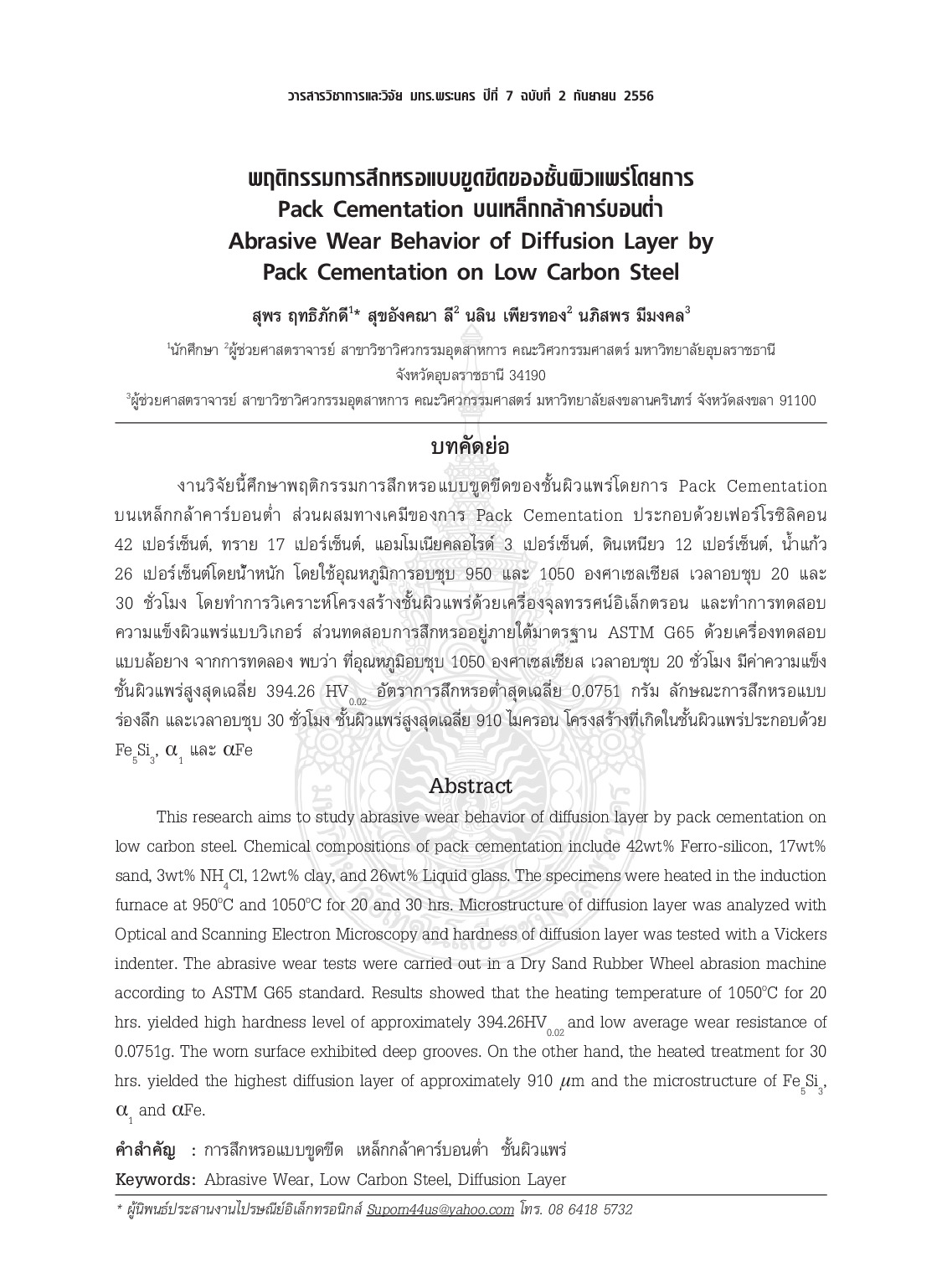
Abrasive wear behavior of diffusion layer by Pack Cementation on low carbon steel
This research aims to study abrasive wear behavior of diffusion layer by pack cementation on low carbon steel. Chemical compositions of pack cementation include 42wt% Ferro-silicon 17wt% sand 3wt% NH4Cl 12wt% clay and 26wt% Liquid glass. The specimens were heated in the induction furnace at 950?C and 1050?C for 20 and 30 hrs. Microstructure of diffusion layer was analyzed with Optical and Scanning Electron Microscopy and hardness of diffusion layer was tested with a Vickers indenter. The abrasive wear tests were carried out in a Dry Sand Rubber Wheel abrasion machine according to ASTM G65 standard. Results showed that the heating temperature of 1050?C for 20 hrs. yielded high hardness level of approximately 394.26HV0.02 and low average wear resistance of 0.0751g. The worn surface exhibited deep grooves. On the other hand the heated treatment for 30 hrs. yielded the highest diffusion layer of approximately 910?m and the microstructure of Fe5Si3 ?1 and ?Fe.