จำนวน Repository ( 25 )

Technology Transfer to Community for Existing Career Development and New Career Creation
This project has three main purposes: to provide training courses for producing and packaging of food textile craft and handicraft community products; to conduct a workshop for initial quality evaluation of community products and their packages; and to encourage the community to develop its products according to Thai Community Product Standard. The methodology of the project included assessing need for technology transfer; preparing the project; appointing the committee; recruiting trainees; inviting speakers; preparing instructors documents place and facilities; conducting the training course; and following up project achievement. Results from the 20 training courses with 204 target trainees revealed satisfaction in training at the level of 83.20%. About 46.15% of the trainees were ready for the community product standard guarantee and 33.17% were able to create new careers.
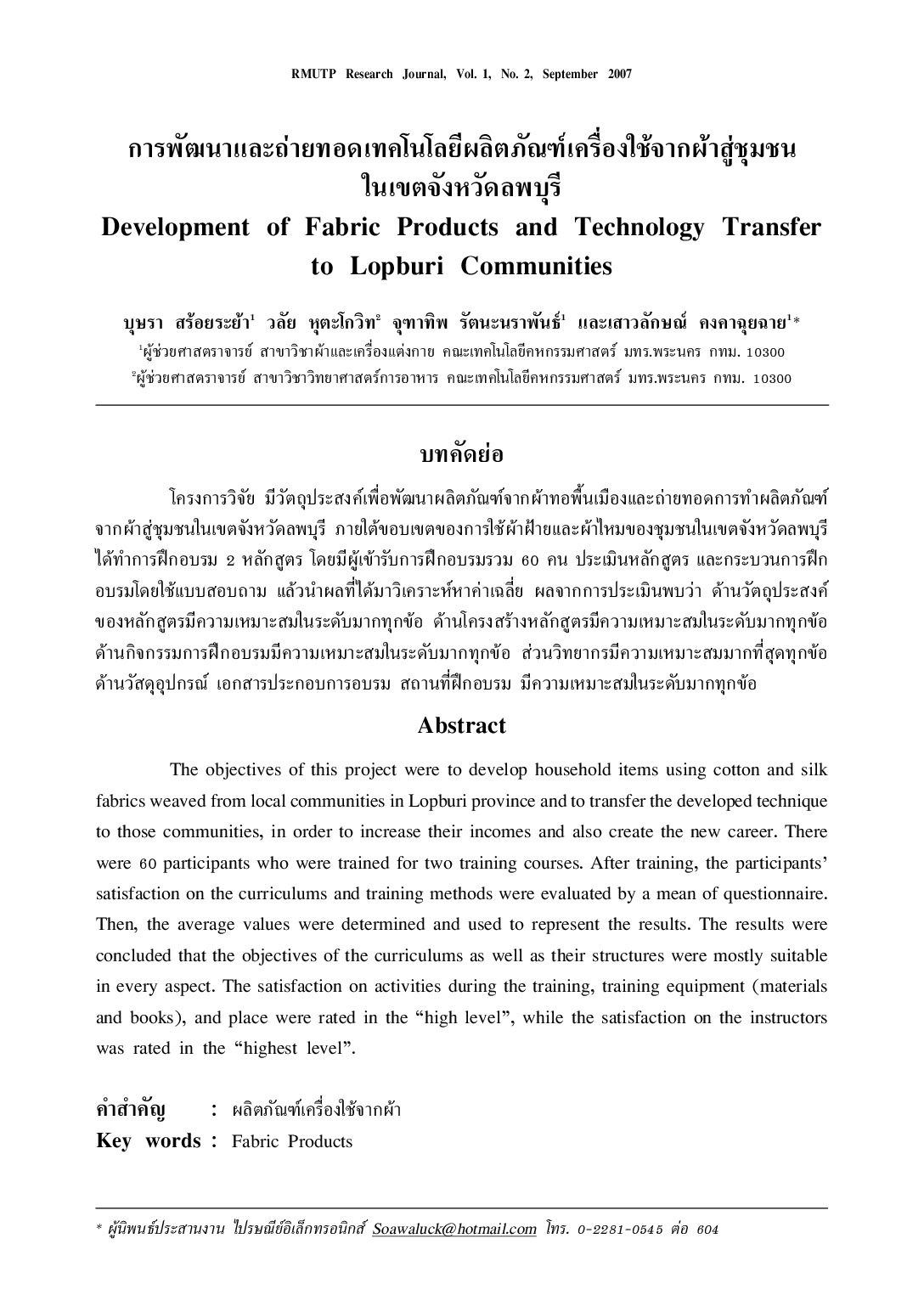
Development of Fabric Products and Technology Transfer to Lopburi Communities
The objectives of this project were to develop household items using cotton and silk fabrics weaved from local communities in Lopburi province and to transfer the developed technique to those communities in order to increase their incomes and also create the new career. There were 60 participants who were trained for two training courses. After training the participants’ satisfaction on the curriculums and training methods were evaluated by a mean of questionnaire. Then the average values were determined and used to represent the results. The results were concluded that the objectives of the curriculums as well as their structures were mostly suitable in every aspect. The satisfaction on activities during the training training equipment (materials and books) and place were rated in the “high level” while the satisfaction on the instructors was rated in the “highest level”.
ระบบควบคุมการปลูกผักไฮโดรโพนิกส์อัจฉริยะสำหรับเกษตรกร
Objective of this research is to research intelligent hydroponic vegetable cultivation control system for farmers. This is a group of lettuce that needs acid-base (pH) and conductivity (EC) in the same system on the planting table with Dynamic Root Floating Technique System (DRFT). By using Internet of Things (IoTs) devices as sensors For controlling the on-off system of the water filling system the on-off of nutrient solution A and B as well as the water spray system to reduce the temperature at the vegetable growing table. The developed hydroponic vegetable control system can effectively replace the workers labor. Vegetables grown are of the same quality used by farmers. Therefore the developed salad cultivation system could be used as a substitute for farmers. It has an easy to use control system.
การพัฒนาระบบเฝ้าสังเกตการแทรกตัวของน้ำเค็มสำหรับพื้นที่ปลูกทุเรียน จังหวัดนนทบุรี
This research is to develop a prototype of a salinity intrusion monitoring system using fuzzy logic to extract salinity values. A system is developed according to a fuzzy logic model using FAOs for appropriate agricultural water quality data considering the electrical conductivity (EC) and total dissolved solids (TDS) as indicators of the salinity value by using the Fuzzy Logic Toolbox to produce and test the generated model. Transformation of the generated models to Embedded C format using the Simulink Coder tool installed in the ARM STM32F microcontroller and a 10-fold cross-validation test was used to validate the data extraction. The Root Mean Square Error (RMSE) for the test results was 0.58175 on average. This research result indicates that the generated model is able to extract data that very closely matches the specified data.
การพัฒนาผลิตภัณฑ์แผ่นฝ้าเพดานจากเส้นใยปาล์มน้ำมันสำหรับวิสาหกิจชุมชน
This research aims to study the using oil palm fiber to develop ceiling board product. The mixture ratios of Gypsum plaster: oil palm fiber: tap water: catalyst are 1 : 0.15 : 1: 0.03 1 : 0.20 : 1: 0.03 1 : 0.25 : 1: 0.03 1 : 0.30: 1: 0.03 and 1 : 0.35 : 1: 0.03 by weight. The ceiling board samples are cast in 30 x 30 x 1 centimeter in dimension. The ceiling board sample testing follows the TIS 219-2552. The results show that the longitudinal and lateral breaking load Nail pull resistance density and thermal conductivity of ceiling board with high quantity of oil palm fiber are lower than ceiling board with low quantity of oil palm fiber while that the deflection and water absorption of ceiling board with high quantity of oil palm fiber are higher. However all of oil palm fiber samples with lower than 0.2 of ratio can pass the standard.