จำนวน Repository ( 278 )
การศึกษาการยืดอายุการเก็บรักษาของผลิตภัณฑ์ขนมปังด้วย calcium propionate, acetic acid และ sorbic acid
White bread has a short shelf life thus the loses its desired charcteracteristics upon storage and its also subject to spoilage by fungi. To avoid this spoilage and increase shelf life the addition of different levels of acidulants (calcium propionate acetic acid and sorbic acid at 0.1 0.2 and 0.3%) were evaluated for their quality characteristics contributing with acidulants as well as their microbial shelf life during 12 days of storage. In addition the mathematical model (GAB and BET) were applied to study the storage condition of bread. From the experiment it was found that bread with calcium propionate addition had the highest specific volume and springiness followed by bread with acetic acid and sorbic acid adding. On the other hand bread contained sorbic acid had the highest density hardness chewiness and color values (L* a*b*) followed by acetic acid and calcium propionate addition in order. Bread contained calcium propionate had the longest shelf life (12 days) followed by bread with acetic acid (8 days) and sorbic acid (6 days) adding respectively. The increase in acidulants levels result in an increase of bread shelf life. From the sorption isotherm curves bread contained 0.3% calcium propionate had the highest monolayer moisture content indicating that it was the most effective against microbrial spoilage of white bread studied.
ชุดสาธิตการสอบเทียบโหลดเซลแบบสองฟังก์ชั่น
The objectives of this research are to design the load cell tolerance testing machine and demonstrate the tolerance of load cell with a tolerance test that has a beam length of 90 cm. It can create the compressed force at the load cell more than 1 kN The experiment cam be divided into 2 stages; 1.) verification of load range and 2.) linearity test. Both stages are tested at a temperature at 25°C using 10 to 30 kg of mass in the lowest compressed force condition of 0.091 kN and the maximum compressed force condition of 1.12kN As a result the linearity performance of the tolerance of the load cell test kit between calculated force and displayed value force are different 0.354 percentage only while the standard deviation of displayed value force and voltage signal output are 0.0013 and 0.0022 respectively. It reveals that the experimental result is reliable because of less than 1. In addition the tolerance of the load cell tolerance testing machine is 0.00300 (0.3 percent) which was calculated from the comparison of the tolerance specification of two main equipment that specified by manufacturer.
การพัฒนารถประหยัดเชื้อเพลิงด้วยเทคนิคระบบส่งกำลังและการตัดต่อกำลัง
The objective of this research is to study the development of eco cars using power-cutting mechanism technique of Transmission System. Two eco cars had been studied. The first car was conducted with the aim of developing transmission system and clutch system by changing from gear drive transmission system and chain drive mechanical clutch to belt and pulley transmission system by new designing the belt and pulley transmission system to have propeller shaft as the device to transmit power from the right to the left side with bearings to help reduce friction. Pulley system and clutch lever were installed in which the newly built clutch can be controlled by driver. The new model of transmission system is weight 0.7 kg which is lighter than the previous weight of 0.8 kg. Based on the first testing by participating in the 22nd Honda Eco Mileage Challenge at Chang International Circuit it was found that the system with belt tension at 1 kN resulted in good performance of transmission system and clutch system with fuel efficiency value at 626.157 km/L. After that the belt tension was adjusted and set up at 1.1 kN for 3 tests at Solar Track Thailand and it was found that the maximum fuel efficiency value was 1061.18 km/L at the speed of 34 km/hr. The second car was improved in transmission system suspension system steering system and also engine. The first trial was experimented on the 22nd racing event at the Chang International Circuit where this fuel efficient prototype car could run at 18 km. The result showed that it could have good mileage which was 275 km/L. After improvement the car was tested again for three times at the Solar Track Thailand circuit where it ran at 16 kilometers. The result revealed that the best saving was equivalent to 613 km/L at the speed of 30.6 km/hr.
การพัฒนาระบบปลูกผักไฮโดรออร์แกนิคแบบอัตโนมัติ
Vegetable Growing System has an absolute requirement of nutrients and minerals. The microbial application can facilitate in addressing limited access to chemical fertilizer concerns. Moreover the photosynthetic microorganism community can contribute together in nutrient availability for plant growth. This research aims to develop an automatic hydro-organic vegetable growing system. Moreover the analytical of photosynthetic microorganism growth rate in fermented juice was also observed within three months in terms of temperature pH electroconductivity total dissolved solids mixed liquor suspended solids and phosphorus. The efficiencies of an automatic hydro-organic vegetable growing system were also monitored along an experimental period (45 days of operation optimization). The vegetable growth rate was observed in terms of leaf length leaf width and root length. These experimental results showed that the phototrophic growth of photosynthetic microorganisms should the main bacterial activity at daytime operation and vegetables could grow by using fermented juice. The photosynthetic microorganism concentration and nutrients concentration in fermented juice was significant to promote the productivity of vegetable growing which the photosynthetic biomass is rich in proteins and vitamins. Besides this system can be easily applied and also very cost-effective for agricultural practice and frequent maintenance every experimental run was necessary.
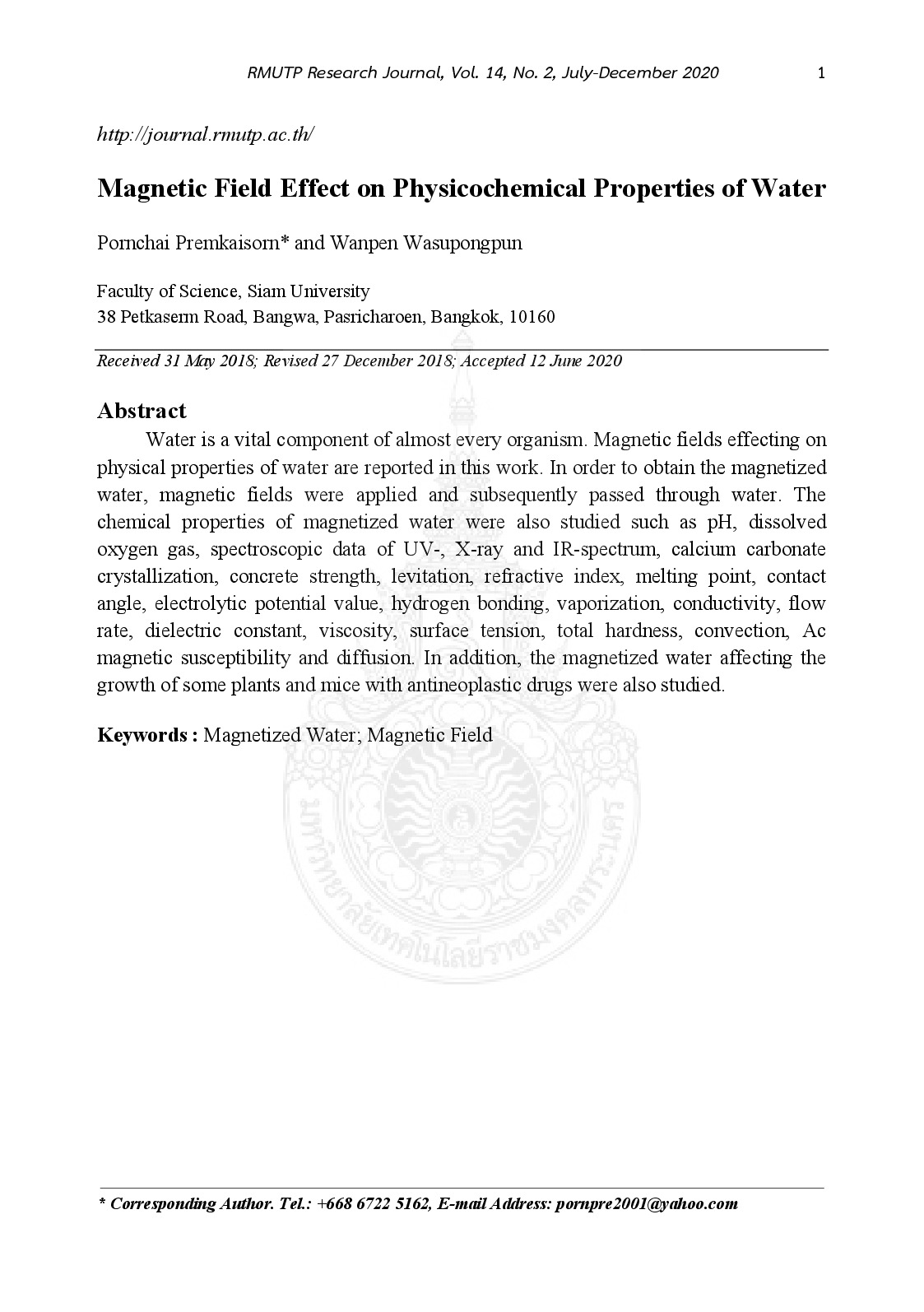
Magnetic field effect on physicochemical properties of water
Water is a vital component of almost every organism. Magnetic fields effecting on physical properties of water are reported in this work. In order to obtain the magnetized water magnetic fields were applied and subsequently passed through water. The chemical properties of magnetized water were also studied such as pH dissolved oxygen gas spectroscopic data of UV- X-ray and IR-spectrum calcium carbonate crystallization concrete strength levitation refractive index melting point contact angle electrolytic potential value hydrogen bonding vaporization conductivity flow rate dielectric constant viscosity surface tension total hardness convection Ac magnetic susceptibility and diffusion. In addition the magnetized water affecting the growth of some plants and mice with antineoplastic drugs were also studied.