จำนวน Repository ( 286 )

ผลการสอดแทรกจริยธรรมในการสอนภาษาไทยโดยใช้เพลงไทยและธรรมะเป็นสื่อ
The purposes of this research were to study and to compare the addition of ethics to Thai teaching using Thai songs and Dhama lessons. The samples chosen by purposive sampling were the first year English for International Communication students of the faculty of Liberal Arts Rajamangala University of Technology Phra Nakhon. They were divided into 2 groups and each group consisted of 30 students. The first group learned Thai with the addition of ethics using Thai songs while the second group learned Thai using Dhama lessons. The instruments were a pretest and a posttest. The results revealed that the test scores of the two groups of students after the addition of ethics to Thai teaching using Thai songs and Dhama lessons were higher. The means scores and standard deviations of the test results of the first group were23.13 and 3.18 and the second group were 22.23 and 3.49 respectively. In addition there was no significant difference (.05) in teaching Thai with the addition of ethics using Thai songs and Dhama lessons.
Design and Product Dvevlopment Ceramics using for making wall of Energy conservation building
Ceramics Porduct Develompnet Ceramics
The Study of Learning Activities' Results Using Reflective Approach and Group Investigation of Translation in Business English for Undergraduates at Rajamangala University of Technology, Bangkok Commercial Campus
The purposes of the study are 1) to develop the translating ability of undergraduates in Business English Field 2) to perceive learning activities problems and 3) to know the undergraduates attitude towards the learning activities using the Reflective approach and Group Investigation technique. The sample used in this study was 38 undergraduates of the Business English Field Academic Year 2006 of Rajamangala University of Technology Bangkok Commercial Campus. The researcher provided the undergraduates 50 business news per a week for 10 groups totaling 300 business news to study trough the seventh stages of the Reflective Approach and Group Investigation technique combination: stage1 student selected a business news to be studied stage2 students planed together and divided labor stage4 students prepared the final report stage5 was a presentation of the report to the class stage6 was an evaluation of each group work and stage7 was a reflective learning recording in the reflective learning form. The study was carried out 13 weeks for forty-two 50 minute periods. The experimental design was one group pretest and posttest design. The instruments used in this study were: 1) the preparation plan 2) The Reflective Approach and Group Investigation learning-activities plan 3) pre and post tests 4) summative tests 5) the RA and GI learning-activities working-observation forms 6) the Reflective leamingrecording form and 7) attitude questionnaires. All datas were statistically analyzed by mean percentage and the t-test
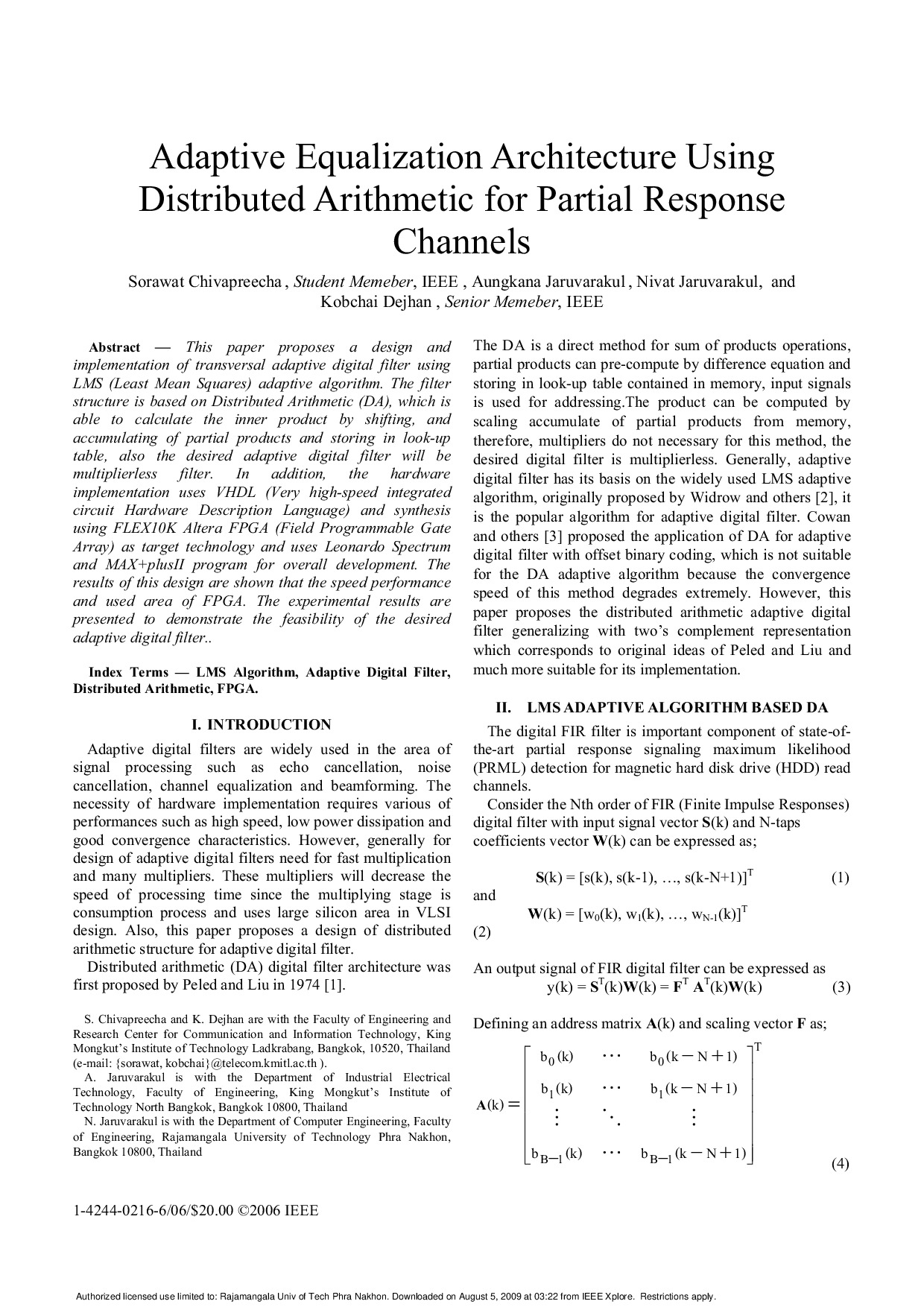
Adaptive Equalization Architecture Using Distributed Arithmetic for Partial Response Channels
This paper proposes a design and implementation of transversal adaptive digital filter using LMS (Least Mean Squares) adaptive algorithm. The filter structure is based on Distributed Arithmetic (DA) which is able to calculate the inner product by shifting and accumulating of partial products and storing in look-up table also the desired adaptive digital filter will be multiplierless filter. In addition the hardware implementation uses VHDL (Very high-speed integrated circuit Hardware Description Language) and synthesis using FLEX10K Altera FPGA (Field Programmable Gate Array) as target technology and uses Leonardo Spectrum and MAX+plusII program for overall development. The results of this design are shown that the speed performance and used area of FPGA. The experimental results are presented to demonstrate the feasibility of the desired adaptive digital filter
A Designed Object Tracked by Mobile Robot using Image Processing
In present there are widely use robot in many fields. Mobile robot can help us in several task such as moving to toxic area risk area or explosion area mine. Movement control can be used in many ways. This paper proposed mobile robot that move by wheels. It move to previous defined picture. By using small camera process an images and check it that is the previous one by using neural network. If it is robot will move toward to that picture. The movement is in flat plane. If that defined picture is not in center robot will move to left or right depend on its position until it is on center. This paper proposed image processing only.