จำนวน Repository ( 278 )
Hazards of reused cooking oil
Reused cooking oil is the oil which is used more than one time and contains less than 25% (by weight) of polar compounds. Degenerative reused cooking oil is the oil which is used more than two times and contains more than 25% (by weight) of polar compounds. Major raw material of fried foods is oil. Therefore usefulness of consumed fried foods depends on the quality of cooking oil. When the oil is heated up while cooking chemical change occurs due to the reactions of hydrolysis oxidation and polymerization. These reactions cause degeneration of the oil i.e. black color rancid smell lower smoke point bubbled increased viscosity and generation of toxic substances called polar compounds. This substance can cause high blood pressure heart disease and coronary artery disease. Furthermore the reused cooking oil also contains polycyclic aromatic hydrocarbons (PAHs) - toxic mutagens which can cause cancer.
Study on properties of honey-nanofibers fabricated by electrospinning technique
Honey-nanofibers were fabricated by electrospinning technique in order to study their potentiality for biomedical application especially as wound healing materials. Honey/Gelatin ratios operating voltages and solution flow rates were considered as the experimental variables. All synthesized nanofibers were tested for their sizes percentages of water uptake and contact angles between the fiber surfaces and water droplets. It was found that 1) size of nanofibers and contact angle between the fiber surfaces and water droplet increased with increasing of honey in solution 2) size and percentage of water uptake of nanofibers increased with stepping up of operating voltage and 3) size of nanofibers was minimized at the flow rate of 0.06 ml/hr for each operating voltage of this study.
Development on the use of oil palm fronds as roughage feed source for thai native cattle
An experimental design was a completely randomized design (CRD). Fifteen Thai native cattle were randomly allocated into 5 treatment groups with 3 animals in one group and one cattle was one replication assigning to be fed with various roughages: (1) fresh Napier grass (NP) (2) fresh oil palm fronds (OPF) (3) oil palm fronds silage (4) OPF silage with 2% of molasses and (5) NaOH treated OPF (1.5% by weight OPF). All treatments were supplemented with concentrate feed consisting of 14% of crude protein at the rate of 1% of live weight (BW). The experimental period was 120 days. The data were analyzed with analysis of variance and mean comparisons among treatments were Duncan’s multiple range test (DMRT). The results showed that no significant differences (p>0.05) were observed among 5 treatments in feed intake of dry matter digestibility of crude protein digestibility of neutral detergent fiber feed conversion ratio and growth rates. However the lowest production cost for 1 kg gain was obtained from the cattle fed with NaOH treated OPF.
Study of a small vacuum coating system for thermal evaporation
In this research we studied and fabricated a small vacuum coating system which is suitable for small pieces of the samples. It can help us to save in both cost and time for coating materials in each run. The home-built system consists of (1) a two-stage rotary pump used as a roughing and backing pump for a vacuum chamber and (2) a diffusion pump. The ultimate pressure of this diffusion pump is about 10-7 torr. From the result of testing the fabricated vacuum system it is found that the chamber pressure under the atmosphere can get down to 2.2 x 10⁻² torr in 6 minutes by the rotary pump. The pressure inside the chamber is continuously lower to achieve 4.5 x 10⁻⁵torr in 30 minutes by the diffusion pump. Moreover we did further testing the system by coating pure aluminum (99.999%) on a Si (100) substrate using a resistive heater source made of tungsten with applied voltage and current of about 2.19 V and 110 A respectively. The aluminum surface has been investigated by SEM and AFM.
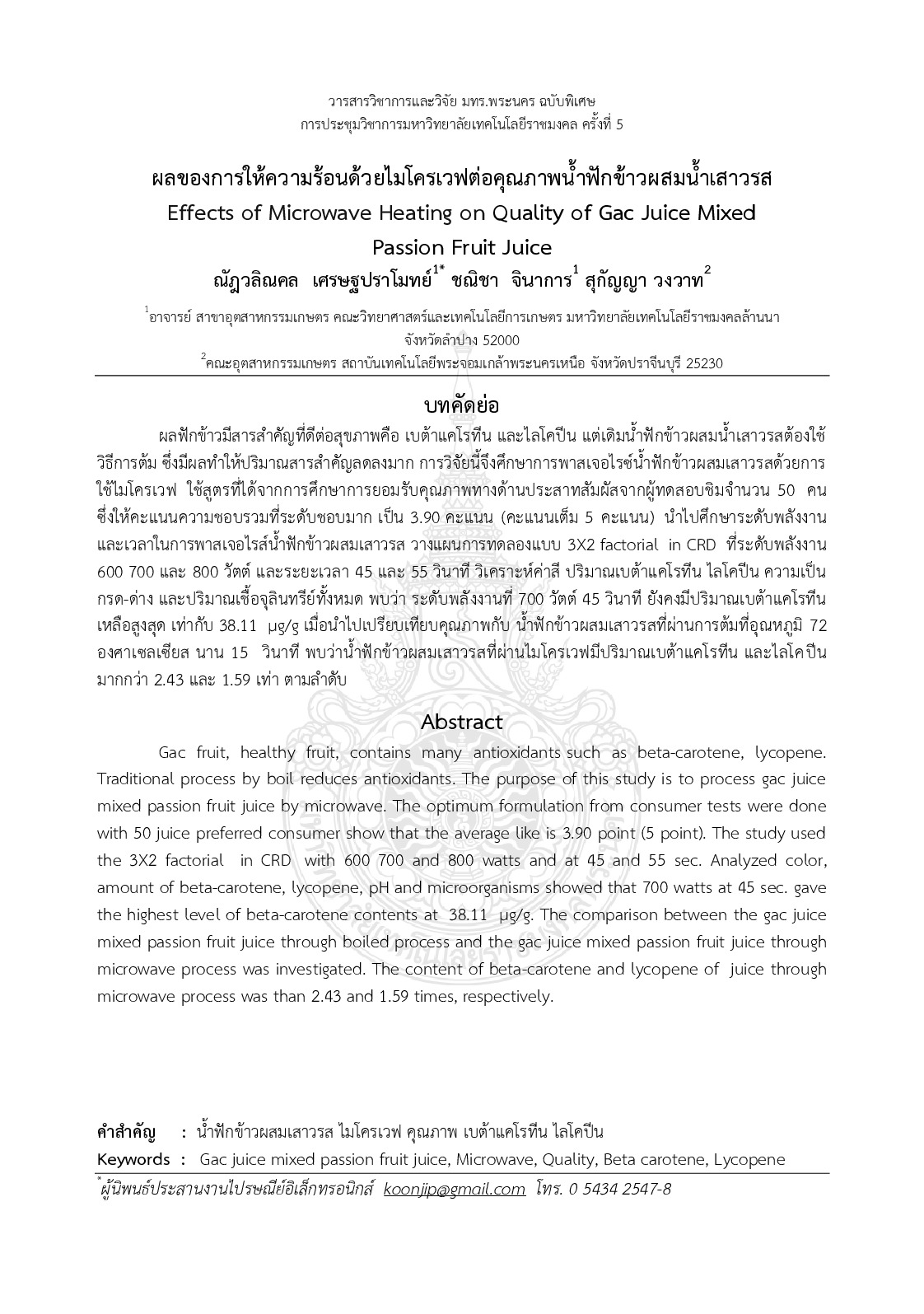
Effects of microwave heating on quality of gac juice mixed passion fruit juice
Gac fruit healthy fruit contains many antioxidants such as beta-carotene lycopene. Traditional process by boil reduces antioxidants. The purpose of this study is to process gac juice mixed passion fruit juice by microwave. The optimum formulation from consumer tests were done with 50 juice preferred consumer show that the average like is 3.90 point (5 point). The study used the 3X2 factorial in CRD with 600 700 and 800 watts and at 45 and 55 sec. Analyzed color amount of beta-carotene lycopene pH and microorganisms showed that 700 watts at 45 sec. gave the highest level of beta-carotene contents at 38.11 ?g/g. The comparison between the gac juice mixed passion fruit juice through boiled process and the gac juice mixed passion fruit juice through microwave process was investigated. The content of beta-carotene and lycopene of juice through microwave process was than 2.43 and 1.59 times respectively.