จำนวน Repository ( 270 )

Nutritive values evaluation of moringa leaves meal for broiler feed ingredient
Nutritive values moringa leaves meal were evaluated and compared with luecaena leaves meal which has similar chemical compositions in order to use moringa leaves meal as broiler chicken feed ingredient. Thirty 3-week old chickens were divided into 3 groups of 10 birds (5 males 5 females) each. Each chicken was randomly fed with experimental diet that was composed with cassava powder (for endogenous nitrogen analysis) powdered moringa Leaves meal and powdered luecaena Leaves meal. The chickens were raised individually in metabolic cage where feed and water were provided ad libitum and both feed intake and feces weight were recorded. Experimental diets and excreta were sampled and subjected to proximate analysis for chemical compositions and gross energy. T-test comparison was used for statistical analysis. Results indicated that nutrients utilization of moringa Leaves meal (utilization percentage of dry matter organic matter protein crude fiber nitrogen free extract energy and metabolizable energy) were higher than those of luecaena Leaves meal (P<0.01). However there was no statistical difference (P>0.05) between moringa Leaves meal and luecaena Leaves meal in utilization percentage of ether extract. Moreover usable energy of moringa leaves meal was also higher than that of luecaena leaves meal (p<0.01). Therefore moringa Leaves meal could be one of potential feedstuffs for use in broiler diet production.
The production of single cell protein from copra meal residue by saccharomyces cerevisiae and bacillus subtilis for development as animal feedstuff
This experiment was conducted to study on single cell protein production from copra meal residue by Saccharomyces cerevisiae and Bacillus subtilis as animal feedstuffs. The experimental design was 4x3 factorial in CRD experiment with two factors were design to experiment. The first factor was comprised of fermented period (0 15 30 and 45 days). While the second factor B was comprised of microorganism type (Saccharomyces cerevisiae Bacillus subtilis and Saccharomyces cerevisiae combined with Bacillus subtilis). The results showed that interaction between factor A and B on pH (4.00-4.53) and percentage yield (29.21-33.80) were highly significantly different (P<0.01). However Incubation temperature were not related between factor A and B. Additional both factor have no effect to incubation temperature (P?0.05). For nutrients composition the group was fermented Saccharomyces cerevisiae combined with Bacillus subtilis showed higher Crude Protein than other treatments (P<0.01). Optimum of period at days 45 showed that crude protein 14.77 percent was significantly (P<0.01) and pepsin digestibility 66.60 percent was significantly (p<0.01)
The effect of using fishes condensate as feed containing on rearing of climbing perch (anabas testudineus bloch)
The experiment on using of different levels fishes condensate as feed contain in climbing perch (Anabas testudineus Bloch). To study on growth rate (SGR) feed conversion ratio (FCR) protein efficiency ratio (PER) and survival rate of climbing perch. The diets contained 40% protein and 3200 Kcal/Kg (DE) in all formulas with varying levels ; 0 25 50 and 75% of fishes condensate replacement of fish meal respectively and compared with pellet feed (formula 5). The diets were given for 10 weeks to fish which the initial average weight were 4.43+0.14 g. The result showed that the SGR FCR PER and survival rate of climbing perch was 25 percentage of fishes condensate (formula 2) gave highest growth performance as SGR 0.72+0.16 (%/day) and PER 1.12+0.22 were significantly different (p<0.05) with 0 75 and 50% respectively but not significantly different from the control feed (formula 5). All of the feed formulas showed no effect on survival rate (p>0.05).
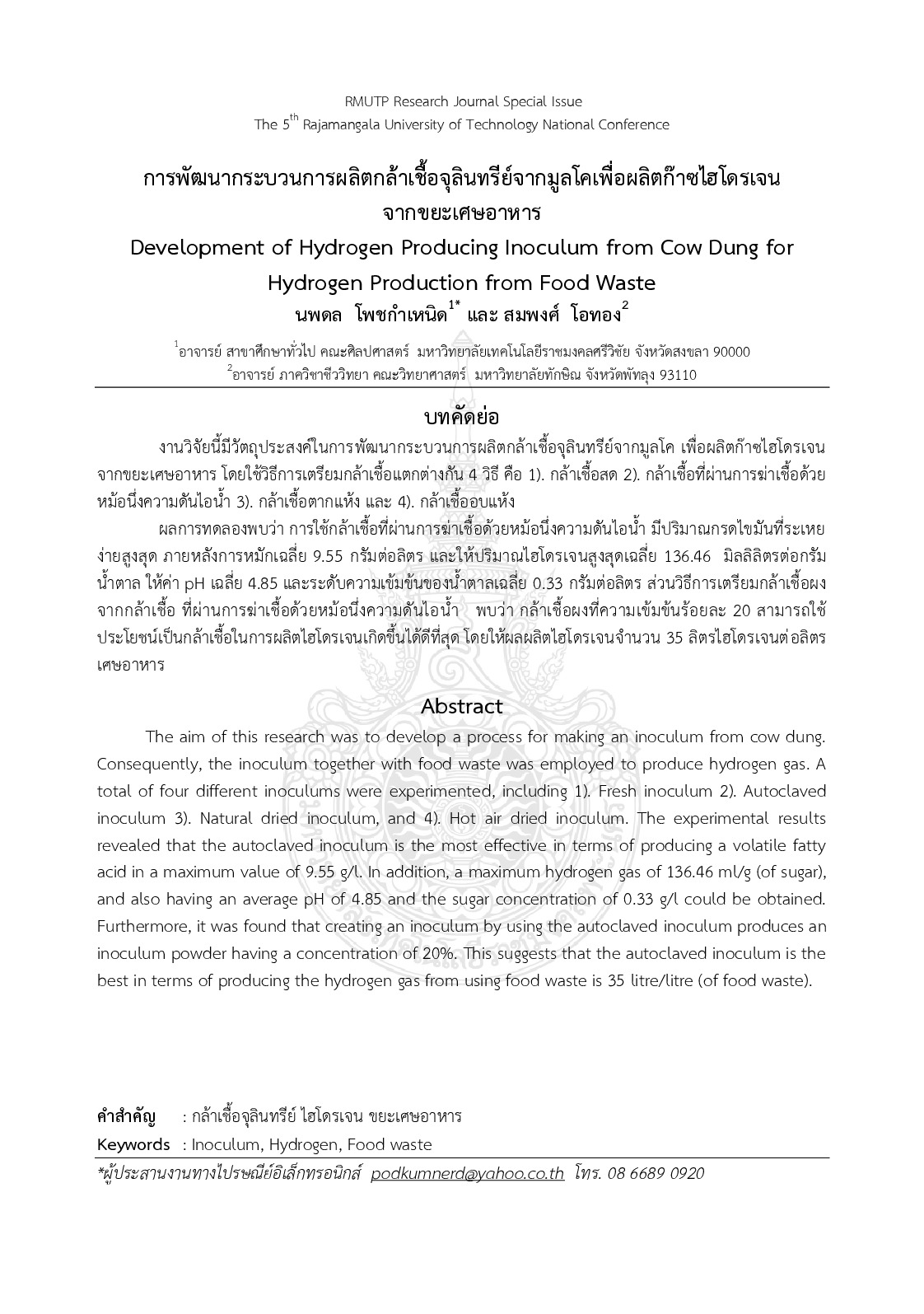
Development of hydrogen producing inoculum from cow dung for hydrogen production from food waste
The aim of this research was to develop a process for making an inoculum from cow dung. Consequently the inoculum together with food waste was employed to produce hydrogen gas. A total of four different inoculums were experimented including 1). Fresh inoculum 2). Autoclaved inoculum 3). Natural dried inoculum and 4). Hot air dried inoculum. The experimental results revealed that the autoclaved inoculum is the most effective in terms of producing a volatile fatty acid in a maximum value of 9.55 g/l. In addition a maximum hydrogen gas of 136.46 ml/g (of sugar) and also having an average pH of 4.85 and the sugar concentration of 0.33 g/l could be obtained. Furthermore it was found that creating an inoculum by using the autoclaved inoculum produces an inoculum powder having a concentration of 20%. This suggests that the autoclaved inoculum is the best in terms of producing the hydrogen gas from using food waste is 35 litre/litre (of food waste).
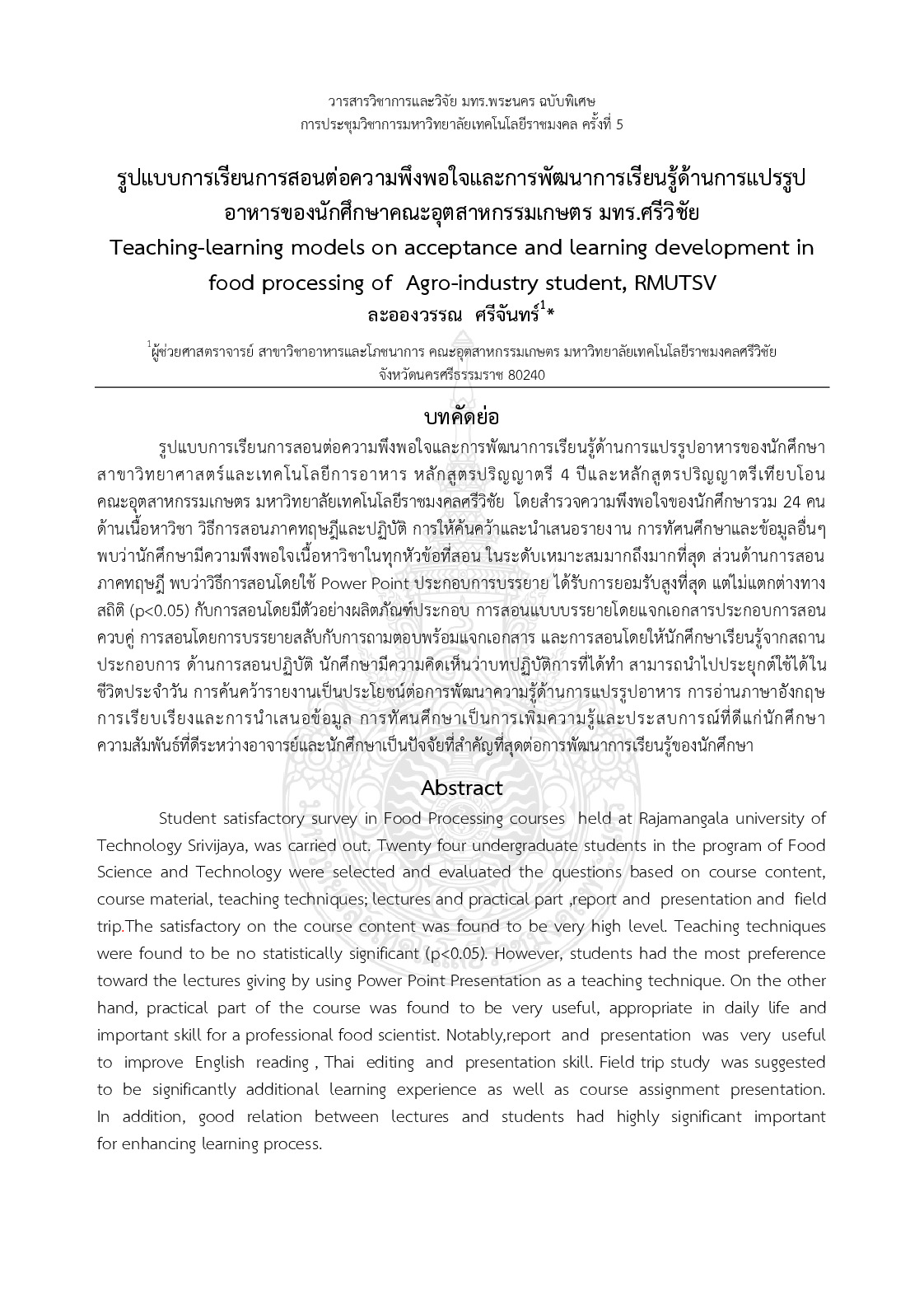
Teaching-learning models on acceptance and learning development in food processing of agro-industry student, RMUTSV
Student satisfactory survey in Food Processing courses held at Rajamangala university of Technology Srivijaya was carried out. Twenty four undergraduate students in the program of Food Science and Technology were selected and evaluated the questions based on course content course material teaching techniques; lectures and practical part report and presentation and field trip.The satisfactory on the course content was found to be very high level. Teaching techniques were found to be no statistically significant (p<0.05). However students had the most preference toward the lectures giving by using Power Point Presentation as a teaching technique. On the other hand practical part of the course was found to be very useful appropriate in daily life and important skill for a professional food scientist. Notablyreport and presentation was very useful to improve English reading Thai editing and presentation skill. Field trip study was suggested to be significantly additional learning experience as well as course assignment presentation. In addition good relation between lectures and students had highly significant important for enhancing learning process.