จำนวน Repository ( 534 )
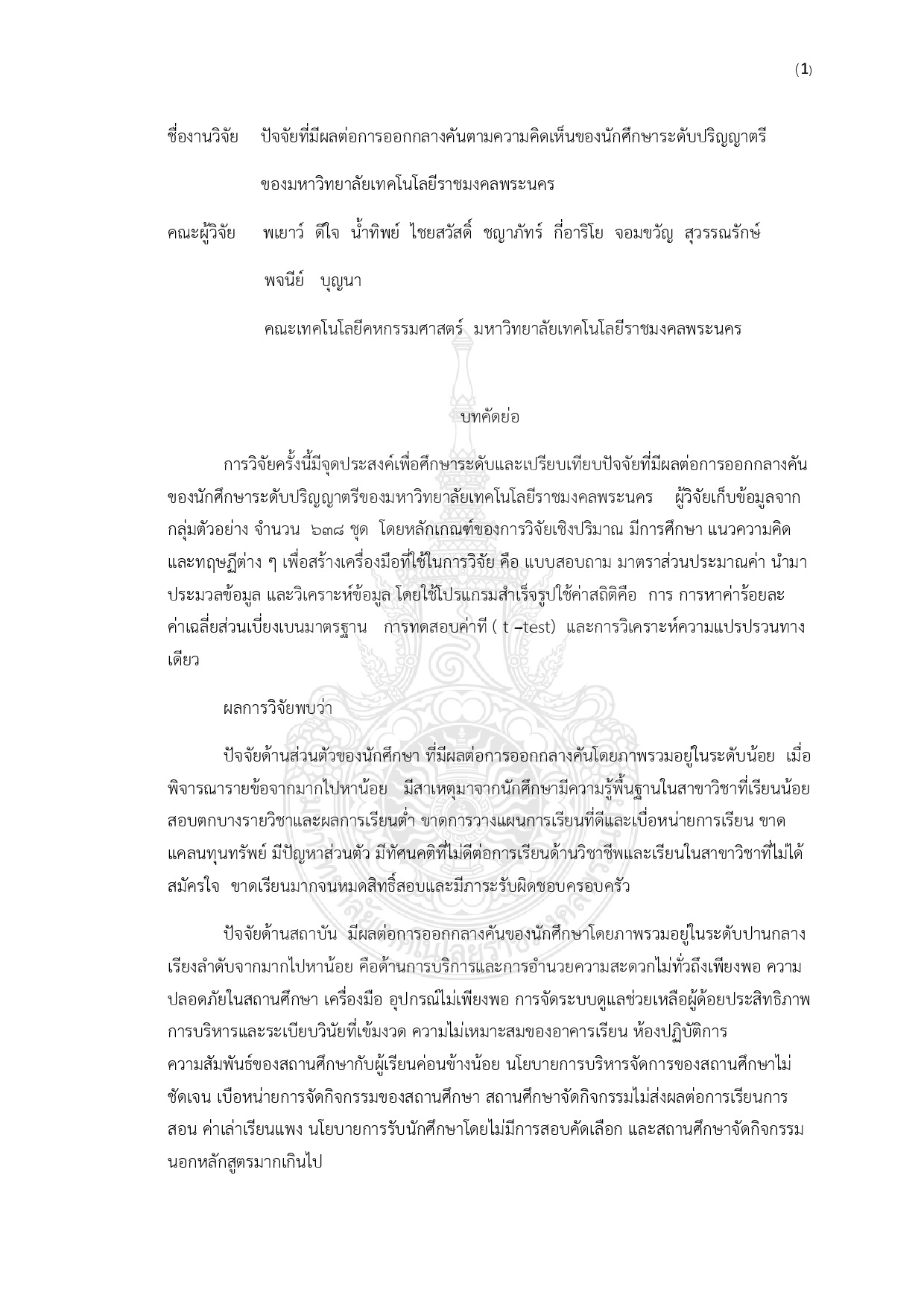
ปัจจัยที่มีผลต่อการออกกลางคันตามความคิดเห็นของนักศึกษาระดับปริญญาตรีของมหาวิทยาลัยเทคโนโลยีราชมงคลพระนคร
The objectives of this research were to study and compare factors affecting dropping out of undergraduates in Rajamangala University of Technology Phra Nakhon. The finding on four types of factors were launched : personal educational institute family and social factor. Survey research methodology was exploited by distributing questionnaires to sample group of 638 RMUTP undergraduates in 2012 academic year. And the data was analyzed by the percentage the standard deviation the t-test and one way analysis of variance (ANOVA). The results were as followed : the personal factor as a whole was at low level they were : insufficient background knowledge in their fields capability in passing the examination getting low grade point average learning without planning boring of learning facing financial problem negative attitude in vocational field learning in dislike branch absence in class and having problems on family responsibility. On the institute factors as a whole it was at moderate level the causes were: inadequate facilities and services of the institute personal safety learning without instruments lack of helpfulness for the handicapped institute’s strict discipline inappropriate laboratory and buildings the executive management’s transparency institute’s relations with students unsuitable activities for learning expensive fee the students’ entrance without admission system overloaded extracurricular activities. On the family factor it was at low level as a whole they were : economics problems the family’s poverty parents’ attitude towards the institute single-mom’s burdens stability of parents career. Finally the social factor as a whole it was at low level they were : distance from students’ home the freshmen’s traditions self( 4) adjustment among peer group improperly learning environment quarrels and conflicts with others and freshmen’s assimilation in new surroundings. By comparing personal factors to family factors the study found that all factors were nonsignificantly different at the level of 0.05. While the institute factors and the social factors were significant different at the level 0.05

การพัฒนาเว็บไซต์การจัดการองค์ความรู้ของคณะเทคโนโลยีราชมงคลพระนคร
The objectives of the research to gain an understanding of satisfaction feedbacks and needs of the users of knowledge management website of the Faculty of Mass Communication Technology Rajamangala University of Technology Phra Nakhon as well as to develop a proper knowledge management website. This research is a survey-based research which questionnaires are used as research tools. The research sampling consists of 256 lecturers students and staffs of the Faculty of Mass Communication Technology. Statistical methods used are average percentage standard deviation t-test Oneway ANOVA LSD chi-square and multiple regression analysis. The research findings are as follow: 1. Different demographics of the target group do not make much difference in satisfaction level. Factors such as sex status within the faculty age education monthly income and communication devices used do not effect user satisfaction. This fact does not correspond with our assumption. However there are some aspects that coincide statistically with our other assumptions for example age effects satisfaction level of website design while education effects satisfaction level of data utilization. 2. The access of knowledge management website is related to the utilization satisfaction. The relationship can be explained as follow: The access frequency of the Faculty of Mass Communication Technology’s knowledge management website has the maximum correlations of 10 while picture has 4 correlations which are device used for website access internet usage location usage time and access frequency of the website. Feedbacks and needs for website development has the maximum correlations of 4 in term of access frequency. In-depth knowledge has the maximum correlations of 2 in term of website development which are internet usage experience and access of knowledge management website. 3. Knowledge of the target group relates to the satisfaction feedbacks and needs of the knowledge management website development which can be explained as follow: Opinions and satisfaction in knowledge management site • Best Equation y = 1.457 +0.332 (faculty knowledge) +0.259 (knowledge attention) • Standard Equation ZY = 0.346 Z(faculty knowledge) + 0.264 Z(knowledge attention) Opinions and needs in the development of knowledge management site • Best Equation y = 1.391 +0.379 (faculty Knowledge) +0.235 (knowledge attention) • Standard Equation ZY = 0.386 Z(faculty knowledge) + 0.234 Z(knowledge attention)
องค์ประกอบที่มีผลต่อการใช้งานระบบ E-Learning ของมหาวิทยาลัยเทคโนโลยีราชมงคลพระนคร
การวิจัยเรื่ององค์ประกอบที่มีผลต่อการใช้งานระบบ E-Learning ของมหาวิทยาลัยเทคโนโลยีราชมงคลพระนคร มีวัตถุประสงค์เพื่อวิเคราะห์องค์ประกอบที่มีผลต่อการใช้งานระบบ E-Learning ของมหาวิทยาลัยเทคโนโลยีราชมงคลพระนคร และศึกษาลักษณะของตัวประกอบสำคัญที่มีต่อการใช้งานระบบ E-Learning ของมหาวิทยาลัยเทคโนโลยีราชมงคลพระนคร กลุ่มตัวอย่างเป็นอาจารย์และนักศึกษา มหาวิทยาลัยเทคโนโลยีราชมงคลพระนคร ทั้ง 9 คณะ โดยแบ่งเป็นอาจารย์ จำนวน 226 คน และนักศึกษา จำนวน 300 คน ซึ่งกำหนดขนาดตัวอย่างตาราง Krejcie&Morgan ผลการวิจัยพบว่า 1. การประเมินตัวแปรรายข้อเกี่ยวกับองค์ประกอบที่มีผลต่อการใช้งานระบบ E-Learning ของมหาวิทยาลัยเทคโนโลยีราชมงคลพระนคร ตัวแปรทั้งหมด 20 ตัวแปร มีค่าเฉลี่ยระหว่าง 6.10 – 6.04 และส่วนเบี่ยงเบนมาตรฐานระหว่าง 0.67 – 0.66 แสดงว่าตัวแปรมีผลต่อการใช้งานระบบ E-Learning ของมหาวิทยาลัยเทคโนโลยีราชมงคลพระนครอยู่ในระดับมาก และแต่ละตัวแปรมีการกระจายของข้อมูล ที่แตกต่างกันมาก 2. การวิเคราะห์ตัวแปรที่สำคัญเกี่ยวกับองค์ประกอบที่มีผลต่อการใช้งานระบบ E-Learning ของมหาวิทยาลัยเทคโนโลยีราชมงคลพระนคร 1. คุณลักษณะเฉพาะของระบบ 2. การบริหารจัดการการเรียน 3. การส่งเสริมความรู้ 4. เนื้อหาของบทเรียน 5. ความสามารถของคอมพิวเตอร์ 6. การติดต่อสื่อสาร 7. การพัฒนาสื่อมัลติมีเดีย ผลของการวิเคราะห์ข้อมูลพบว่า ตัวแปรอิสระหรือตัวพยากรณ์ทั้ง 7 องค์ประกอบดังกล่าว มีความสัมพันธ์ต่อการใช้งานระบบ E-Learning ของมหาวิทยาลัยเทคโนโลยีราชมงคลพระนคร ระหว่าง 2.69–1.33 ซึ่งมีค่าสัมพันธ์กันในระดับสูง โดยทั้ง 7 องค์ประกอบ มีอำนาจการพยากรณ์ร่วมกันได้ร้อยละ 44 และมีความคลาดเคลื่อนของการพยากรณ์ (Error) เท่ากับ 11.11 จากนั้นนำค่าสัมประสิทธิ์สหสัมพันธ์ที่ได้จากการวิเคราะห์องค์ประกอบนี้ไปสร้างเป็นสมการขององค์ประกอบมาตรฐานทั้ง 7 องค์ประกอบ
สุขภาพจิตของอาจารย์คณะครุศาสตร์อุตสาหกรรม มหาวิทยาลัยเทคโนโลยีราชมงคลพระนคร
The objectives of this research were as follows : 1. to study the attitude of the Industrial Education of Rajamangala University of Technology Phra Nakhon’s lecturers regarding to mental health 2. to compare the attitude of the Industrial Education of Rajamangala University of Technology Phra Nakhon’s lecturers regarding to mental health such as the difference sex the difference age the difference marital status the different of education level and the different of teaching experiences and 3. to study the recommendations of factors and prevention to reduce tension of the Industrial Education of Rajamangala University of Technology Phra Nakhon’s lecturers. The research’s tool was questionnaire. The sample data collection was 36 the Industrial Education of Rajamangala University of Technology Phra Nakhon’s lecturers. The Perpose Sampling or Judgement Sampling was stratified by Krejcie and Morgan Table. The results were analyzed by two statistics that is descriptive statistics; frequency percentage mean standard deviation and inferential statistics; Independent – Samples T-Test and Kruskal – Wallist H (K-W) from the Statistical Package for Social Science (SPSS) program.
แนวทางการพัฒนาวินัยนักศึกษาตามความคิดเห็นของบุคลากรสายวิชาการ มหาวิทยาลัยเทคโนโลยีราชมงคลพระนคร
การวิจัยเรื่องแนวทางการพัฒนาวินัยนักศึกษาตามความคิดเห็นของบุคลากรสายวิชาการ มหาวิทยาลัยเทคโนโลยีราชมงคลพระนคร มีวัตถุประสงค์เพื่อศึกษาแนวทางการพัฒนาวินัยนักศึกษาตามความคิดเห็นของบุคลากรสายวิชาการ มหาวิทยาลัยเทคโนโลยีราชมงคลพระนคร กลุ่มตัวอย่างเป็นอาจารย์ มหาวิทยาลัยเทคโนโลยีราชมงคลพระนคร 9 คณะ ที่ปฏิบัติงานในปี 2555 จานวน 230 คน ได้มาจากตารางกาหนดขนาดตัวอย่างตาราง Krejcie&Morgan เครื่องมือที่ใช้ในการเก็บรวบรวมข้อมูลในการวิจัยครั้งนี้ คือ แบบสอบถามความคิดเห็นของบุคลากรสายวิชาการเกี่ยวกับแนวทางการพัฒนาวินัยของนักศึกษามหาวิทยาลัยเทคโนโลยีราชมงคลพระนคร 4 ด้าน ได้แก่ ด้านการแต่งกาย ด้านการตรงต่อเวลา ด้านความสะอาด ด้านการแสดงความเคารพ และด้านการปฏิบัติตามระเบียบข้อบังคับของ มทร.พระนคร สถิติที่ใช้ในการวิเคราะห์ข้อมูล ได้แก่ ค่าร้อยละ (Mean) และค่าส่วนเบี่ยงเบนมาตรฐาน (S.D.) ผลการวิจัยพบว่า แนวทางการพัฒนาวินัยของนักศึกษามหาวิทยาลัยเทคโนโลยีราชมงคลพระนคร 4 ด้านได้แก่ ด้านการแต่งกาย ด้านการตรงต่อเวลา ด้านความสะอาด ด้านการแสดงความเคารพ และด้านการปฏิบัติตามระเบียบข้อบังคับของ มทร.พระนคร ตามความคิดเห็นของบุคลากรสายวิฃาการโดยภาพรวมควรมีการพัฒนาวินัยของนักศึกษาในทุกด้าน มีค่าเฉลี่ยอยู่ในระดับมาก เมื่อพิจารณารายด้านพบว่า ด้านที่ควรมีการพัฒนาวินัยของนักศึกษามากที่สุด คือ ด้านความสะอาด รองลงมา คือ ด้านการปฏิบัติตามระเบียบข้อบังคับของ มทร.พระนคร ด้านการตรงต่อเวลา ด้านการแสดงความเคารพ และด้านที่ควรมีการพัฒนาวินัยของนักศึกษาต่ำที่สุด คือ ด้านการแต่งกาย ตามลำดับ