จำนวน Repository ( 286 )
Optimization of the Aluminum Riveting Process Using an Experimental Design Technique
The purpose of this research is to determine the optimal factors existing in the aluminum riveting process. First a 25 full-factorial design was used to screen five factors and two levels by selecting a lapping-joint method using only one rivet which exhibited significant riveting shear. The five riveting parameters used were press force 5000 and 8000 newtons a thickness of material of 2.5 and 4mm a size of hole of 4.7 and 5.2 mm over long rivets of 4.7 and 5.2 mm and press times of 5 and 15 seconds. There were three parameter levels: thickness of the metal (2.5 3.2 and 4.0 mm) size of the hole (2.5 3.2 and 4.0 mm) and size of the over-long rivet (4.5 5.6 and 6.7mm) then a Box-Behnken design was used in order to analyze the data and find the optimization point. The experiment found that a standard rivet has a shear strength resistance of 1113.30 newtons. The study methodology was to prepare the riveting specimens use by selecting a lapping joint per one rivet to test the mechanical quality and shear. The results of the experiment show that the optimal conditions (to a statistically significant degree) were to use a 5.2 mm hole a 2.8 mm level of thickness and a 6.3 mm over-long rivet. The optimal point for the shear test was 1417.55 newtons and an over-shear strength of 303 newtons could be increased by 27.32 percent.
The Improvement Of Carbon Black From Waste Tires For Offset Printing Ink Using Coupling Agent
This work was aimed to improve the carbon black from waste tires for printing ink using coupling agent to disperse carbon black particle for making an oil-based offset ink. This experiment used 2 coupling agent these were silane coupling and derivative fatty acid and used to produce offset inks for the 7 formulas. Formula 1 Commercail carbon blackFormula 2 carbon black was not washed by Nitric acid formula 3 carbon black was not washed by Nitric acid and was added silane coupling agent formula 4 carbon black was not washed by Nitric acid and was added fatty acid modified emulsifier formula 5 carbon black was washed by nitric acid formula 6 carbon black was washed by nitric acid and was added silane coupling formula 7 carbon black was washed by nitric acid and was added fatty acid modified emulsifier. Bring all 6 formulas to test property to compare with offset ink commercial. First find the smallest particle of carbon black for 90 minutes. It was found that formula 4 took 20 minutes to make particles 12 micron and it is smalles particle of all. Then measured ink flow by Spread-O-Meter and measured diameter after 1 minute. It was found that formula 3 and 3 were 77 mm. and approximate commercial ink. Then measured tack of ink with Ink-O-Meter it was found that formula 2 3 4 6 and 7 were 2.4 and formula 5 was 2. Then measured viscosity and yield value of ink by Lary viscometer. It was found that formula 2 had 77 poise of ink viscosity and 670 dyne.s/cm2 of ink yield value that was approximate commercial ink. Finally measured Emulsification capacity (%) by Kershaw Water Pick up Tester. It was found that formula 6 had 74% and it was approximate commercial ink.
Design and Product Development Ceramics Using for Making Wall of Energy Conservation Building
This research aims to study and develop ceramics material using in the wall construction which can be used to proof the heat and water reduce absorbed humidity in the building. The product can save the energy especially the building which is set the air conditioning. The experiment found that the proportion of clay body can be developed and the result of thermal conductivity (K- value) was 0.111 W/ m. /K the permeability was 7 percent the glaze can be used to proof water. The product was compared to three kinds of construction materials which are brick concrete masonry unit and autoclaved aerated concrete found that K- value and permeability were lower. Moreover it can proof water and save more energy for the air conditioning building.
Temperature Reduction in Hydroponic Planting System Using Heat Pipe
This paper presents an establishment of a mathematical model to determine the optimal size of heat pipe (thermosyphon) heat exchanger for reduce the inlet air temperature in evaporative cooling system of greenhouse. The condition of a mathematical model is the total length of heat pipe is 1.5 m. A mathematical model will determine the optimal value of evaporator section and condenser section. The range of evaporator length is 0.5 – 1.4 m with an increment of 0.1 m and condenser length is in range of 0.1 – 1.0 m with an increment of 0.1 m. The inlet air temperature in evaporative cooling of greenhouse is depend on ambient temperature about 35 degree Celsius. While the cooling water temperature is 20 degree Celsius. Evaporative pad of evaporative cooling system is 2 m in width and 7 m in length. From the conditions above the optimize results from a mathematical model are as follows: evaporator section length is 0.9 m and condenser section length is 0.6 m moreover it was shown that investment net saving and maximum heat rate are 79.83 Thousand Baht 0.552 Million Baht and 15.6 kW respectively.
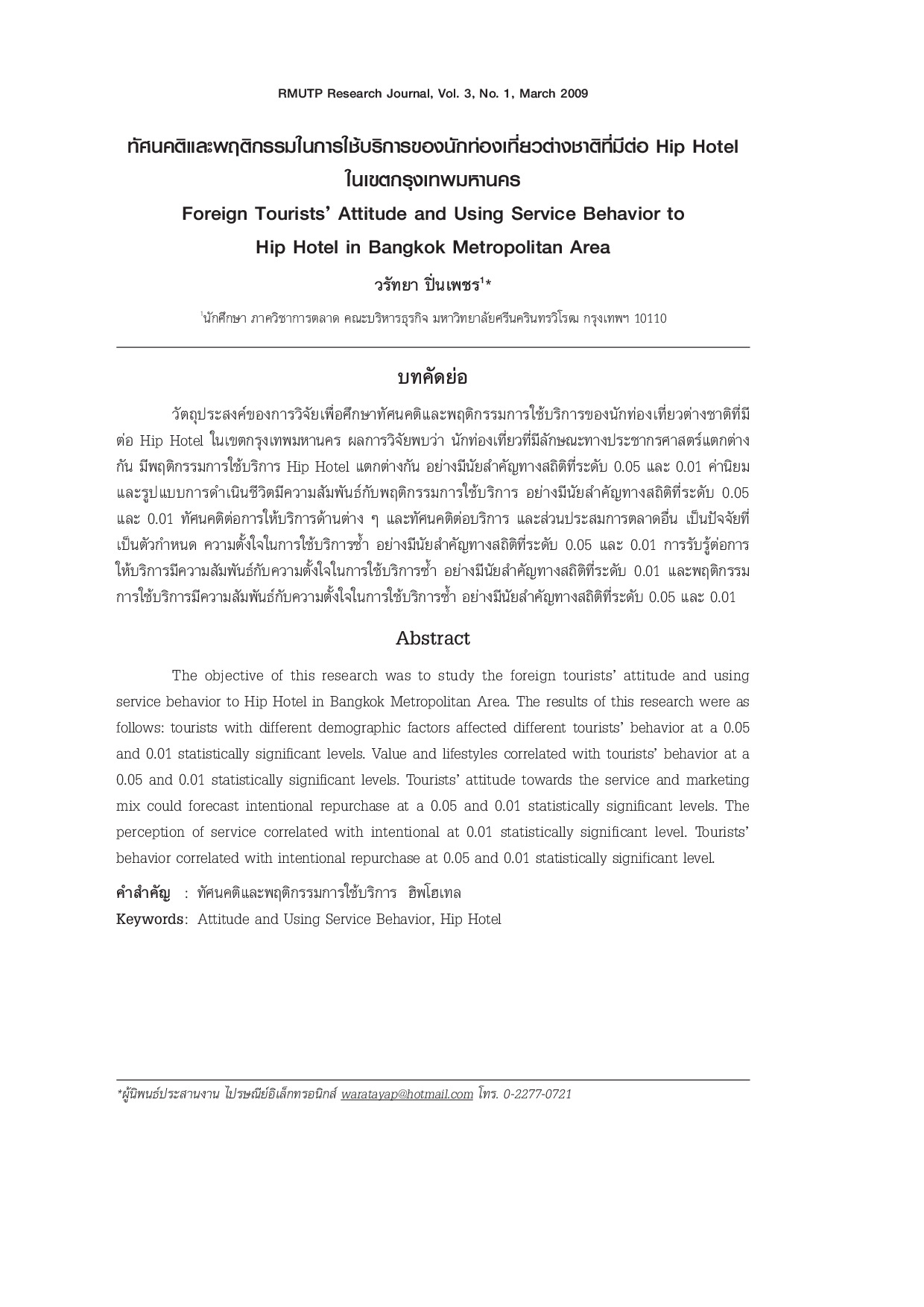
Foreing Tourists’Attitude and Using Service Behavior to Hip Hotel in Bangkok Metropolitan Area
The objective of this research was to study the foreign tourists’ attitude and using service behavior to Hip Hotel in Bangkok Metropolitan Area. The results of this research were as follows: tourists with different demographic factors affected different tourists’ behavior at a 0.05 and 0.01 statistically significant levels. Value and lifestyles correlated with tourists’ behavior at a 0.05 and 0.01 statistically significant levels. Tourists’ attitude towards the service and marketing mix could forecast intentional repurchase at a 0.05 and 0.01 statistically significant levels. The perception of service correlated with intentional at 0.01 statistically significant level. Tourists’ behavior correlated with intentional repurchase at 0.05 and 0.01 statistically significant level.