จำนวน Repository ( 121 )
การพัฒนาผลิตภัณฑ์เบเกอรี่จากหยวกกล้วยและส่วนเหลือทิ้งใน การผลิตกล้วยตากของกลุ่มวิสาหกิจชุมชนแม่บ้านบางตาโฉม จังหวัดสิงห์บุรีสู่เชิงพาณิชย์อย่างยั่งยืน
Bakery Products Development from the Banana Pseudo-stems and Waste from Dried Banana Production at Ban Bang Ta Chom Community Enterprise Sing Buri Province for Sustainable Commerce. Research on bakery product development from paprika and bananas in Production of Dried Banana of Bang Ta Chom Housewife Community Enterprise Group Sing Buri province for sustainable commercialization in order to: 1. Develop bakery products from 4 types of Banana Pseudo-stems and Waste 2. study the formulas and production processes of bakery products from Banana Pseudo-stems and Waste 3. study the consumer test of bakery products from 4 types of Banana Pseudo-stems and Waste and 4. To transfer technology Little Bakery products from Banana Pseudo-stems and Waste then bring the shelf life in conditions ranging from 0-10 days and compare the physical properties. Chemical and microorganisms such as pH value color measurement and total number of microorganisms found that Khanom Jeen noodles stored in modified atmosphere conditions have longer shelf life than those stored. At normal atmospheric conditions and vacuum conditions. Chemical analysis results showed that the bakery products decreased their pH over time. With values between 4.31 ± 0.00 and 2.99 ± 0.01 and bakery products Stored at 100% carbon dioxide (CO2) modified atmosphere packed in a sealed nylon / PET vacuum plastic bag. Store at room temperature. Can be stored for up to 10 days and found that the total number of microbes increased when the storage life is longer But not over the standard of community products so the products are safe and not harmful to consumers. Consumer test results show that consumers like and are interested in buying bakery products that use 100 percent carbon dioxide (CO2) at 75 percent.
การพัฒนาผลิตภัณฑ์กระดาษและบรรจุภัณฑ์จากแกลบ และส่วนเหลือทิ้งในการแปรรูปข้าว เพื่ออนุรักษ์ศิลปไทย
This research is a study on the Development of Paper and Packaging from Rice Husk and Rice Processing Wastes for producing for Thai Art Conservation. This research purpose to develop products and packaging from the rice husk in rice processing to study the processes of paper production and forming products to design and develop products and packaging and to transfer technology products and packaging from the leftovers in rice processing to conserve Thai arts to the community and to study the satisfaction of the product and packaging development program from the leftovers in rice processing in order to conserve Thai arts to the community. The research findings can be summarized as follows: 1. In this research the research team produced paper and molded products experimenting with the ratio of RICE HUSK and paper SA fibers and find the best ratio of rice husk 50: paper SA fibers 50 so that rice husk can better adhere to paper and creates a beautiful texture for making products. Moreover this research uses the waste from the rice processing process it able to develop products according to objectives. At the same time can be produced at the household level. As well as finding marketing methods for new products to be able to sell which generates income for the community. 2. The results of the physical characteristics of paper produced from rice husk paper with the ratio of rice husk 50 to 50 has a moderate weight. The paper can be folded. The tensile strength of the paper is moderate. The surface is good. The characteristics of the paper after coated with waterproofing it was coated with natural extracts and environmentally friendly. When testing the water color paint on paper the water color slowly absorbed but does not spread along the paper fibers and also slightly absorbed in the backside paper. 3. In this research the development of products and packaging from the leftovers in rice processing for preserving Thai art into 2 categories 1. Develop paper from rice husk for processing into products and developing molded products from rice husk consisting of 3 sets of ornaments consisting of necklaces bracelets earrings 4 sets of home decor consisting of pans wall paintings and 3 sets of household items consisting of 4 multipurpose boxes fruit trays altar table 4. The knowledge transfer by organizing a workshop for theoretical and practical work the duration of knowledge transfer was 2 days 50 participants between 11 - 12 august 2019 at Bang Tachong Community Enterprise Village No.8 Tha Ngam Subdistrict and District in Buri Sing Buri province. Most participants are satisfied with the highest levels in all questions.
การพัฒนาผลิตภัณฑ์เบเกอรี่จากราข้าวและส่วนเหลือทิ้งในการแปรรูปข้าว
Development of Bakery Products from Rice Bran and Rice Processing Wastes to 1. Develop bakery products from rice bran and wastes amount 4 types 2. Study the formulas and processes of food production from rice bran and wastes for the appropriate 4 types 3. Study consumer acceptance of food products from rice bran and wastes in 4 types and 4. Transfer technology of bakery products from rice bran and wastes in 4 types to the community After that the storage life of each condition will be studied from 0-10 days and the physical properties are compared. Chemical and microorganisms such as pH value color measurement and total number of microorganisms found that Khanom Jeen noodles stored in modified atmosphere conditions have longer shelf life than those stored. At normal atmospheric conditions and vacuum conditions. Chemical analysis results showed that the bakery products decreased their pH over time. With values between 4.31 ± 0.00 and 2.99 ± 0.01 and bakery products Stored at 100% carbon dioxide (CO2) modified atmosphere packed in a sealed nylon / PET vacuum plastic bag. Store at room temperature. Can be stored for up to 10 days and found that the total number of microbes increased when the storage life is longer But not over the standard of community products (PhorChor. 500/2547 Knmhin) so the products are safe and not harmful to consumers. Consumer test results show that consumers like and are interested in buying bakery products that use 100 percent carbon dioxide (CO2) at 75 percent.
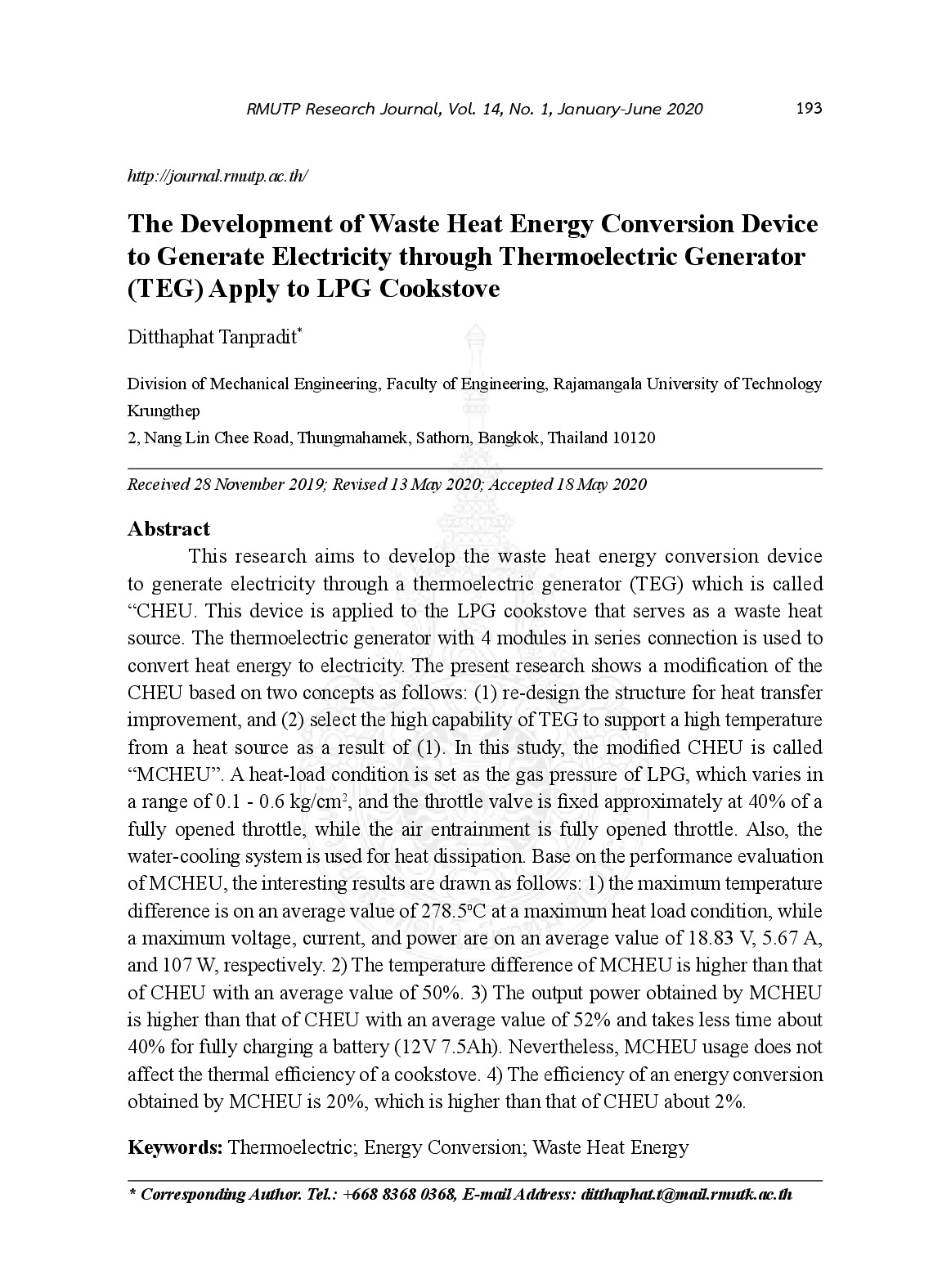
The development of waste heat energy conversion device to generate electricity through hermoelectric generator (TEG) apply to LPG cookstove
This research aims to develop the waste heat energy conversion device to generate electricity through a thermoelectric generator (TEG) which is called “CHEU. This device is applied to the LPG cookstove that serves as a waste heat source. The thermoelectric generator with 4 modules in series connection is used to convert heat energy to electricity. The present research shows a modification of the CHEU based on two concepts as follows: (1) re-design the structure for heat transfer improvement and (2) select the high capability of TEG to support a high temperature from a heat source as a result of (1). In this study the modified CHEU is called “MCHEU”. A heat-load condition is set as the gas pressure of LPG which varies in a range of 0.1 - 0.6 kg/cm2 and the throttle valve is fixed approximately at 40% of a fully opened throttle while the air entrainment is fully opened throttle. Also the water-cooling system is used for heat dissipation. Base on the performance evaluation of MCHEU the interesting results are drawn as follows: 1) the maximum temperature difference is on an average value of 278.5oC at a maximum heat load condition while a maximum voltage current and power are on an average value of 18.83 V 5.67 A and 107 W respectively. 2) The temperature difference of MCHEU is higher than that of CHEU with an average value of 50%. 3) The output power obtained by MCHEU is higher than that of CHEU with an average value of 52% and takes less time about 40% for fully charging a battery (12V 7.5Ah). Nevertheless MCHEU usage does not affect the thermal efficiency of a cookstove. 4) The efficiency of an energy conversion obtained by MCHEU is 20% which is higher than that of CHEU about 2%.
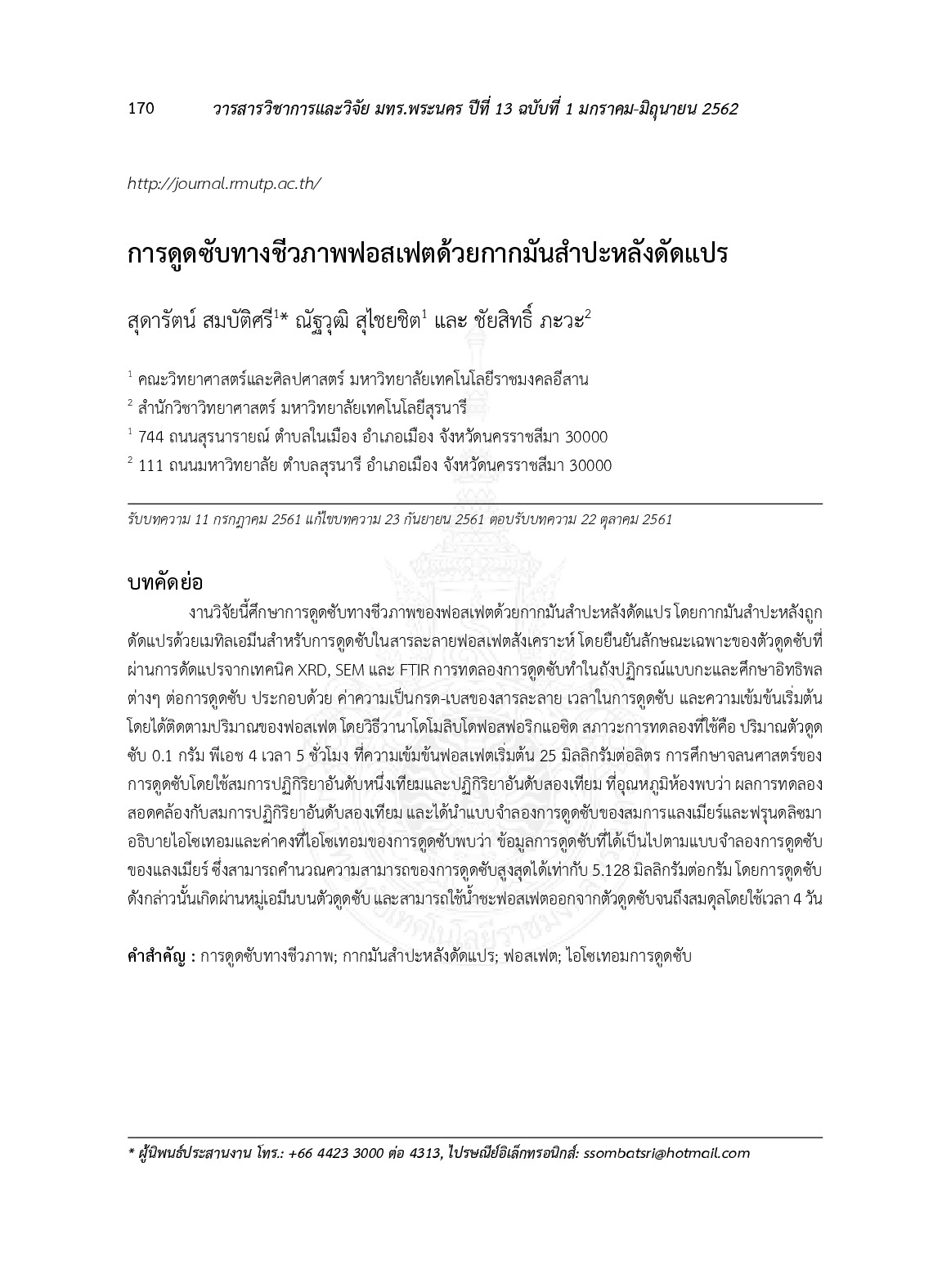
การดูดซับทางชีวภาพฟอสเฟตด้วยกากมันสำปะหลังดัดแปร
The biosorption of phosphate using modified cassava waste were studied. Cassava pulp was modified in methylamine for the adsorption of phosphate ion in aqueous solution. XRD SEM and FTIR result confirmed the surface modification of modified cassava waste. The adsorption experiments were conducted in a batch reactor. The studied parameters included pH contact time and initial concentrations. The amount of phosphate in the solution was measured by Vanadomolybdophosphoric acid method. Optimum conditions of adsorption were 0.10 g of modified cassava waste pH 4 and 5 hour of contact time at 25 mg/L of initial phosphate concentration. Kinetic of adsorption were studied by using the pseudo-first and pseudo-secondorder models at room temperature. The results indicated that the pseudo-second-order model best described adsorption kinetic data. The Langmuir and Freundlich adsorption models were applied to describe the isotherms and isotherm constants. The adsorption of modified cassava fitted well with the Langmuir model and the maximum adsorption capacity of 5.128 mg/g; and the active site of adsorption was amine functional group. Phosphate released in water reach equilibrium within 4 days.