จำนวน Repository ( 580 )

Thai dessert product development form palmyra - plum powder
A research was aimed to investigate appropriate procedures of cabinet drying of flour made from Toddy palm at 60 65 and 70 degree Celsius and employed it as an ingredient in 3 Thai traditional desserts - Kanom-Chun Kanom Num-dok-mai and Kanom Puy-fai respectively. The investigation emphasized on these effects on color and odor of the products. Palm flours at the level of 0% 10% 20% and 30% was added then physical and chemical properties consumer’s acceptance were investigated and their shelf-life of the products packed in polyvinyl chloride and double layer of polyvinyl chloride and polyethylene at room temperature was inspected every day. Drying temperature of 60 ?C and 10% flour addition in the formulation found to be the optimal condition and also produces best quality of the products accepted by consumers as in such conditions overall score of acceptance was statistically significantly highest ( P>0.05) with 7.73 7.95 and 7.62 average scores for Chun Kanom Num-dok-mai and Kanom Puy-fai consecutively. Proximate analysis of these products in terms of moisture ash fat fiber protein and carbohydrate revealed that they were statistically different ( P>0.05). When 100 consumers were asked to taste and rank their acceptances Kanom Puy-fai Kanom Num-dok-mai and Kanom Puy-fai was acceptable by 66 28 and 6 panels successively. However these products should not store for more than a day due to the fact that microbiologically total viable count would be exceeds specified standard by a day.
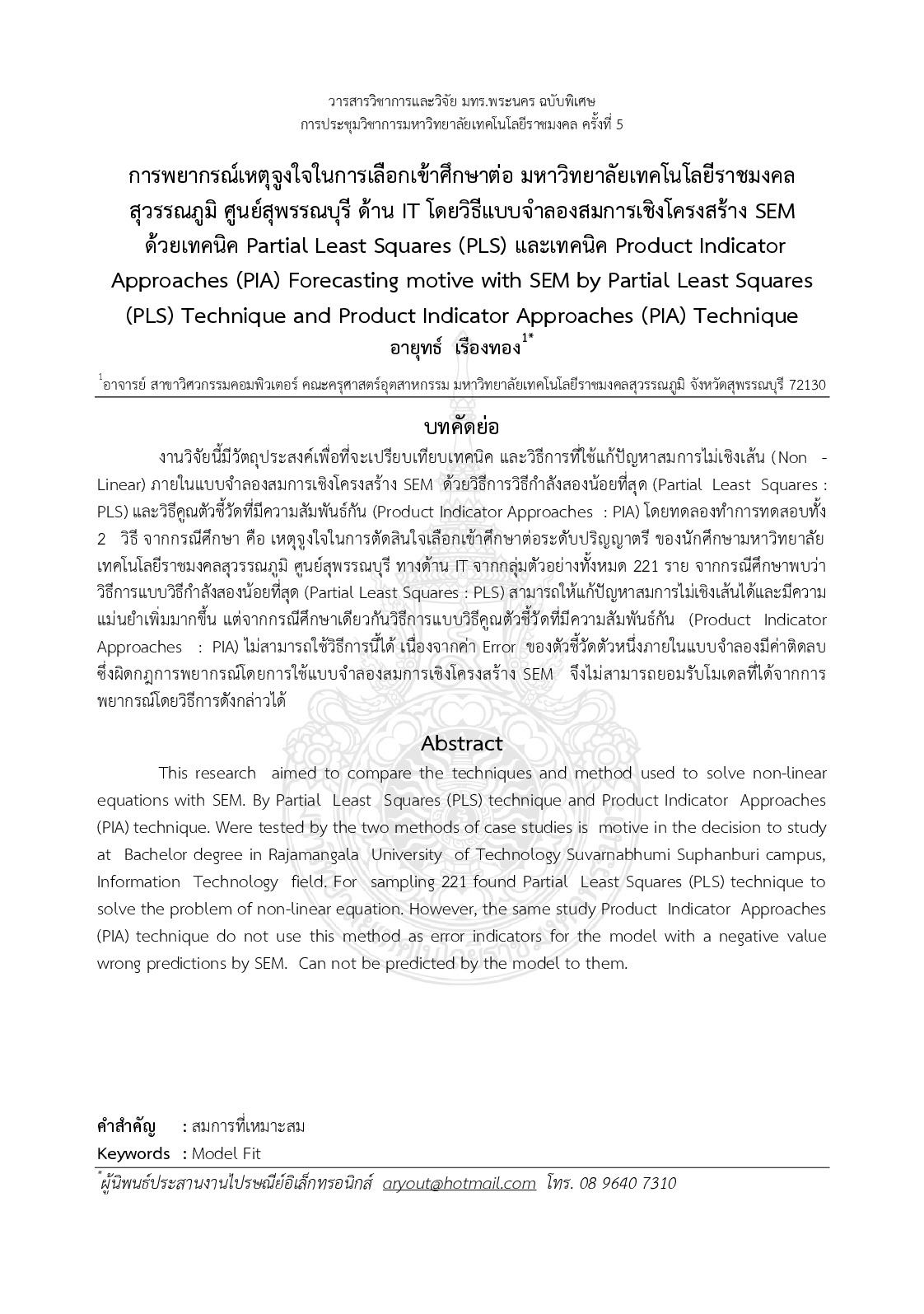
Approaches (PIA) forecasting motive with SEM by partial least squares (PLS) tchnique and product indicator approaches (PIA) technique
This research aimed to compare the techniques and method used to solve non-linear equations with SEM. By Partial Least Squares (PLS) technique and Product Indicator Approaches (PIA) technique. Were tested by the two methods of case studies is motive in the decision to study at Bachelor degree in Rajamangala University of Technology Suvarnabhumi Suphanburi campus Information Technology field. For sampling 221 found Partial Least Squares (PLS) technique to solve the problem of non-linear equation. However the same study Product Indicator Approaches (PIA) technique do not use this method as error indicators for the model with a negative value wrong predictions by SEM. Can not be predicted by the model to them.
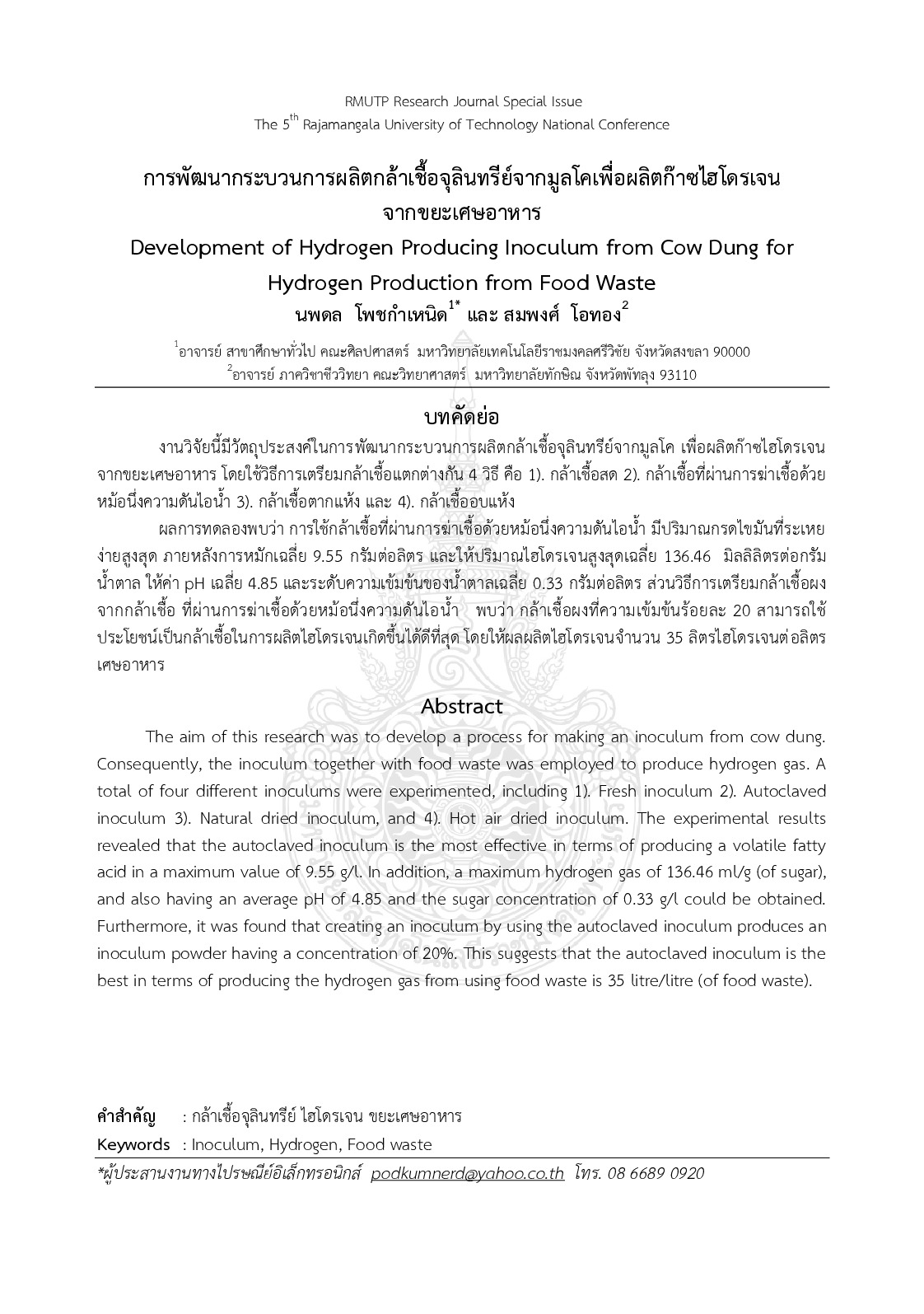
Development of hydrogen producing inoculum from cow dung for hydrogen production from food waste
The aim of this research was to develop a process for making an inoculum from cow dung. Consequently the inoculum together with food waste was employed to produce hydrogen gas. A total of four different inoculums were experimented including 1). Fresh inoculum 2). Autoclaved inoculum 3). Natural dried inoculum and 4). Hot air dried inoculum. The experimental results revealed that the autoclaved inoculum is the most effective in terms of producing a volatile fatty acid in a maximum value of 9.55 g/l. In addition a maximum hydrogen gas of 136.46 ml/g (of sugar) and also having an average pH of 4.85 and the sugar concentration of 0.33 g/l could be obtained. Furthermore it was found that creating an inoculum by using the autoclaved inoculum produces an inoculum powder having a concentration of 20%. This suggests that the autoclaved inoculum is the best in terms of producing the hydrogen gas from using food waste is 35 litre/litre (of food waste).
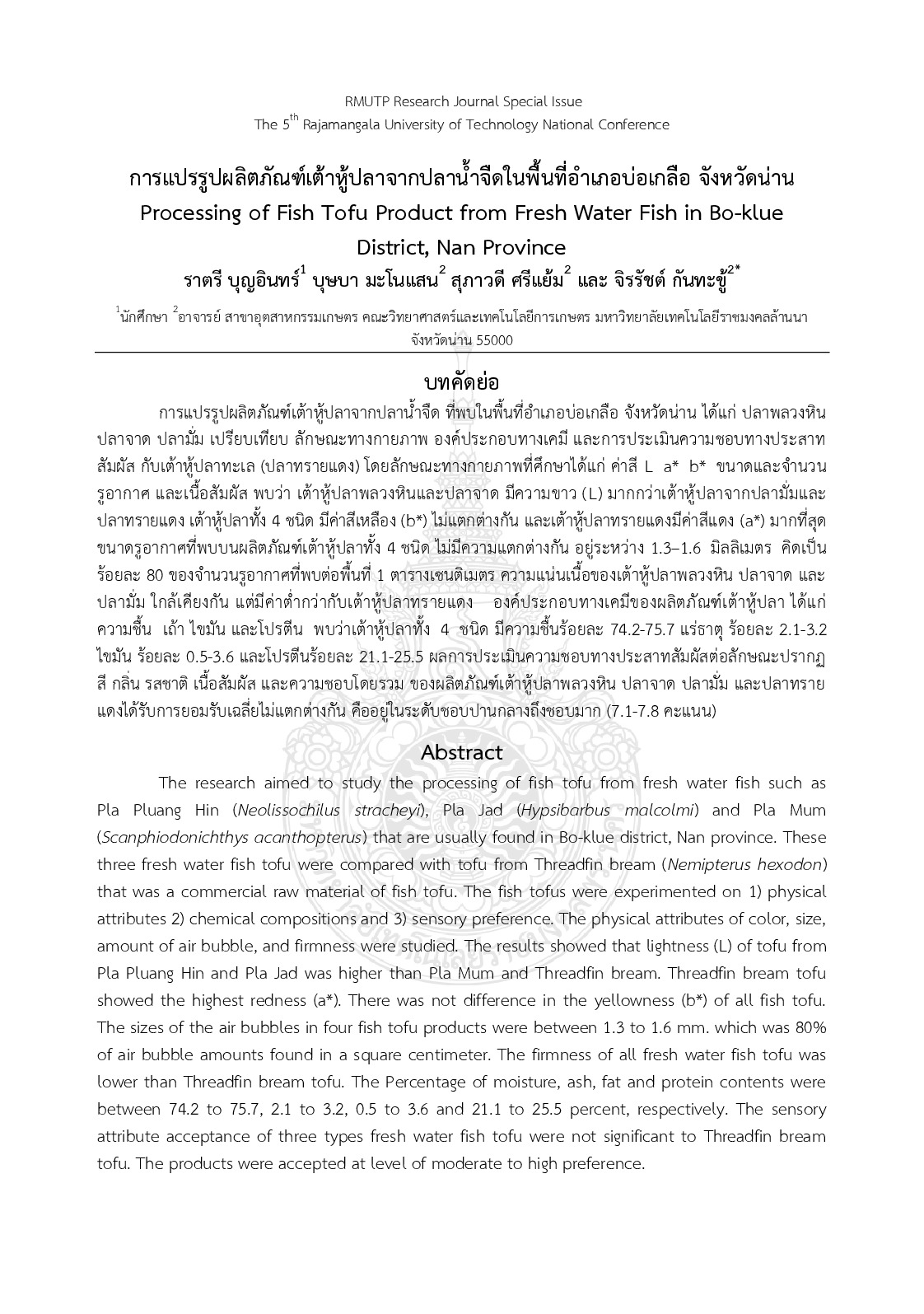
Processing of fish tofu product from fresh water fish in bo-klue district, nan Province
The research aimed to study the processing of fish tofu from fresh water fish such as Pla Pluang Hin (Neolissochilus stracheyi) Pla Jad (Hypsibarbus malcolmi) and Pla Mum (Scanphiodonichthys acanthopterus) that are usually found in Bo-klue district Nan province. These three fresh water fish tofu were compared with tofu from Threadfin bream (Nemipterus hexodon) that was a commercial raw material of fish tofu. The fish tofus were experimented on 1) physical attributes 2) chemical compositions and 3) sensory preference. The physical attributes of color size amount of air bubble and firmness were studied. The results showed that lightness (L) of tofu from Pla Pluang Hin and Pla Jad was higher than Pla Mum and Threadfin bream. Threadfin bream tofu showed the highest redness (a*). There was not difference in the yellowness (b*) of all fish tofu. The sizes of the air bubbles in four fish tofu products were between 1.3 to 1.6 mm. which was 80% of air bubble amounts found in a square centimeter. The firmness of all fresh water fish tofu was lower than Threadfin bream tofu. The Percentage of moisture ash fat and protein contents were between 74.2 to 75.7 2.1 to 3.2 0.5 to 3.6 and 21.1 to 25.5 percent respectively. The sensory attribute acceptance of three types fresh water fish tofu were not significant to Threadfin bream tofu. The products were accepted at level of moderate to high preference.
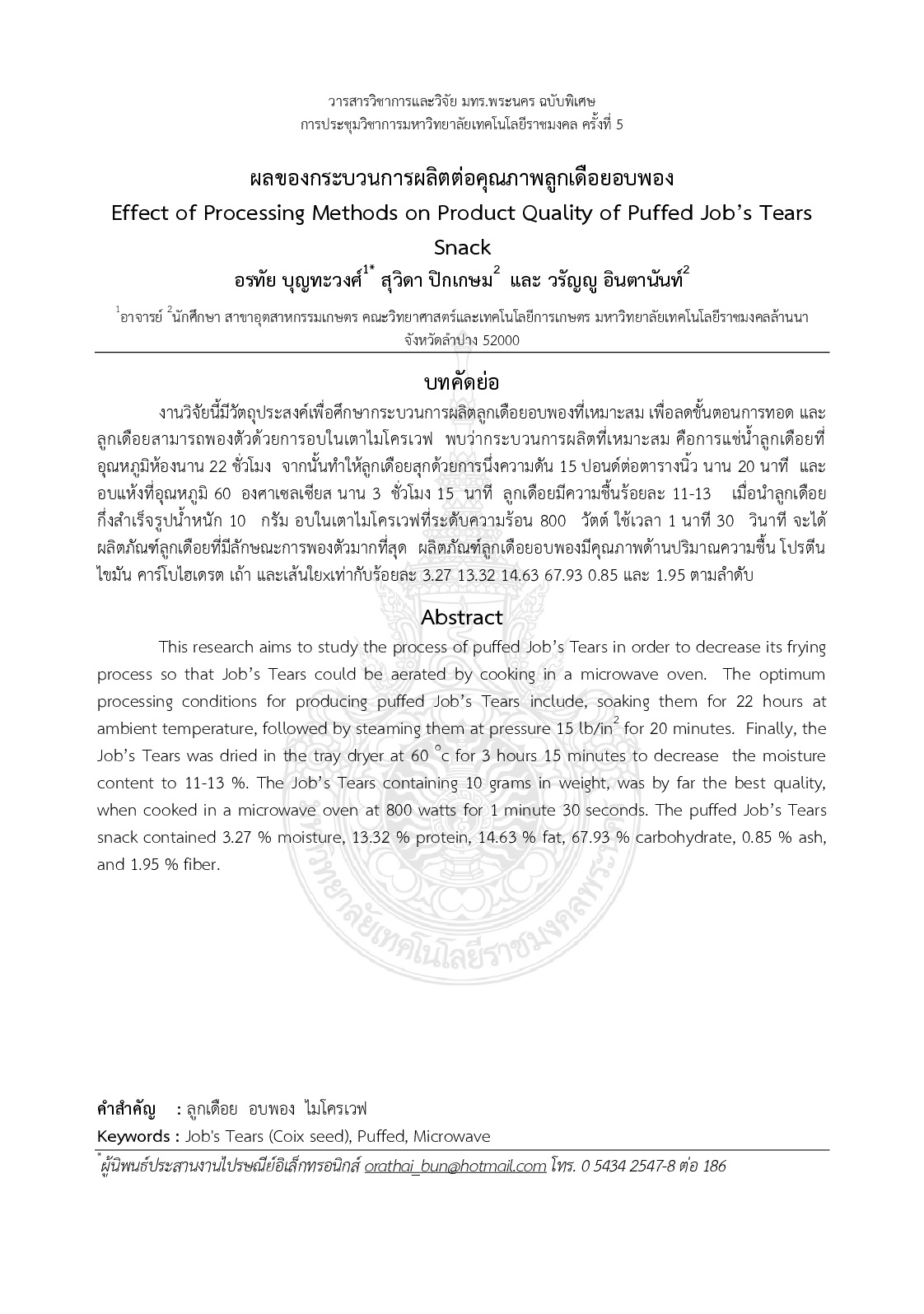
Effect of processing methods on product quality of puffed job’s tears snack
This research aims to study the process of puffed Job’s Tears in order to decrease its frying process so that Job’s Tears could be aerated by cooking in a microwave oven. The optimum processing conditions for producing puffed Job’s Tears include soaking them for 22 hours at ambient temperature followed by steaming them at pressure 15 lb/in2 for 20 minutes. Finally the Job’s Tears was dried in the tray dryer at 60 oc for 3 hours 15 minutes to decrease the moisture content to 11-13 %. The Job’s Tears containing 10 grams in weight was by far the best quality when cooked in a microwave oven at 800 watts for 1 minute 30 seconds. The puffed Job’s Tears snack contained 3.27 % moisture 13.32 % protein 14.63 % fat 67.93 % carbohydrate 0.85 % ash and 1.95 % fiber.