จำนวน Repository ( 121 )
การเพิ่มการถ่ายเทความร้อนของถังน้ำร้อนในระบบผลิตน้ำร้อนที่ใช้พลังงานความร้อนทิ้งจากเครื่องปรับอากาศ
This research is to study in heat transfer of hot water tank from an air conditioner which is a cylinder type and has a hot water pipe around the tank. It is used for finding a position and a pattern of distribution of the hot water pipe around the tank in the highest heat transfer condition. The study uses the cylinder of hot water tank filled 45 liters of 25 oC water. An experiment separates in 3 positions of pipe wrapping which are the bottom the center and the top of the tank. Then 80 oC of hot water run thought the hot water pipe which is wrapped around the tank for 120 minutes. The result of the experiment shows that tubing position that causes the highest heat transfer is at the bottom of tank. Pipe wrapping at the bottom of the tank has the heat transfer higher than the top of the tank at 30%. Furthermore this experiment studies in spacing of hot water pipe. There are 3 types for testing which are spacing hot water pipe as one time two times and three times of diameter of pipe. The result illustrates that spacing the hot water pipe can significantly increase the heat transfer. The heat transfer of spacing the hot water pipe in three times of diameter of pipe is higher 5.8 % than spacing in one times. In addition this research is to study in the effect of turbulent flow on the heat transfer by installing agitator in order to stir water in the tank. The result is that water stirring in the tank for increasing the heat transfer is not effective for investment because the energy using for stirring is higher than the enhanced heat transfer
Utilization of cassava pulp and cassava wastewater for bioethanol production
The purpose of this study was to optimize the bioethanol production from cassava pulp and cassava wastewater. The study was divided into two phase: 1.) Pretreatment and enzymatic hydrolysis 2.) Bioethanol fermentation. The effect of substrate and ratio of loading 1 3 5 and 7% (w/v) with the mixed enzyme α-amylase and glucoamylase ratio of 1:1 (v/v).The results showed that at 7% substrate loading the highest reducing sugar concentration was 89.55±1.13 g/L. Regarding the best ratio of α-amylase and glucoamylase at 1:1 (v/v) with fermentation time of 4 h gave the highest yield of 0.58±0.02 (g product/g substrate). In addition the highest glucose yield of 0.36±0.04 (g product/g substrate) was observed in 2 h fermentation time after hydrolysis with α-amylase and glucoamylase using cellulase and xylanase ratio of 1:1 (v/v). The results indicated that usage of mixed enzyme proved to spend shorter hydrolysis time and enhance the fermentable sugar production from cassava waste. The enzymatic hydrolysate was used as substrate for bioethanol fermentation using S.cerevisiaeTISTR5339. The results showed that the ethanol yield at fermentation time at 6 h with S.cerevisiae5 10 20 and 30% (v/v) were 0.27±0.027 0.23±0.002 0.19±0.022 and 0.16±0.011 (g ethanol/g substrate) respectively. The result indicated that ethanol yield decreased with increasing cell concentration of S.cerevisiaeTISTR5339 from 5% (v/v) to 30% (v/v).
การบําบัดน้ำเสียจากชุมชนด้วยระบบเอสบีอาร์ร่วมกับยางพื้นรองเท้า
This research has studied the treatment of municipal wastewater with shoe soles as a supporting media for Sequencing Batch Reactor. The objectives of this research were the conditions to for optimize growing Photosynthetic Bacteria (PSB) and understand the treatment efficiencies of municipal wastewater treatment with PSB in Sequencing Batch Reactor (SBR). Three types of shoe soles were applied in this research composed of rubber shoe soles neoprene and EVA and the control without shoe soles. The experimental factors included the essential parameters such as BOD COD SS MLSS MLVSS Phosphorus and Ammonia-Nitrogen. F/M Ratio was adjusted at 0.13 and hydraulic retention time (HRT) was at 5 days. The results indicated that the removal efficiencies of SBR with rubber shoe soles in terms of BOD COD SS phosphorus and ammonia-nitrogen were 87% 80% 94% 53% and 68% respectively. The removal efficiencies of SBR with Neoprene shoe soles in terms of BOD COD SS Phosphorus and Ammonia-Nitrogen were 89% 81% 95% 20% and 73%. The removal efficiencies of SBR with EVA shoe soles in terms of BOD COD SS phosphorus and ammonia-nitrogen were 91% 86% 95% 56% and 74%. The removal efficiencies of SBR without shoe soles in terms of BOD COD SS phosphorus and ammonia-nitrogen were 84% 79% 93% 86% and 67% respectively. The treated wastewater was rather clear low content of suspended solids and no malodor. From overall results the treatment of municipal wastewater by anaerobic sequencing batch reactor with different types of shoe soles was not significant for wastewater treatment efficiencies by anaerobic with any 3 types among of shoes soles can be efficiently applied for municipal wastewater treatment.
การเฝ้าระวังการเกิดไฟไหม้ในพื้นที่บ่อขยะโดยใช้โดรนและเทคโนโลยีการรับรู้ระยะไกล
This research was the application of Unmanned Arial Vehicle (drones) in conjunction with remote sensing technology to monitor the occurrence of the waste dump site fire. The research began with designing and developing prototype tools to collect data from the field site. After the tools were tested they were used to measure gases from the dumping sites. After that the field observation was performed in Nonthaburi Province Pathum Thani Province and Pha Nakhon Si Ayuthaya Province. The final step of the research was to collect the data of active fire hot spot and image from MODIS system satellite covered the area of Nonthaburi Province Pathum Thani Province Pha Nakhon Si Ayuthaya Province and Samut Prakan Province in the period of 1 November 2017 to 31 October 2018. The result showed that the developed drone and the prototype gas detection units worked as designed. The result of gases measurement by the tools were similar to the references equipment. The field observation showed that the dumping site mainly composted of plastic organic matter and cotton which up to 74.9 percent in total. This indicated the factor that influenced the dump site gas generation. Based on the combination technique in the research it could be concluded that Drone and Remote sensing technology were the compromised technology for monitoring fire from the municipal solid waste dump site area.
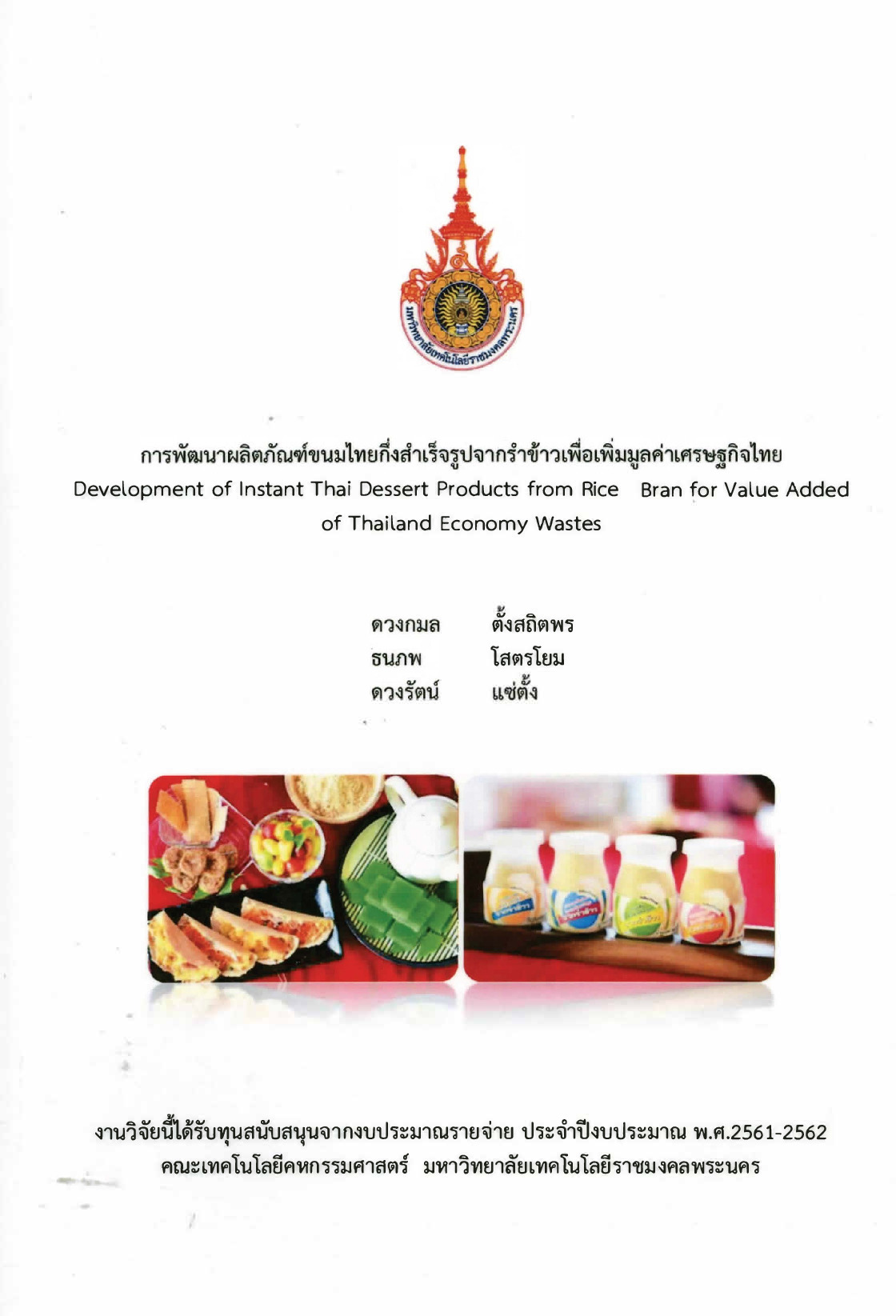
การพัฒนาผลิตภัณฑ์ขนมไทยกึ่งสำเร็จรูปจากรำข้าวเพื่อเพิ่มมูลค่าเศรษฐกิจไทย
Development of Instant Thai Dessert Products from Rice Bran for Value Added of Thailand Economy Wastes. The purpose of this study was developing formula and prototype of Thai Dessert Products from Rice Bran for 4 products such as Khanom Bueng Thai Dried Rice Ball Khonom Chan and Look-Chub. The suitable condition for Khanom Bueng Thai was using Rice Bran flour as 60% and using Mung bean flour as 40%. The result of physical analysis showed that : products have hardness cripyness brown bright color flavor and taste suitable and chemical analysis the percentage of low moisture fat and crude fiber content have more than. The suitable condition for Dried Rice Ball was using Rice Bran powder in 100% for products and drying at 70 ๐C 90 mins. The result of physical analysis showed that : products have firmness texture brown bright color and chemical analysis the percentage of the moisture protein fat crude fiber ash and carbohydrate content 7.05 ± 0.00 7.05 ± 0.00 23.98 ± 0.00 5.25 ± 0.20 10.86 ± 0.00 and 32.26 ± 0.00 respective. The protein and crude fiber content have more than. The suitable condition for Khonom Chan was using Rice Bran flour as 25%. The result of physical analysis showed that : products have after steamed mealiness texture brown bright color and chemical analysis the percentage of the moisture protein fat crude fiber ash and carbohydrate content 4.40 ± 0.05 1.97 ± 0.02 11.18 ± 0.00 2.40 ± 0.06 2.00 ± 0.00 and 77.43 ± 0.00 respective. The protein and crude fiber content have more than. The suitable condition for Look-Chub was using Rice Bran powder as 50% and using Mung bean as 50%. The result of physical analysis showed that : products have after microwave 5 sec. mealiness texture brown bright color and chemical analysis the percentage of the moisture protein fat crude fiber ash and carbohydrate content 2.00 ± 0.70 4.39 ± 0.00 8.82 ± 0.15 2.44 ± 0.492.00 ± 0.71 and 80.35 ± 0.00 respective. The shelf life of 4 products in vacuum packaging (VP) have more than 4 months and consumer acceptability like very much product.