จำนวน Repository ( 75 )

Species Composition and Phenology of Aquatic plants in Na Hae District, Loei Province, Northeastern Thailad
Species composition and reproductive phenology of aquatic plants in Na Haeo District. Loei Province Northeastern Thailand were conducted from October 2008 to September 2009. A total of 85 species 67 genera were identified from 37 families. Of the 85 species there were 4 species of lower plants and 81 species
The Extraction and Biological Activity of Medicinal Plant Extracts.
The biological activity of erude hexane ethylacetate and methanol extracts from stem bark of Xylocarpus granatum Koen. Walsura trichostemon Miq. And Parinari anamense Hance with sequential extraction and maceration technique. The crude extract was employed toevaluate the biological activity such as the antimicrobial activities test by the Microplate broth dilution techniques the antioxidant activities test by DPPH radical scavenging assay the totalphenolic contents test by the Folin-Ciocalteu method the anti-malaria (Plasmodium falciparum) test by Microculture Radioisotope Technique the anti-Mycobacterium Tuberculosis (anti-TB) test by Green fluorescent protein microplate assay (GFPMA) and the anti-cancer (KB-Oral cavity cancer) test by Resazurin Microplate assay (REMA)
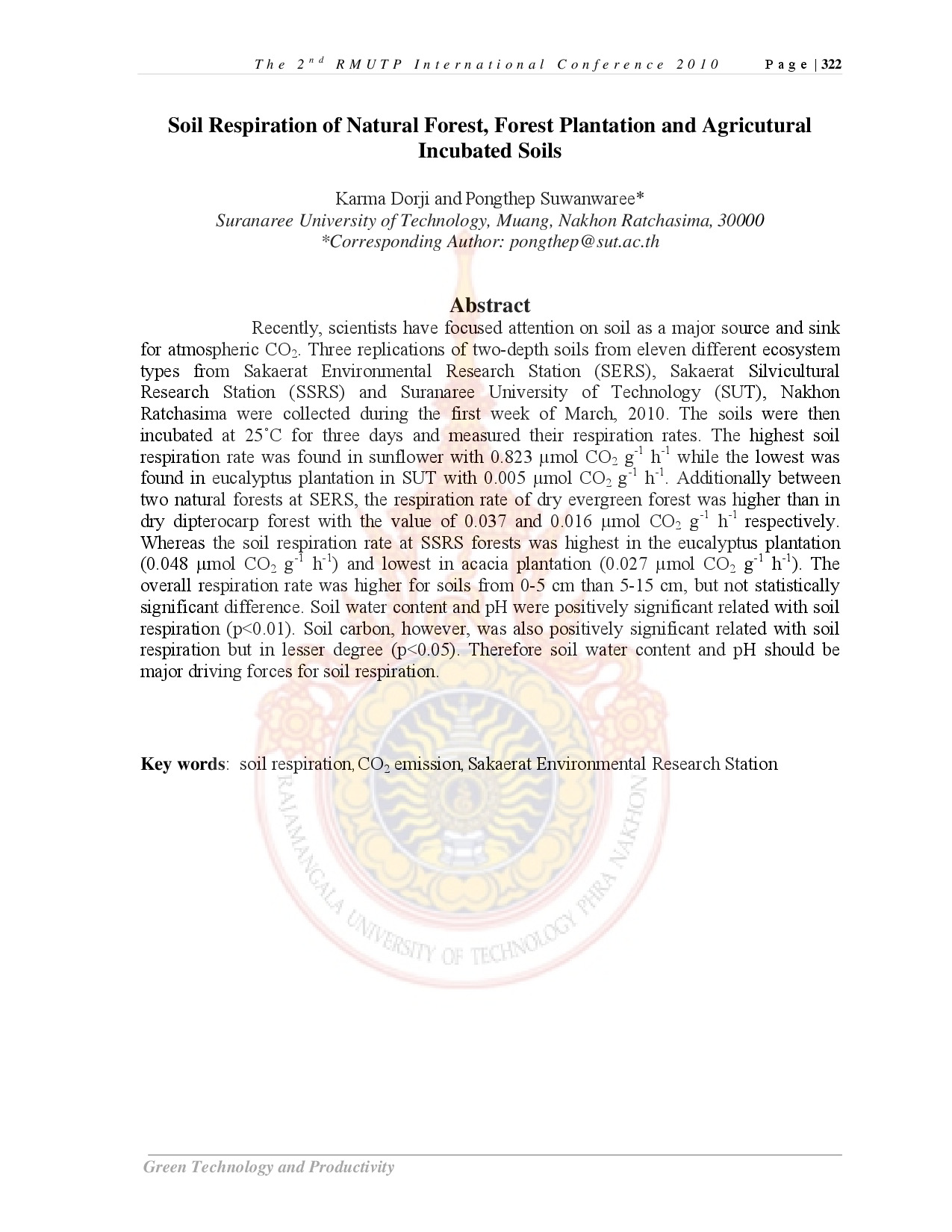
Soil Respiration of Natural Forest, Forest Plantation and Agricutural Incubated Soils
Recently scientists have focused attention on soil as a major source and sink for atmospheric CO2. Three replications of two-depth soils from eleven different ecosystem types from Sakaerat Environmental Research Station (SERS) Sakaerat Silvicultural Research Station (SSRS) and Suranaree University of Technology (SUT) Nakhon Ratchasima were collected during the first week of March 2010. The soils were then incubated at 25°C for three days and measured their respiration rates. The highest soil respiration rate was found in sunflower with 0.823 μmol CO2 g-1 h-1 while the lowest was found in eucalyptus plantation in SUT with 0.005 μmol CO2 g-1 h-1. Additionally between two natural forests at SERS the respiration rate of dry evergreen forest was higher than in dry dipterocarp forest with the value of 0.037 and 0.016 μmol CO2 g-1 h-1 respectively. Whereas the soil respiration rate at SSRS forests was highest in the eucalyptus plantation (0.048 μmol CO2 g-1 h-1) and lowest in acacia plantation (0.027 μmol CO2 g-1 h-1). The overall respiration rate was higher for soils from 0-5 cm than 5-15 cm but not statistically significant difference. Soil water content and pH were positively significant related with soil respiration (p<0.01). Soil carbon however was also positively significant related with soil respiration but in lesser degree (p<0.05). Therefore soil water content and pH should be major driving forces for soil respiration.
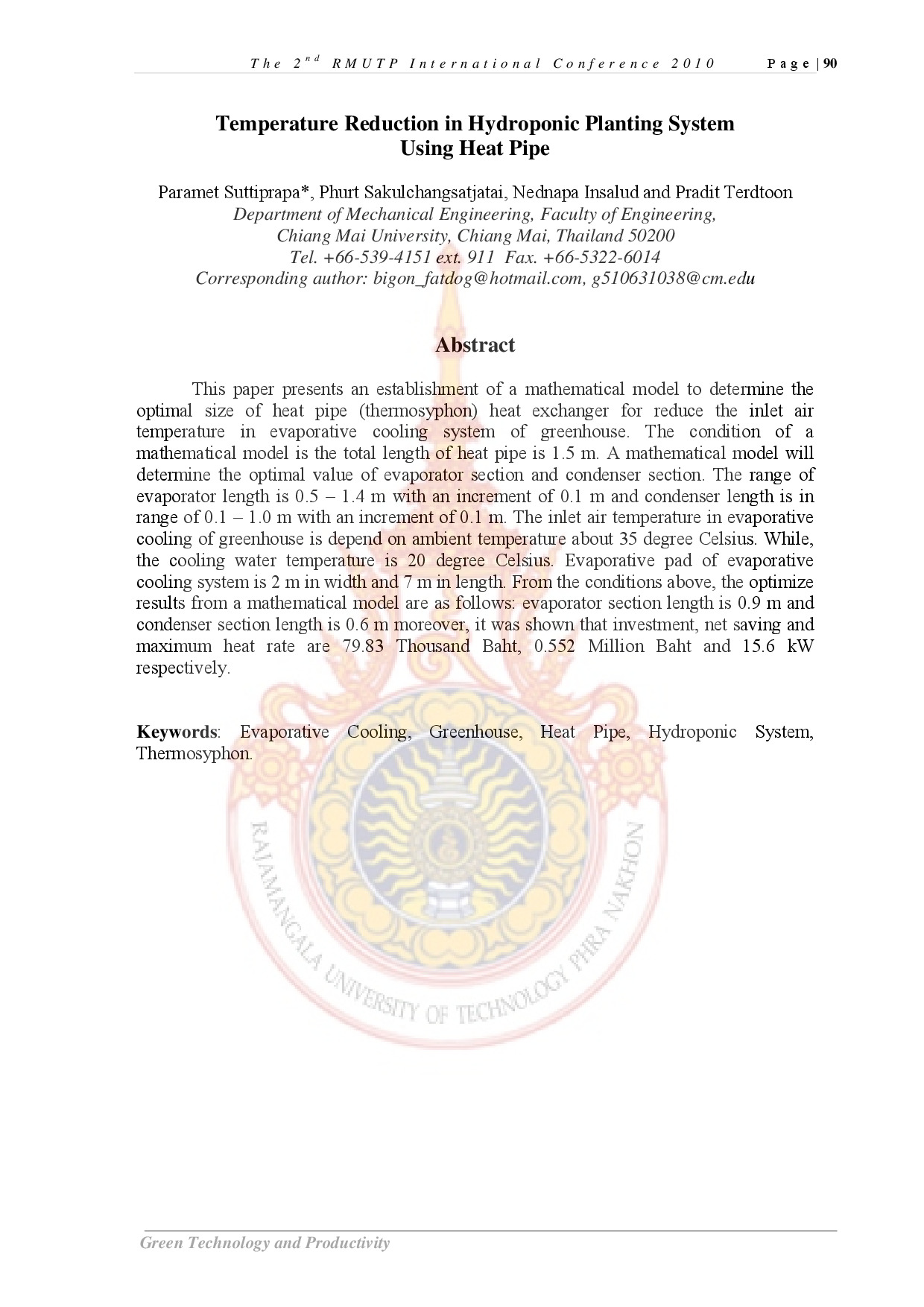
Temperature Reduction in Hydroponic Planting System Using Heat Pipe
This paper presents an establishment of a mathematical model to determine the optimal size of heat pipe (thermosyphon) heat exchanger for reduce the inlet air temperature in evaporative cooling system of greenhouse. The condition of a mathematical model is the total length of heat pipe is 1.5 m. A mathematical model will determine the optimal value of evaporator section and condenser section. The range of evaporator length is 0.5 – 1.4 m with an increment of 0.1 m and condenser length is in range of 0.1 – 1.0 m with an increment of 0.1 m. The inlet air temperature in evaporative cooling of greenhouse is depend on ambient temperature about 35 degree Celsius. While the cooling water temperature is 20 degree Celsius. Evaporative pad of evaporative cooling system is 2 m in width and 7 m in length. From the conditions above the optimize results from a mathematical model are as follows: evaporator section length is 0.9 m and condenser section length is 0.6 m moreover it was shown that investment net saving and maximum heat rate are 79.83 Thousand Baht 0.552 Million Baht and 15.6 kW respectively.
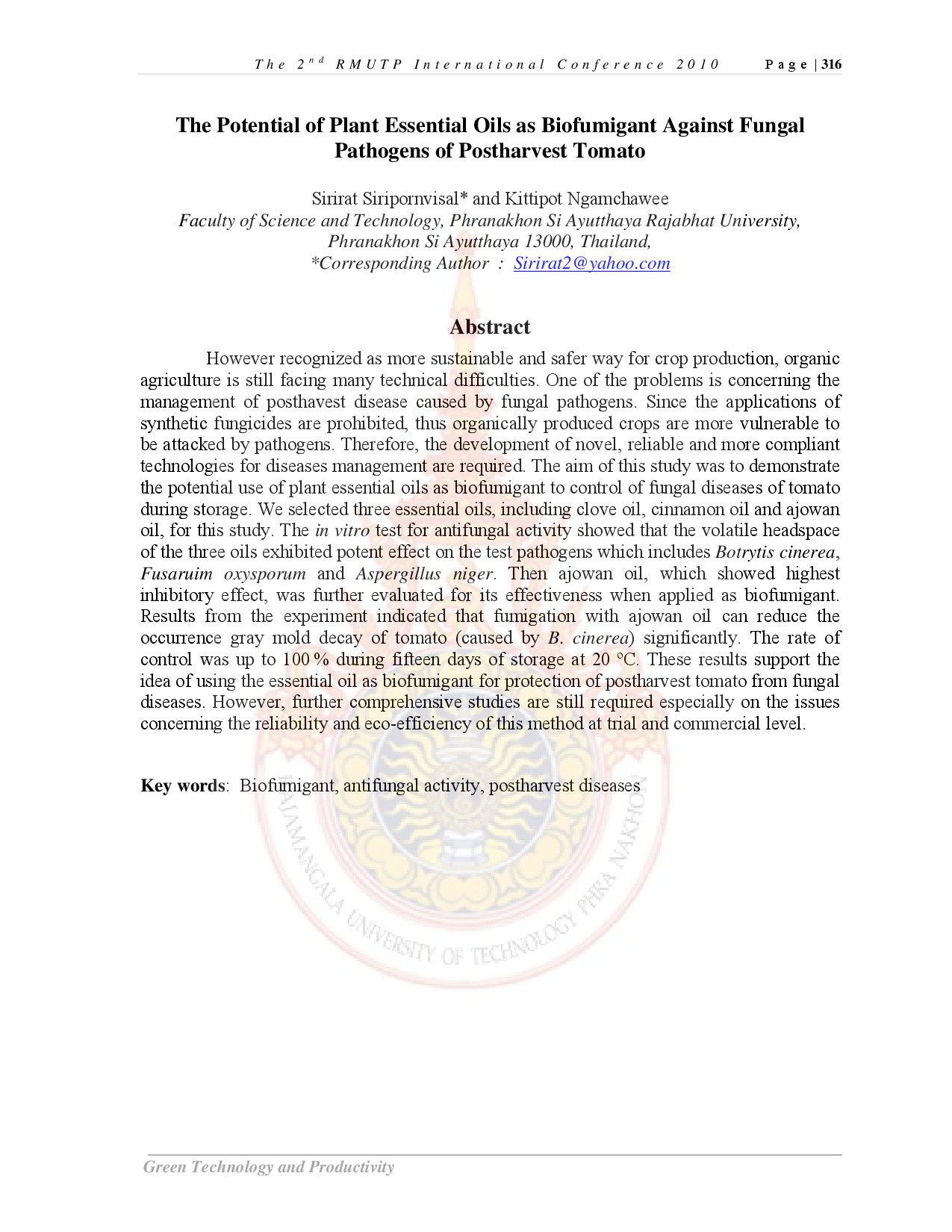
The Potential of Plant Essential Oils as Biofumigant Agains Fungal Pathogens of Postharvest Tomato
However recognized as more sustainable and safer way for crop production organic agriculture is still facing many technical difficulties. One of the problems is concerning the management of posthavest disease caused by fungal pathogens. Since the applications of synthetic fungicides are prohibited thus organically produced crops are more vulnerable to be attacked by pathogens. Therefore the development of novel reliable and more compliant technologies for diseases management are required. The aim of this study was to demonstrate the potential use of plant essential oils as biofumigant to control of fungal diseases of tomato during storage. We selected three essential oils including clove oil cinnamon oil and ajowan oil for this study. The in vitro test for antifungal activity showed that the volatile headspace of the three oils exhibited potent effect on the test pathogens which includes Botrytis cinerea Fusaruim oxysporum and Aspergillus niger. Then ajowan oil which showed highest inhibitory effect was further evaluated for its effectiveness when applied as biofumigant. Results from the experiment indicated that fumigation with ajowan oil can reduce the occurrence gray mold decay of tomato (caused by B. cinerea) significantly. The rate of control was up to 100 % during fifteen days of storage at 20 ºC. These results support the idea of using the essential oil as biofumigant for protection of postharvest tomato from fungal diseases. However further comprehensive studies are still required especially on the issues concerning the reliability and eco-efficiency of this method at trial and commercial level.