จำนวน Repository ( 70 )

Method for working-life enhancement of epoxy-based adhesive
For one-part adhesive systems a long working-life adhesive which can be cured rapidly at processing temperature is required in industrial applications because it provides assembly process versatility. The aim of this research was to study the methods for extending the working-life of an epoxy-based adhesive with anhydride curing agent. This adhesive formulation is used as an underfill material in electronic industry. The scope of this study was divided into two parts: 1) modification of adhesive formulation process 2) determination of the component in adhesive which causes the adhesive viscosity increased at ambient temperature. The results showed that the adhesive working-life extended from 2 hours to 6 hours with reducing formulation process time removing the moisture in filler and reducing fluxing precursor loading in adhesive. In addition the fluxing precursor loading also affects the thermo-mechanical properties of adhesive. For characterization the working-life and thermo-mechanical properties of this formulation were investigated using rheological technique and dynamic mechanical analysis (DMA) respectively.
Utilization of sludge from power plant as cement substitution
The feasibility of wastewater treatment sludge from the power plant was studied as cement substituted material. The sludge were used as the air dried sample and the oven dried sludge at 300o C. Their properties then the optimum ratio of cement substituted portion for cement block were determined. In the control set; cement sand and water ratio were 1 2.75 and 0.825 (w/w) respectively while the treatment set sludge replacing were varied at 10 20 and 30 %. The blocks were produced and cured in tap water for 7 14 and 28 days and tested their compressive strength. The leaching ability of heavy metals namely Cd Cr Cu and Pb were determined by Waste Extraction Test or WET (according to the standard from the Notification of Ministry of Industry A.D. 2005) and Toxicity Characteristic Leaching Procedure; TCLP (US EPA method 1311). The results showed that the solution from cement block curing both of control set treatment block had basicidic pH range 11 – 12 and caused reduction of the heavy metal solubility. The solution conductivity range 5 - 7 mS/cm. The 10% dried sludge cement blocks were the suitable ratio compared with the control set which the maximum compressive strength at 28th day was 253.81 Kg/cm2 and 4.73 % moisture. All metal leaching abilities were less than those Notification and US EPA standard. Those optimum ratios 10 % can be applied to produce cement pot.
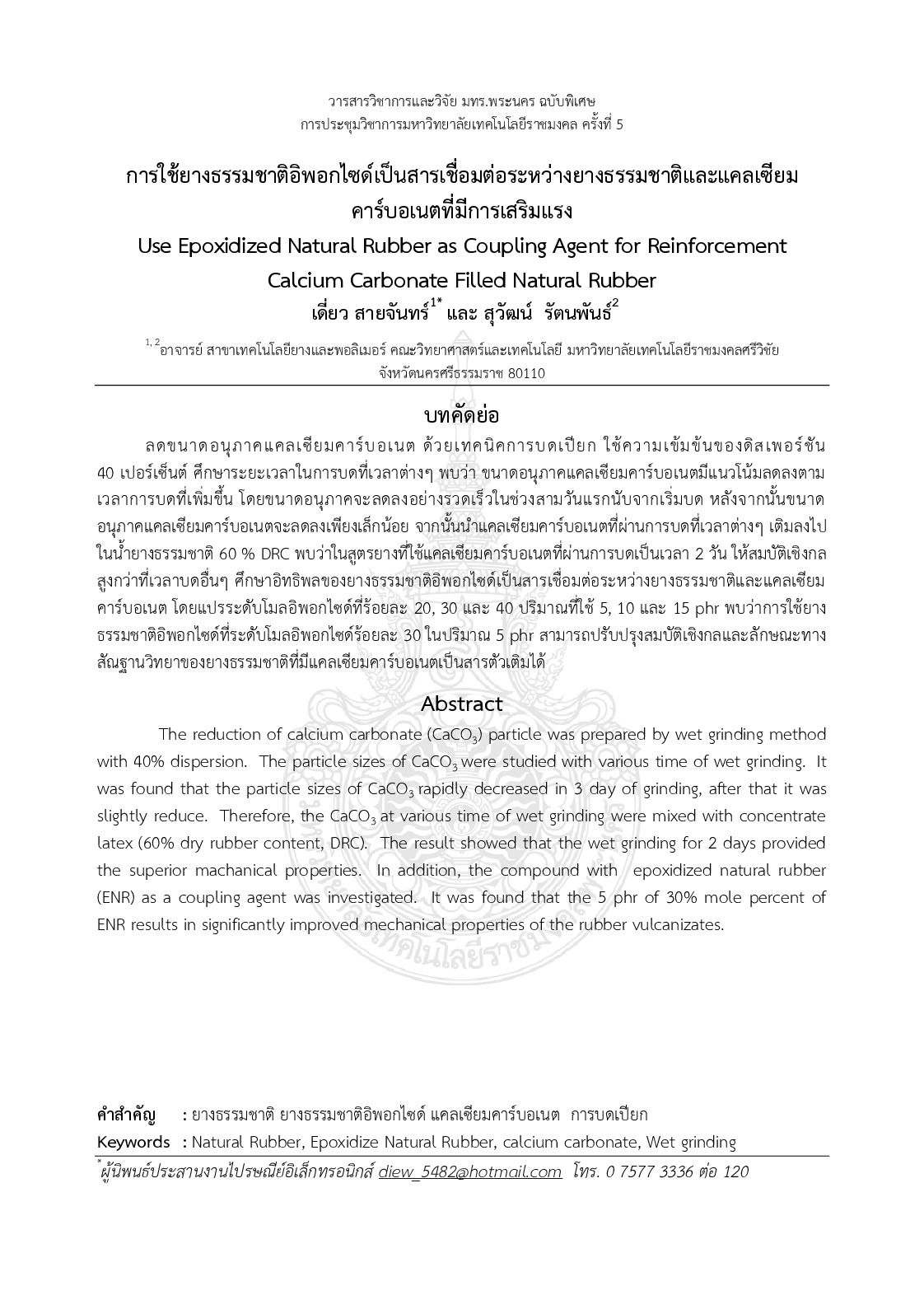
Use epoxidized natural rubber as coupling agent for reinforcement calcium carbonate filled natural rubber
The reduction of calcium carbonate (CaCO3) particle was prepared by wet grinding method with 40% dispersion. The particle sizes of CaCO3 were studied with various time of wet grinding. It was found that the particle sizes of CaCO3 rapidly decreased in 3 day of grinding after that it was slightly reduce. Therefore the CaCO3 at various time of wet grinding were mixed with concentrate latex (60% dry rubber content DRC). The result showed that the wet grinding for 2 days provided the superior machanical properties. In addition the compound with epoxidized natural rubber (ENR) as a coupling agent was investigated. It was found that the 5 phr of 30% mole percent of ENR results in significantly improved mechanical properties of the rubber vulcanizates.
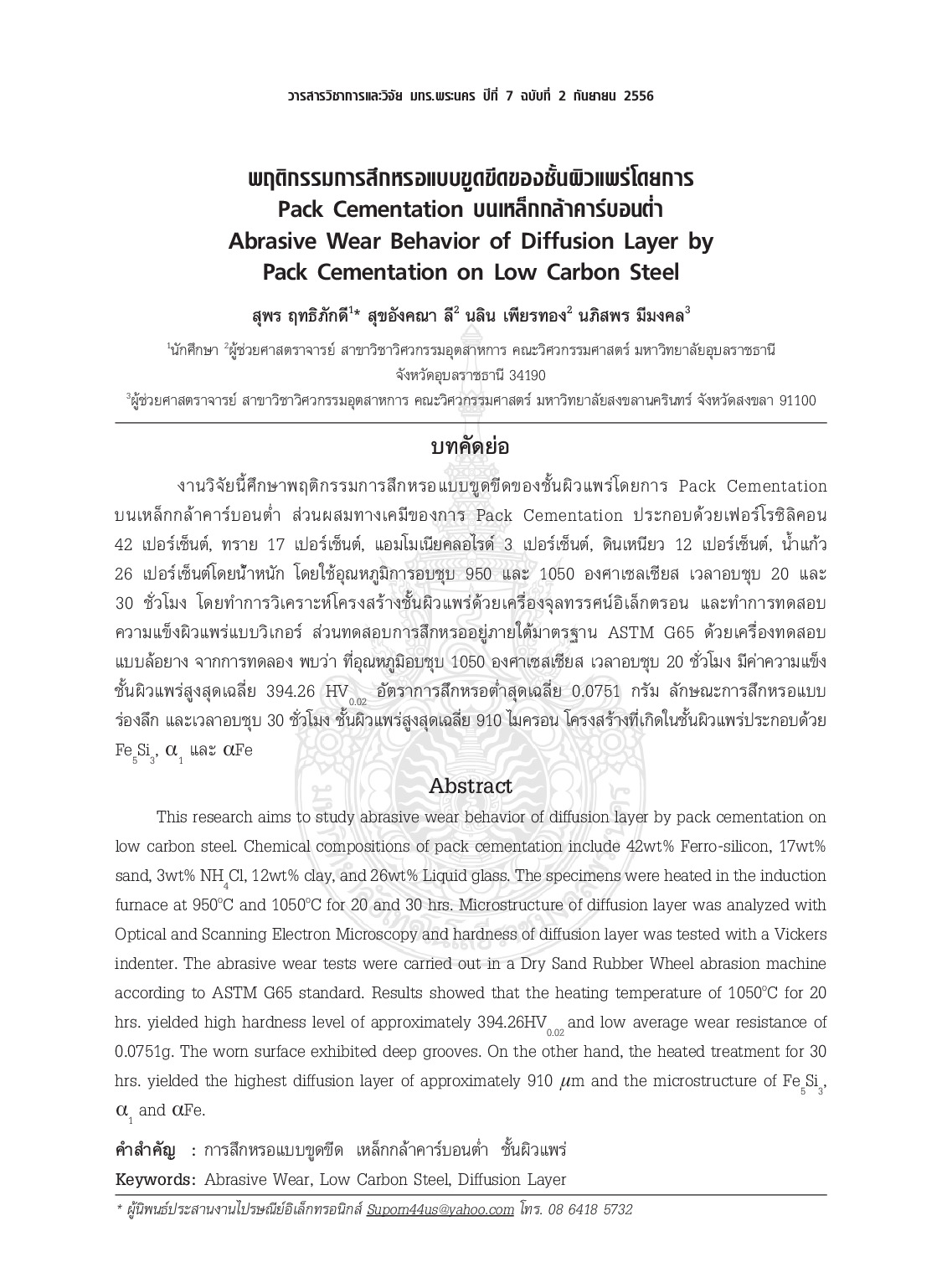
Abrasive wear behavior of diffusion layer by Pack Cementation on low carbon steel
This research aims to study abrasive wear behavior of diffusion layer by pack cementation on low carbon steel. Chemical compositions of pack cementation include 42wt% Ferro-silicon 17wt% sand 3wt% NH4Cl 12wt% clay and 26wt% Liquid glass. The specimens were heated in the induction furnace at 950?C and 1050?C for 20 and 30 hrs. Microstructure of diffusion layer was analyzed with Optical and Scanning Electron Microscopy and hardness of diffusion layer was tested with a Vickers indenter. The abrasive wear tests were carried out in a Dry Sand Rubber Wheel abrasion machine according to ASTM G65 standard. Results showed that the heating temperature of 1050?C for 20 hrs. yielded high hardness level of approximately 394.26HV0.02 and low average wear resistance of 0.0751g. The worn surface exhibited deep grooves. On the other hand the heated treatment for 30 hrs. yielded the highest diffusion layer of approximately 910?m and the microstructure of Fe5Si3 ?1 and ?Fe.
การพัฒนาแผ่นใยไม้อัดซีเมนต์จากการประยุกต์ใช้เส้นใยธรรมชาติจากกากมะพร้าวและต้นข้าวโพด
This research aims to study the application of coconut meal and corncob fiber as high density cement-bonded fiberboard. The cement: fine sand: coconut meal and corncob fiber: water ratio is equal to 1: 0.2: 0.05: 0.3. The fibers are taken from coconut meal and corncob that 5 ratios are used to all of fiber mixing. The fiberboard production use casting in normal temperature. Resulting the CN75 ratio (coconut meal and corncob fiber is equal to 0.0125: 0.0375) is suitable ratio which pass TIS 878- 2537 standard (cement bonded particle board) and has good physicalproperties mechanical properties and thermal insulation.