จำนวน Repository ( 116 )
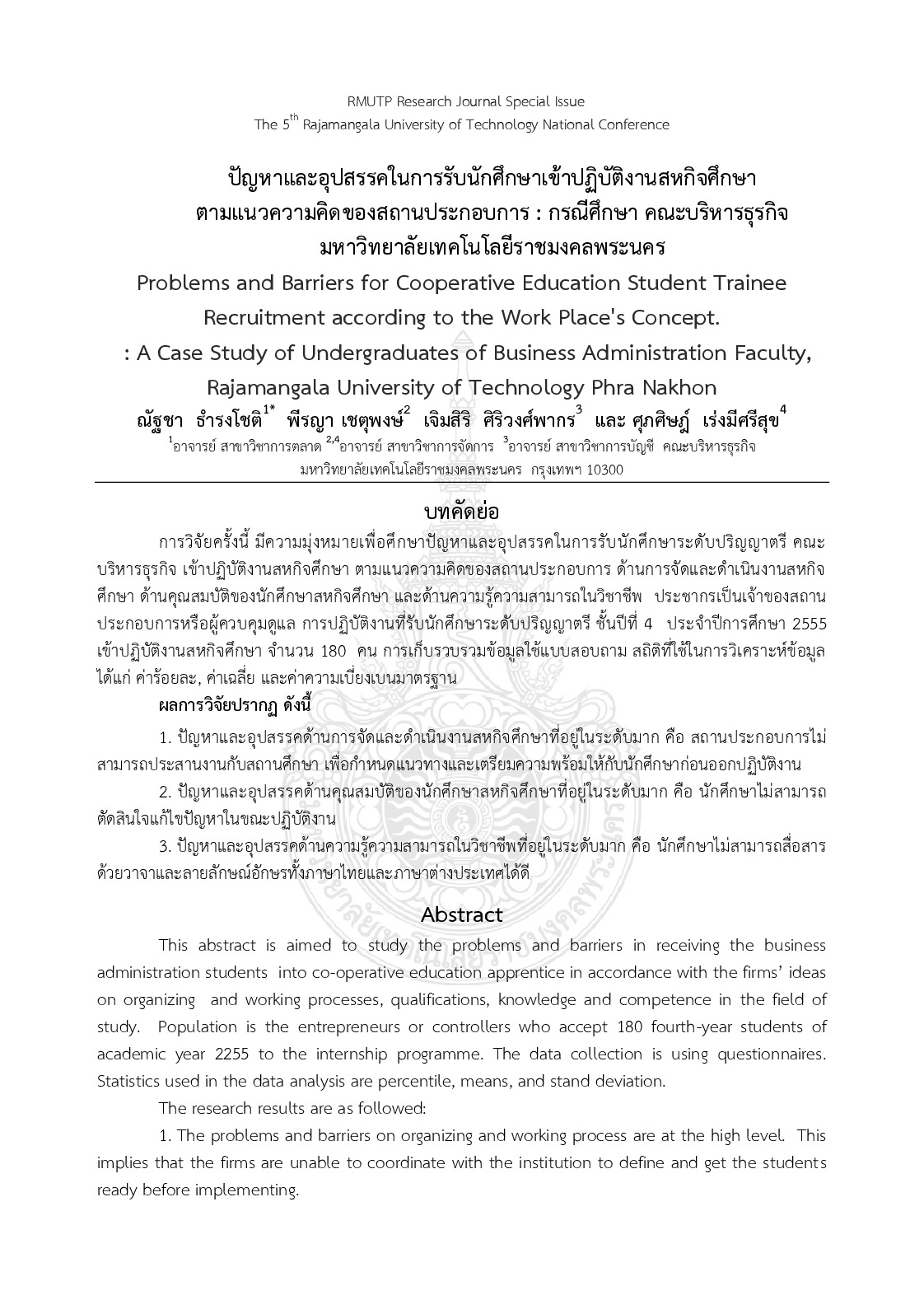
Problems and barriers for cooperative education student trainee recruitment according to the work place's concept. : a case study of undergraduates of business administration faculty, Rajamangala University of Technology Phra Nakhon
This abstract is aimed to study the problems and barriers in receiving the business administration students into co-operative education apprentice in accordance with the firms’ ideas on organizing and working processes qualifications knowledge and competence in the field of study. Population is the entrepreneurs or controllers who accept 180 fourth-year students of academic year 2255 to the internship programme. The data collection is using questionnaires. Statistics used in the data analysis are percentile means and stand deviation. The research results are as followed: 1. The problems and barriers on organizing and working process are at the high level. This implies that the firms are unable to coordinate with the institution to define and get the students ready before implementing.2. The problems and barriers on the qualifications of cooperative study students are at the high level. This implies that those students are unable to make decision to solve problems during internship. 3. The problems and barriers on knowledge and competence in their fields of study are at the high level. This implies that students are unable to communicate well both verbally and alphabetically in Thai and foreign languages.
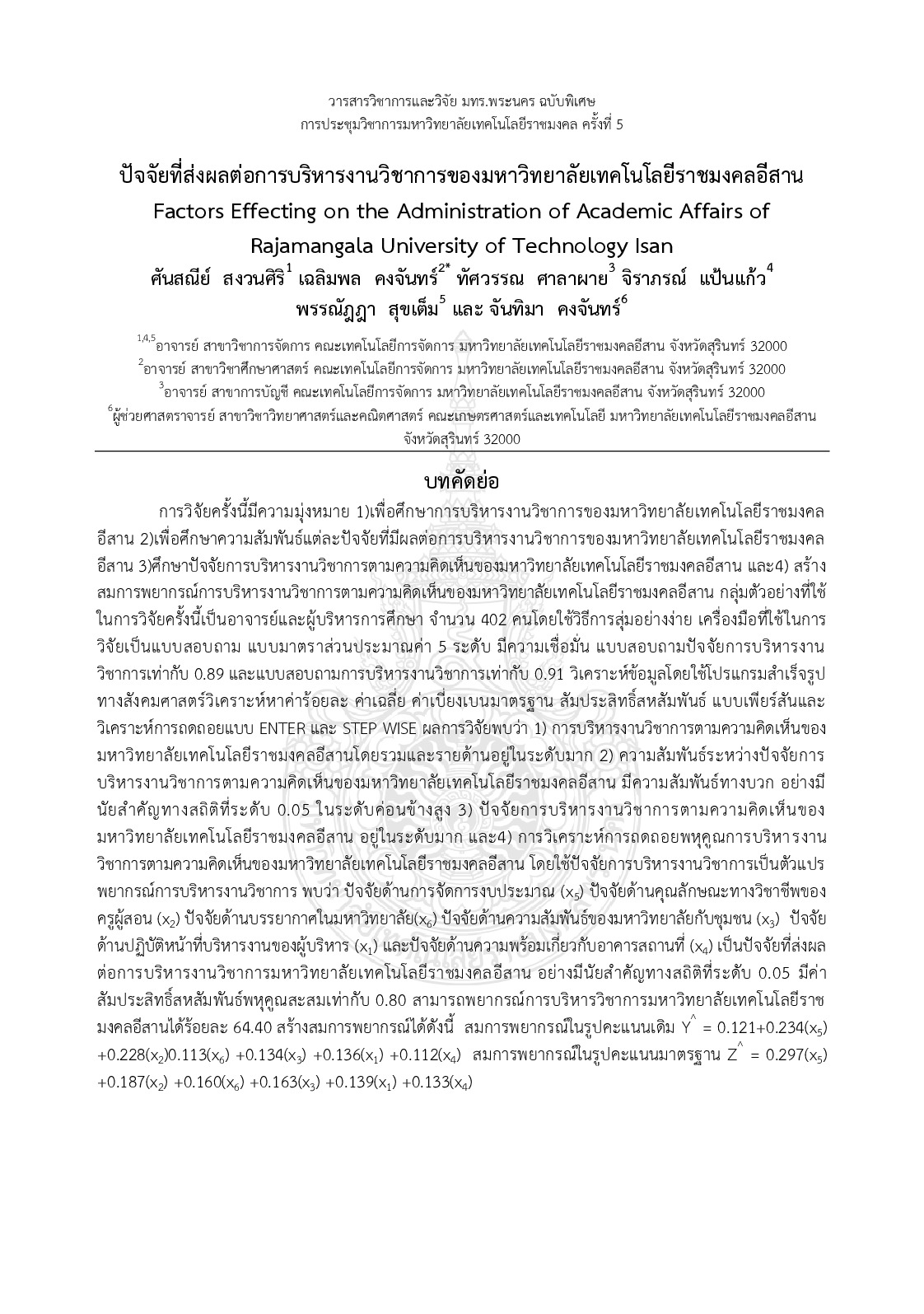
Factors effecting on the administration of academic affairs of Rajamangala University of Technology isan
The purposes of this research were 1) to study the school academic administration of Rajamangala University of Technology Isan 2) to study the correlation between the administrative factors of school academic administration and the university academic administration of Rajamangala University of Technology Isan 3) to study Factors Effecting on the Administration of Academic Affairs of Rajamangala University of Technology Isan 4) to analyze the multiple regression of Factors Effecting on the Administration of Academic Affairs of Rajamangala University of Technology Isan. The sample groups were Teachers and Administrator in Rajamangala University of Technology Isan. The sample groups were 402 Teachers and Administrators selected through Simple Sampling. The research instrument was a 5 level-rating scales questionnaire with the reliabilities of part 2 and 3 were 0.89 and 0.91 respectively. The statistical Techniques employed in data analysis were percentage mean standard deviation Pearson Product Moment Correlation Coefficient and Enter and stepwise Multiple Regression Analysis by using the Computer program. The results were as follows 1. A whole and each part of the University academic administration of Rajamangala University of Technology Isan were high level. 2. The positive relationship of the administrative factors and the school academic administration of Rajamangala University of Technology Isan were high level and significantly at 0.05 3. A whole factors and each part of the academic administration of Rajamangala University of Technology Isan were high level. 4. For the forecast of best factor Enter and stepwise Multiple Regression Analysis it was found that the budget management(x5) characteristics of teachers(x2) University atmosphere(x6) the relationship between University and community (x3) Performance of administrator(x1) and the readiness of University of administration at 0.05 level significance (x4). If showed a stepwise Multiple Regression (R) of 0.80 finally the forecast for the University academic administration was at 64.40 percent. The forecast equations for the University academic administration were as follows: Equation of raw score: Y^ = 0.121+0.234(x5) +0.228(x2)0.113(x6) +0.134(x3) +0.136(x1) +0.112(x4) Equation of standard score: Z^ = 0.297(x5) +0.187(x2) +0.160(x6) +0.163(x3) +0.139(x1) +0.133(x4)
Problems and Barriers for cooperative Education Student Trainee Recruitment according to the Work Place’s concept : A Case Study of Undergraduates of Business Administration Faculty : A Case Study of Undergraduates of Business Administration Faculty, Rajamangala University of Technology Phra Nakhon
This research is to study the problems and barriers for cooperative education student trainee recruitment according to the work place’s concept the aspects of training management training format training students’ qualifications and training students’ knowledge. The population are owners of various workplaces who accept 180 fourth year undergraduate students in training. Questionnaires are used to collect data statistically analyzed by Percentage Mean and Standard Deviation. The findings of the research reveals problems and obstacles as follow : 1. For the training management aspect the workplaces are not able to cooperate with the university to set aims and prepare the students before training the workplaces do not recognize purposes of the university’s training course the suitable positions for the students are not provided by the workplaces. 2. For the training students’ qualifications the students are unlikely to make decision in their performances’ problem solving no self-confidence and carefulness in their performances. 3. For the training students’ knowledge the students are unable to analyze and plan their performances; they have not a good command of both written and spoken English and Thai. In addition they lack of vocational skills.
Psycho-social Factors Related to Effective Teaching Behavior of Business Administration Faculty Lecturers at Rajamangala University of Technology, Bandkok Metropolitan
The objectives of this research were: 1) to study psycho-social factors related to effective teaching behavior of the lectures at Faculty of Business Administration Rajamangala university of Technology Bangkok metropolitan 2) to study social characteristics and psychological characteristics that could predict effective teaching behavior of the lectures in overall and small groups at Faculty of Business Administration Rajamangala university of Technology Bangkok metropolitan 3) to study the interaction between social characteristics and psychological characteristics affecting to effective teaching behavior of the lectures at Faculty of Business Administration Rajamangala university of Technology Bangkok metropolitan. The sample used in this study consisted of 252 lectures at Faculty of Business Administration Rajamangala university of Technology Bangkok metropolitan. There were three independent variables. One was social support and the other two were innovation acceptance and attitude towards effective teaching behavior. The dependent variable was effective teaching behavior. Statistical analysis stepwise multiple regressions Two –Way ANOVA were applied to analyze lecturers in both overall and small groups according to their biosocial factors. The results of the study are as follows. 1. Three major variables to predict the lecturers’ effective teaching behavior are variables from social characteristics and psychological characteristics. In the overall group the percentage of the predictability score is 54.40. In smaller groups the percentage of the predictability score ranges from 44.60 to 62.90. The highest score is predicted by attitude towards effective teaching innovation acceptance and social support in Rajamangala university of Technology Ratanakosin. 2. The analysis from Two –Way ANOVA shows that the lecturers who highly accepted innovation and received high social support showed highly effective teaching. However the factors of innovation acceptance as well as social support had no interaction with the lecturers’ effective teaching behavior. When looking into each independent variable it was found that the score of effective teaching behavior varied according to the innovation acceptance in overall group and smaller groups which were classified into groups of male lecturers female lecturers inexperienced lecturers experienced lecturers higher-than-bachelors degree lecturers single lecturers married lecturers and lecturers from four centers of Rajamangala university of Technology. It was also found that the score of social support varied in both overall group and smaller groups of male lecturers female lecturers younger lecturers senior lecturers experienced lecturers higher-than-bachelors degree lecturers and married lecturers. In case of lectures having attitude of effective teaching behavior and being socially supported when looking into each of the independent variables and there was no interaction between them. The score of effective teaching behavior varied in accordance with attitude of effective teaching behavior in groups of male lecturers female lecturers younger lecturers senior lecturers inexperienced lecturers experienced lecturers lecturers with higher than bachelors degree married lecturers groups of lectures from Rajamangala university of Technology Phra Nakhon Rajamangala university of Technology Ratanakosin Rajamangala University of Technology Krungthep. Finally the variations which are resulted from social support in groups of male lecturers female lecturers younger lecturers inexperienced lecturers experienced lecturers lecturers with higher than bachelors degree married lecturers groups of lectures from Rajamangala university of Technology Ratanakosin and Rajamangala University of Technology Rajamangala University of Technology Tawan-ok.
ผลการจัดการเรียนรู้แบบร่วมมือเชิงบูรณาการ วิชาเทคนิคการจัดดอกไม้ ของนักศึกษา ระดับปริญญาตรี สาขาวิชาการบริหารธุรกิจคหกรรมศาสตร์ มทร.พระนคร
The research studied results of integrated learning management in flower arrangement techniques subject of students from the bachelor’s degree in Home Economics Business Administration program Rajamangala University of Technology Phra Nakhon. The researchers provided the cooperative learning and selected three units of flower arrangement techniques subject consisting of materials and tools for arranging flowers creative flower arrangement and international flower arrangement. The research samples were the second year students of Home Economics Business Administration program. The research methods used in this study were a learning achievement form a satisfaction form and a participant observation form. Results of the study found were: 1. The effects of cooperative learning on students flower arrangement techniques subject achievement was found that there was a statistically significant difference between students pretest and post-test scores at the level .05. 2. The satisfaction of students toward flower arrangement techniques subject was at the highest level ( x = 4.00). It showed that students’ attitudes toward cooperative learning were at good level.