จำนวน Repository ( 592 )
การพัฒนาผลิตภัณฑ์ซอสสำเร็จรูปจากเปลือกแตงโมที่เหลือใช้
This research had objectives to study the proper amount of adding of unused water melon peel in products of tomato sauce chili sauce pizza sauce and seafood sauce. This research studied the nutritional value of sauce products and studied the acceptance of consumers towards sauce products. The test found about the study about proper amount of unused water melon peel in four kinds of sauce products. The researcher tested about acceptance of forty examinees who are instructors in field of Food and Nutrition majoring Food and Nutritional science and majoring Food Service Industry by using 9-point hedonic scale by adding water melon peel into tomato sauce at levels of 5 10 and 15 per cent of all ingredients It is found that the examinees accepted chili sauce at level of 15 per cent that is in the much favor level (8). The chili sauce has been added with water melon peel at levels of 3 6 and 9 per cent of total ingredients. It was found that the examinees accepted it at level of 9 per cent that was from the level of moderate favor to much favor (7-8). The examinees accepted pizza sauce which has been added with water melon peel at level of 10 20 and 30 per cent of all ingredients. It was found that examinees accepted at level of 30 per cent which was in the level of much favor (8). The examinees accepted seafood sauce which has been added with water melon peel at level of 10 20 and 30 per cent of all ingredients. It was found that examinees accepted at level of 20 per cent which was in the level from moderate to very much favor (7-8). When the researcher studied the physical features of sauce product it was found that pH value at which was 25 degrees Celsius was in range of 3.90 3.49 3.83 and 2.73. The viscosity value was 4650cp 32639cp 37760cp and 612cp or centipoints respectively. Nutritional value of sauce product it was found that tomato sauce which has been added with water melon peel for 15 per cent has total calory for 70 per cent protein for less than 1.25 per cent fat for 0 per cent ash for 1.43 per cent carbohydrate for 17.5 per cent and moisture amount of 81.1 per cent. Chili sauce which is added with water melon peel for 9 per cent has total energy for 71.2 per cent; protein is less than 1.25 per cent fat is 0 per cent ash is 3.85 per cent; carbohydrate is 17.8 per cent and it has moisture amount of 78.4 per cent. Pizza sauce which is addedwith water melon peel for 30 per cent has total energy for 145 per cent; protein is less than 1.25 per cent fat is 3.49 per cent ash is 3.18 per cent; carbohydrate is 28.5 per cent and it has moisture amount of 64.8 per cent. Seafood sauce which is added with water melon peel for 20 per cent hashas total energy for 91.8 per cent; protein is 1.59 per cent fat is 0.20 per cent ash is 4.19 per cent; carbohydrate is 20.9 per cent and it has moisture amount of 73.1 per cent. However adding of water melon peel into four kinds of sauce products can be done but it should be realized about chemical components of starting components for example moisture amount and carbohydrate. These components may affect physical features for example smell flavor and texture. These features affect acceptance of products. From technology transfer of sauce products from water melon rind at 157/16 moo 9 Kao San housewife Group agricultural enterprise Bang Plee Bang Pla Samut Prakarn. 50 housewife Group agricultural there the level of satisfaction in every aspect.

การวิเคราะห์ประสิทธิภาพการใช้อาคารเรียน คณะเทคโนโลยีคหกรรมศาสตร์
โครงการวิจัย เรื่อง การวิเคราะห์ประสิทธิภาพการใช้อาคารเรียน คณะเทคโนโลยีคหกรรมศาสตร์ มีวัตถุประสงค์เพื่อศึกษาและวิเคราะห์การใช้พื้นที่อาคารเรียน โดยเฉพาะห้องเรียน ทฤษฎีและห้องปฏิบัติการ คณะเทคโนโลยีคหกรรมศาสตร์ เพื่อใช้เป็นข้อมูลในการวางแผนการใช้ ห้องเรียน ให้เกิดประโยชน์สูงสุด รวมทั้งแก้ปัญหาห้องเรียนไม่เพียงพอต่อการใช้งาน โดยศึกษาข้อมูล การใช้ประโยชน์ห้องเรียนทฤษฎีและห้องปฏิบัติการ ในอาคารเรียน 3 หลัง คณะเทคโนโลยีคหกรรมศาสตร์ และพื้นที่ขอความอนุเคราะห์อาคารคณะครุศาสตร์อุตสาหกรรม วิเคราะห์ผลเปรียบเทียบตามเกณฑ์ มาตรฐานประสิทธิภาพการใช้ห้องเรียน ตามประกาศกระทรวงศึกษาธิการ เรื่องแนวทางการเพิ่ม ประสิทธิภาพการใช้ประโยชน์อาคารของสถาบันอุดมศึกษา 3 ด้าน จากการวิเคราะห์ข้อมูลการใช้ประโยชน์ พบว่า 1. ด้านการใช้ประโยชน์ตามความจุของห้องเรียน พบว่า การใช้ห้องเรียนทฤษฎีและ ห้องปฏิบัติการ คณะเทคโนโลยีคหกรรมศาสตร์ ยังไม่เป็นตามเกณฑ์มาตรฐานประสิทธิภาพการใช้ ห้องเรียน (ห้องเรียนทฤษฎี 17 ห้อง ห้องปฏิบัติการ 28 ห้อง) 2. ด้านการใช้ประโยชน์ตามเวลา พบว่า การใช้ห้องเรียนทฤษฎี อาคารเรือนปัญญา มี อัตราการใช้ประโยชน์ตามเวลา (ร้อยละ 82.34) และการใช้ห้องปฏิบัติการในอาคารทั้ง 3 หลัง สอดคล้องตามตามเกณฑ์มาตรฐานประสิทธิภาพการใช้ห้องเรียน คือ อาคารเรือนปัญญา (ร้อยละ 100.29) อาคาร 5 (ร้อยละ 86.76) และ อาคาร 5 (ร้อยละ 82.21) 3. ด้านประสิทธิภาพการใช้ห้องเรียน พบว่า การใช้ห้องเรียนทฤษฎี เฉพาะอาคารเรือน ปัญญา (ร้อยละ 67.75) และห้องปฏิบัติการ ในอาคาร 5 (ร้อยละ 60.79) มีอัตราการใช้ห้องตาม เกณฑ์มาตรฐานประสิทธิภาพการใช้ห้องเรียน ผลการศึกษาครั้งนี้ พบว่าการใช้ประโยชน์ห้องเรียนของคณะเทคโนโลยีคหกรรมศาสตร์ ยังไม่เป็นไปตามเกณฑ์ด้านความจุของห้องเรียนในทุกอาคาร แสดงถึงความไม่สัมพันธ์กันของจำนวน ความจุของห้องเรียนและจำนวนนักศึกษาที่จัดตารางเรียนตารางสอนจริง นอกจากนั้นในด้านการใช้ ประโยชน์ตามเวลา ห้องเรียนทฤษฎี ในอาคาร 5 และอาคารคณะครุศาสตร์อุตสาหกรรม ยังไม่เป็นไป ตามเกณฑ์การใช้ประโยชน์ตามเวลา เนื่องจากปัญหาความพร้อมและทันสมัยของสื่อเทคโนโลยีเพื่อการศึกษา
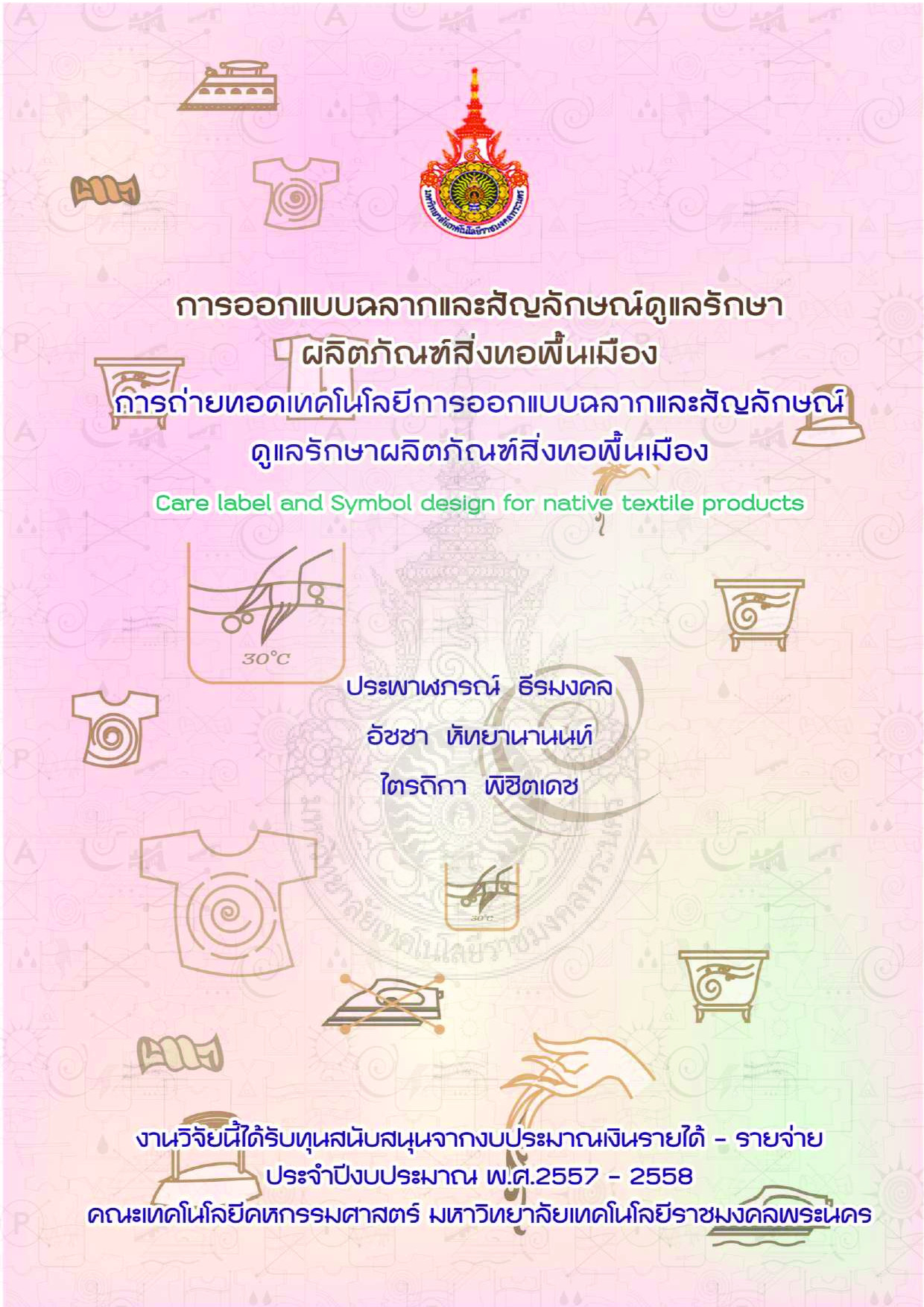
การออกแบบฉลากและสัญลักษณ์ดูแลรักษาผลิตภัณฑ์สิ่งทอพื้นเมือง
This research is Care label and Symbol design for native textile products. The purpose of this research were 1) to study and design the care label and symbol design of native textile products. 2) to design the care label and symbol design of native textile products and 3) to assessment the consumers satisfaction towards the care label and symbol design for native textile products. 4) to transfer knowledge towards the SMEs production communities about the care label and symbol design for native textile products. 5) to assessment the consumers satisfaction towards the care label and symbol design for native textile products. The research instruments used to collect data: 1) a draft care label and symbol design of native textile products of 6 types (10 prototypes) as 60 prototypes of washing bleaching spinning twisting and drying ironing and colour dropping. 2) Questionnaire of expert opinion and selective drafts for 3 models as 18 prototypes. 3) Questionnaire of consumers satisfaction towards the care label and symbol design for native textile product of 100 people: buyers sellers manufacturers and those interested in native textiles. The evaluation data was analyzed by using SPSS program in frequency mean and percentage. All in conclusion as table and descriptive. In the second research year the process are focus group people for transfer knowledge as SMEs community Enterprise OTOP production communities and other that it is interesting in this research : MEA-LA small enterprise in Singburi province PAMONT Hand-woven Communities in Ratchaburi province and Thai SONG-DUM Woven Ban-Sa-Kee-Rai in Nakhompathum province. To plan the schedule and set the date place amount of participate and lectures 102 people on 12 22 and 28 July 2015 and asking for consumer satisfaction of the curriculum and lecture for “transfer knowledge the care label and symbol design for native textile product” by Questionnaire of participate satisfaction. Last the evaluation data was analyzed by using SPSS program in mean and percentage. The First year’s research showed that mostly respondents were male at 59 percent aged 46 years at 52 percent and also being the entrepreneurs / business owners at 45 percent. 48 percent as bachelors degree and their income were an average of 20001 - 25000 baht at 46 percent. The analysis of consumers satisfaction can be concluded that the first types of care label and symbol design for native textile product at highest levels satisfaction is Colour dropping at 4.46. The next types is bleaching at 4.44 Washing at 4.42 Ironing at 4.38 Twisting and Drying at 4.32 and the last types is at least levels satisfaction is Spinning at 4.28 but all have been satisfied at maximum average and highest level of satisfaction. The research in the second year found that mostly participates were female aged 51 – 60 years old finished the secondary school and also there are farmer. The participates are their income under 5000 baht and They are moderately understanding symbol and care label but they are not make for their products. In relation to technology transfer of “the care label and symbol design for native textile product” divided into 3 parts it is also the curriculum and lecture for this research. The analysis of participate satisfaction It have been satisfied at maximum average and highest level of satisfaction in facilities. The participants are mainly used to provide benefits to themselves for one month to apply the gained after the training. The participants used care and symbol label for their products. Moreover a focus will be capped by the other communities to teach another one for working out. Satisfaction with the benefits of technology transfer and utilization. Satisfaction at the highest level. The comments and suggestions of the participants found that they need for re-training again. They would like to have a longer period of training in order to gain more knowledge. All lecturer can transfer knowledge during the training as well.
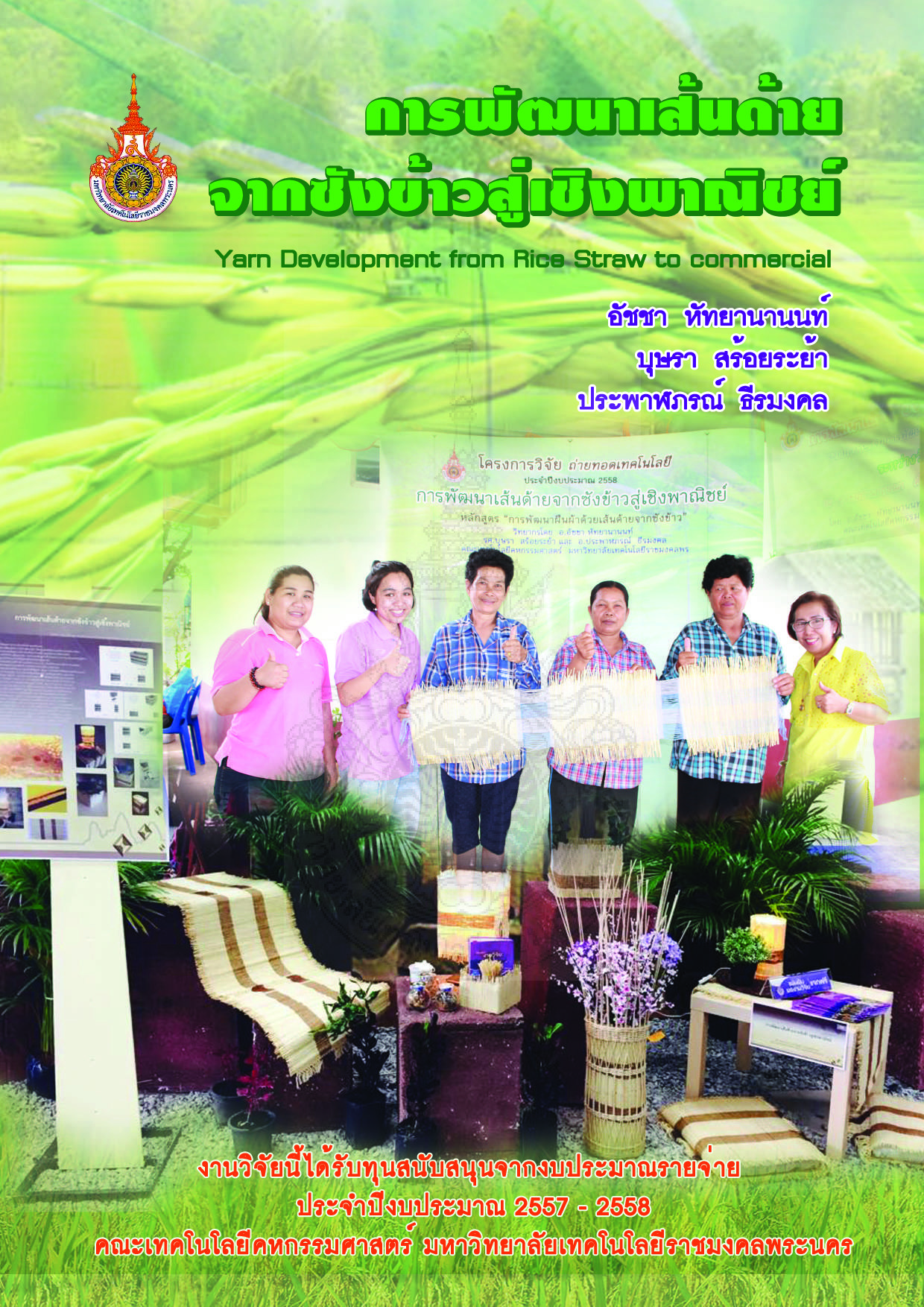
การพัฒนาเส้นด้ายจากซังข้าวสู่เชิงพาณิชย์
This research is Yarn Development from Rice straw to commercial. It aims to study the process of seperating fibers from rice straw. To study the physical properties of fibers from rice straw and to study the process of manufacturing yarn from rice straw fibers. The research material is rice straw fibers after that data was analyzed byphysical textile testing laboratory. The result of the first year’s research was the rice straw yarn has been developed as woven and develop into commercial products to promote. The process of separating fibers from rice straw which dried the sun for a few days. Selecting the rice straw fiber length at least 30 cm. to subtract the joints of the lower end of the stem by hand. peel off the rice straw fiber and place flat on a horizontal line. Then Rice straw fiber were tested in the physical laboratory was found that it is cellulose fibers tensile strength (Newton) at 28.18 elongation (percent) is at 2.01. The amounts of metals has plenty of CADMIUM at 0.1 mg/kg CHROMIUM (TOTAL) / (VI) at 0.5 mg/kg COPPER at 0.5 mg/kg and LEAD at 0.1 mg/kg which was not found to be risk for using. The fiber cross-section of rice straw fiber were found to be oval the middle is clearly. The fiber length is smooth and transparent when viewed from the side to see the clarity of the fiber. Rice straw fiber was weave in plain structure. Warp yarn uses a special brown cream and brown flat yarns. We use rice straw fiber with the same type of yarn. There are 2 warp yarn and using natural color without blench. Rice straw fabric was dyeing with dried hibiscus flowers (Kaa-Jeab herb) and mordant as ashes. The result is red light because of rice straw fiber surface is smooth and lustrous. Therefrom When woven as a fabric to develop be 4 products prototype : table lamps tablecloths in Japanese style potted plants and Accessories Box The result of the second year’s research there are focus group inquire for people it is interesting in this research and Date for transfer knowledge as: Ban-Krit-Sa- Na community Krit-Sa-Na sub-district bang-pra-ma district in Supanburi province. To plan the schedule and set the date place amount of participate and lectures 34 people The range of time to transfer as 3 days on 3 – 5 May 2015 and asking for consumer satisfaction of the curriculum and lecture for “transfer knowledge Yarn Development from Rice straw to commercial” by Questionnaire of participate satisfaction. Last the evaluation data was analyzed by using SPSS program in mean and percentage. The second year found that mostly participates were female aged under 21 years old finished the secondary school and also there are farmer. The participates are their income under 5000 baht and no income. For the participates questions relation to technology transfer of “Yarn Development from Rice straw to commercial” about course divided into 3 parts: The purpose The curriculum and The knowledge. The satisfaction of participates about project divided into 3 parts: Service process Lecturer and Facilities found that have been satisfied at maximum average and highest level of satisfaction in every parts of both satisfied participates questions. The participants are mainly used to provide benefits to themselves for one month to apply the gained after the training. Satisfaction with the benefits of technology transfer and utilization. Satisfaction at the highest level the participants used knowledge to apply with local and waste material. Moreover the participates make product as soon as finish course and they are planning to produce the table Hand Woven for weaving the Rice straw yarn fabric and push it to be OTOP products. The comments and suggestions of the participants found that they need for re-training again. They would like to have a longer period of training in order to gain more knowledge. All lecturer can transfer knowledge during the training as well.
วัฒนธรรมการแต่งกายชุดย่าหยาและรองเท้าปักของสตรีอำเภอเมือง จังหวัดภูเก็ต
The purposes of this research were to 1) investigate the history of Chinese settlement in Phuket 2) examine the culture of Yaya clothing and stitched women’s shoes 3) study the pattern of Yaya clothing and stitched women’s shoes and 4) analyze the suitability of the city circumstance and clothing. The researcher studied the document and the pictures and collected the data by using Non-Participant Observation to observe the behavior of Chinese Violet (Yaya) clothing and stitched women’s shoes in Mueng district Phuket province and conduct in-depth interview with 8 field specialists. Snowball sampling was used to select key informant. Data were analyzed by descriptive analysis. The results were found that during the reign of King Rama III and King Rama V Hokkien Chinese from Southern and Eastern China migrated to Phuket by the junk boat. Mining is the major source of income of Chinese in Phuket others are merchandising fishing and agriculture. Most of Chinese got married with other local Thai people. We call them “Baba” for the people of mixed Thai and Chinese heritage. For the culture of Yaya clothing and stitched women’s shoes in Mueng district Phuket province it was found that in the previous days the daily women clothing was the straight- point collar shirt with pleated sleeves and Pateh skirt. In the auspicious occasions women wore long evening gowns and made a high hair bun. Later wearing a long evening gown was adapted to be the short one according to the weather and circumstance and for better movement; Yaya shirt became popular because of its ventilation. Yaya clothing and stitched women’s shoes were designed into various patterns such as animals flowers and plants and nature. Stitched women’s shoes were made from laces or beads. The stitch pattern meant good luck and propitiousness. Both Yaya clothing and stitched women’s shoes were designed by the owners and inherited from generation to generation. For the result of the study about the suitability of the city circumstance and clothing it was found that Yaya clothing is beautiful and unique; however it is not suitable to wear in daily life because it is too thin and easily torn. At present Phuket people cannot stitch the shoes themselves and they have to import them from Penang and Melaka with high price; consequently it is not popular whil high heeled shoes are more popular. Anyway Yaya clothing is conserved and restored to express its uniqueness and it is the strength of Phuket’s tourist attraction. Yaya clothing is back and adapted to changing society culture and circumstance.