จำนวน Repository ( 534 )

Rajamangala University of Technology Phra Nakhon and Its Social Service Role : Case study on the
Rajamangala University of Technology Phra Nakhon had signed an MOU with the Ministry of Science and Technology to set up a Clinic Technology in January 2003. The Clinic has operated since the fiscal year 2004 with subsidiary from the Ministry of Science and Technology. It has a main duty in transferring technology providing consulting and information services on technology research and development and distributing knowledge and insight in science and technology. In 2005 the Clinic received a budget of 3278100 baths in 9 projects that provided service for 4171 persons. In 2006 a budget of 1786500 baths was allocated for 6 projects that provided service for 2017 persons. In 2007 it received a budget of 2622000 baths in 12 projects that provided services for 2874 persons. The Clinic has achieved a success in reducing expense increasing income and enhancing life quality of communities. It obviously has an important role in integrating research work into technological transfer and economic development of communities.
Rajamangala University of Technology Phra Nakhon : Case study
Since its original inception under the name of Rajamangala Institute of Technology and now as the Rajamangala University of Technology Phra Nakhon RMUTP has a long history of initiating research projects in order to help develop and improve the overall well-being of the Thai population and the countryûs economy. The Banana Product Development Project was one such research project that was established to serve the community. Its objective was to solve the banana problem in the local Thai community; that is the problem of having more bananas as a result of low consumer demand. The project findings would therefore create new innovations to help the community and develop its economy. This research project was started in 1976 and from around 1997 has been transferring the research result to the communities. The project is still currently active and highly successful. It has won awards in both national and international competitions as a result of successful developments which include for example the establishment of a Thai Banana Club Banana Product Development as a result of extended research and technological improvements in order to help the community the economy and local industries
Technology Transfer on Banana Flour and Food Products
The project aimed to construct and disseminate knowledge on banana flour and food products through media; to transfer technology by conducting the workshop training on banana flour and food products and to follow up knowledge implementation for community market testing. Project was done by preparing contents materials equipments sites taking photos gathering data producing original media producing VCD training need analysis preparing training program evaluating and following up the training achievement. The result of the project was found that 500 VCD cases were constructed for 85 trainees. Percentages of the project achievement was 99.16%. There was a significant difference between pre-test and post-test of the knowledge at .05 level. Mean of the achievement in creating quality work was at 4.30. The achievement percentages of implementing how to make banana flour baked dessert and Thai dessert for community market testing was 12.5%.
Technology Transfer to Community for Existing Career Development and New Career Creation
This project has three main purposes: to provide training courses for producing and packaging of food textile craft and handicraft community products; to conduct a workshop for initial quality evaluation of community products and their packages; and to encourage the community to develop its products according to Thai Community Product Standard. The methodology of the project included assessing need for technology transfer; preparing the project; appointing the committee; recruiting trainees; inviting speakers; preparing instructors documents place and facilities; conducting the training course; and following up project achievement. Results from the 20 training courses with 204 target trainees revealed satisfaction in training at the level of 83.20%. About 46.15% of the trainees were ready for the community product standard guarantee and 33.17% were able to create new careers.
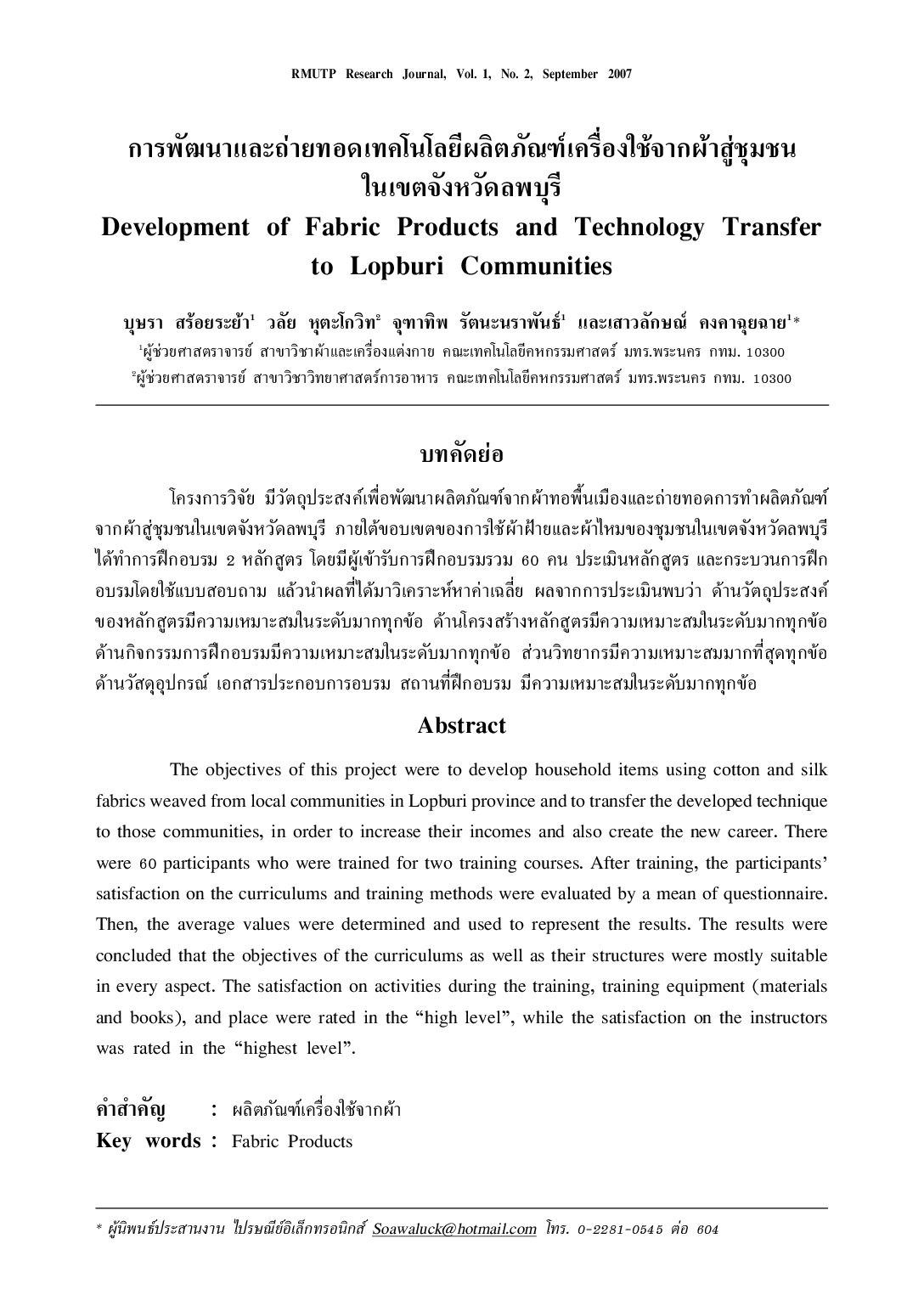
Development of Fabric Products and Technology Transfer to Lopburi Communities
The objectives of this project were to develop household items using cotton and silk fabrics weaved from local communities in Lopburi province and to transfer the developed technique to those communities in order to increase their incomes and also create the new career. There were 60 participants who were trained for two training courses. After training the participants’ satisfaction on the curriculums and training methods were evaluated by a mean of questionnaire. Then the average values were determined and used to represent the results. The results were concluded that the objectives of the curriculums as well as their structures were mostly suitable in every aspect. The satisfaction on activities during the training training equipment (materials and books) and place were rated in the “high level” while the satisfaction on the instructors was rated in the “highest level”.