จำนวน Repository ( 3 )

การพัฒนาและสร้างสรรค์บรรจุภัณฑ์ด้วยกลวิธีเปเปอร์มาเช่
This study aims to study the use of recycled paper as a new material. To develop and create a packaging Paper Mache can be used to substitute for wood and plastic in packaging for storing items and for reducing waste from paper and plastic. They can be utilized in real life and to study the satisfaction of small packaging with papermaking. The sample is General Population Consumers using made of wood and plastic. The tool used was a questionnaire with 100 people randomly generated. Data were analyzed using percentage mean and standard deviation testing for the value of the F test. The results showed that 5 experts found that 4 persons were satisfied with the results of the study. The average was 4.60 satisfied with the development and creation of packaging by Paper Mache. The target group of 100 people is at a high level. The average was 4.12 4.09 4.05 4.05 as follows: 1. Experts were satisfied with the results of the study developed and produced the packaging with the papermaking technique. It was found that 5 experts found that 4 persons gave the overall opinion about the characteristics of the paper pulp formula 2 was an average of 4.60. At most levels on the texture aspect (before dryness) the average was 4.75 The highest level can be used to actually have an average. 4.60 Moisture content was at the highest level of 4.50 And for liquid absorption and texture the average dry weight was 4.40 at the highest level 2. There was satisfaction with the development and creation of packaging with Paper Mache. It was found that 100 consumers of plastic packaging were satisfied with plastic flower pots at a high level 4.12 in average followed by multi-purpose boxes. The average level was 4.09 and the small scale was 4.05 and the bin was dry. (For home use) at a high level. The mean score was 4.05
มาตรฐานน้ำดื่มบรรจุขวดที่จำหน่ายในจังหวัดอ่างทอง
In this study water quality standard of bottled drinking water distributed in Ang Thong Province was investigated. The results showed that clear plastic bottled drinking water presented completely label information and MFD./EXP. clearly appearance and odourless presented in all samples while Total Dissolved Solid (TDS) of tested clear plastic bottled drinking water samples were in a range of 1±0.00 to 277±0.00 mg/L. Coliform bacteria and fecal coliform bacteria of all tested water samples were less than 2.2 MPN/100 mL and E. coli and total heterotrophic bacteria were not found in all samples. pH values of 18 tested samples were less than 6.5 (60.00%) plastic bottled drinking water samples. Tested opaque plastic bottled drinking water samples showed completely label information and MFD./EXP. clearly appearance and odourless found in all samples while TDS of tested opaque plastic bottled drinking water samples were in a range of 12±0.00 to 13±0.00 mg/L. Coliform bacteria and fecal coliform bacteria of tested water samples were less than 2.2 MPN/100 mL and E. coli and total heterotrophic bacteria were not found in all samples. pH values of 3 tested samples were less than 6.5 (100.00%). Indeed assessment of both types of bottled drinking water samples distributed in Ang Thong Province Thailand based on 6 qualities assessment of standard for drinking water in sealed container set by Ministry of Public Health of Thailand revealed that the tested clear and opaque plastic bottled drinking water samples met the standard for 40.00% and 0% based on pH respectively.
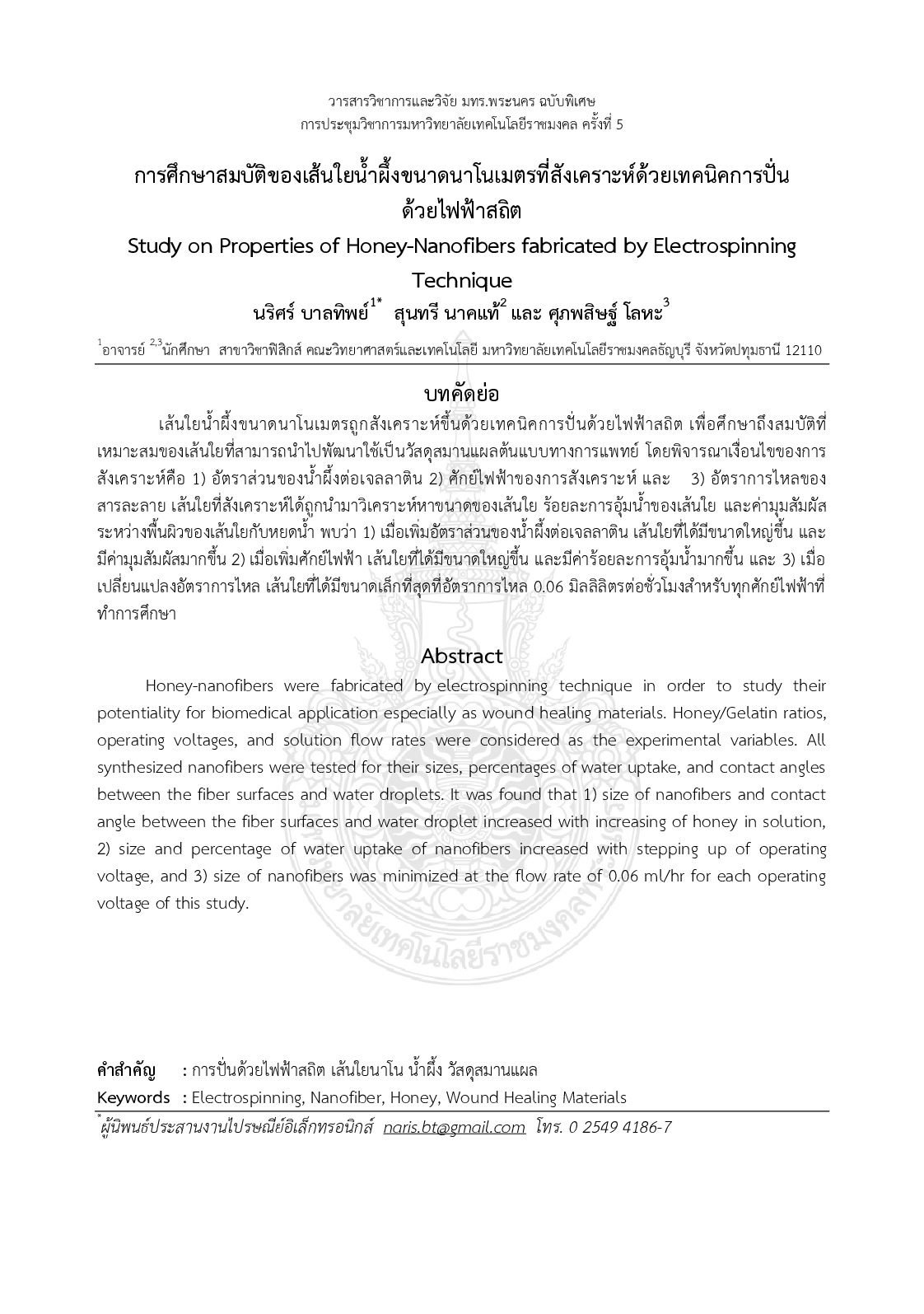
Study on properties of honey-nanofibers fabricated by electrospinning technique
Honey-nanofibers were fabricated by electrospinning technique in order to study their potentiality for biomedical application especially as wound healing materials. Honey/Gelatin ratios operating voltages and solution flow rates were considered as the experimental variables. All synthesized nanofibers were tested for their sizes percentages of water uptake and contact angles between the fiber surfaces and water droplets. It was found that 1) size of nanofibers and contact angle between the fiber surfaces and water droplet increased with increasing of honey in solution 2) size and percentage of water uptake of nanofibers increased with stepping up of operating voltage and 3) size of nanofibers was minimized at the flow rate of 0.06 ml/hr for each operating voltage of this study.