จำนวน Repository ( 4 )
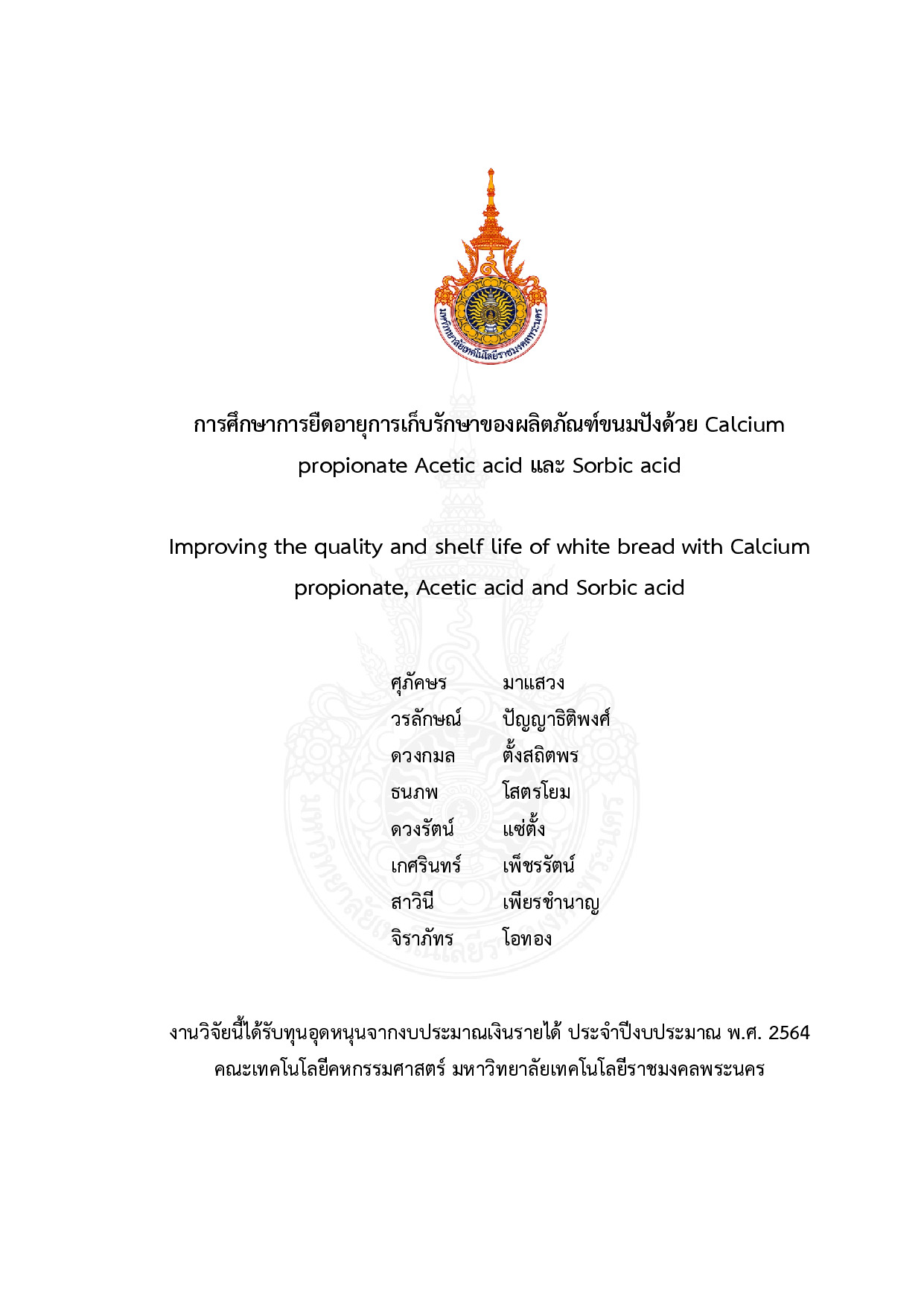
การศึกษาการยืดอายุการเก็บรักษาของผลิตภัณฑ์ขนมปังด้วย calcium propionate, acetic acid และ sorbic acid
White bread has a short shelf life thus the loses its desired charcteracteristics upon storage and its also subject to spoilage by fungi. To avoid this spoilage and increase shelf life the addition of different levels of acidulants (calcium propionate acetic acid and sorbic acid at 0.1 0.2 and 0.3%) were evaluated for their quality characteristics contributing with acidulants as well as their microbial shelf life during 12 days of storage. In addition the mathematical model (GAB and BET) were applied to study the storage condition of bread. From the experiment it was found that bread with calcium propionate addition had the highest specific volume and springiness followed by bread with acetic acid and sorbic acid adding. On the other hand bread contained sorbic acid had the highest density hardness chewiness and color values (L* a*b*) followed by acetic acid and calcium propionate addition in order. Bread contained calcium propionate had the longest shelf life (12 days) followed by bread with acetic acid (8 days) and sorbic acid (6 days) adding respectively. The increase in acidulants levels result in an increase of bread shelf life. From the sorption isotherm curves bread contained 0.3% calcium propionate had the highest monolayer moisture content indicating that it was the most effective against microbrial spoilage of white bread studied.

ความเป็นพิษร่วมของเอทิลีนไดเอมีนเตตระอะซิติกแอซิดและสารลดแรงตึงผิวสังเคราะห์ต่อแหนเป็ดใหญ่และแหนเป็ดเล็ก
Using of ethylenediaminetetraacetic acid (EDTA) and synthetic surfactant increase the chemical contamination in water. The co-phytotoxicity of EDTA (0-20 mg/l) and 3 synthetic surfactants; Triton X-100 (0-10xCMC) Tween 80 (0-10xCMC) and sodium dodecyl sulfate (SDS) (0-2 x CMC) on the growth of 2 duckweeds spirodela polyrrhiza and Lemma perpusilla were studied for 3 days. The results showed that the surfactant were phytotoxic on the growth of both plants while EDTA was not. SDS was the most toxic to plant especially on all chlorophyll content. Triton X-100 was only toxic to the growth of L. perpusilla and weight of S. polyrrhiza. Tween 80 was less or the least toxic to both plants. This surfactant only decreased chlorophyll a and total chlorophyll content of S.polyrrhiza and L. perpusilla. There was not any interaction between EDTA and surfactant on most toxicity tests. With these results synthetic surfactant contamination should be more concerned than co-contamination with EDTA.
The Efficacy of Peroxyacetic Acid and Sodium Hypochlorite Solutions in Reducing Microorganisms on the Surface of Carved Fruits and Vegetables
This study examined the efficacy of two sanitizers; peroxyacetic acid (PAA) and sodium hypochlorite (NaOCl) in reducing total microbial counts on the carved leaf-shape surface of five types of fruits and vegetables: pumpkin carrot radish cantaloupe and Japanese cucumber. The samples were dipped for 3 or 5 min in various concentrations of PAA (40 60 or 80 mg/L) and NaOCl (50 or 75 mg/L) with distilled water as the control. After dipping the samples were drained for 5 min and the total plate counts were determined in triplicate. Dipping in 60 mg/L of PAA for 3 min was the best treatment for reducing microorganisms on the surface of carved carrot and radish; and 80 mg/L of PAA for 5 min was the best treatment for reducing microorganisms on the surface of carved pumpkin cantaloupe and Japanese cucumber. PAA at concentration 60 -80 mg/L showed potential as an effective sanitizer for carved fruits and vegetables more so than both concentrations of NaOCl.
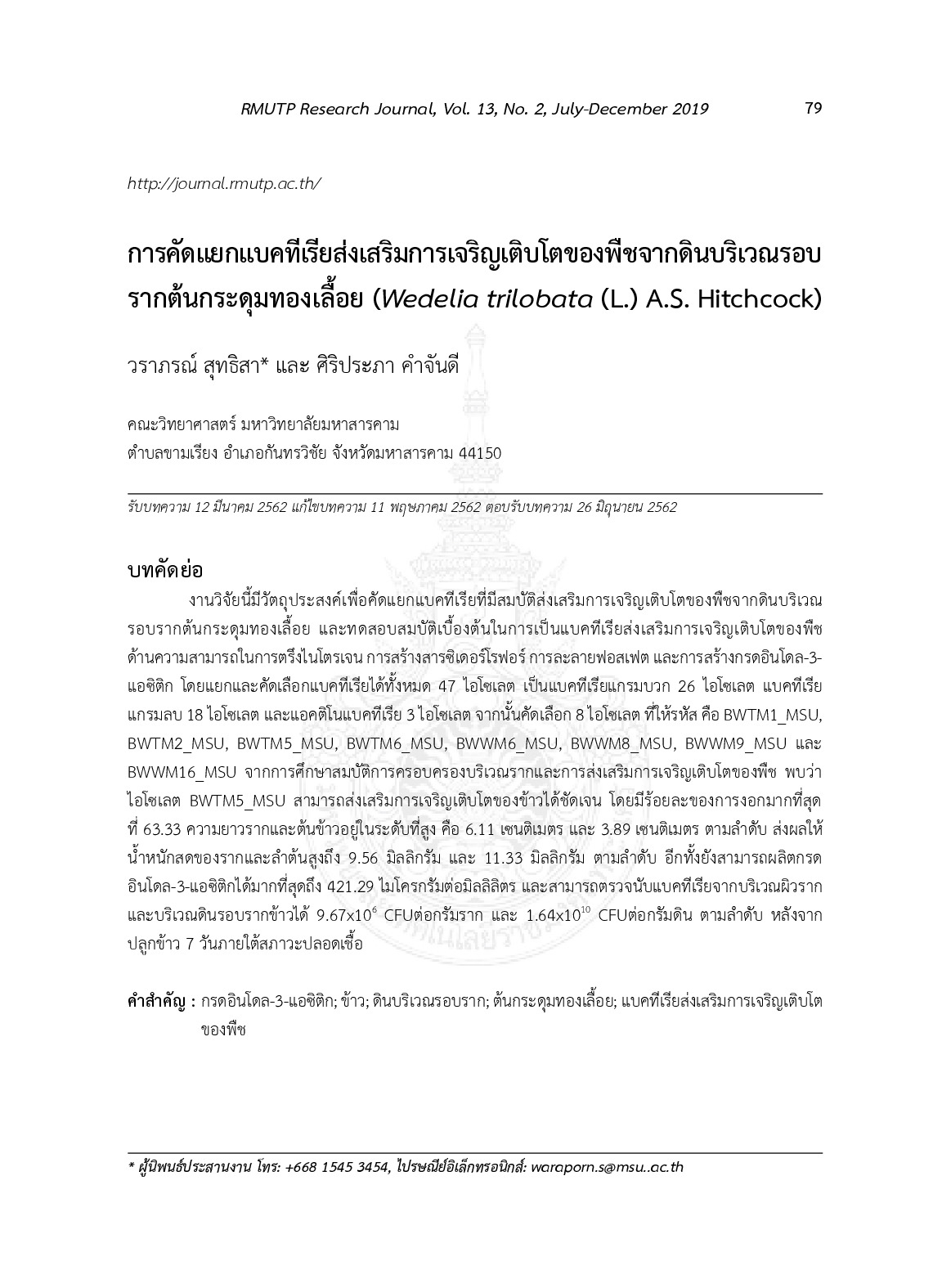
การคัดแยกแบคทีเรียส่งเสริมการเจริญเติมโตของพืชจากดินบริเวณรอบรากต้นกระดุมทองเลื้อย (Wedelia trilobata (L.) A.S. hitchcock)
The objective of this research was to isolate plant growth promoting rhizobacteria from Wedelia trilobata (L.) A.S. Hitchcock rhizosphere and preliminarily test their plant growth promoting properties such as nitrogen fixation siderophore production phosphate solubilization and indole-3-acetic acid production. Forty-seven bacterial isolates were obtained including 26 isolates of gram positive 18 isolates of gram negative and 3 isolates of actinobacteria. After that 8 isolates (including BWTM1_MSU BWTM2_MSU BWTM5_MSU BWTM6_MSU BWWM6_MSU BWWM8_MSU BWWM9_MSU and BWWM16_MSU) were selected for studying on root colonization and plant growth promoting properties under aseptic condition. The results showed that BWTM5_MSU had the evident on the promotion of plant growth with the most percentage of rice seed germination (63.33%) high level of root and shoot length with 6.11 cm and 3.89 cm respectively. As a result the root and shoot fresh weight was as high as 9.56 mg and 11.33 mg respectively. It also correlated with the highest production of indole-3-acetic acid up to 421.29 ug/ml. The root colonization was studied by counting rhizobacteria isolate BWTM5_MSU from rice rhizoplane and rhizosphere with presented bacterial number at 9.67x10⁶ CFU/g root and 1.64x10 10 CFU/g soil respectively.