จำนวน Repository ( 26 )
กำลังและความต้านทานการกัดกร่อนของมอร์ต้าร์ที่ใช้วัสดุประสานกระตุ้นด้วยด่างจากเถ้าถ่านหินแคลเซียมสูง
The aim of this study is developed of alkali activated high calcium fly ash to use as cementitious material to replace Portland cement. The mixture of mortar made from fly ash and sodium hydroxide solution (NaOH) was used to activate strength at concentrations of 2 4 6 and 8 molars. Superplasticizer was used to control the flow of mortar in the rage of 105 – 110. The compressive strength of mortar was determined at 7 28 45 and 60 days. The acid resistance of mortars due to sulfuric at a concentration of 3% were also investigated. The results showed the mortar made from high calcium fly ash with sodium hydroxide of 6 molar obtained the highest compressive strength which could be developed compressive strength up to 189 ksc at 60 days. For the acid resistance of mortar it was found that the of use 6 molar of NaOH activated high calcium fly ash binder had the least weight loss due to sulfuric acid attack.
ผลของเส้นใยธรรมชาติและการปรับปรุงผิวที่มีต่อสมบัติทางความร้อนและกายภาพของพอลิแลคติกแอซิด
his research work aimed to study the effects of the addition of sisal fiber and surface treatment by epoxy silane on the physical and thermal properties of polylactic acid (PLA). Specimens of PLA and unidirectional fiber-reinforced composite were processed by a compression molding machine and evaluated the physical and thermal properties by water absorption measurement and differential scanning calorimetry (DSC) analysis respectively. The result showed that water absorption tended to increase by adding sisal fiber whereas surface treatment of sisal fiber by epoxy silane improved water resistance of composites. The water absorption values at immersion time of 5 days were 0.89 1.13 and 1.26 % for PLA PLA/treated sisal fiber composite and PLA/untreated sisal fiber composite respectively. For thermal properties the addition of sisal fiber led to decreases in glass transition temperature and crystallinity. These were because the presence of continuous fiber might interfere with the crystallization of PLA. The surface treatment of continuous fiber with epoxy silane led to difficult crystallization. The good interfacial adhesion interrupted PLA alignment.
แบบจำลองพื้นผิวตอบสนองและการหาสูตรอาหารที่เหมาะสมสำหรับการเพิ่มการผลิตกรดแกมมา-ไลโนเลนิกในมอส Physcomitrella patens โดยใช้วิธีพื้นผิวตอบสนอง
The objective of this study is to obtain a model that maximize production of γ-linolenic acid (GLA) by the moss Physcomitrella patens employing response surface methodology (RSM). The RSM with a three-variables (sucrose potassium nitrate and glutamate concentrations) and five-level (-2 -1 0 1 and 2) central composite design (CCD) including 20 experimental runs was employed to optimize the medium composition. Results showed that the experimental data could be appropriately fitted into a second-order polynomial model with a coefficient of determination (R2) more than 0 .9 5 for GLA production. Analysis of variance (ANOVA) revealed that the model was highly significant (p<0.0001) and the effects of the sucrose (20-100 g/L) and glutamate (0.5-2.5 g/L) concentrations on GLA production were significant (p<0.05). The GLA production with the optimized culture medium (sucrose concentration of 62.92 g/L potassium nitrate of 0.80 g/L and glutamate concentration of 1 .4 2 g/L) by RSM increased 4.61 folds when compared with the standard BCD medium. This experimental value (16.37 mg GLA/L) fit well with the predicted values (16.20 mg GLA/L).
การศึกษาการยืดอายุการเก็บรักษาของผลิตภัณฑ์ขนมปังด้วย calcium propionate, acetic acid และ sorbic acid
White bread has a short shelf life thus the loses its desired charcteracteristics upon storage and its also subject to spoilage by fungi. To avoid this spoilage and increase shelf life the addition of different levels of acidulants (calcium propionate acetic acid and sorbic acid at 0.1 0.2 and 0.3%) were evaluated for their quality characteristics contributing with acidulants as well as their microbial shelf life during 12 days of storage. In addition the mathematical model (GAB and BET) were applied to study the storage condition of bread. From the experiment it was found that bread with calcium propionate addition had the highest specific volume and springiness followed by bread with acetic acid and sorbic acid adding. On the other hand bread contained sorbic acid had the highest density hardness chewiness and color values (L* a*b*) followed by acetic acid and calcium propionate addition in order. Bread contained calcium propionate had the longest shelf life (12 days) followed by bread with acetic acid (8 days) and sorbic acid (6 days) adding respectively. The increase in acidulants levels result in an increase of bread shelf life. From the sorption isotherm curves bread contained 0.3% calcium propionate had the highest monolayer moisture content indicating that it was the most effective against microbrial spoilage of white bread studied.
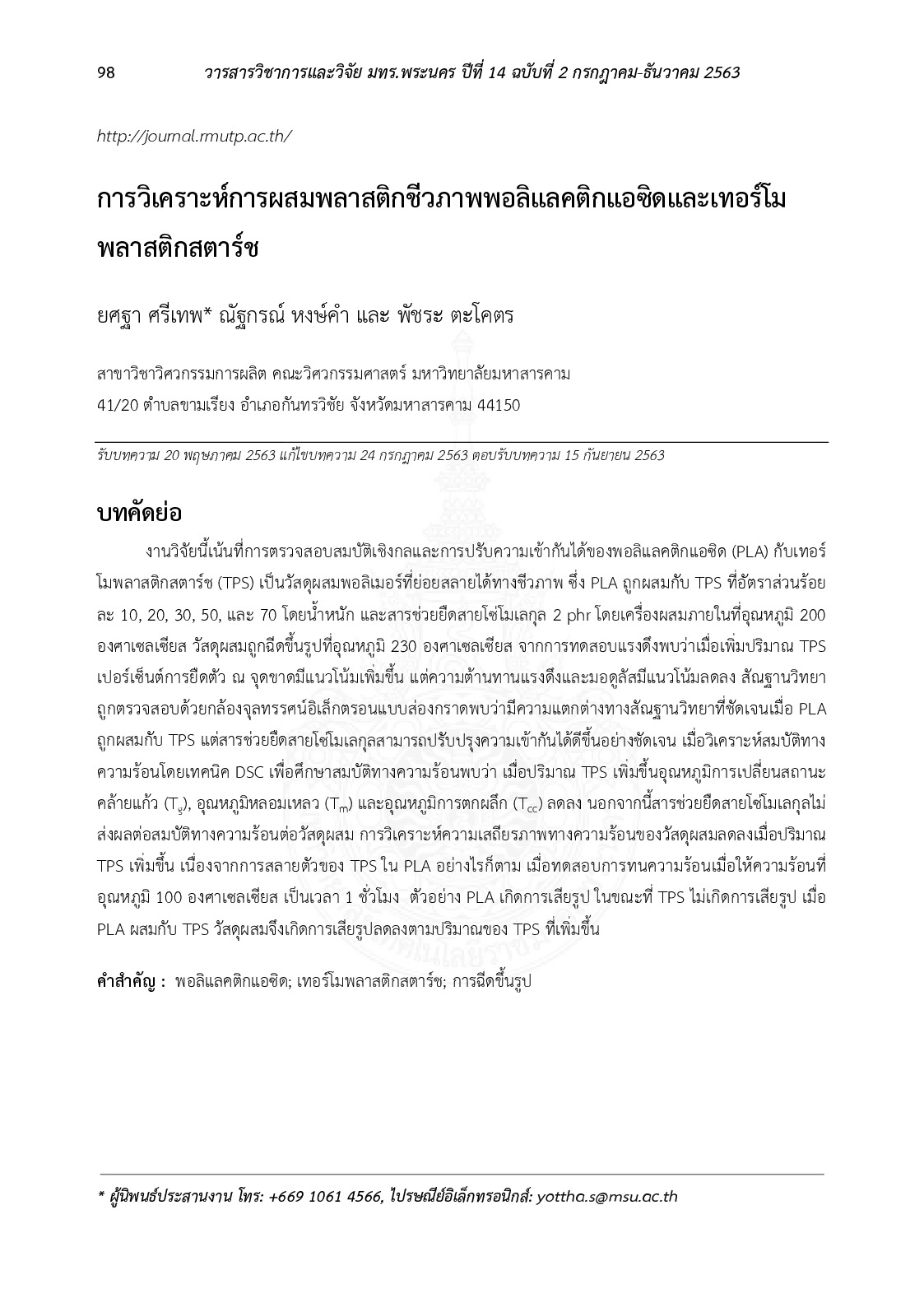
การวิเคราะห์การผสมพลาสติกชีวภาพพอลิแลคติกแอซิดและเทอร์โมพลาสติกสตาร์ช
This research was concentrated on characterized mechanical properties and adjusted compatibility of poly (lactic acid) (PLA) with thermoplastic starch (TPS) as biodegradable polymers composites. PLA was blended with TPS at the proportion of 10 20 30 50 and 70 wt% as well as 2 phr chain extender by an internal mixer at 200°C. The blended materials were then injection molded at 230°C. Tensile testing showed that as the amount of TPS increase the elongation at break tended to increase but the tensile strength and modulus tended to decrease. The morphology was investigated by scanning electron microscope. It was found that distinct phase between PLA and TPS was observed. Yet adding the chain extender clearly improved the compatibility between PLA and TPS. The blended materials were also analyzed by differential scanning calorimetry method to study thermal properties. It was found that as the amount of TPS increased the glass transition temperature (Tg) melting temperature (Tm) and cold crystallization temperature (Tcc) deceased. Additionally chain extenders did not affect thermal properties. The thermal stability of the composites decreased when increasing the amount of TPS because of the degradation of TPS in PLA. However when heated at 100ºC for 1 hr the PLA sample bent while TPS did not bend. When PLA was mixed with TPS the composite was bent according to adding TPS.