จำนวน Repository ( 11 )

The development of knowledge on playing thai chess through the computer assisted instruction (cai) : case study group of young thai people
The research is conducted how to learning and to play chess by making program Computer Assisted Instruction (CAI) to delivery of learning materials and documentation to 1000 schools in area responsible of the Office of The Basic of Education to stimulating activities and learning Thai chess. Exploring the need of young chess players the researcher gathering information by using questionnaire. The quantitative research based on a population sample. The third of the popularity are young people aged between 7-12 years youth aged 12-18 years and young people aged more than 18 to 22 years. The results showed that schools in the north to meet the highest rate of 87.18 percent compared to young chess players do in Thailand mostly young men. The 71.75 percent of the youth in learning to play Thai chess through the ages between 7-12 years old 36.00 percent were in elementary school. The 39.25 percent of the most experienced and know to play is 58.00 percent. The recommendation and comment on the online chess the average levels of good. The people who had experience after playing online chess score average level of very good. Which indicates that playing thaichess through learning this research has been used to do chess players and much wider. Improve playing skills. Be the number of ideas and Thailand culture in the young group of players.
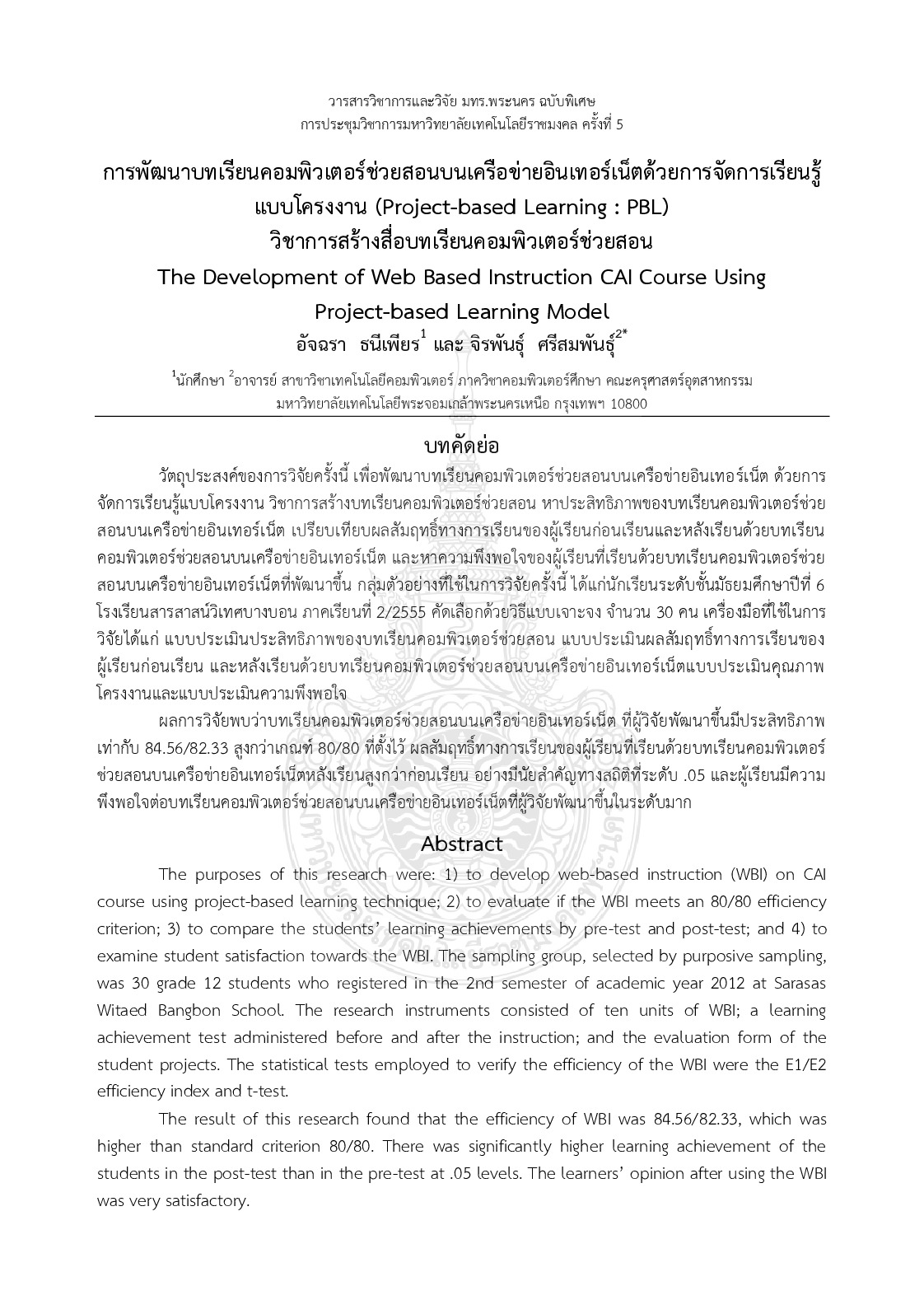
The development of web based instruction CAI course using project-based learning model
The purposes of this research were: 1) to develop web-based instruction (WBI) on CAI course using project-based learning technique; 2) to evaluate if the WBI meets an 80/80 efficiency criterion; 3) to compare the students’ learning achievements by pre-test and post-test; and 4) to examine student satisfaction towards the WBI. The sampling group selected by purposive sampling was 30 grade 12 students who registered in the 2nd semester of academic year 2012 at Sarasas Witaed Bangbon School. The research instruments consisted of ten units of WBI; a learning achievement test administered before and after the instruction; and the evaluation form of the student projects. The statistical tests employed to verify the efficiency of the WBI were the E1/E2 efficiency index and t-test. The result of this research found that the efficiency of WBI was 84.56/82.33 which was higher than standard criterion 80/80. There was significantly higher learning achievement of the students in the post-test than in the pre-test at .05 levels. The learners’ opinion after using the WBI was very satisfactory.
การเปรียบเทียบความสามารถการแยกแยะเนื้อหาตามระดับความรู้ผู้เรียนของครูที่เรียนรู้ด้วยสื่อ CAI กับการเข้ารับการฝึกอบรมสำหรับการสอนปฏิบัติคอมพิวเตอร์
There are three main purposes of this research. The first is to compare teachers ability in classifying content by students knowledge level before and after learning. The second is to study difference of pretest and posttest score according to students level. The third is to compare ability and determine efficiency in classifying content by duration of teaching experiences. Samples in this study were 30 teachers from Rajamangala University of Technology who leamed through CAI media (15 teachers) and who attended computer training course (15 teachers). The questionnaire was used to measure their ability in classifying content by students knowledge level. Results of the study can be concluded as follows: 1. Teachers ability in classifying content before and after leaming differed significantly at the level of 0.05. Howeverability in classifying content after leaming did not show significant statistical difference. 2. The difference in pretest and posttest scores showed that leaming with CAI could increase level of teachers ability in classifying more than attending training courses. 3. Teachers with different duration of teaching experience showed significant different ability in classifying content by students knowledge level at the level of 0.05. 4. Teachers with more than 7 years of teaching experiences showed the highest efficiency in classifying content.
การพัฒนากลุ่มจังหวัดภาคกลางตอนล่าง 2 เป็นเมืองท่องเที่ยวอัจฉริยะ ภายใต้กรอบแนวคิด BCG Economy
This study Development of lower central provinces 2 as smart city tourism under the concept of BCG Economy aims to study guidelines for the development of lower central provinces 2 to be smart tourism cities under the concept of BCG Economy. The research employed a Mixed Methods Research.The quantitative research sample was 400 tourists who travel in lower central provinces 2 the research tools was a questionnaire with open-ended questions. the data is described by frequency percentage and standard deviation and qualitative research is 20 key informant the research tool was an open-ended questionnaire for in-depth interviews. Most participants were female 20-29 years old had obtained a bachelor degree employment monthly income in the range of 20001-30000 baht experience travel trip in lower central provinces 2 6 time or more spend 3001-4000 baht per trip 2 days per trip tourists travel for a vacation during the months of November to December. Suggestions for the development of lower central provinces 2 to be smart tourism cities under the concept of BCG Economy. 1.use appropriate technology for tourism 2.use technology that tourists can easily use 3.promote community tourism 4. create awareness among tourists to cherish tourism resources. 5. relevant agencies should work together. 6. there should be research studies and apply the research results correctly.
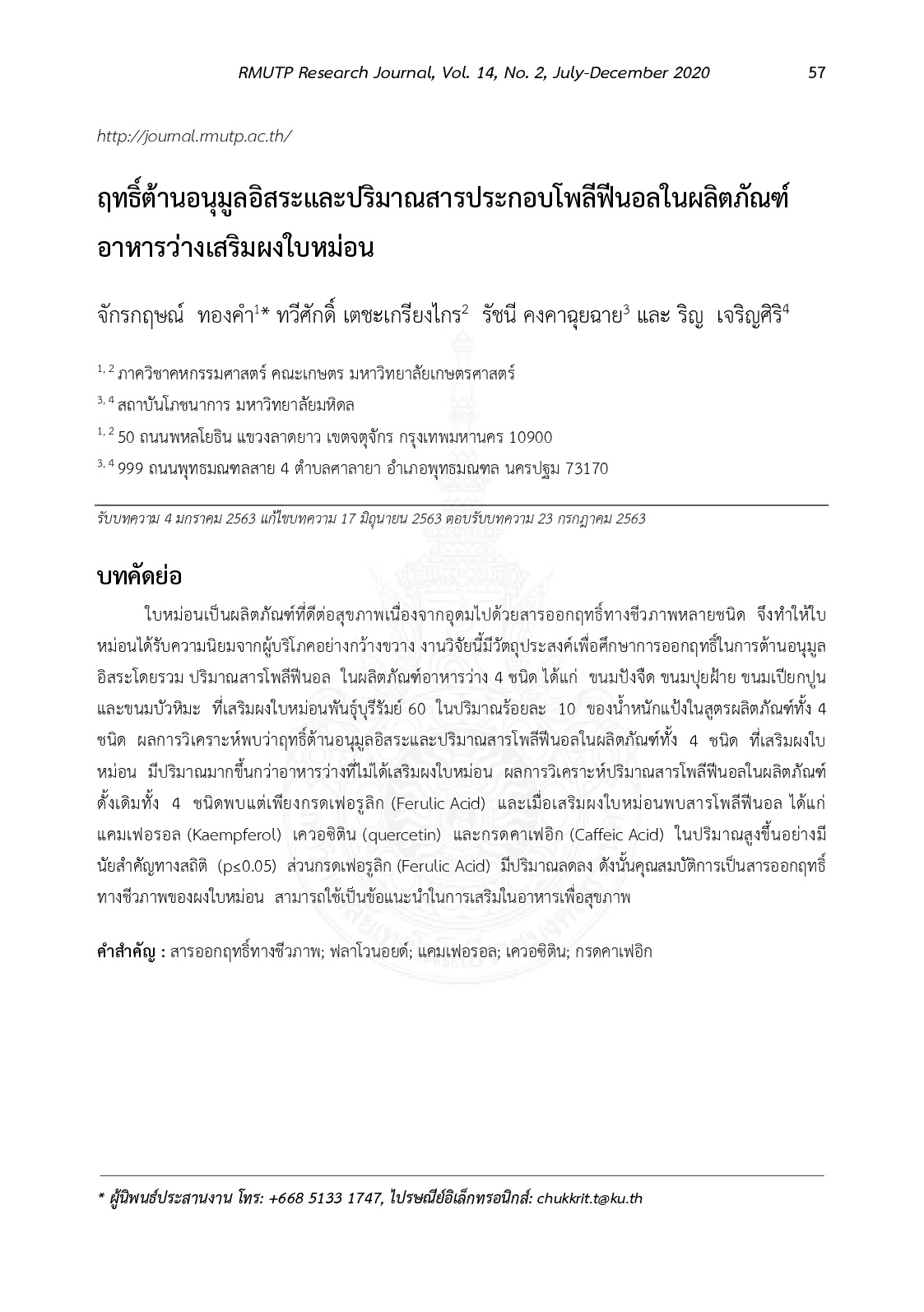
ฤทธิ์ต้านอนุมูลอิสระและปริมาณสารประกอบโพลีฟีนอลในผลิตภัณฑ์อาหารว่างเสริมผงใบหม่อน
The potential health benefits attributed to mulberry leaf and its bioactive compounds have led to a huge increase of mulberry leaf products in the food market. The objective of this research was to determine total antioxidant activities ( FRAP and DPPH assays) and polyphenol compounds in 4 snack products i.e. loaf-bread puifai (Thai steamed cupcakes) peakpoon (Green coconut sweet pudding) and snow skin mooncake fortified with 10% mulberry leaf powder from “ Buri Rum 60” cultivar. The result showed that antioxidant activities and polyphenol contents increased in 4 products fortified with mulberry leaf powder. Ferulic acid was the only phenolic compound found in all original products. Kaempferol quercetin and caffeic acid were significantly increased whereas ferulic acid was reduced in the modified formulas. Therefore these bioactive compounds properties of mulberry leaf powder suggested their possible use for fortifying the healthy foods.