จำนวน Repository ( 26 )
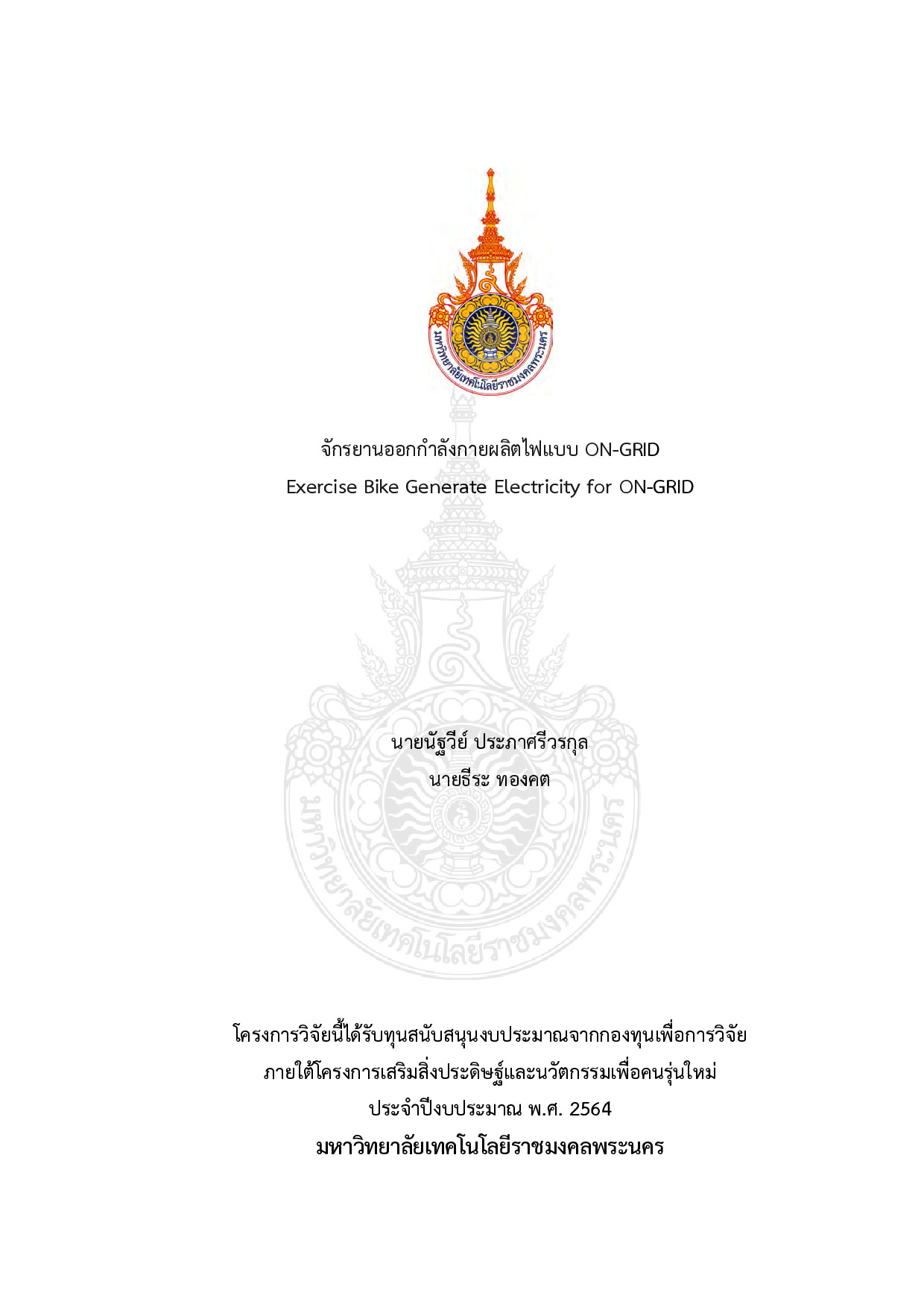
จักรยานออกกำลังกายผลิตไฟแบบ ON-GRID
This Project presents electric bicycle. The structural feature is the use of the bicycle to be modified as it is designed to spin the rotor of the 5-phase magnetic line generator set and test the voltage distribution. The principle of operation of electric bicycles relies on the mechanical energy gained from cycling. The rotor consists of a series of permanent magnetic poles intersecting with a stator consisting of a set of conductor coils generating an AC voltage and converting it from AC to DC through a diode bridge to obtain DC voltage. To be connected to the boost converter to increase the output side pressure level to get the right voltage to charge a 12 volt battery. batteries. The test has been tested for cycling to generate electricity at a speed of 400 rpm while no-load has a voltage of 23.3 volt and with a load per load and at a speed of 400 rpm the voltage is 12.1 volt If the bicycle is cycled at an increased speed the voltage and current will increase. In order to transmit electric power to the single-phase power system an inverter is used to connect the single-phase power system to transmit to the single-phase power grid.
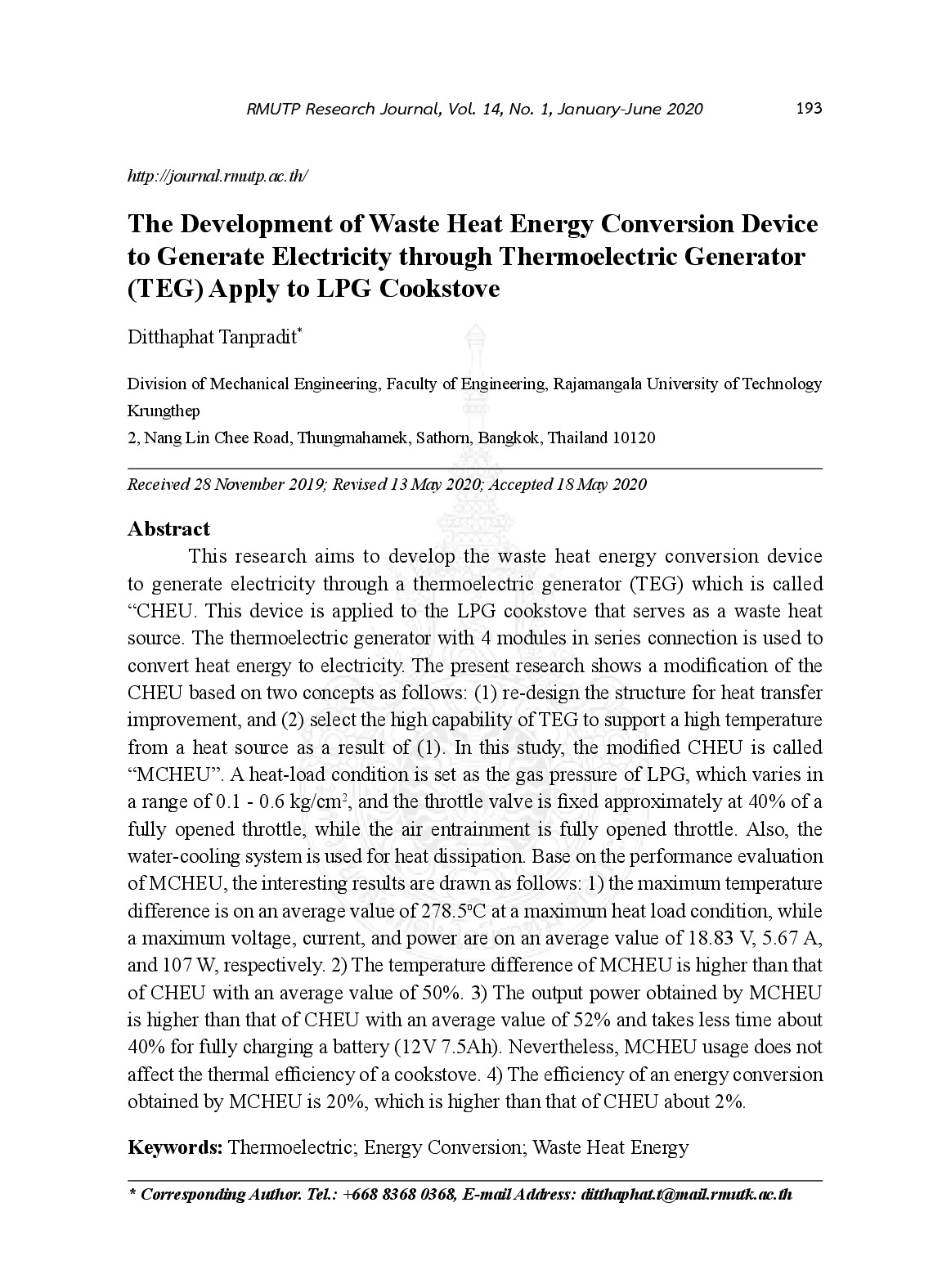
The development of waste heat energy conversion device to generate electricity through hermoelectric generator (TEG) apply to LPG cookstove
This research aims to develop the waste heat energy conversion device to generate electricity through a thermoelectric generator (TEG) which is called “CHEU. This device is applied to the LPG cookstove that serves as a waste heat source. The thermoelectric generator with 4 modules in series connection is used to convert heat energy to electricity. The present research shows a modification of the CHEU based on two concepts as follows: (1) re-design the structure for heat transfer improvement and (2) select the high capability of TEG to support a high temperature from a heat source as a result of (1). In this study the modified CHEU is called “MCHEU”. A heat-load condition is set as the gas pressure of LPG which varies in a range of 0.1 - 0.6 kg/cm2 and the throttle valve is fixed approximately at 40% of a fully opened throttle while the air entrainment is fully opened throttle. Also the water-cooling system is used for heat dissipation. Base on the performance evaluation of MCHEU the interesting results are drawn as follows: 1) the maximum temperature difference is on an average value of 278.5oC at a maximum heat load condition while a maximum voltage current and power are on an average value of 18.83 V 5.67 A and 107 W respectively. 2) The temperature difference of MCHEU is higher than that of CHEU with an average value of 50%. 3) The output power obtained by MCHEU is higher than that of CHEU with an average value of 52% and takes less time about 40% for fully charging a battery (12V 7.5Ah). Nevertheless MCHEU usage does not affect the thermal efficiency of a cookstove. 4) The efficiency of an energy conversion obtained by MCHEU is 20% which is higher than that of CHEU about 2%.
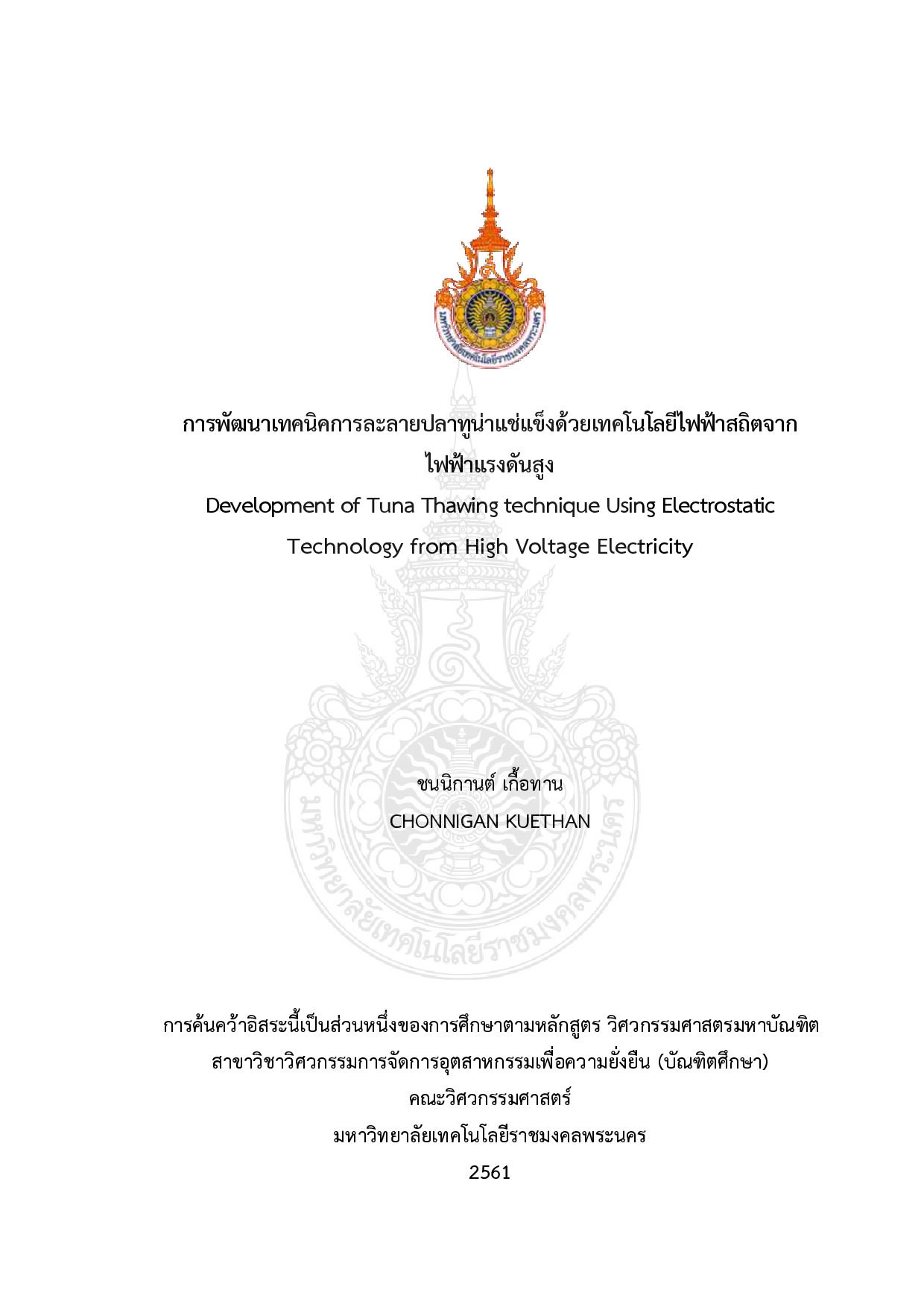
การพัฒนาเทคนิคการละลายปลาทูน่าแช่แข็งด้วยเทคโนโลยีไฟฟ้าสถิตจากไฟฟ้าแรงดันสูง
Frozen fish thawing method using an Electrostatic Technology from a High Voltage Electricity (ETHVE) is one of an alternative method. Due to this method the material has a uniform temperature and also increase the temperature of the material resulting in a short time thawing process. Therefore the objective of this research is to develop the thawing method for frozen tunas using an ETHVE compared to some water immersion method. The experiment was carried out by using frozen tunas with an initial temperature of -18 °C then thawing frozen tunas with the ETHVE until the temperature of the tunas increased to 5 °C. Then the tunas were steamed until the temperature of 60 °C compared to that water immersion method. The qualities of steamed tunas were determined by percentage of tunas meat and tunas blood. The results showed that the tunas thawing techniques using the ETHVE provided a uniform temperature of tunas meat both the surface and the center the piece of tunas. In addition this technique also provided a higher percentage of tunas meat and tunas blood and some surface area has slight burns compared to that water immersion method. The frozen tuna which was thawed by using the ETHVE method which some surface and center using temperature at 5 °C and –2 °C respectively. The tunas surface area were slightly burned the percentage of tunas meat and tonas blood were 45% and 5% respectively. During the frozen tuna thawing using the water immersion method has the surface and center temperature at 12 °C and –2 °C respectively; The tunas surface area were very burnt the percentage of tunas meat and tunas blood were 42% and 3% respectively.

ความร่วมมือด้านพลังงานไฟฟ้าของอาเซียน : ผลกระทบจากการนาเข้าและการส่งออกพลังงานไฟฟ้าต่อราคาค่าไฟฟ้า
การศึกษาเรื่อง “ความร่วมมือด้านพลังงานไฟฟ้าของอาเซียน: ผลกระทบจากการนาเข้าและการส่งออกพลังงานไฟฟ้าต่อราคาค่าไฟฟ้า” มีวัตถุประสงค์เพื่อ เพื่อศึกษาสภาพการซื้อขายพลังงานไฟฟ้าในภูมิภาคอาเซียน เพื่อหาผลกระทบจากการนาเข้าและส่งออกพลังงานไฟฟ้าต่อราคาค่าไฟฟ้า ภาคครัวเรือนและภาคอุตสาหกรรมของอาเซียน และเพื่อศึกษาถึงปัญหาและอุปสรรคในการซื้อขายพลังงานไฟฟ้าของประเทศไทยกับประเทศเพื่อนบ้านในอาเซียน รวมถึงแนวทางในการแก้ไขปัญหาดังกล่าว โดยเก็บรวบรวมข้อมูลโดยใช้วิธีการแบบผสม (Mixed Method) สาหรับข้อมูลในเชิงปริมาณทาการศึกษาโดยการวิเคราะห์อนุกรมเวลา (Time Series Analysis) สาหรับข้อมูลในเชิงคุณภาพทาการศึกษาโดยการสัมภาษณ์เชิงลึก (in-depth interview technique) โดยใช้แนวสัมภาษณ์ (interview guide) เก็บรวบรวมข้อมูลจากผู้ให้ข้อมูลหลัก (key Informants) ซึ่งเป็นผู้รับผิดชอบระดับสูงในโครงการซื้อขายพลังงานไฟฟ้าในภูมิภาคอาเซียน ได้แก่ ตัวแทนเจ้าหน้าที่จากอาเซียน กระทรวงพลังงาน การไฟฟ้าฝ่ายผลิตแห่งประเทศไทย การไฟฟ้าส่วนภูมิภาค การไฟฟ้านครหลวง เจ้าหน้าที่ระดับสูงด้านพลังงานจากสาธารณรัฐประชาธิปไตยประชาชนลาวและมาเลเซีย และบริษัทเอกชนที่ผลิตหรือจาหน่ายพลังงานไฟฟ้าในภูมิภาคนี้ ผลการวิเคราะห์อนุกรมเวลา รายเดือน ตั้งแต่ปี พ.ศ. 2553-2557 พบว่า ปริมาณการผลิตพลังงานไฟฟ้าภายในประเทศเพิ่มขึ้น 1% จะทาให้ต่อราคาค่าไฟฟ้าขายส่งลดลง 0.08% ปริมาณการนาเข้าพลังงานไฟฟ้าเพิ่มขึ้น 1% จะทาให้ต่อราคาค่าไฟฟ้าขายส่งเพิ่มขึ้น 0.03% ในขณะที่ปริมาณการส่งออกพลังงานไฟฟ้าไม่มีอิทธิพลต่อราคาค่าไฟฟ้าขายส่งอย่างมีนัยสำคัญทางสถิติ และผลการสัมภาษณ์เชิงลึก ตั้งแต่ปี พ.ศ. 2558-2559 พบว่า ผู้ให้สัมภาษณ์ทั้งหกองค์กรเห็นด้วยว่า ความร่วมมือด้านพลังงานไฟฟ้าระหว่างประเทศจะไปสู่การลดต้นทุนการผลิตค่าไฟฟ้า การลดราคาค่าฟ้าสาหรับผู้บริโภค และความมั่นคงด้านพลังงานของประเทศไทย ด้วยเหตุผลสำคัญดังนี้ ประการที่หนึ่ง การซื้อขายพลังงานไฟฟ้าระหว่างประเทศทาให้ประเทศไทยสามารถใช้พลังงานในการผลิตได้อย่างมีประสิทธิภาพมาก ประการที่สอง การซื้อขายไฟฟ้าระหว่างประเทศทาให้ประเทศไทยสามารถสร้างความสมดุลระหว่างอุปสงค์และอุปทานของพลังงานไฟฟ้าตามฤดูกาลที่แตกต่างกัน ประการสุดท้าย การซื้อขายพลังงานไฟฟ้าระหว่างประเทศส่งเสริมให้เกิดความร่วมมือระหว่างประเทศ อย่างไรก็ตามกฎระเบียบที่แตกต่างกันของแต่ละประเทศเป็นอุปสรรคสำคัญต่อความร่วมมือด้านพลังงาน หากมีการแก้ไขปัญหาสำคัญดังกล่าวเพื่อลดขั้นตอนและระยะเวลาในการเจรจาต่อรองทางการค้า จะทาให้ความร่วมมือด้านพลังงานไฟฟ้าในภูมิภาคนี้มีประสิทธิภาพมากขึ้น อันจะส่งผลต่อการลดต้นทุนการผลิตค่าไฟฟ้า การลดราคาค่าฟ้าสาหรับผู้บริโภค และความมั่นคงด้านพลังงานทั้งในปัจจุบันและอนาคต
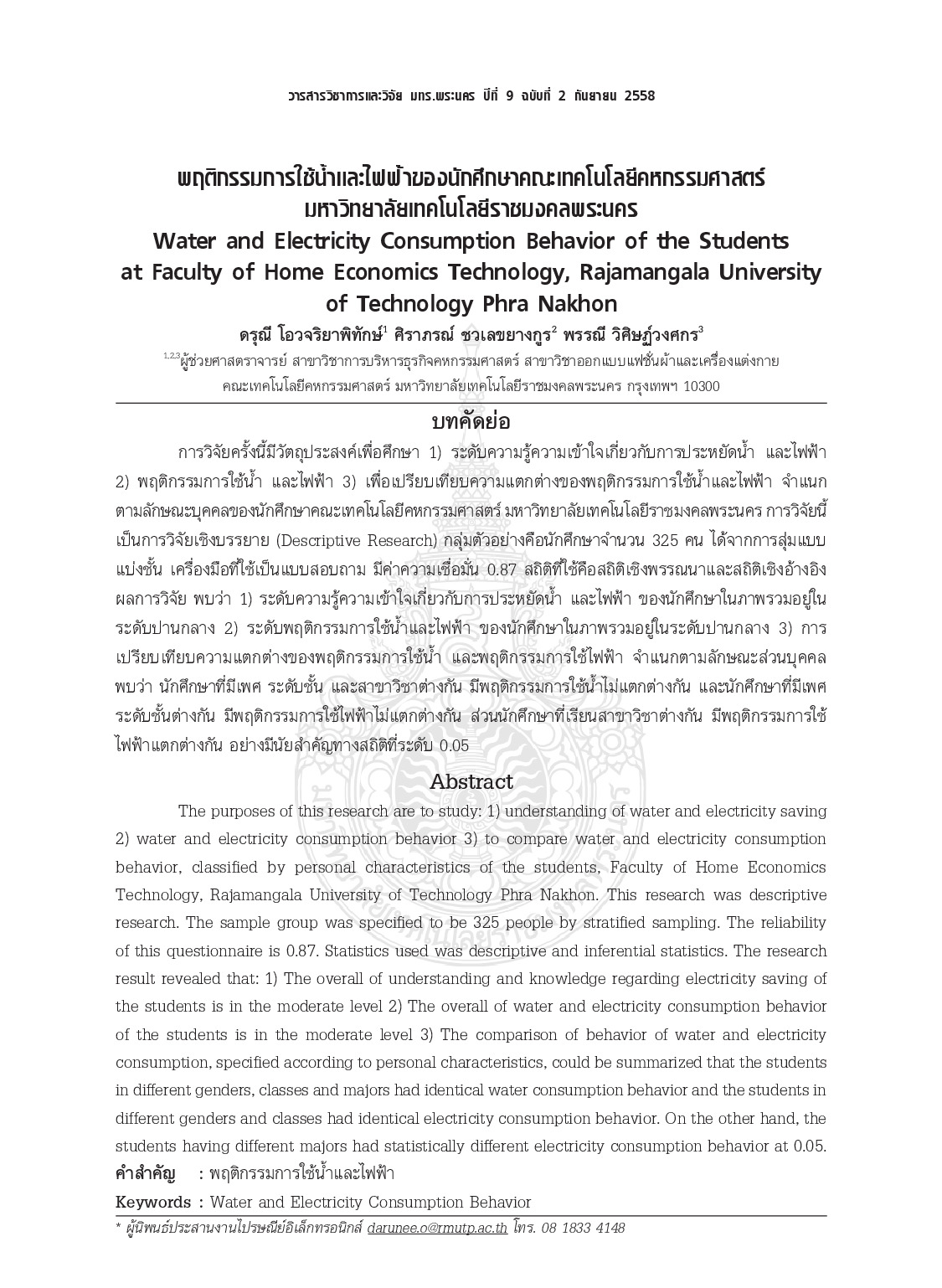
พฤติกรรมการใช้น้ำ และไฟฟ้าของนักศึกษาคณะเทคโนโลยีคหกรรมศาสตร์ มหาวิทยาลัยเทคโนโลยีราชมงคลพระนคร
The purposes of this research are to study: 1) understanding of water and electricity saving 2) water and electricity consumption behavior 3) to compare water and electricity consumption behavior classified by personal characteristics of the students Faculty of Home Economics Technology Rajamangala University of Technology Phra Nakhon. This research was descriptive research. The sample group was specified to be 325 people by stratified sampling. The reliability of this questionnaire is 0.87. Statistics used was descriptive and inferential statistics. The research result revealed that: 1) The overall of understanding and knowledge regarding electricity saving of the students is in the moderate level. 2) The overall of water and electricity consumption behavior of the students is in the moderate level. 3) The comparison of behavior of water and electricity consumption specified according to personal characteristics could be summarized that the students in different genders classes and majors had identical water consumption behavior and the students in different genders and classes had identical electricity consumption behavior. On the other hand the students having different majors had statistically different electricity consumption behavior at 0.05.