จำนวน Repository ( 5 )
การผลิตวัสดุปรับปรุงดินจากเศษอาหารและผักตบชวาด้วยกรรมวิธีดีไฮเดรชั่น
The purpose of this study is to produce the soil improvement materials from food waste and water hyacinth by using a dehydration process. The experiments were divided into two parts : 1) the study of the optimum temperature and time for converting food waste and water hyacinths to soil improvement materials by determining the temperatures of 100 °C 150 °C and 200°C in the periods of 1 hour 2 hours and 3 hours respectively 2) the study of nutrient content in the materials before and after mixing into the soil for 5 days. The soil used in the experiment was sampled from Sai Ma Subdistrict Nonthaburi Province. The parameters used to evaluate the ability to improve the soil quality were soil moisture pH electro conductivity total nitrogen total phosphorus total potassium and organic matter. The results showed that the optimum temperature for drying the food waste was 150°C for 2 hours and the optimum temperature for drying the water hyacinth was 200°C for 3 hours. When the materials were mixed into soil it found that the soil drainage was improved. Mixing the materials into soil could increase the pH value from 5.2 to 5.4 and increase the electrical conductivity from 0.72 mS/cm to 14.78 mS/cm. Besides the plant nutrients including Nitrogen phosphorus and potassium also increased after adding soil improvement materials.
การศึกษา สํารวจ และวิเคราะห์องค์ประกอบของเสีย และแนวทางการใช้ของเสีย อาหารทะเล ตลาดทะเลไทย จ.สมุทรสาคร
This research is a survey study. And analyze the waste composition And guidelines for the use of seafood waste in the Thai seafood market Samut Sakhon Province According to the survey 96.27 percent of the waste comes from restaurants. This is because Most fresh seafood restaurants Will feed the seafood whole Therefore there is no garbage such as shrimp if it is a restaurant the customers will have left shrimps on the head. But the fresh restaurants give away the shrimp and crab so the garbage from the fresh restaurant only has fishbone which is very small. Because most customers accept the whole fish There were also some places where the vendors cut the fish and left their bones. But when analyzed by type of waste it found that shell waste was the highest. Which is up to 55.29 percent. Followed by shrimp shells fish bone and fish heads and crab shells the study found that seafood debris had material properties with low moisture content. It also contains calcium as the main component. For example shellfish contain calcium as the main component which is found in approximately 98.50 percent. Not only striped shells Fishbone shrimp and crab shells are also low humidity and high in calcium. The bizarre one was holding a sea bass head and a grouper head with a high amount of organic matter. And with low ash content food waste that should be analyzed for the possibility of recycling are striped shells cockle shells shrimp shells fishbone shells fishbone dumplings tuna and crab shells.

การย่อยสลายภายใต้สภาวะไร้อากาศของสารอินทรีย์ประเภทเศษอาหารเข้มข้นในกระบวนการผลิตแก๊สชีวภาพ
The purposes of this research were to investigate anaerobic digestion of concentrated food waste in biogas production system at mesophilic temperature (37 C). The effect of grinding and pH controlled at 6.20 and 7.00 on methane production were also studied. It was found that the ability of mix bacteria which had initial concentration of 2100 mg/l for digesting concentrated food waste with grinding was higher than that without grinding because of the increase in surface area (about 1.37 time). In this system the optimum condition for bacteria growth was found at pH 7.00. Under optimal condition the digestion efficiency in term of chemical oxygen demand (COD) removal was 18.81% higher corresponding to an increase in methane production rate (19.10%) than other conditions
System design gio gasifier from food waste catalyst from pigeon feces and pig feces underanaerobic conditions
Educational system designed to produce Biogas from food waste. By comparing the quality of pigeon dung. And the value of the pig was used as the catalyst. In anaerobic conditions. Purpose was to compare the quality. And the amount of gas from the two types of catalyst used and the process of building a compost bin for households in the city. Which places the living repository of materials Rajamangala University of Technology PhraNakhon. Bangkok campus as a place of experimentation. The fermentation process is used for the same condition is temperature materials and processes in each trial which takes a total of 60 days separated by a period of preparation. During the experiment. And at the conclusion of the experiment. The 10-day period of preparation for the trial and during the 40 days of the conclusion of the 10-day trial that the mixed infection. And rubbish food for 10 days to wait for an extended amount of infected nodes Jane Mehta. The index values are measured. System including temperature fermentation - acid alkaline VOCs. Hydrogen sulfide oxygen carbon monoxide and methane gas in the range 12.00 pm - 13.00 pm every day for 30 days The result was the conclusion that Swine manure fermentation properties of methane higher than the pigeons in 3: 1 can be seen from the measurement equipment and systems. The odor is caused by the pigeons is very low and almost no odor. When compared to the after-fermentation of swine manure to 19 days while the smell of fermentation of swine manure odor remains
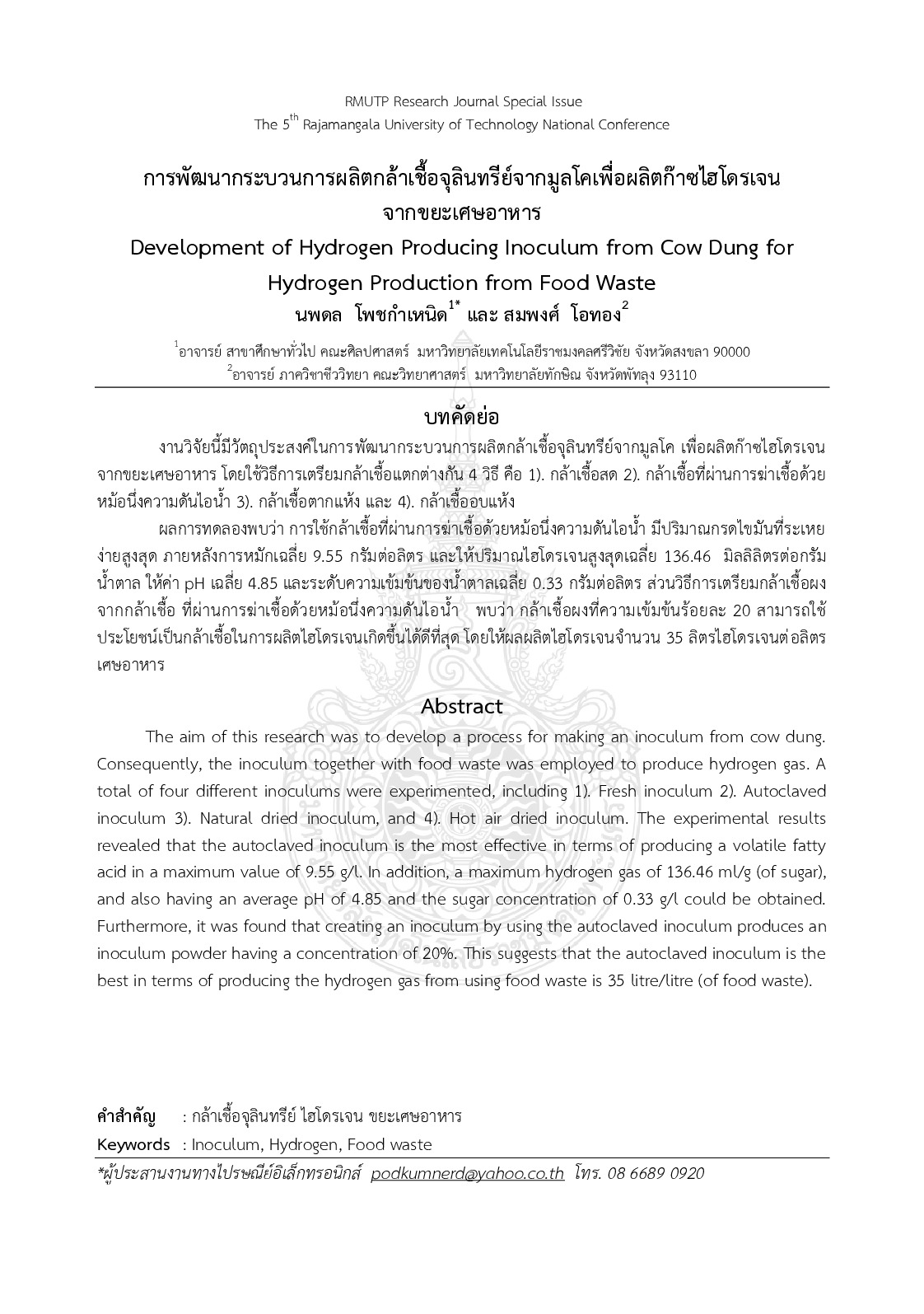
Development of hydrogen producing inoculum from cow dung for hydrogen production from food waste
The aim of this research was to develop a process for making an inoculum from cow dung. Consequently the inoculum together with food waste was employed to produce hydrogen gas. A total of four different inoculums were experimented including 1). Fresh inoculum 2). Autoclaved inoculum 3). Natural dried inoculum and 4). Hot air dried inoculum. The experimental results revealed that the autoclaved inoculum is the most effective in terms of producing a volatile fatty acid in a maximum value of 9.55 g/l. In addition a maximum hydrogen gas of 136.46 ml/g (of sugar) and also having an average pH of 4.85 and the sugar concentration of 0.33 g/l could be obtained. Furthermore it was found that creating an inoculum by using the autoclaved inoculum produces an inoculum powder having a concentration of 20%. This suggests that the autoclaved inoculum is the best in terms of producing the hydrogen gas from using food waste is 35 litre/litre (of food waste).