จำนวน Repository ( 7 )
การพัฒนาโครงสร้างเกรนต้านทานการสึกหรอของชิ้นงานความแข็งสูงพิเศษด้วยกระบวนการอบผนึก
This study developed the cemented tungsten carbide by steadily sintering at 1430 °C for one hour. The tungsten carbide structure is a long shape. Its grain size has a difference between width and length and there are high distribution of sizes and shapes. In comparison with the work piece which has the similar size of grain structure the milling duration of tungsten carbide is less even though the condition of WC-Co is the same (95% WC – 5% Co). When the sintering of 1400 °C with the identical milling duration is performed. It turned out that both grain structures of the tungsten carbide and the work piece are similar and their grain sizes are slightly different. However when the grain structures are almost the same and sphericity is increased the hardness and wear resistance will also be improved. Therefore the size of grain structure between 1.00 – 3.00 μm with the milling duration of 100 hours will provide a work piece that has a wear resistance according to international standard

การวิเคราะห์หาปริมาณคลอร์ไพรีฟอสและโลหะหนักที่เป็นพิษบางชนิดในตัวอย่างผักจากแม่น้ำเลย
The research aimed to analyze and compare contents of accumulated residue of chlorpyrifos chromium lead and cadmium in five varieties of vegetables in Loei River Loei Province. Five varieties of vegetables such as Vegetable fern (Diplazium esculentum Limnocharis flava (L.)) Limnocharis flava (L.) Buch Lasia spinosa (L.) Thwaites swamp cabbge (Ipomoea aquatica Forsk) and water mimosa (Neptunia oleracea Lour.) were collected during winter summer and rainy seasons from Phu Luang Mueang Loei and Chiang Khan District. Chlorpyrifos was analyzed by high performance liquid chromatography (HPLC). The results showed that the highest chlorpyrifos contents were found in vegetables in winter and summer season in the amount of 0.04±0.00 mg/kg. Analysis of all three heavy metals were carried out dry ashing at 500C and acid digestion with nitric acid prior to analyzing by flame atomic absorption spectrophotometry (FAAS). The results showed that cadmium accumulation in the highest content among all metals in water mimosa (Neptunia oleracea Lour.) in summer season from Phu Luang District (1.83±0.01 mg/kg). The second highest metal content was lead which has found in swamp cabbge (Ipomoea aquatica Forsk) in summer from Mueang Loei District (1.40±0.08 mg/kg). chromium showed the lowest content in Limnocharis flava (L.) Buch in winter from Mueang Loei District (0.47±0.04 mg/kg). The contents of chlorpyrifos and heavy metals were not exceed the legal limits set by International Standard Food and Ministry of Republic Health No.98 of Thailand except Ipomoea aquatica Forsk which collected in summer that showed the lead content higher than the legal limits.
การพัฒนากระบวนการอบผนึกชิ้นงานความแข็งสูงพิเศษเพื่อเพิ่มประสิทธิภาพ การต้านทานการสึกหรอตามแนวทางการจัดการวัสดุเพื่อความยั่งยืน
This study aims to development of production process of hard metal by tungsten carbide powder with the particle sized of 0.1 - 0.35 µm. This carbide powder were made of recycling cemented carbide tool scraps so it is mixed with Ta = 2.82 % Mo = 0.45 % Nb = 1.22 % Ti = 4.56 % Zr = 0.37 % The shape of the carbide powder are roughly round due to ball milling for 300 hours. It was mixing cobalt 10 % and Paraffin wax 2 % which is found the work piece that running through the process of sintering with a temperature of 1400 °c and 1430 °c have the hardness of 1368.5 and 1346.3 HV respectively. In one hour of holding time process the work piece with 1430 °c of the sintering causes less wear. After the test of turning operation it can be concluded that the tungsten carbide cutting tool provides the equivalent quality as a standard cutting tool.
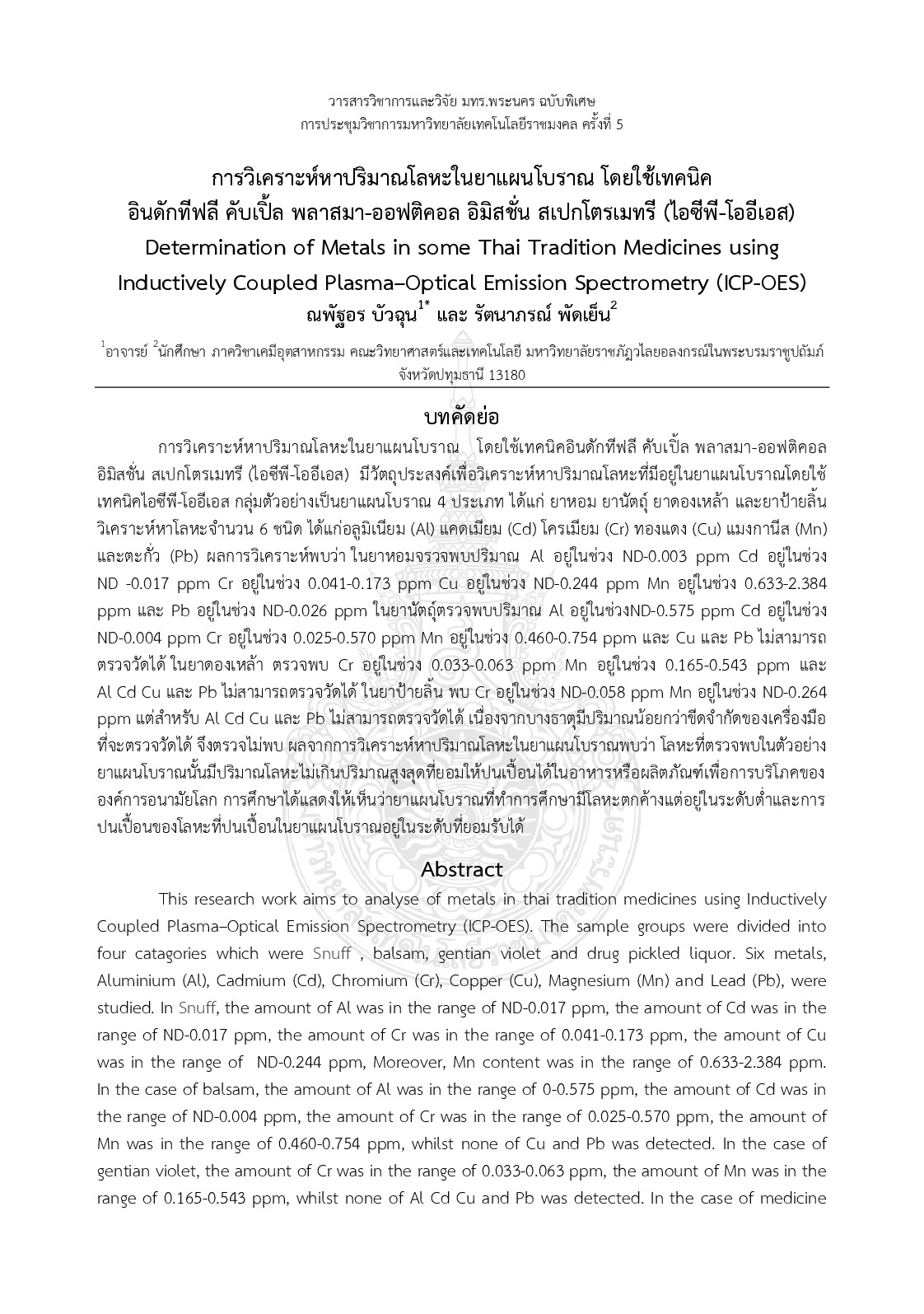
Determination of metals in some thai tradition medicines using inductively coupled plasma–optical emission spectrometry (ICP-OES)
This research work aims to analyse of metals in thai tradition medicines using Inductively Coupled Plasma–Optical Emission Spectrometry (ICP-OES). The sample groups were divided into four catagories which were Snuff balsam gentian violet and drug pickled liquor. Six metals Aluminium (Al) Cadmium (Cd) Chromium (Cr) Copper (Cu) Magnesium (Mn) and Lead (Pb) were studied. In Snuff the amount of Al was in the range of ND-0.017 ppm the amount of Cd was in the range of ND-0.017 ppm the amount of Cr was in the range of 0.041-0.173 ppm the amount of Cu was in the range of ND-0.244 ppm Moreover Mn content was in the range of 0.633-2.384 ppm. In the case of balsam the amount of Al was in the range of 0-0.575 ppm the amount of Cd was in the range of ND-0.004 ppm the amount of Cr was in the range of 0.025-0.570 ppm the amount of Mn was in the range of 0.460-0.754 ppm whilst none of Cu and Pb was detected. In the case of gentian violet the amount of Cr was in the range of 0.033-0.063 ppm the amount of Mn was in the range of 0.165-0.543 ppm whilst none of Al Cd Cu and Pb was detected. In the case of medicine pickled the amount of Cr was in the range of ND-0.058 ppm the amount of Mn was in the range of ND-0.264 ppm the amount of Ni was in the range of 0-0.034 ppm no metals Al Cd Cu and Pb was observed. The detected metals in thai tradition medicines have the contamination value under the optimization scale for consumable under WHO. It show that some metals were retained in thai tradition medicines and the contamination level of metals in were acceptable.
การสังเคราะห์อนุภาคนาโนโลหะโดยการระเหยด้วยเลเซอร์ในน้ำ
Nanomaterials are widely used in many applications such as medicine cosmetic industry and other. When the size of the particle is reduced the number of atoms on the surface and the ratio between surface area to volume of the material increase result in the enhancement of the material’s physical magnetic and optical properties. There are many methods to synthesize the nanoparticle such as grinding chemical reaction electrochemical method and laser ablation. In this research laser ablation was chosen to synthesize the metal nanoparticles because this method is quick and convenient and does not produce hazardous waste. The results show that the laser with 6V electric potential could synthesize the metal nanoparticles with the smallest size. The metal nanoparticles with larger size were obtained when higher electrical potential of 8V and 10V were used. In conclusion the electric potential of the laser affects the size of the metal nanoparticle obtained from laser ablation.