จำนวน Repository ( 2 )
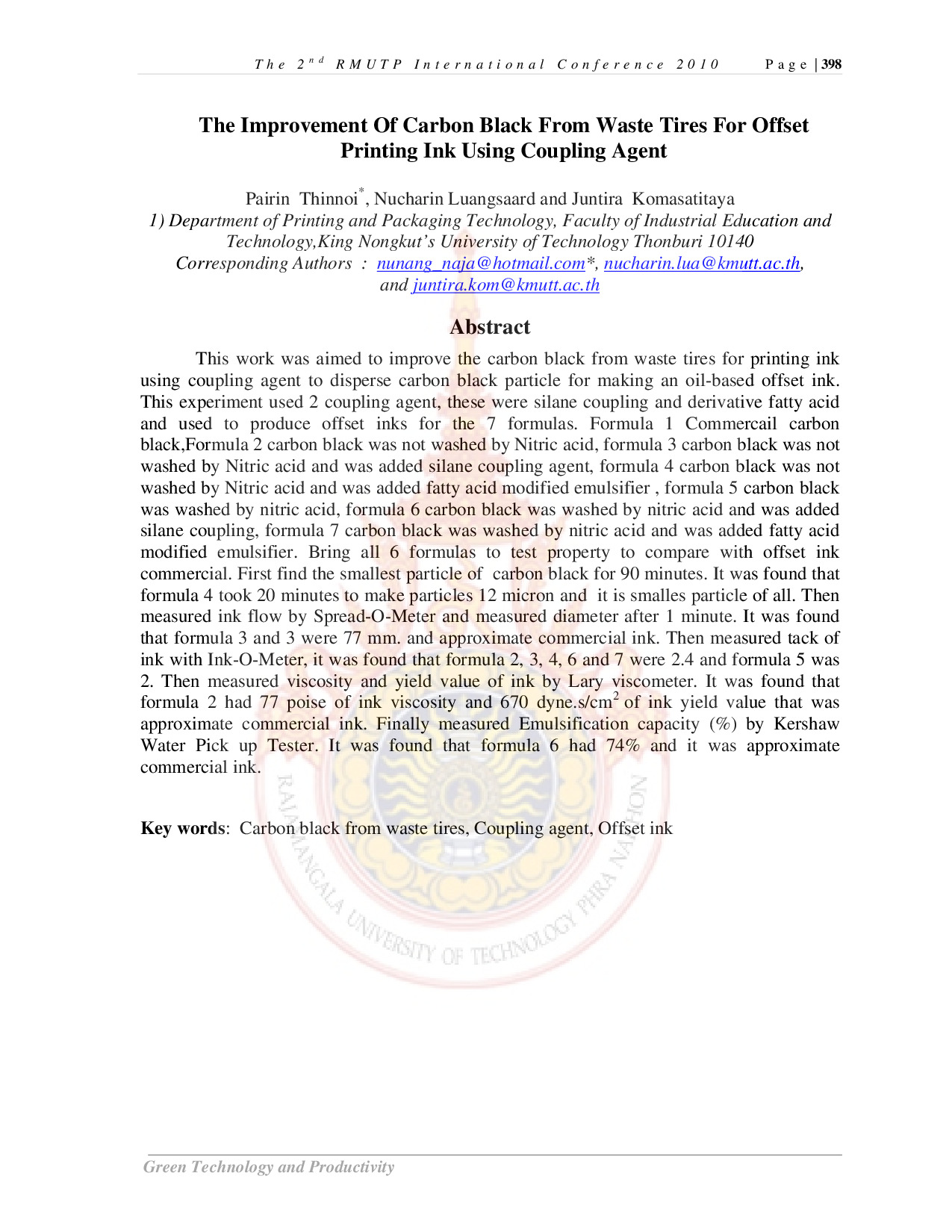
The Improvement Of Carbon Black From Waste Tires For Offset Printing Ink Using Coupling Agent
This work was aimed to improve the carbon black from waste tires for printing ink using coupling agent to disperse carbon black particle for making an oil-based offset ink. This experiment used 2 coupling agent these were silane coupling and derivative fatty acid and used to produce offset inks for the 7 formulas. Formula 1 Commercail carbon blackFormula 2 carbon black was not washed by Nitric acid formula 3 carbon black was not washed by Nitric acid and was added silane coupling agent formula 4 carbon black was not washed by Nitric acid and was added fatty acid modified emulsifier formula 5 carbon black was washed by nitric acid formula 6 carbon black was washed by nitric acid and was added silane coupling formula 7 carbon black was washed by nitric acid and was added fatty acid modified emulsifier. Bring all 6 formulas to test property to compare with offset ink commercial. First find the smallest particle of carbon black for 90 minutes. It was found that formula 4 took 20 minutes to make particles 12 micron and it is smalles particle of all. Then measured ink flow by Spread-O-Meter and measured diameter after 1 minute. It was found that formula 3 and 3 were 77 mm. and approximate commercial ink. Then measured tack of ink with Ink-O-Meter it was found that formula 2 3 4 6 and 7 were 2.4 and formula 5 was 2. Then measured viscosity and yield value of ink by Lary viscometer. It was found that formula 2 had 77 poise of ink viscosity and 670 dyne.s/cm2 of ink yield value that was approximate commercial ink. Finally measured Emulsification capacity (%) by Kershaw Water Pick up Tester. It was found that formula 6 had 74% and it was approximate commercial ink.
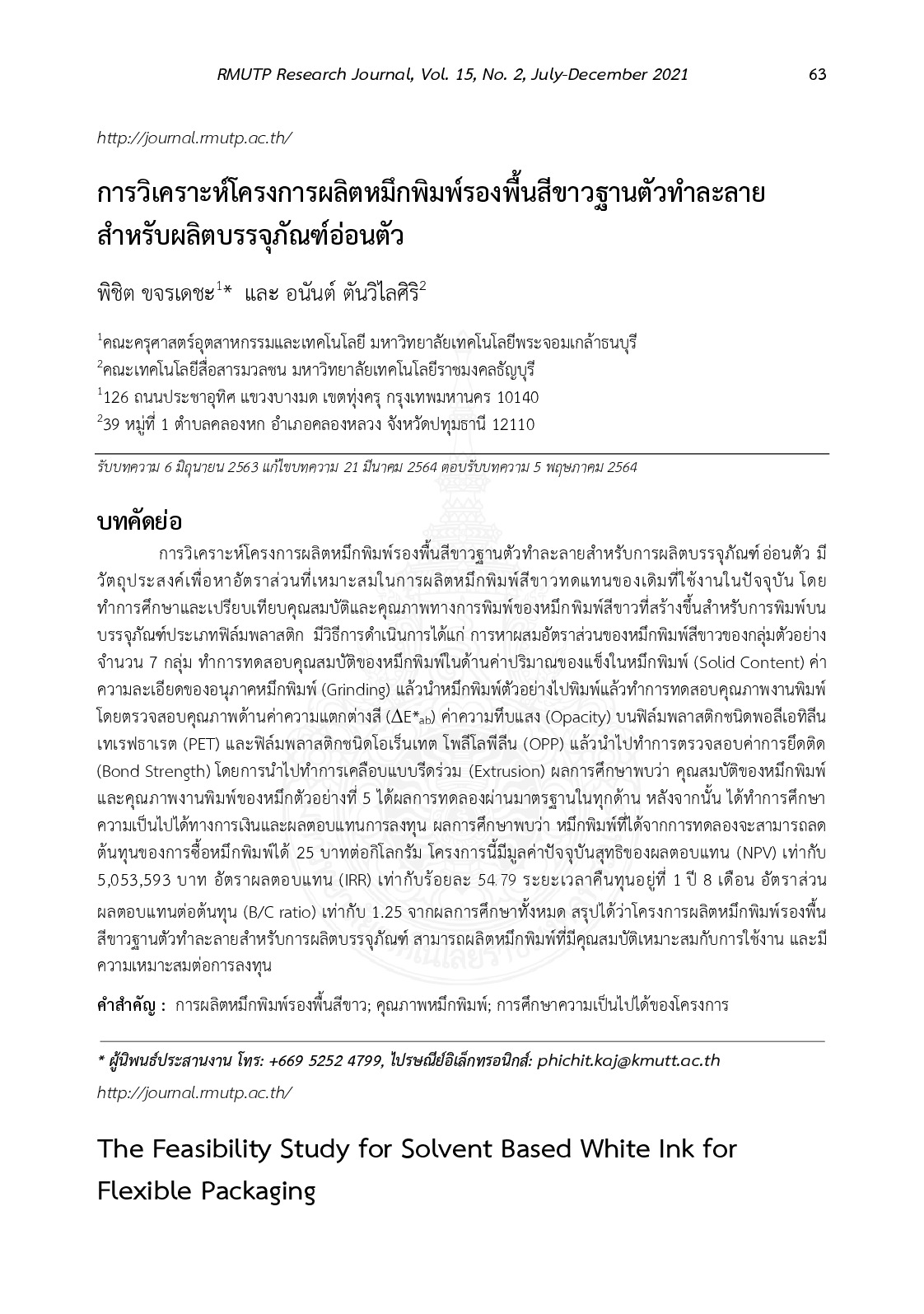
การวิเคราะห์โครงการผลิตหมึกพิมพ์รองพื้นสีขาวฐานตัวทำละลายสำหรับผลิตบรรจุภัณฑ์อ่อนตัว
The research proposes to find an optimum ratio of solvent based white ink for flexible package development by studying and comparing the qualification of white ink on plastic film. The process consists of separating the white ink ratio into 5 sampling group ratios and then examining ink quality by its’ solid content and grinding. The viscosity is controlled in 16 second and then measured by Zahn’s cup no. 3. The sampling ink is printed and inspected printing quality by (1) E*ab and opacity on polyethylene terephthalate (PET) plastic film and oriented polypropylene (OPP) and (2) bond strength by extrusion. The result shows that sampling ink with hardener substances and ink and varnish ratio is at 90:10 certifies in all aspects compare with other sample. Indicators are the net present value (NPV) Benefit/Cost Ratio: B/C Ratio Pay Back Period and internal rate of return of investment (IRR). The Feasibility Study found that the projects are the net present value (NPV) of 5053593 baht payback period of 1 year 8 month and rate of return on investment (IRR) was 54.79 %. B/C ratio = 1.25