จำนวน Repository ( 5 )

Bananas drying performance with a developed hot Air dryer using waste heat from charcoal production process
The purpose of this research is to develop a hot air dryer using waste heat from a200 liter kiln for drying bananas and to investigate its drying performance. The main parts of the dryer consist of the drying chamber that has dimensions 0.71x0.83x.091 m3 the air circulation system and a heat exchanger which receives waste heat from the exhaust tube and kiln surface. The dryer was developed by designing a drying chamber on the top of a 200 liter kiln to reduce heat lost in the structure and an exhaust gas heat exchanger was developed using groups of copper tubes for increasing then heat transferred to the air. The drying performances were analyzed by measuring specific drying rates and specific energy consumption. Experiments were performed under different temperatures of 60 70 and 80℃ And at a constant velocity of 1.8 ms-1. Eucalyptus was selected as the heat source. Thirty kg of peeled bananas were prepared at an initial moisture content of 241.19±31.50% dry basis and were dried until to final moisture content of 48.47±10.46% dry basis. All experiments were carried out in duplicate. For temperatures of 60 70 and 80 ℃ the ave age specific drying rates were 0.085±0.0004 0.114±0.0009 and 0.1277±0.010 kg water h-1kesolid-1 and the average specific energy consumptions were 1.42±0.055 1.21±0.355 and 1.04±0.074 MJ/kg water respectively. Some dried bananas had burned at a temperature of 80℃ so at temperature of 70 ℃ was the optimal condition in this experiment. This produced good color a high specific drying rate and low specific energy consumption.
Experimental investigation of a thermosyphon economizer to recover waste heat in the electronics industry
A case study was conducted to design construct and test a thermosiphon economizer for increasing the temperature of feed water by using waste hot water. The simulation of the thermosiphon economizer (heat exchanger) for the establishment of the optimum size was performed using the thermos-economical method. The thermosyphon was made of a total of 80 copper tubes (outside diam.19.05 mm) with evaporative adiabatic and condensation lengths of 300 10 and 300 mm respectively. The working fluid was R-134a filling ratio was 50% by evaporative volume and the thermosiphon was arranged in a staggered form. In testing performance flow rate of the inlet hot water was set at 10 L/min and the controlled inlet temperature of cold water at 25oC. The average flow rate of the cold water was set at 5 7 and 10 L/min respectively. Results showed that the maximum of rate of heat transfer from the condenser section occurred at the flow rate of the cold water of 10 L/min. When test the inlet temperature of hot water of 4555 and 65 o C were used at the inlet volume flow rate of cold water of 10 L/min maximum heat transfer rates from the condenser 4626 8260 and 8790 W were achieved. Moreover the outlet temperature of the cold water which was initially 25o C changed to 311 34 and 37o C respectively. Therefore increasing the outlet feed water temperature reduced energy consumption. The effectiveness of the thermosiphon economizer with the inlet temperatures of hot water of 45 55 and 65o C was 0.47 0.48 and 0.49 respectively.
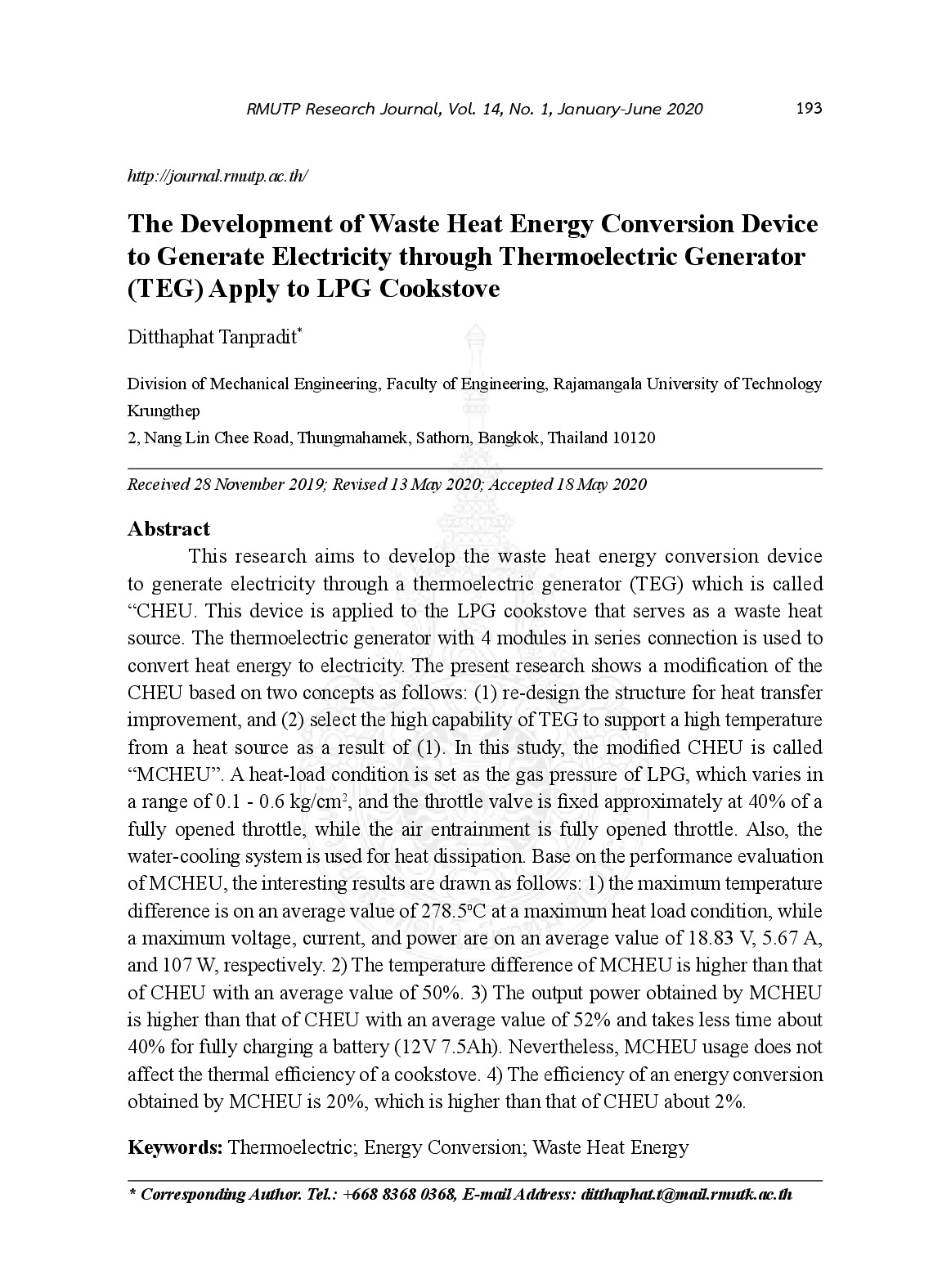
The development of waste heat energy conversion device to generate electricity through hermoelectric generator (TEG) apply to LPG cookstove
This research aims to develop the waste heat energy conversion device to generate electricity through a thermoelectric generator (TEG) which is called “CHEU. This device is applied to the LPG cookstove that serves as a waste heat source. The thermoelectric generator with 4 modules in series connection is used to convert heat energy to electricity. The present research shows a modification of the CHEU based on two concepts as follows: (1) re-design the structure for heat transfer improvement and (2) select the high capability of TEG to support a high temperature from a heat source as a result of (1). In this study the modified CHEU is called “MCHEU”. A heat-load condition is set as the gas pressure of LPG which varies in a range of 0.1 - 0.6 kg/cm2 and the throttle valve is fixed approximately at 40% of a fully opened throttle while the air entrainment is fully opened throttle. Also the water-cooling system is used for heat dissipation. Base on the performance evaluation of MCHEU the interesting results are drawn as follows: 1) the maximum temperature difference is on an average value of 278.5oC at a maximum heat load condition while a maximum voltage current and power are on an average value of 18.83 V 5.67 A and 107 W respectively. 2) The temperature difference of MCHEU is higher than that of CHEU with an average value of 50%. 3) The output power obtained by MCHEU is higher than that of CHEU with an average value of 52% and takes less time about 40% for fully charging a battery (12V 7.5Ah). Nevertheless MCHEU usage does not affect the thermal efficiency of a cookstove. 4) The efficiency of an energy conversion obtained by MCHEU is 20% which is higher than that of CHEU about 2%.
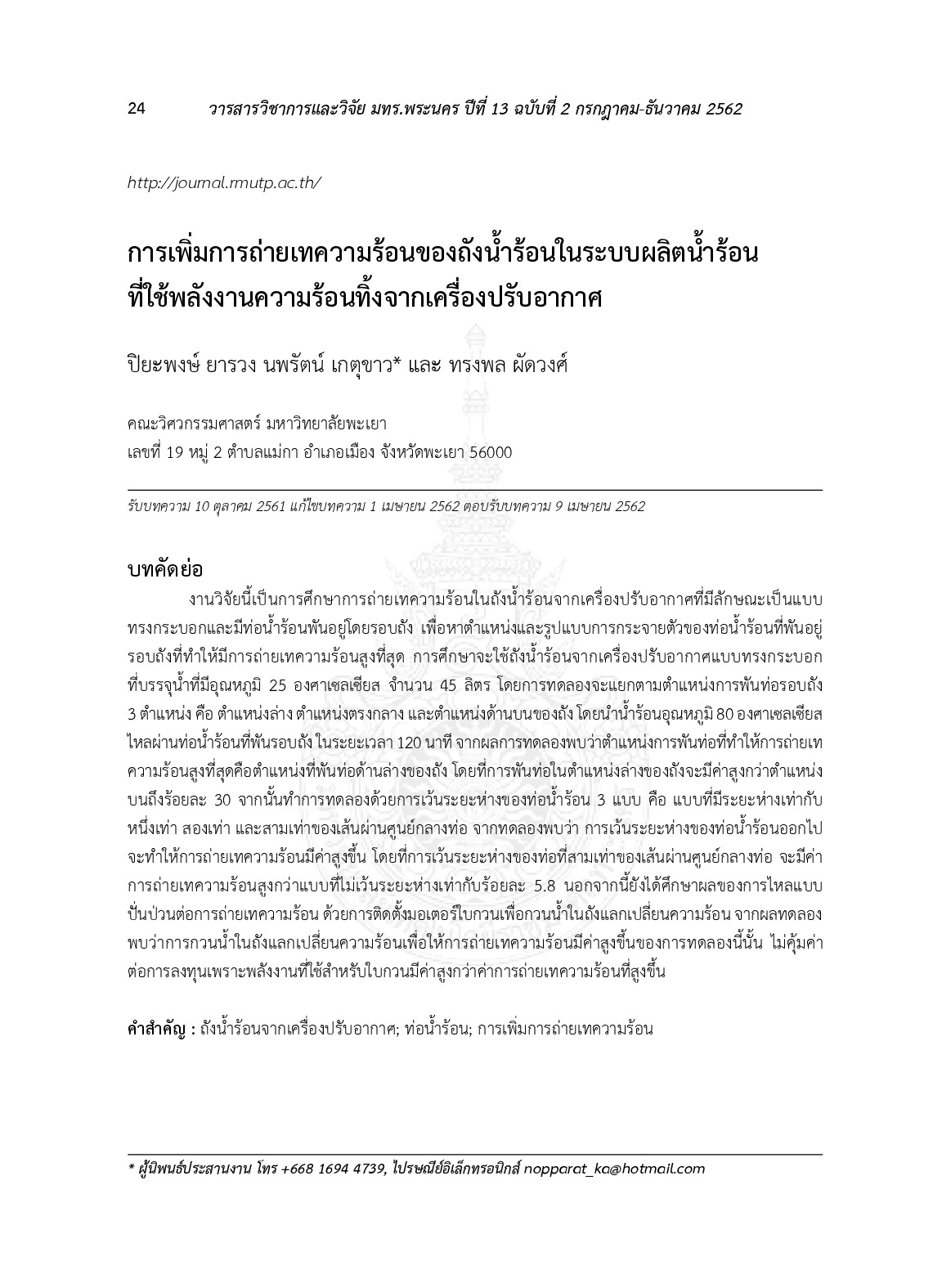
การเพิ่มการถ่ายเทความร้อนของถังน้ำร้อนในระบบผลิตน้ำร้อนที่ใช้พลังงานความร้อนทิ้งจากเครื่องปรับอากาศ
This research is to study in heat transfer of hot water tank from an air conditioner which is a cylinder type and has a hot water pipe around the tank. It is used for finding a position and a pattern of distribution of the hot water pipe around the tank in the highest heat transfer condition. The study uses the cylinder of hot water tank filled 45 liters of 25 oC water. An experiment separates in 3 positions of pipe wrapping which are the bottom the center and the top of the tank. Then 80 oC of hot water run thought the hot water pipe which is wrapped around the tank for 120 minutes. The result of the experiment shows that tubing position that causes the highest heat transfer is at the bottom of tank. Pipe wrapping at the bottom of the tank has the heat transfer higher than the top of the tank at 30%. Furthermore this experiment studies in spacing of hot water pipe. There are 3 types for testing which are spacing hot water pipe as one time two times and three times of diameter of pipe. The result illustrates that spacing the hot water pipe can significantly increase the heat transfer. The heat transfer of spacing the hot water pipe in three times of diameter of pipe is higher 5.8 % than spacing in one times. In addition this research is to study in the effect of turbulent flow on the heat transfer by installing agitator in order to stir water in the tank. The result is that water stirring in the tank for increasing the heat transfer is not effective for investment because the energy using for stirring is higher than the enhanced heat transfer
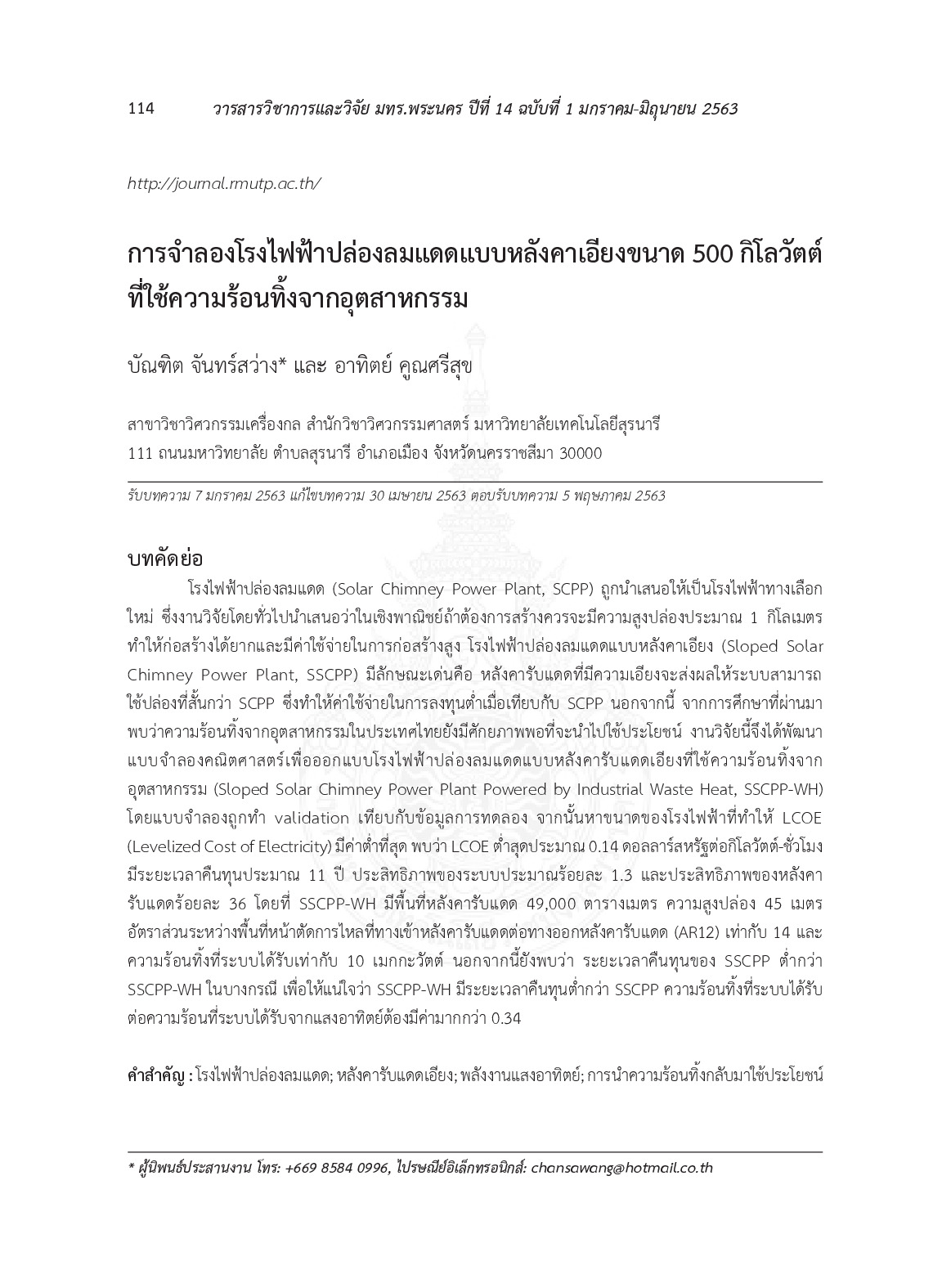
การจำลองโรงไฟฟ้าปล่องแดดแบหลังค่าเอียงขนาด 500 กิโลวัตต์ที่ใช้ความร้อนทิ้งจากอุตสาหกรรม
The solar chimney power plant (SCPP) has been proposed as a promising alternative power plant. According to the literature the chimney for commercial-scale SCPPs should be about 1 km high. The construction of these tall chimneys is very challenging and the construction cost is enormous. The sloped solar chimney power plant (SSCPP) is a variation of the SCPP. One of the SSCPP’s prominent feature is that its collector is sloped and then its chimney can be shorter than that of the SCPP. This leads to a lower investment cost of SSCPPs compared with that of SCPPs. Also previous studies show that the industrial waste heat potential of Thailand is considerable and should be investigated. As a result this study developed a mathematical model for designing a sloped solar chimney power plant powered by industrial waste heat (SSCPP-WH). The model was justified by validation using experimental data. Then several SSCPPs with different geometrical dimensions were simulated to determine a proper dimension that has the lowest levelized cost of electricity (LCOE). It was found that the LCOE is about 0.14 USD/kWh the payback period is about 11 years system efficiency of 1.3% and collector efficiency of 36%. for an SSCPP-WH with a collector area of 49000 m2 chimney height of 45m flow area ratio between solar collector inlet and solar collector outlet (AR12) of 14 and waste heat of 10 MW. It was also found that the payback period of SSCPP with no supplied waste heat is lower than that of some SSCPP-WHs. To make sure that the payback period for the SSCPP-WH is faster than that of SSCPP with no waste heat a ratio of the supplied waste heat to the absorbed solar energy of the SSCPP-WH must be greater than 0.34.