จำนวน Repository ( 22 )
การแปลงหน้าที่ทางคุณภาพเพื่อพัฒนาผลิตภัณฑ์ผลิตไฟฟ้าจากลมระบายความร้อนของเครื่องปรับอากาศ
This research had the objective to design and develop power production from daily life leftovers for their highest benefit of utilization by using the principle of quality function development and power generator that changed mechanical energy into electric energy. In developing electric generator product from air conditioner condensing unit the researcher found that there were 4 important factors including speed installation distance size and cross-sectional area of the fan and the test was conducted between 8.00-17.00 hours. The researcher collected the data and analyzed the test result and found that the best result in the test was to install the product at the distance of 10 cm by using an 18 fan in order to acquire the best voltage and the data were collected so that they could be implemented in developing such product in the future.

การผลิตไฟฟ้าจากความร้อนสูญเสียของเตาแก๊สด้วยชุดกำเนิดไฟฟ้าเทอร์โมอิเล็กทริค
This research aimed to study powe generation from heat loss strove by thermoelectric generator unit. As cooking with a gas stove can cause heat loss between the stove and the cookware this heat loss from gas stove can be converted into the electricity. For the experiment the researcher used a gas stove model KB5 installed with thermoelectric plate model TEG1-241-1.4-1.2 connected in a series to the power of 4 modules. Then experimental conditions of the gas pressure in the gas strove were set at 0.1 0.2 0.3 0.4 0.5 and 0.6 kg/cm2 respectively while the amount of mixed air was constant during the experiment. The results showed that when the gas pressure was at 0.6 kg2 the temperatures of the hot side and cold side of the thermoelectric generator was equal 250.5oC and 65.5oC respectively. Lt also generated the highest electric power of 53.3 watts. The power conversion efficiency was 5.3% at 38.1 Volts with 1.4 Amperes. In addition when electric was connected to a thermoelectric generator unit with 12 VDC 7-watt LED bulb the gas pressure in the gas stove were set at 0.3 0.4 0.5 and 0.6 kg/cm2 respectively was affected by the difference between the heating temperature and the cold temperature in the range of 185o C that could lighten up LED bulb.
การควบคุมแรงดันและกำลังไฟฟ้าสำหรับเครื่องกำเนิดไฟฟ้าสามเฟส
This research presents the simulation of a three-phase generator. The aim is to study and analyze the condition of the generator functions. By simulating the operation of the generator used in factory which use this generator as a backup power source to replace primary power source of electricity-supplier. In this test can start or stop the generator to determine the parameters at that time. The generator is used when the main electrical power distribution error and the generator is disabled when electric power system of electricity-supplier back to normal.
เครื่องกำเนิดไฟฟ้า 5 เฟสแบบเส้นแรงแม่เหล็กไหลตามแนวแกนเพลาขนาด 1 กิโลวัตต์ ประยุกต์ใช้กับพลังงานลมผลิตไฟฟ้า
This research project presents about the design and construction of a five-phase generator for producing magnetic force along the shaft axis that there are various important elements which should be considered in the processes of the design and construction such as flux per pole number of poles number of turns rotor speed and winding coefficient of coils. The experiment result is found that the five-phase axial flux permanent magnet generator along the shaft axis can produce DC voltage by the efficiency without load and with load. Furthermore this contribution can be used to produce electricity with other renewable energy such as electricity from wind energy.
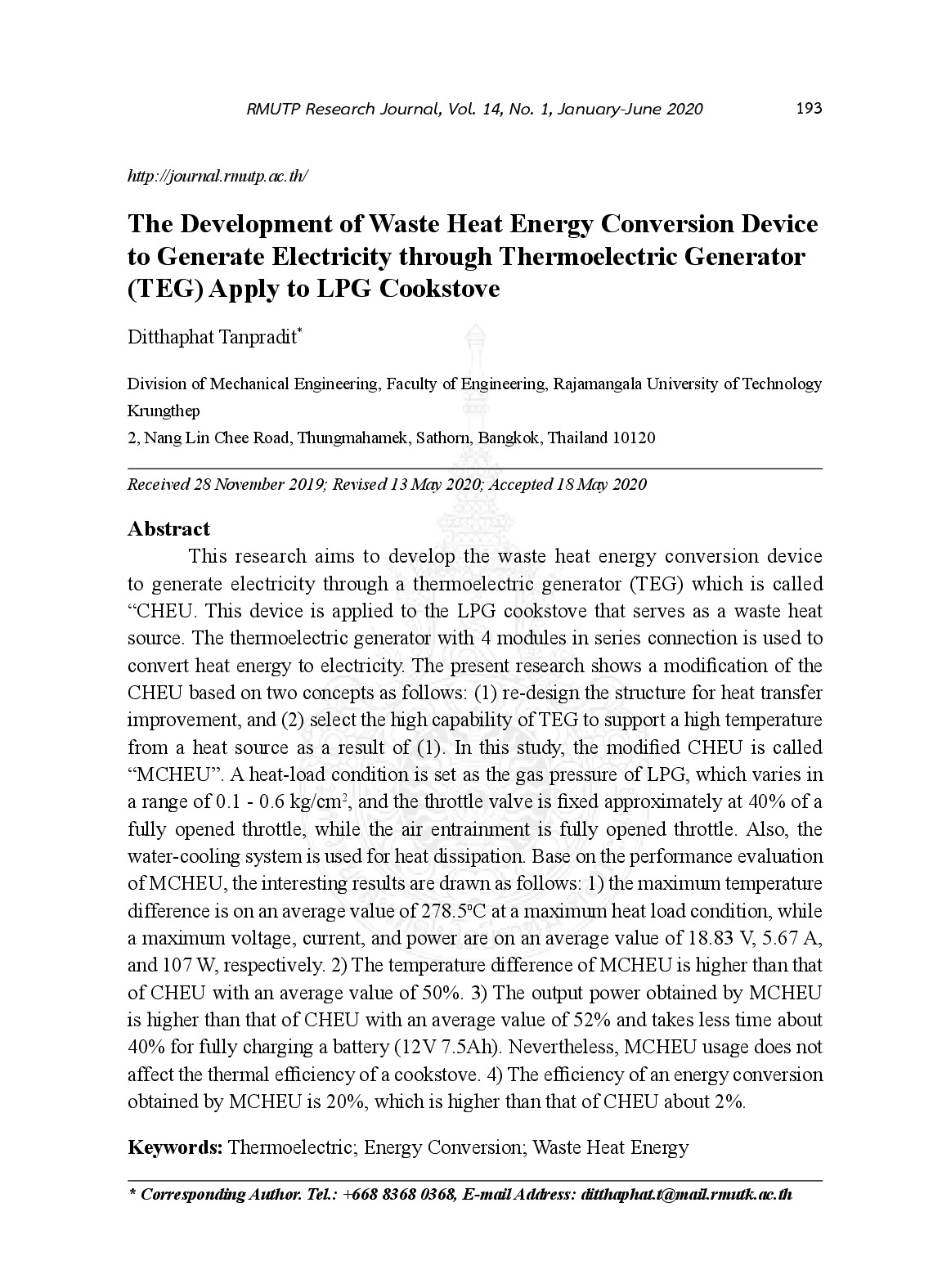
The development of waste heat energy conversion device to generate electricity through hermoelectric generator (TEG) apply to LPG cookstove
This research aims to develop the waste heat energy conversion device to generate electricity through a thermoelectric generator (TEG) which is called “CHEU. This device is applied to the LPG cookstove that serves as a waste heat source. The thermoelectric generator with 4 modules in series connection is used to convert heat energy to electricity. The present research shows a modification of the CHEU based on two concepts as follows: (1) re-design the structure for heat transfer improvement and (2) select the high capability of TEG to support a high temperature from a heat source as a result of (1). In this study the modified CHEU is called “MCHEU”. A heat-load condition is set as the gas pressure of LPG which varies in a range of 0.1 - 0.6 kg/cm2 and the throttle valve is fixed approximately at 40% of a fully opened throttle while the air entrainment is fully opened throttle. Also the water-cooling system is used for heat dissipation. Base on the performance evaluation of MCHEU the interesting results are drawn as follows: 1) the maximum temperature difference is on an average value of 278.5oC at a maximum heat load condition while a maximum voltage current and power are on an average value of 18.83 V 5.67 A and 107 W respectively. 2) The temperature difference of MCHEU is higher than that of CHEU with an average value of 50%. 3) The output power obtained by MCHEU is higher than that of CHEU with an average value of 52% and takes less time about 40% for fully charging a battery (12V 7.5Ah). Nevertheless MCHEU usage does not affect the thermal efficiency of a cookstove. 4) The efficiency of an energy conversion obtained by MCHEU is 20% which is higher than that of CHEU about 2%.