จำนวน Repository ( 3611 )
การรับรู้สื่อโฆษณา และการตลาดเชิงกิจกรรม ที่มีความสัมพันธ์กับพฤติกรรมการตัดสินใจซื้อแป้งประกอบอาหารตราโกกิของผู้บริโภคในเขตกรุงเทพมหานคร
The objectives of this independent study were 1) to investigate consumer perceptions of advertising media and event marketing of Gogi Tempura Flour 2) to investigate consumer buying decision behavior for Gogi Tempura Flour in Bangkok area 3) to investigate the relationship between demographic characteristics and consumer buying decision behavior for Gogi Tempura Flour in Bangkok area and 4) to investigate the relationship between consumer perceptions of advertising media and event marketing of Gogi Tempura Flour in Bangkok area. The sample consisted of 400 consumers in Bangkok area. Data were collected through the questionnaire and then analyzed by frequency percentage and Chi-Square Test.1. The sample mostly consisted of: females (67.50%); those aged 25-30 years (31%); freelancers(merchants/business owners/freelancers) (52%) those graduated with bachelor’s degree (72.50%); those earned monthly income of 10001-20000 baht (46.50%) and single people (56.50%). 2. The sample’s perception of Gogi Tempura Flour advertising came from magazine and event marketing. However they never perceived Gogi Tempura Flour advertising through television. 3. In terms of the sample’s buying decision behavior they bought Gogi Tempura Flour after tasting sample foods cooked by using Gogi Tempura Flour as well as visiting Gogi booth in department store. 4. Age occupation education level. Monthly income and marital status were related to Gogi Tempura Flour buying behavior of consumers in Bangkok area at statistical significance level of .05. However gender was not related to the sample’s Gogi Tempura Flour buying behavior.5. Advertising media and event marketing perception were related to Gogi Tempura Flour buying behavior of consumers in Bangkok area at statistical significance level of .05.
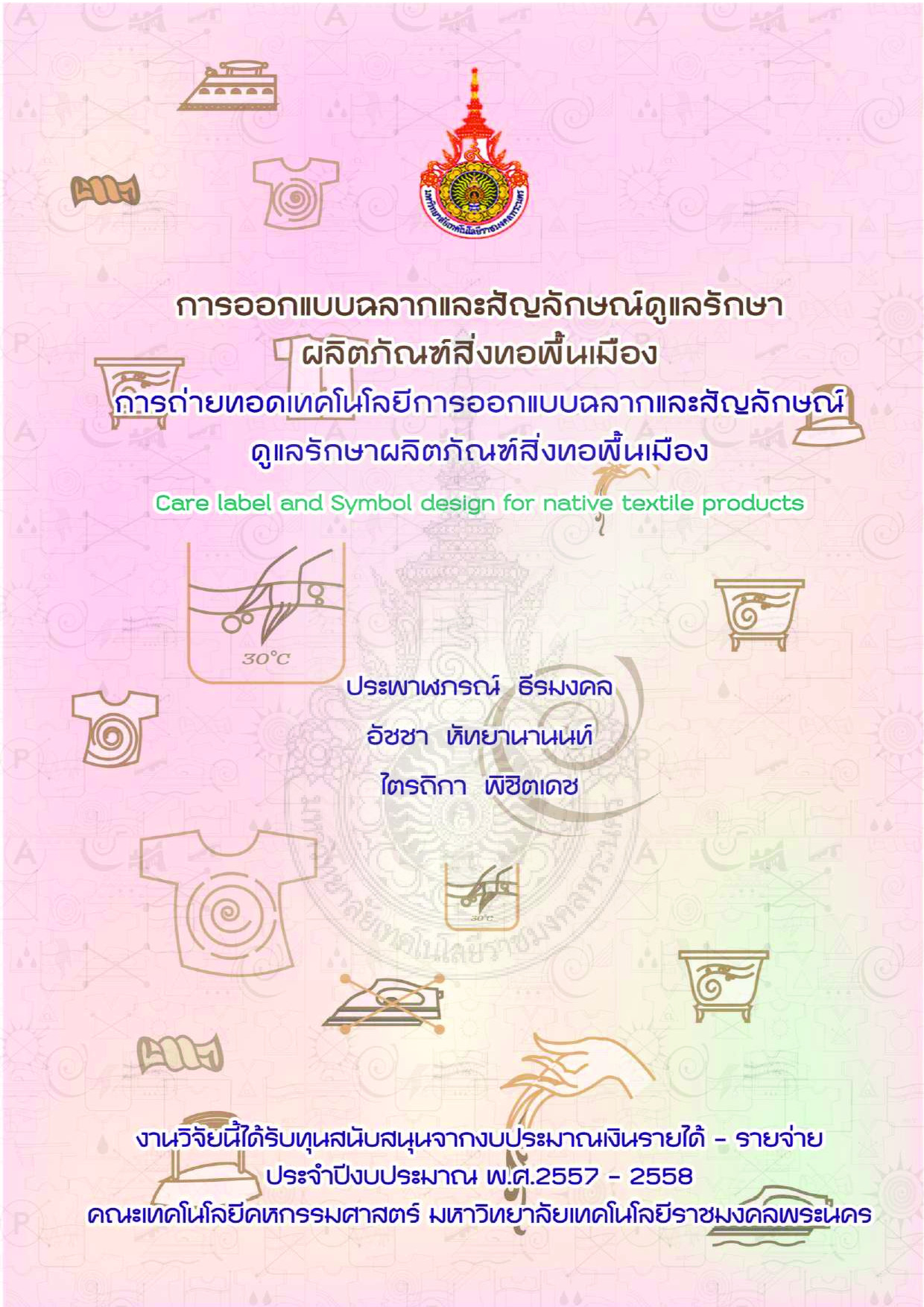
การออกแบบฉลากและสัญลักษณ์ดูแลรักษาผลิตภัณฑ์สิ่งทอพื้นเมือง
This research is Care label and Symbol design for native textile products. The purpose of this research were 1) to study and design the care label and symbol design of native textile products. 2) to design the care label and symbol design of native textile products and 3) to assessment the consumers satisfaction towards the care label and symbol design for native textile products. 4) to transfer knowledge towards the SMEs production communities about the care label and symbol design for native textile products. 5) to assessment the consumers satisfaction towards the care label and symbol design for native textile products. The research instruments used to collect data: 1) a draft care label and symbol design of native textile products of 6 types (10 prototypes) as 60 prototypes of washing bleaching spinning twisting and drying ironing and colour dropping. 2) Questionnaire of expert opinion and selective drafts for 3 models as 18 prototypes. 3) Questionnaire of consumers satisfaction towards the care label and symbol design for native textile product of 100 people: buyers sellers manufacturers and those interested in native textiles. The evaluation data was analyzed by using SPSS program in frequency mean and percentage. All in conclusion as table and descriptive. In the second research year the process are focus group people for transfer knowledge as SMEs community Enterprise OTOP production communities and other that it is interesting in this research : MEA-LA small enterprise in Singburi province PAMONT Hand-woven Communities in Ratchaburi province and Thai SONG-DUM Woven Ban-Sa-Kee-Rai in Nakhompathum province. To plan the schedule and set the date place amount of participate and lectures 102 people on 12 22 and 28 July 2015 and asking for consumer satisfaction of the curriculum and lecture for “transfer knowledge the care label and symbol design for native textile product” by Questionnaire of participate satisfaction. Last the evaluation data was analyzed by using SPSS program in mean and percentage. The First year’s research showed that mostly respondents were male at 59 percent aged 46 years at 52 percent and also being the entrepreneurs / business owners at 45 percent. 48 percent as bachelors degree and their income were an average of 20001 - 25000 baht at 46 percent. The analysis of consumers satisfaction can be concluded that the first types of care label and symbol design for native textile product at highest levels satisfaction is Colour dropping at 4.46. The next types is bleaching at 4.44 Washing at 4.42 Ironing at 4.38 Twisting and Drying at 4.32 and the last types is at least levels satisfaction is Spinning at 4.28 but all have been satisfied at maximum average and highest level of satisfaction. The research in the second year found that mostly participates were female aged 51 – 60 years old finished the secondary school and also there are farmer. The participates are their income under 5000 baht and They are moderately understanding symbol and care label but they are not make for their products. In relation to technology transfer of “the care label and symbol design for native textile product” divided into 3 parts it is also the curriculum and lecture for this research. The analysis of participate satisfaction It have been satisfied at maximum average and highest level of satisfaction in facilities. The participants are mainly used to provide benefits to themselves for one month to apply the gained after the training. The participants used care and symbol label for their products. Moreover a focus will be capped by the other communities to teach another one for working out. Satisfaction with the benefits of technology transfer and utilization. Satisfaction at the highest level. The comments and suggestions of the participants found that they need for re-training again. They would like to have a longer period of training in order to gain more knowledge. All lecturer can transfer knowledge during the training as well.
Condition and Problems of Student Activity in Rajamangala University of Technology Phra Nakhon
This research aims to students toward the acitivites of the Rajamangala University of Technology Phra Nakhon. And to compare the reviews of students on the activities of Rajamangala University of Technology Phra Nakhon. The samplings for this study were the 386 students in Rajamangala University of Technology Phra Nakhon. All 9 faculty. Accident Sampling The statistics were used namely; percentage mean and standard deviation (S.D) t-test and One-Way ANOVA. The statistical significant level of 0.05 and test on the differences with Seheffe method. The results were as follows : students toward the activities of the Rajamangala University of Technology Phra Nakhon. Found that overall comments to a large extent. When considering by aspects in arranging daily activities that benefit students. The mean maximum. And the implementation of student activities. The lowest average. Hypothesis testing to compare the reviews on the issues and events of Rajamangala University of Technology Phra Nakhon. Found that students gender and the different. Had opinions toward condition and the activities of Rajamangala University of Technology Phra Nakhon. No difference. And Students at different grade. Had opinions toward activities and problems of Rajamangala University of Technology Phra Nakhon. Different at significant level 0.05
Effect of extraction methods on mao berry marc properties
In this study the mao berry marc which was divided into 5 varieties including Fapratan Phusung Phupanthong Yaykhamta and mixed variety were dried in tray dryer at low temperature (50?C) and high temperature (60?C) for 72 hr. All samples were investigated their properties including yield color water activity pH tannin total phenolic total anthocyanin antioxidant activity in term of %DPPH activity total microorganism and yeast & mold content. It was found that the yield color in term of ?h aw tannin and anthocyanin content of low temperature drying sample showed the highest value. However the total microorganism and yeast & mold content of high temperature drying samples were not present in all samples which less than those recommended in the Thai Community Product Standard (dried fruits: 136/2003). Eight trained-panelists were used for Hedonic scale (1-9 point) sensory evaluation including clarity color odor taste and overall linking of high temperature drying samples were similar in five varieties (P>0.05).
Design of the control system to control AC/DC converter with a fast transient response
This paper presents a design of the control system to control AC/DC converter. Algorithm of a control system design consists of the output voltage loop control used a fuzzy gain scheduling of PI control and the current loop control used a hysteresis control which is described in this paper. The evaluation of the proposed control system is used to control an isolated CUK AC/DC converter operation with a 250W load and a -48V output voltage. The system is achieved as the following; the tight output voltage both the steady state operation and the transient response a power factor is nearly unity and the waveform of input current is nearly sinusoidal. In addition the control system design is simple and uncomplicated