จำนวน Repository ( 3611 )

The study of bachelor of science programs in applied chemistry in Thailand's Higher Educational Institutions
The Purposes of1bis Research were to study of Bachelor of Science Programs in Applied Chemistry and in related other areas in Thailand s Higher Educational Institutions. The sample consisted of 27 Programs of Bachelor ofScience Programs in chemistry Applied Chemistry and Industrial chemistry in Thailand s Higher Educational Institutions. Instruments used for collecting data were Curriculum Data Sheets. The data were analyzed by using SPSS for window. The statistics used were frequency percentage and mean. The results were as follows: 1. Most of the Bachelor of Science programs are chemistry. The others are Applied Chemistry and Industrial chemistry respectively. 2. The Total Course Credits of Bachelor of Science Programs were 137.12 Credits including General Education Courses (34.46 credits) Specific Courses (96.50 credits) and free elective courses (6.42 credits). 3. The Total Course Credits of the Bachelor of Science Programs before 2005 were 140.67 credits including General Education Courses (35.28 credits) specific courses (99.22 credits) and free elective courses (6.61 credits). 4. The Total Course Credits of the Bachelor of Science Programs s after 2005 were 129.13 credits including General education courses (32.63 credits) specific courses (90.38 credits) and free elective courses (8.76 credits). 5. The Total Course Credits of Bachelor of Science Programs in Applied Chemistry were . 130.67 credit including General education courses (37.67 credits) specific courses (85.00 credits) and free elective courses (8.00 credits). 6. The minors of Bachelor of Science programs in Applied Chemistry consisted of Industrial Chemistry and Management Environmental Chemistry Material Chemistry Natural Products Chemistry Polymer Chemistry Applied Chemistry for Industry Chemistry Education and Medicinal Biochemistry.
The study of fluid flow via the square channel by using Lattice Boltzmann Method
This research studied the flow of fluid through a rectangular barrier with the Lattice Boltzmann Method. The concept of this method relies on the streaming and collision of particles with respect to the conservation laws of mass and momentum. The objective of this research was studied patterns of fluid flow through the obstruction and Reynolds number to affect the flow pattern. The simulation showed that the flow pattern changes from laminar flow to turbulent flow when Reynolds numbers increased. In accordance with the theory.
A study of obtained knowledge using from physics I for engineers for daily life application of undergraduate student at Rajamangala University of Technology Phra Nakhon
The purpose of this study was to investigate obtained knowledge using from Physics I for Engineers for daily life application of undergraduate student from faculty of engineering Rajamangala University of Technology Phra Nakorn. Sample was 316 students which taken from four engineering majors; computer electrical industrial and mechanical engineering. A questionnaire a four point scale was used as testing tool. The statistical analyses were performed in mean standard deviation and one way analysis of variance. The results revealed that students used their obtained knowledge in moderate level (3.10). Students in each programs showed significantly different used their obtained knowledge at 0.05 level. Electrical engineering students (3.27) showed highest number of the course content using follow by mechanical engineering (3.09) computer engineering (3.07) and industrial engineering (2.75) respectively.
Variables affecting to learning achievement in Bio-organic chemistry of students on Rajamangala University of Technology Phra Nakhon
The purposes of this research were to study of Variables Affecting to Learning Achievement in Bio-organic chemistry and construct the prediction equation models ofstudents Bio-organic chemistry Leaming Achievement in Rajamangala University of Technology Phra Nakhon(RMUTP). The sample consisted of60 students ofRMUTP Sampling by Quota Sampling method. The instnunents used in this research were the questionnaire of 5-rated rating scales of those II categories. The reliability of the questionnaire was that the Bio-organic chemistry attitude 0.688 Achievement motivation in Bio-organic chemistry 0.766 Students learning behavior 0.742 Attitude towards University 0.80 I Personality ofchemistry teacher 0.851 Teaching behavior ofchemistry teacher 0.869 Parents support 0.796 University surrounding 0.719 Facilities of University 0.834 with the total average of 0.911 and the test of 4 choices Bio-organic chemistry Learning Achievement consisted of 50 items. The level ofdifficulty was between 0.27 -0.53 the power ofdiscrimination was between 0.35 -0.69 The reliability was 0.79 .The data were analyzed through statistical techniques of percentage mean standard deviation and multiple regression. The results were as follows: The Variables Affecting on students Bio-organic chemistry Learning Achievement at .05 level of significant were the Bio-organic chemistry attitude(xl) Achievement motivation in Bio-organic chemistry (-2) predicted at the rate of 15.50 Percent The raw score prediction equation was : A Y = 9.493 + 2.202 Xl + 0.730 X2 The standard score prediction equation was : A Zy = 0.380 ZXI + 0.123 Zx2
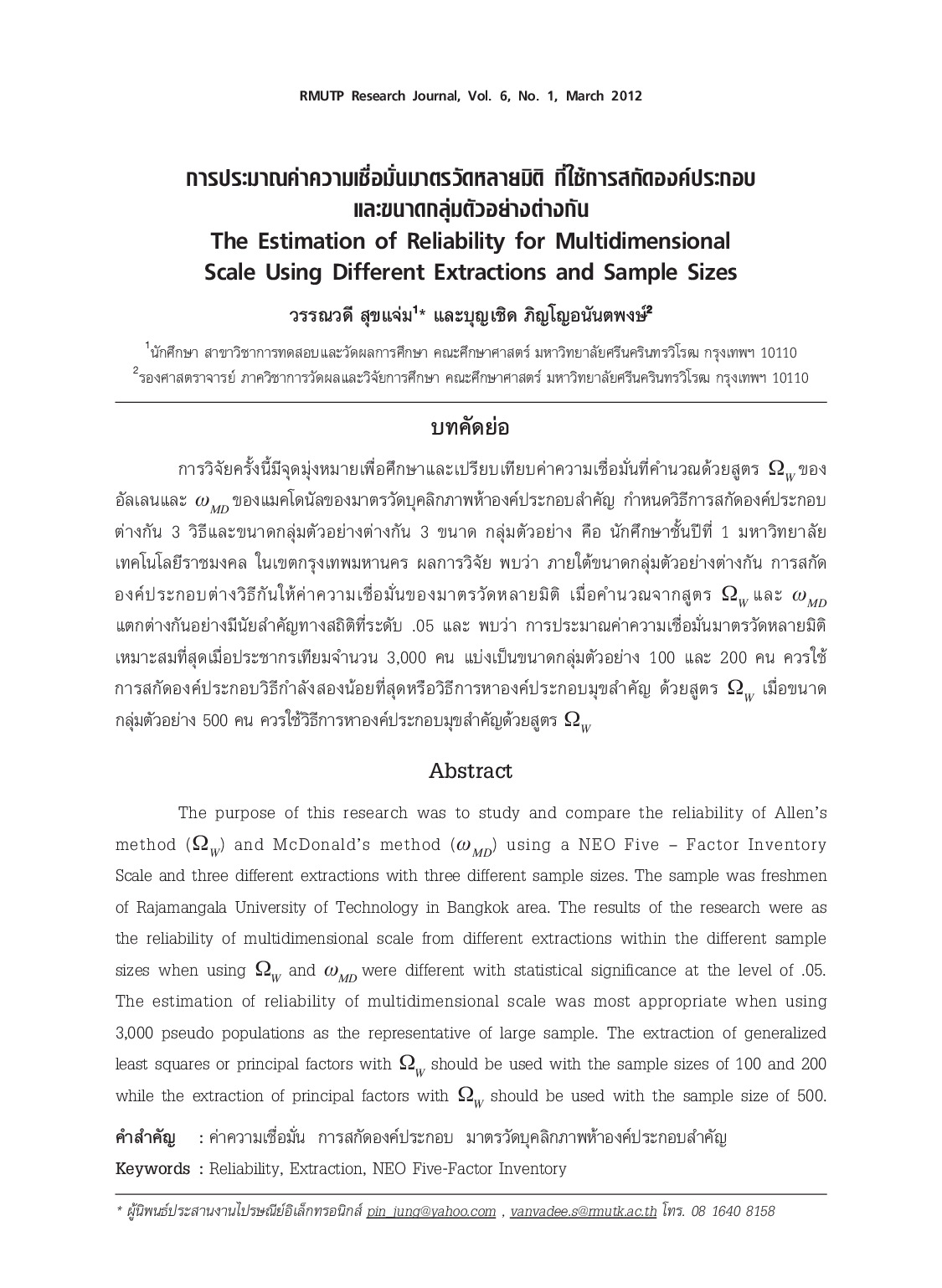
The Estimation of Reliability for Multidimensional Scale Using Different Extractions and Sample Sizes
The purpose of this research was to study and compare the reliability of Allen’s method (ΩW) and McDonald’s method (ωMD) using a NEO Five – Factor Inventory Scale and three different extractions with three different sample sizes. The sample was freshmen of Rajamangala University of Technology in Bangkok area. The results of the research were as the reliability of multidimensional scale from different extractions within the different sample sizes when using ΩW and ωMD were different with statistical significance at the level of .05. The estimation of reliability of multidimensional scale was most appropriate when using 3000 pseudo populations as the representative of large sample. The extraction of generalized least squares or principal factors with ΩW should be used with the sample sizes of 100 and 200 while the extraction of principal factors with ΩW should be used with the sample size of 500.