จำนวน Repository ( 3611 )
การพัฒนาผลิตภัณฑ์อัดเม็ดจากข้าวหักไรซ์เบอร์รี่
Riceberry rice is dark purple coloured grains. It is one of the most famous rice for consumers. There are nutrients and high antioxidant properties. Riceberry broken rice (RBR) is a by-product from the rice milling process and has a low value. It can be processed into various products. The purpose of this research was to study the ingredients and the ratios for tablet formulations including RBR powder milk powder whey protein icing sugar strawberry powder bulking agent anticaking agent and lubricant agent. Tabletting of powders was performed using a rotary tablet press machine. It was found that the powder products exhibited passable flow with the Carr Index of 24.57-32.10% and the Hausner Ratio value of 1.33-1.47. The water activity value of product was in the range 0.36-0.45. The tablets had thickness 3.86-4.38 mm diameter 13.07-13.35 mm and weight 0.62-0.71 g/tablet. The increase of RBR powder content (10% - 40%) decreased hardness value of tablet products about 5 times (from 64 N to 12 N). Sensory evaluation of products in appearance color texture odor flavor hardness dissolution in the mouth and overall liking were conducted using 9 - point hedonic scale with 30 untrained panelists. The results showed that the optimal tablet formulation consisted of 30% RBR powder 30% icing sugar 18% milk powder 1% anticaking agent 1% lubricant agent and 20% bulking agent or strawberry powder. They showed the highest overall liking scores in ranges of “like slightly” to “like moderately”
แบบจำลองพื้นผิวตอบสนองและการหาสูตรอาหารที่เหมาะสมสำหรับการเพิ่มการผลิตกรดแกมมา-ไลโนเลนิกในมอส Physcomitrella patens โดยใช้วิธีพื้นผิวตอบสนอง
The objective of this study is to obtain a model that maximize production of γ-linolenic acid (GLA) by the moss Physcomitrella patens employing response surface methodology (RSM). The RSM with a three-variables (sucrose potassium nitrate and glutamate concentrations) and five-level (-2 -1 0 1 and 2) central composite design (CCD) including 20 experimental runs was employed to optimize the medium composition. Results showed that the experimental data could be appropriately fitted into a second-order polynomial model with a coefficient of determination (R2) more than 0 .9 5 for GLA production. Analysis of variance (ANOVA) revealed that the model was highly significant (p<0.0001) and the effects of the sucrose (20-100 g/L) and glutamate (0.5-2.5 g/L) concentrations on GLA production were significant (p<0.05). The GLA production with the optimized culture medium (sucrose concentration of 62.92 g/L potassium nitrate of 0.80 g/L and glutamate concentration of 1 .4 2 g/L) by RSM increased 4.61 folds when compared with the standard BCD medium. This experimental value (16.37 mg GLA/L) fit well with the predicted values (16.20 mg GLA/L).
การพัฒนาและประเมินผลเครื่องอบแห้งแบบปั๊มความร้อนขนาดเล็กสำหรับกล้วยน้ำว้าสไลด์
The purposes of this research were to develop and to test performance of mini heat pump dryer for slice banana. Drying chamber of 0.48×0.47×0.39 m3 was designed and it could contain three trays. The three trays had dimension of 0.33×0.409 m2. A blower with 174.6 W motor of air condition was modify and could adjust flow rates of three levels for air cycle system in dryer. The air system had bypass air at evaporator. The refrigerant of R-134a and four main parts were used in the heat pump system. The four main parts were a 497 W hermetic compressor a 1800 W condenser an expansion valve and a 1300 W evaporator. Experiments for test performance of the mini heat pump dryer used close loop air system an evaporator bypass air of 60 % a temperature of 60 oC and various flow rates of 0.117 0.128 and 0.140 m3/s. Slide bananas of 400-500 g had an initial moisture content of 244-281 %dry basis and were dried until final moisture content lower than 6.24±0.007 %dry basis. It was found that the flow rates of 0.117 0.128 and 0.140 m3/s had coefficients of performance (COPh) of 3.32±0.066 3.88±0.031 and 4.24±0.08 respectively and had specific moisture extraction rates (SMER) of 184.5±11.85 186.2±8.17 and 200.1±21.34 g/kWh respectively. The flow rate at 0.140 m3/s was the best condition because it had high specific moisture extraction rate.
การต้านรังสียูวีและการยับยั้งแบคทีเรียของด้ายที่เคลือบด้วยพอลิไวนิลแอลกอฮอล์ด้วยเครื่องกรอด้าย
The objective of this study is to explore a method to improve UV protection and antibacterial properties of the cotton yarn surface to produce high-quality textile products. Cotton yarns were coated with sodium hydrogen phosphate magnesium chloride softener solution and 0 to 0.54 M of polyvinyl alcohol to hold surface yarns to the yarn body using the winding machine. The coated yarns were analyzed using Field emission scanning electron microscope Fourier transform infrared spectroscopy and UV-Vis spectrophotometer. Optimal results were achieved when coating with 0.45 M PVA exhibited UV protection was excellent protection. The cotton yarn coated 0.45 M polyvinyl alcohol displayed the antibacterial activity in the presence of Staphylococcus aureus and Escherichia coli was 87 and 91% respectively. The expected overall properties may open the way towards new applications of high performance fabrics leading to an innovative product development in the textile industry
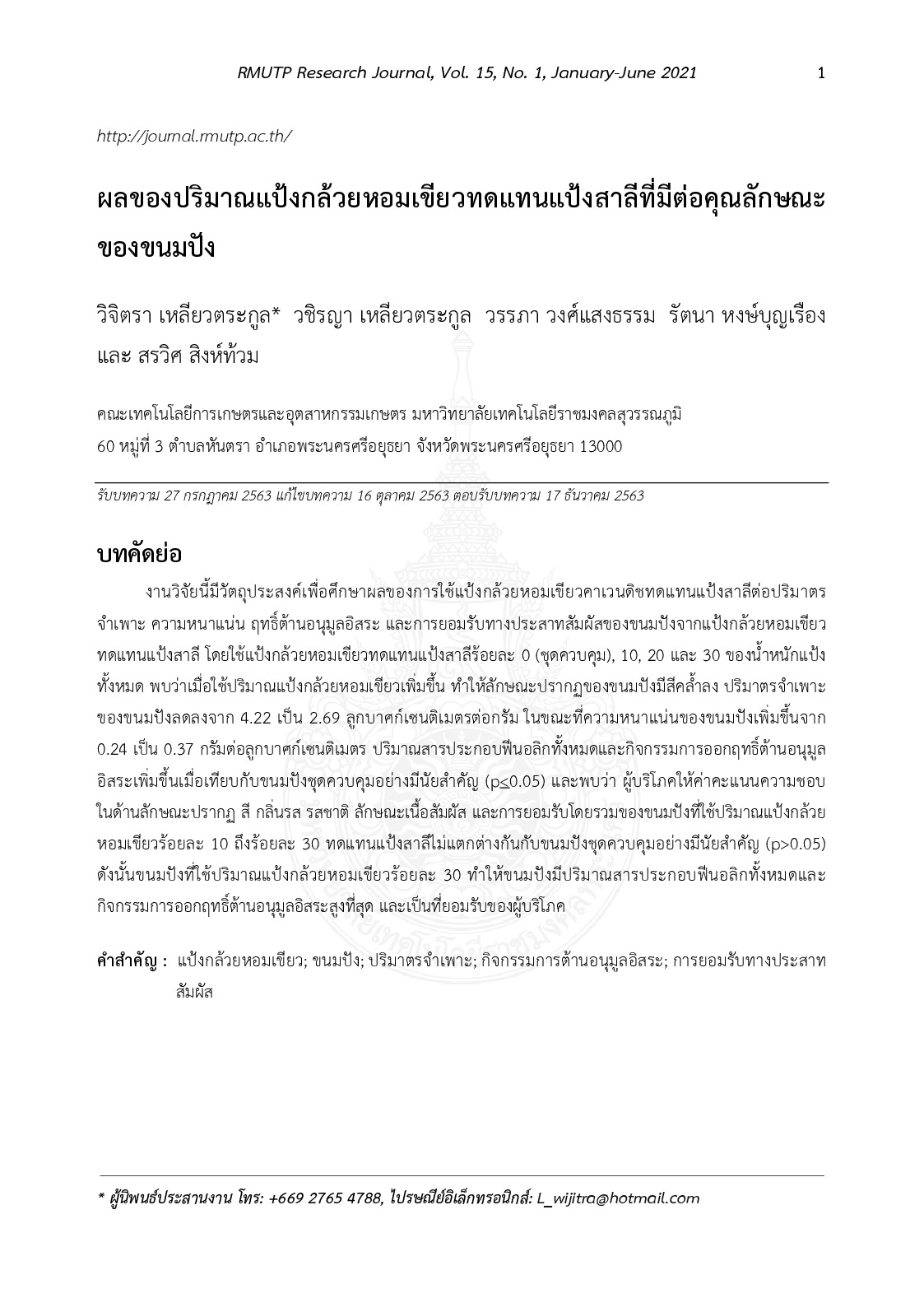
ผลของปริมาณแป้งกล้วยหอมเขียวทดแทนแป้งสาลีที่มีต่อคุณลักษณะของขนมปัง
The objective of this research was to study the effect of substitution of wheat flour with Cavendish banana flour on specific volume density antioxidant activity and the sensory acceptance of bread using Cavendish banana flour instead of wheat flour as 0% (control) 10% 20% and 30% of the total flour weight. It was found that an increasing amount of Cavendish banana flour caused the darker of the bread appearance and the specific volume of the bread decreased from 4.22 to 2.69 cm3/g while the bread density increased from 0.24 to 0.37 g/cm3. The total phenolic content and antioxidant activity of the bread made of Cavendish banana flour instead of wheat flour were significantly greater than the control bread (p<0.05). Also the sensory acceptance scores by panelists in terms of appearance color aroma taste texture and overall acceptance of bread using 10-30% of Cavendish banana flour content were not significantly different compared to the control bread (p>0.05) . Therefore the bread using 30% Cavendish banana flour gave the highest amount of total phenolic compounds and antioxidant activity with well accepted by consumers.