จำนวน Repository ( 45 )
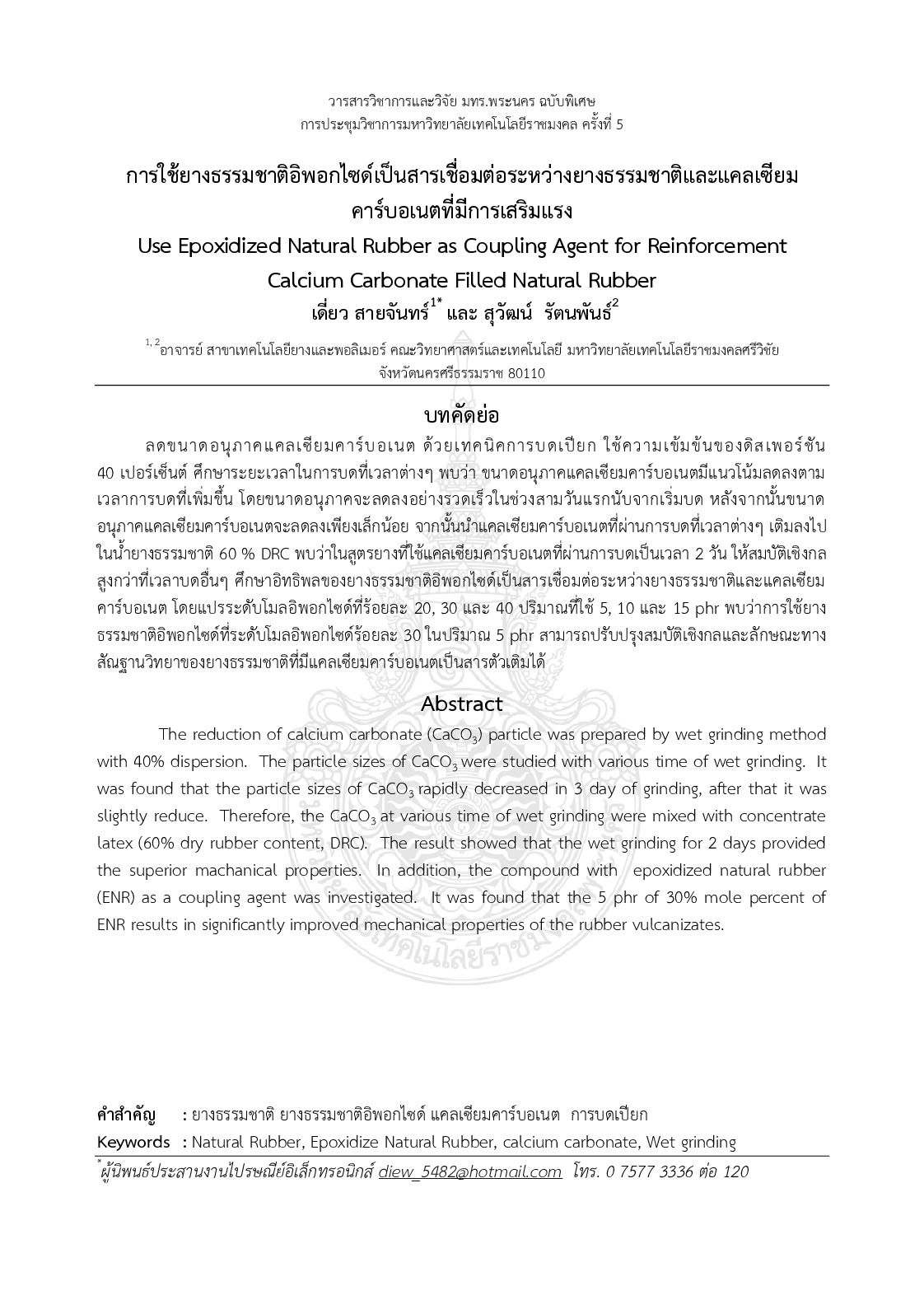
Use epoxidized natural rubber as coupling agent for reinforcement calcium carbonate filled natural rubber
The reduction of calcium carbonate (CaCO3) particle was prepared by wet grinding method with 40% dispersion. The particle sizes of CaCO3 were studied with various time of wet grinding. It was found that the particle sizes of CaCO3 rapidly decreased in 3 day of grinding after that it was slightly reduce. Therefore the CaCO3 at various time of wet grinding were mixed with concentrate latex (60% dry rubber content DRC). The result showed that the wet grinding for 2 days provided the superior machanical properties. In addition the compound with epoxidized natural rubber (ENR) as a coupling agent was investigated. It was found that the 5 phr of 30% mole percent of ENR results in significantly improved mechanical properties of the rubber vulcanizates.
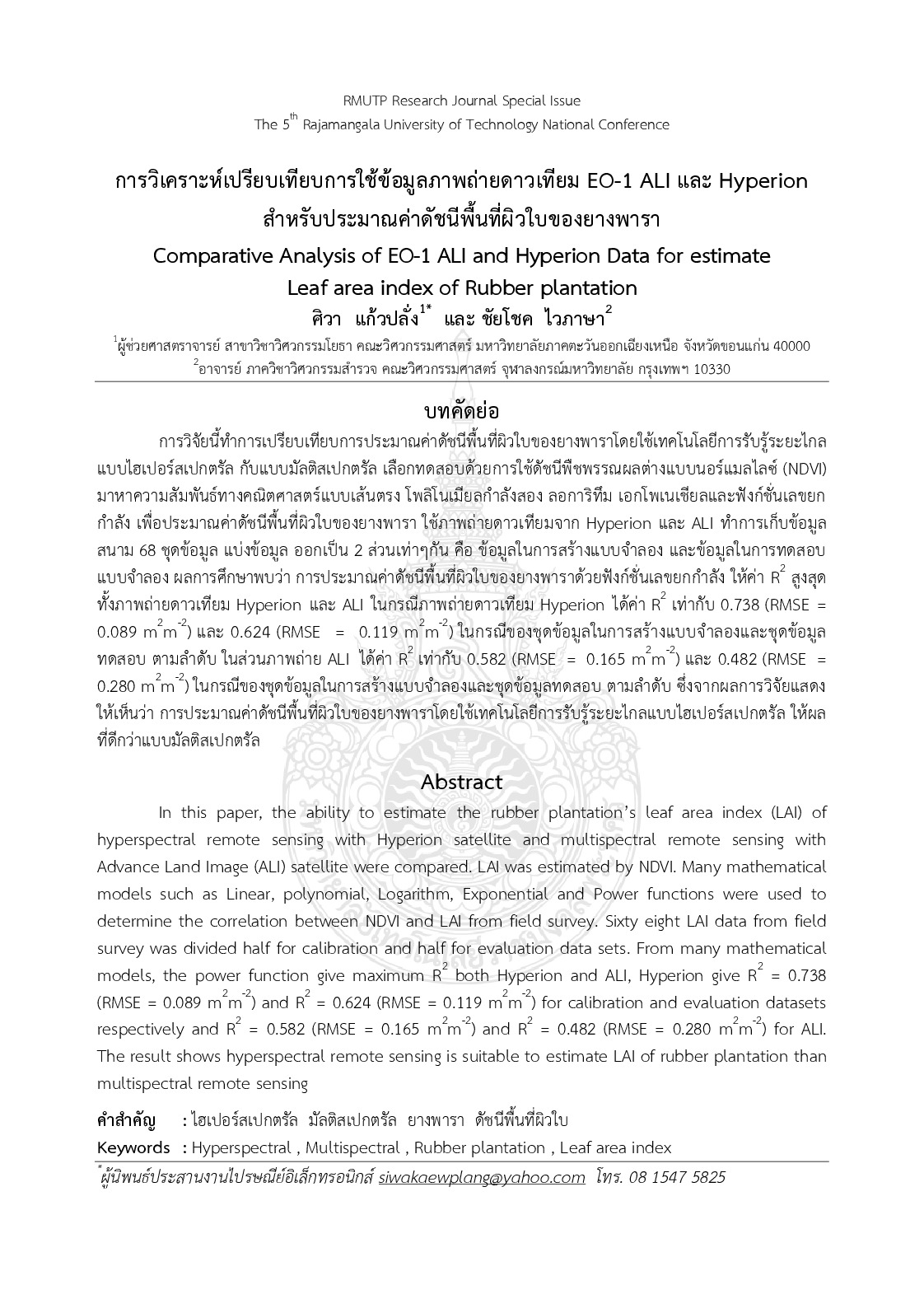
Comparative analysis of EO-1 ALI and Hyperion data for estimate leaf area index of rubber plantation
In this paper the ability to estimate the rubber plantation’s leaf area index (LAI) of hyperspectral remote sensing with Hyperion satellite and multispectral remote sensing with Advance Land Image (ALI) satellite were compared. LAI was estimated by NDVI. Many mathematical models such as Linear polynomial Logarithm Exponential and Power functions were used to determine the correlation between NDVI and LAI from field survey. Sixty eight LAI data from field survey was divided half for calibration and half for evaluation data sets. From many mathematical models the power function give maximum R2 both Hyperion and ALI Hyperion give R2 = 0.738 (RMSE = 0.089 m2m-2) and R2 = 0.624 (RMSE = 0.119 m2m-2) for calibration and evaluation datasets respectively and R2 = 0.582 (RMSE = 0.165 m2m-2) and R2 = 0.482 (RMSE = 0.280 m2m-2) for ALI. The result shows hyperspectral remote sensing is suitable to estimate LAI of rubber plantation than multispectral remote sensing
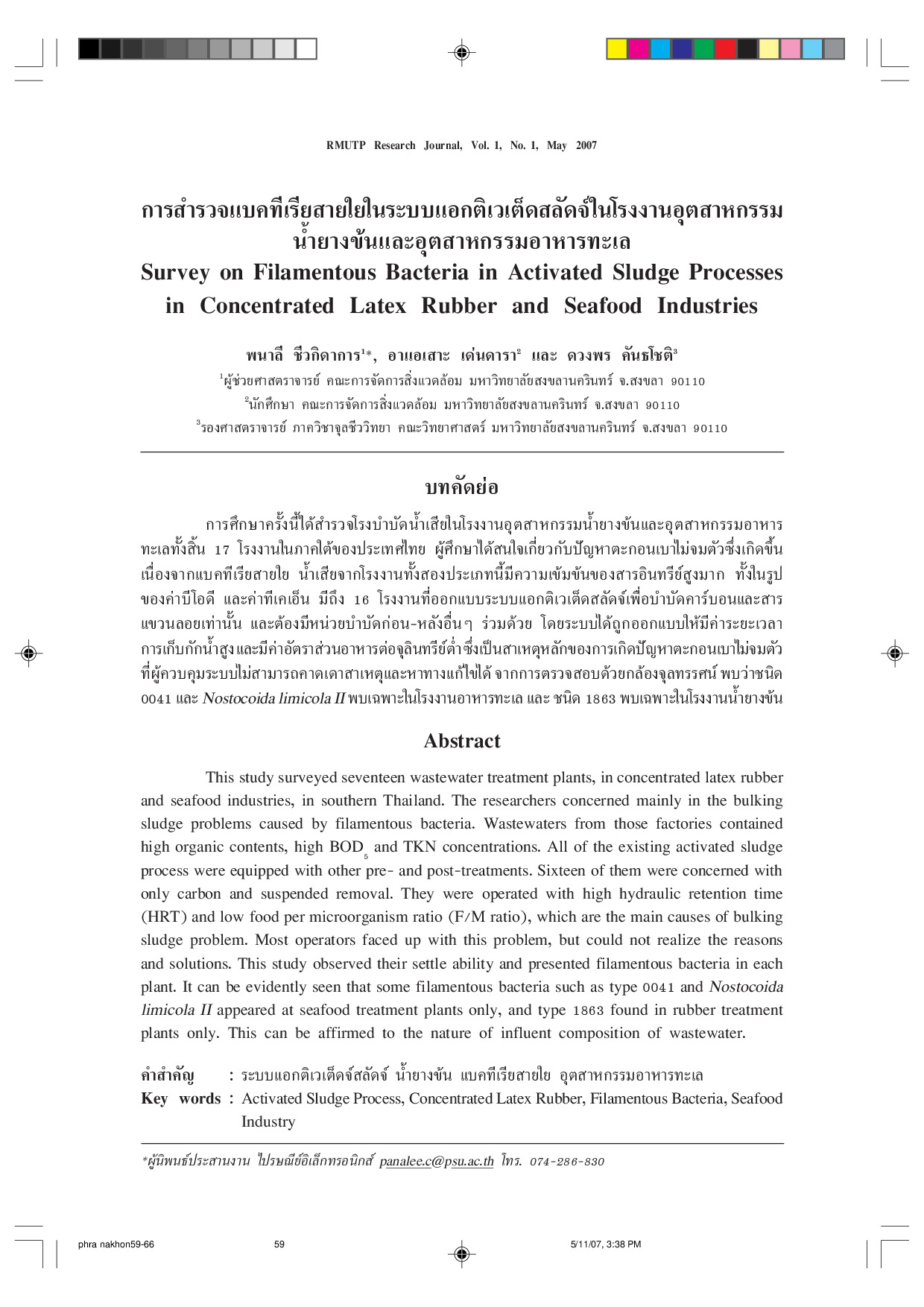
Survey on Filamentous Bacteria in Activated Sludge Processes in Concentrated Latex Rubber and Seafood Industries
This study surveyed seventeen wastewater treatment plants in concentrated latex rubber and seafood industries in southern Thailand. The researchers concerned mainly in the bulking sludge problems caused by filamentous bacteria. Wastewaters from those factories contained high organic contents high BOD5 and TKN concentrations. All of the existing activated sludge process were equipped with other pre- and post-treatments. Sixteen of them were concerned with only carbon and suspended removal. They were operated with high hydraulic retention time (HRT) and low food per microorganism ratio (F/M ratio) which are the main causes of bulking sludge problem. Most operators faced up with this problem but could not realize the reasons and solutions. This study observed their settle ability and presented filamentous bacteria in each plant. It can be evidently seen that some filamentous bacteria such as type 0041 and Nostocoida limicola II appeared at seafood treatment plants only and type 1863 found in rubber treatment plants only. This can be affirmed to the nature of influent composition of wastewater.
การบําบัดน้ำเสียจากชุมชนด้วยระบบเอสบีอาร์ร่วมกับยางพื้นรองเท้า
This research has studied the treatment of municipal wastewater with shoe soles as a supporting media for Sequencing Batch Reactor. The objectives of this research were the conditions to for optimize growing Photosynthetic Bacteria (PSB) and understand the treatment efficiencies of municipal wastewater treatment with PSB in Sequencing Batch Reactor (SBR). Three types of shoe soles were applied in this research composed of rubber shoe soles neoprene and EVA and the control without shoe soles. The experimental factors included the essential parameters such as BOD COD SS MLSS MLVSS Phosphorus and Ammonia-Nitrogen. F/M Ratio was adjusted at 0.13 and hydraulic retention time (HRT) was at 5 days. The results indicated that the removal efficiencies of SBR with rubber shoe soles in terms of BOD COD SS phosphorus and ammonia-nitrogen were 87% 80% 94% 53% and 68% respectively. The removal efficiencies of SBR with Neoprene shoe soles in terms of BOD COD SS Phosphorus and Ammonia-Nitrogen were 89% 81% 95% 20% and 73%. The removal efficiencies of SBR with EVA shoe soles in terms of BOD COD SS phosphorus and ammonia-nitrogen were 91% 86% 95% 56% and 74%. The removal efficiencies of SBR without shoe soles in terms of BOD COD SS phosphorus and ammonia-nitrogen were 84% 79% 93% 86% and 67% respectively. The treated wastewater was rather clear low content of suspended solids and no malodor. From overall results the treatment of municipal wastewater by anaerobic sequencing batch reactor with different types of shoe soles was not significant for wastewater treatment efficiencies by anaerobic with any 3 types among of shoes soles can be efficiently applied for municipal wastewater treatment.

การพัฒนาคุณสมบัติด้านฉนวนป้องกันความร้อนของกระเบื้องหลังคาคอนกรีตโดยใช้น้ายางพารา
The purpose of this research is to improve the physical and mechanicalqualities of natural rubber latex tiles. Water: surfactant: surfactant: 1: 2.75: 0.03: 0.30:0.03: 0.04 by weight and added with natural latex. In the ratio of Portland Cement Type 1: Natural Latex is 1: 0 1: 0.025 1: 0.05 1: 0.075 and 1: 0.10. Formed with compression presses at normal temperatures it was found that the optimum amount of natural latex For concrete reinforced concrete tiles the ratio is 1: 0.025. The tests in accordance with Thai Industrial Standard TIS 535-2556 are tested in 4 aspects. Dimensional stress test Water absorption test And waterproofness testing The value has passed the benchmark. And low thermal conductivity. Increasing the insulation of the roof as well. Can be used as a prototype product tile concrete roof natural latex. To produce commercially And there can be many local latex or rubber latex. To be more useful and valuable.