จำนวน Repository ( 3611 )

การพัฒนาแผ่นเส้นใยอิเล็คโทรสปันจากโปรตีนไหมซิริซิน สารสกัดรางจืด และสารสกัดหญ้าหางม้าสำหรับประยุกต์เป็นแผ่นปิดแผล
In this work fiber mat based on silk sericin and thunbergia laurifolia linn extract was developed via electrospinning technique for wound dressing application. The waste cocoons were selected from Nakhon Ratchasima 1 (K1) with appropriate spicy for extracting the silk sericin protein. Trunk of thunbergia laurifolia linn was selected for preparing thunbergia laurifolia linn extract. Polyvinyl alcohol (PVA) with several concentrations were chose and fabricated to fibers by electrospinning technique to investigate suitable polymer concentration for mixing silk sericin and thunbergia laurifolia linn extract. The result revealed that PVA of 9 wt % was suitable due to Several parameters were investigated to prepare the electrospun fiber of silk sericin and thunbergia laurifolia linn extract such as their mixing ratio voltage the distance between the needle and the substrate and the needle size. The results indicated that mixing ratio of silk sericin and thunbergia laurifolia linn extract at 50:50 (w/w) voltage of 15 kV the distance of the needle and the substrate at 8 cm and the needle size of 18 were optimum condition for the fabrication of electrospun fiber with diameter of 100-200 nm and that with smooth and continue feature.
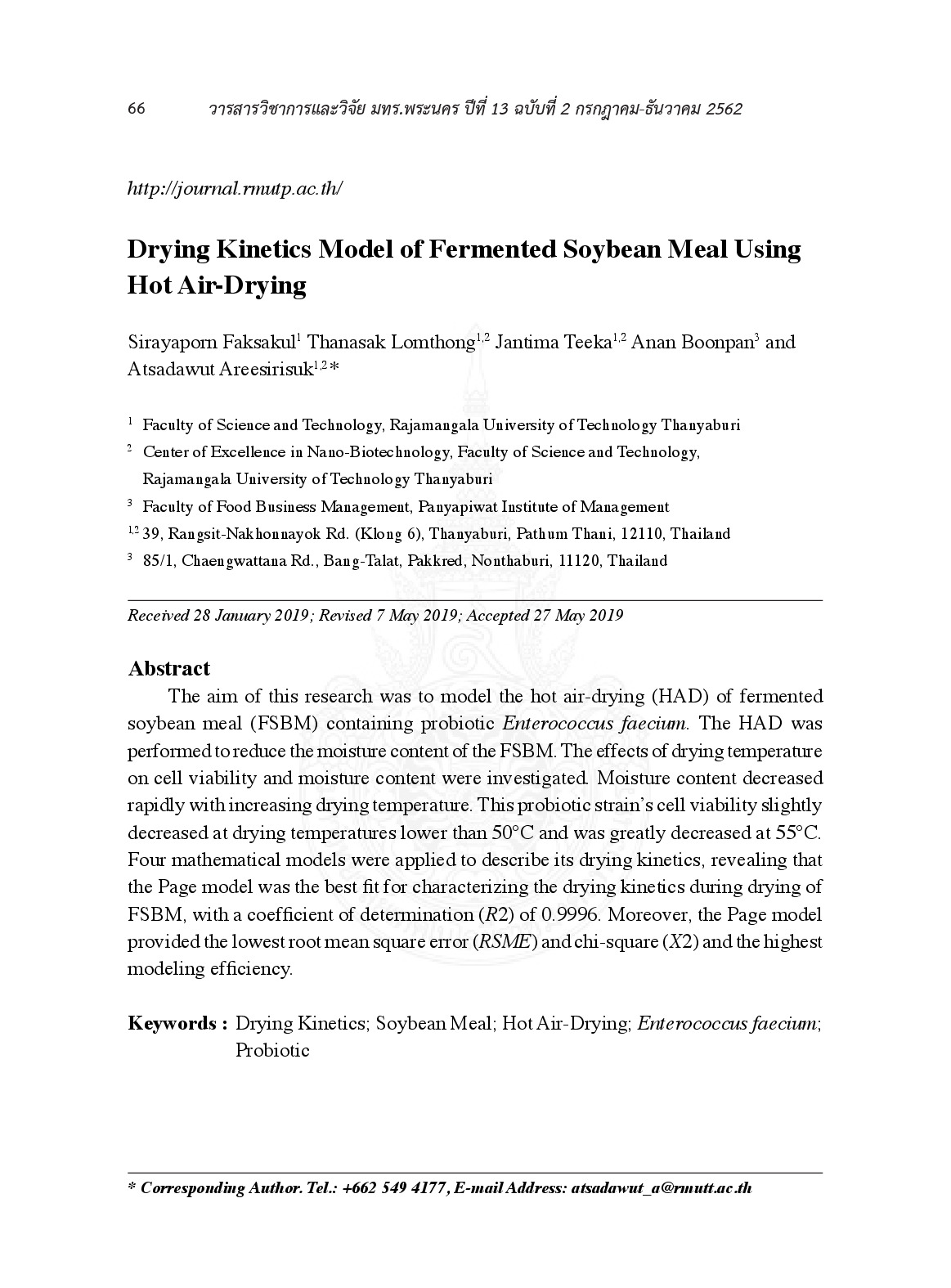
Drying kinetics model of fermented soybean meal using hot air-drying
The aim of this research was to model the hot air-drying (HAD) of fermented soybean meal (FSBM) containing probiotic Enterococcus faecium . The HAD was performed to reduce the moisture content of the FSBM. The effects of drying temperature on cell viability and moisture content were investigated. Moisture content decreased rapidly with increasing drying temperature. This probiotic strain’s cell viability slightly decreased at drying temperatures lower than 50°C and was greatly decreased at 55°C. Four mathematical models were applied to describe its drying kinetics revealing that the Page model was the best fit for characterizing the drying kinetics during drying of FSBM with a coefficient of determination (R2) of 0.9996. Moreover the Page model provided the lowest root mean square error (RSME) and chi-square (X2) and the highest modeling efficiency
การพัฒนาระบบสารสนเทศในการจัดการทรัพยากรและฐานข้อมูล
This research is the study and development of the information system for managing resources and database by focusing on the workload academic teacher (WAT) systems for the teachers worked on the Faculty of Science and Technology Rajamangala University of Technology Phra Nakhon. The main objective was to develop the WAT systems based on the web-based application (web application) and to evaluate the effectiveness and to assess user satisfaction with WAT systems. The WAT systems were also performed based on the system development life cycle (SDLC) and requirements gathering analysis of existing systems with the paper-based managements to new systems for use in the electronic managements. The evaluation of efficiency of the WAT systems was performed by the information technologists for the functionality of WAT systems resulting in the average satisfaction score is 4.36 with the standard deviation of 0.54. As the same experts the satisfaction of usability such as login procedure choosing the workload issues to easy document upload and filledforms performances etc. resulting in the average satisfaction score is 4.29 with the standard deviation of 0.55. These results provided the high level of experts’ satisfaction. After improving the WAT systems the functionality and the usability of systems were evaluated by usage teachers. It was found that the average satisfaction score of the functionality is 4.21 with the standard deviation of 0.67 and the usability is 3.56 with the standard deviation of 0.96 (n=15). It can be implied that the WAT systems can be applied to practical and responsive to the needs of users.
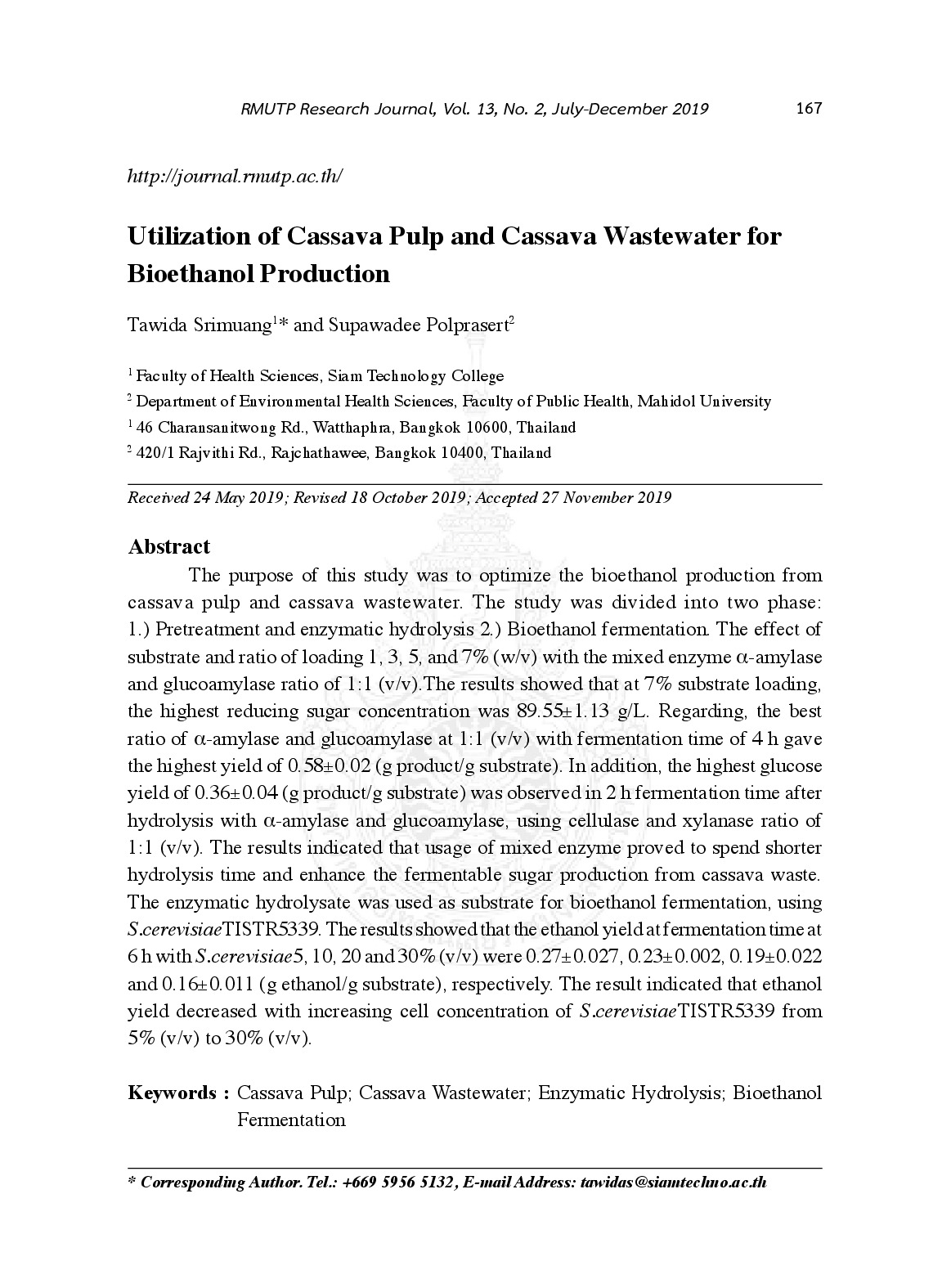
Utilization of cassava pulp and cassava wastewater for bioethanol production
The purpose of this study was to optimize the bioethanol production from cassava pulp and cassava wastewater. The study was divided into two phase: 1.) Pretreatment and enzymatic hydrolysis 2.) Bioethanol fermentation. The effect of substrate and ratio of loading 1 3 5 and 7% (w/v) with the mixed enzyme α-amylase and glucoamylase ratio of 1:1 (v/v).The results showed that at 7% substrate loading the highest reducing sugar concentration was 89.55±1.13 g/L. Regarding the best ratio of α-amylase and glucoamylase at 1:1 (v/v) with fermentation time of 4 h gave the highest yield of 0.58±0.02 (g product/g substrate). In addition the highest glucose yield of 0.36±0.04 (g product/g substrate) was observed in 2 h fermentation time after hydrolysis with α-amylase and glucoamylase using cellulase and xylanase ratio of 1:1 (v/v). The results indicated that usage of mixed enzyme proved to spend shorter hydrolysis time and enhance the fermentable sugar production from cassava waste. The enzymatic hydrolysate was used as substrate for bioethanol fermentation using S.cerevisiaeTISTR5339. The results showed that the ethanol yield at fermentation time at 6 h with S.cerevisiae5 10 20 and 30% (v/v) were 0.27±0.027 0.23±0.002 0.19±0.022 and 0.16±0.011 (g ethanol/g substrate) respectively. The result indicated that ethanol yield decreased with increasing cell concentration of S.cerevisiaeTISTR5339 from 5% (v/v) to 30% (v/v).
การพัฒนาวัตกรรมทางอาหาร: เครื่องดื่มนมโปรตีนสูงถั่วดาวอินคา
Milk one of the favorite food around the world typically is produced by the mammary glands of mammals such as a cow. However dairy from the cow is not suitable for people with dairy allergies and lactose intolerance. Thus the global demand for non-diary or plant-based milk is rising. Sacha Inchi (Plukenetia Volubilis L) or Dao incha is an edible oil-seed nut originated from the Amazon Rainforest in Peru. This crop is known as a rich source of oil with high content of polyunsaturated fatty acids. Not only essential fatty acids but the nuts also consist of high protein level and minerals. It is not surprising that in recent years there has been growing interest in developing the sacha inchi plant as a novel food such as roasted nuts or cookie. This study evaluated the chemical physical microbiological properties and nutritional factor of milk from Sacha Inchi comparing with pressed-cake powder from a by-product of Sacha Inch oil extraction process. According to our results the Sacha Inchi has a potential to be developed as an alternative plant-based milk. The roasted Sacha Inchi milk consists of a complete protein with all nine essential amino acids and they are rich in omega 3 6 and 9. A high contents of minerals such as 2400 mg of calcium per 100 g sample was aslo found in raosted Sacha Inchi nuts. By roasting the nut the protein content was found to be decreasing up to 55.34 % to the same level of the protein content in the pressed-caked Sacha inchi powder. However roasting can add a flavor to the Inchi nuts and also in the milk. Comparing the nutrition factors of the nut milk and the pressed-cake Sacha Inchi milk the pressed-cake milk consists of fat and calory less than roasted Sacha Inchi milk. However the protein and sodium content is quite similar at 4% and 15 mg respectively. The preference for original matcha green tea and cocoa of the roasted Sacha Inchi milk were determined. The three samples were not significantly different in the liking of any attributes (p>0.05). The color of the three flavour of non-diary milk showed slight to moderate in customer liking. Although not significantly different in affection the cocoa flavor had higher liking scores than original and green tea flavors. The just-about-right results showed that the disliking of Sacha inchi milk was mainly due to too much bean aroma and flavour as well as too less sweet taste. The Dao Inca milk has the potential to be new high protein milk that is good for health-conscious consumers and those who are allergic to cows 3 milk. The current product was not well liked due to intense beany aroma and flavor and too less sweet taste. However using other flavours and seasoning such as cocoa could mask the beany smell and flavour.