จำนวน Repository ( 3611 )
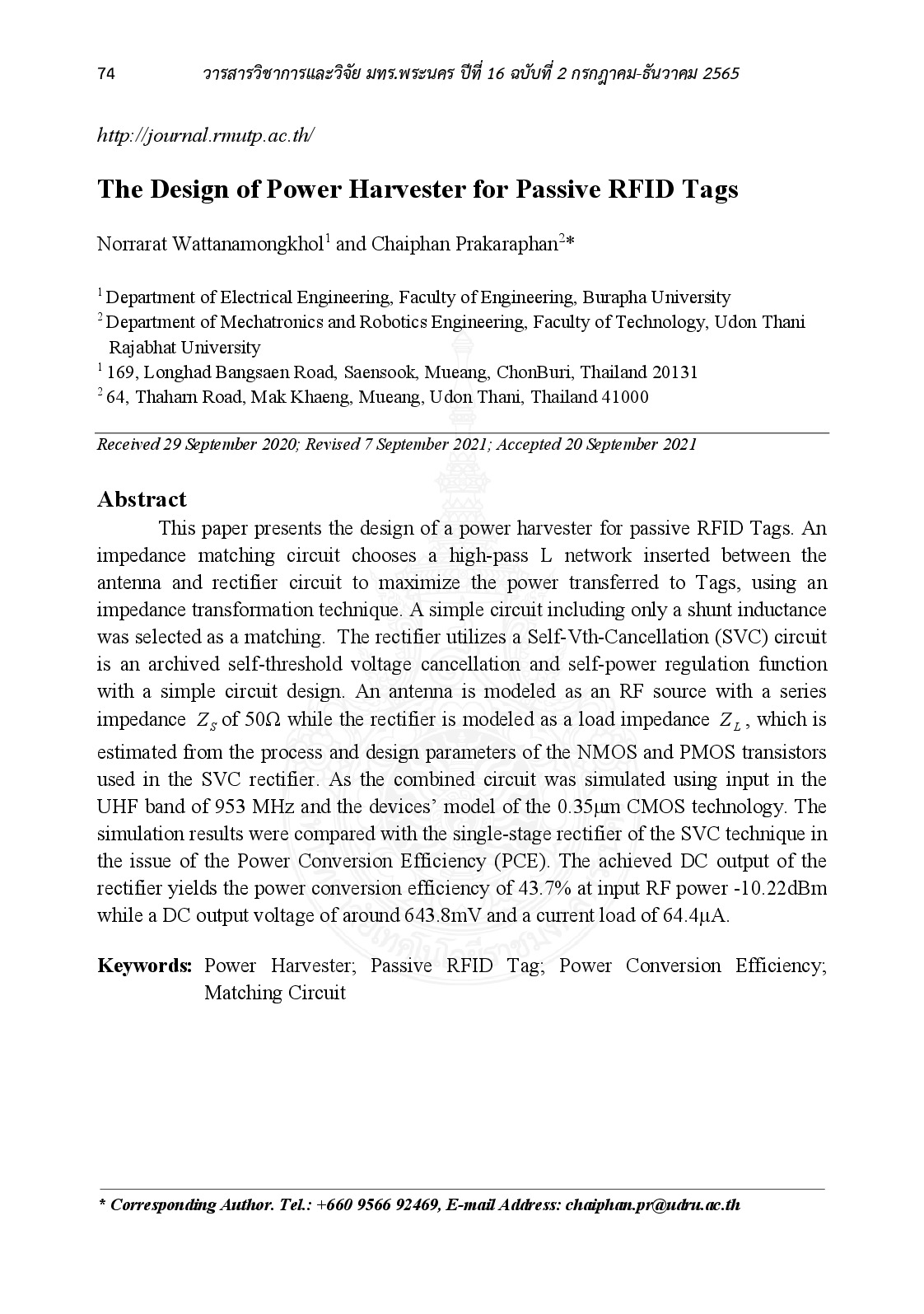
The Design of power harvester for passive RFID Tags
This paper presents the design of a power harvester for passive RFID Tags. An impedance matching circuit chooses a high-pass L network inserted between the antenna and rectifier circuit to maximize the power transferred to Tags using an impedance transformation technique. A simple circuit including only a shunt inductance was selected as a matching. The rectifier utilizes a Self-Vth-Cancellation (SVC) circuit is an archived self-threshold voltage cancellation and self-power regulation function with a simple circuit design. An antenna is modeled as an RF source with a series impedance Zs of 50Ω while the rectifier is modeled as a load impedance ZL which is estimated from the process and design parameters of the NMOS and PMOS transistors used in the SVC rectifier. As the combined circuit was simulated using input in the UHF band of 953 MHz and the devices’ model of the 0.35μm CMOS technology. The simulation results were compared with the single-stage rectifier of the SVC technique in the issue of the Power Conversion Efficiency (PCE). The achieved DC output of the rectifier yields the power conversion efficiency of 43.7% at input RF power -10.22dBm while a DC output voltage of around 643.8mV and a current load of 64.4μA.

The study of optimum factors in gold plating process to enhance OTOP knife products for ban mai knife forgers village, Lom Sak district, Phetchabun
This research aimed to study the optimum factors affecting the quality of gold plating process to enhance OTOP knife products of Ban Mai knife forgers village. This study focused on application of AISI 5160 steel and the 24k gold plating process.In the experiment three samples of plating currents were observed; 10 12 and 14 volts each at 30 60 90 120 150 seconds and 180 seconds respectively. The study found that applying the electric currents in gold plating at 12 volts for 120 seconds gave the best results for the gold color and thickness by giving the thickness of the gold surface at 33.82 micron and the color value between L*=88.72 a*=4.45 and b*=78.58. Moreover the gold dispersion was consistent throughout the workpiece. From applying the electric currents in gold plating at 10 volts it lessened the thickness of the gold plating which made the gold plating look uneven. From applying the electric currents in gold plating at 14 volts it increased the thickness of the gold plating which resulted in a dull or burned finish from over-plating. In comparison the cost of the knife before plating with gold costs only 30 baht per piece while the cost of the knife after plating with gold costs 99 baht per piece. In conclusion the daily sales of a product increase from 50-60 items per day to 60-75 items per day which also resulted in increased revenue and profitability from 1500-1800 baht per day to 5940-7425 baht per day on average.
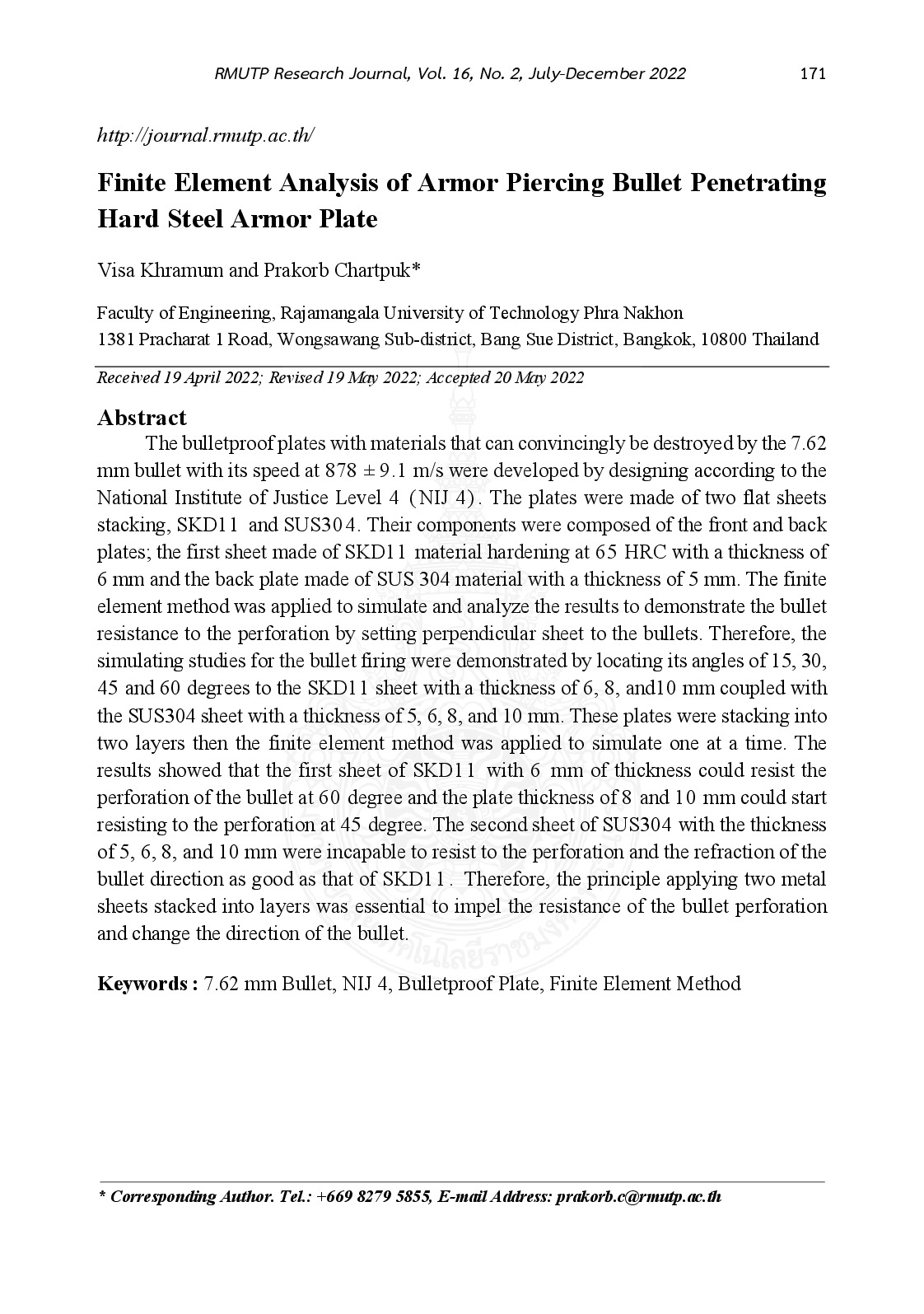
Finite element analysis of armor piercing bullet penetrating hard steel
The bulletproof plates with materials that can convincingly be destroyed by the 7.62 mm bullet with its speed at 878 ± 9.1 m/s were developed by designing according to the National Institute of Justice Level 4 (NIJ 4). The plates were made of two flat sheets stacking SKD11 and SUS304. Their components were composed of the front and back plates; the first sheet made of SKD11 material hardening at 65 HRC with a thickness of 6 mm and the back plate made of SUS 304 material with a thickness of 5 mm. The finite element method was applied to simulate and analyze the results to demonstrate the bullet resistance to the perforation by setting perpendicular sheet to the bullets. Therefore the simulating studies for the bullet firing were demonstrated by locating its angles of 15 30 45 and 60 degrees to the SKD11 sheet with a thickness of 6 8 and10 mm coupled with the SUS304 sheet with a thickness of 5 6 8 and 10 mm. These plates were stacking into two layers then the finite element method was applied to simulate one at a time. The results showed that the first sheet of SKD11 with 6 mm of thickness could resist the perforation of the bullet at 60 degree and the plate thickness of 8 and 10 mm could start resisting to the perforation at 45 degree. The second sheet of SUS304 with the thickness of 5 6 8 and 10 mm were incapable to resist to the perforation and the refraction of the bullet direction as good as that of SKD11. Therefore the principle applying two metal sheets stacked into layers was essential to impel the resistance of the bullet perforation and change the direction of the bullet.

Isolation, classification and study of the influence of glow discharge plasma on dirty panicle rice fungal pathogens
This study was conducted to isolate and classify fungal dirty panicle disease pathogens from five rice varieties. Observation of rice seeds under stereo microscope showed that the seeds from all five varieties had 100% lesions of dirty panicle disease. When isolating the fungal pathogen with three methods i.e. (i) ground rice seeds shaken in dH2O and then spread on potato dextrose agar (PDA) (ii) rice seeds washed with dH2O twice then placed on PDA and (iii) rice seeds shaken in 5% clorox for 5 min after that washed with dH2O twice and then placed on PDA 57 isolates of fungi were obtained. Morphological characterization classified the fungi into 17 genera i.e. Alternaria Arthrinium Aspergillus Biporalis Botryotinia Botrytis Corynespora Curvularia Cylindrocarpon Fusarium Humicola Monilinia Mucor Penicillium Rhizopus Stachybotrys and Stemphylium. Four genera i.e. Alternaria Bipolaris Curvularia and Fusarium were reported to cause of dirty panicle disease of rice. The effect of glow discharge plasma on inhibition of fungal pathogen showed that exposed glow discharge plasma for 150s could inhibit mycelium growth of Curvularia but did not affect to Bipolaris and Fusarium.
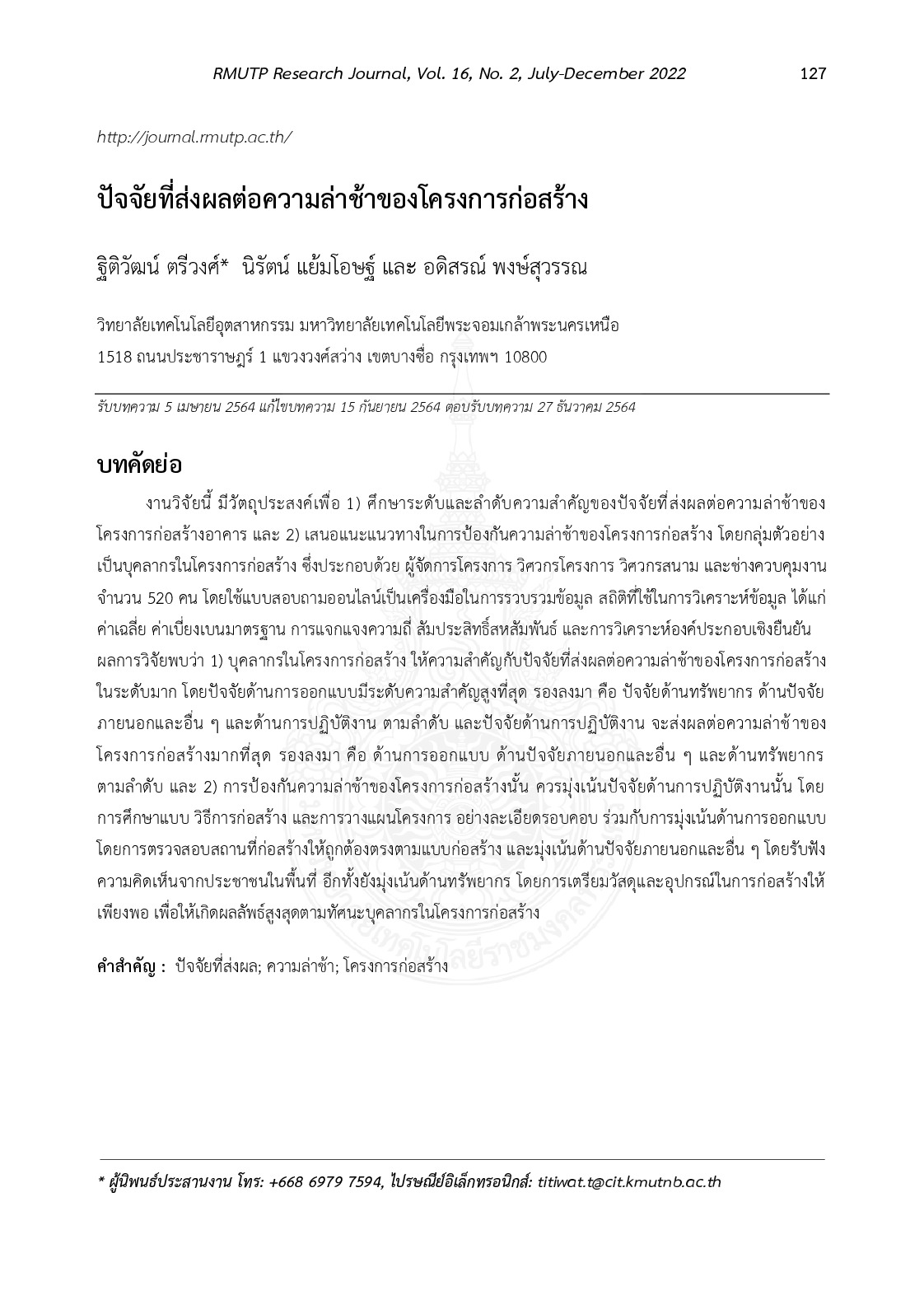
ปัจจัยที่ส่งผลต่อความล่าช้าของโครงการก่อสร้าง
The research is aimed to 1) study the level and priority of the factors affecting the delay of construction projects and 2) provide suggestions in relation to the prevention of such delay. The sample is 520 people who were working for different construction projects. They were project managers project engineers field engineers and foremen. The data were collected by using online questionnaires and analyzed to find out mean standard deviation (SD) frequency correlation coefficient and confirmatory factor analysis. The findings reveal two significant aspects. First those who were working in the construction projects concerned about the factors affecting the delay of the projects at high level. Respectively the factors related to design resource external factors and others were taken into consideration. The factor regarding to work performance is regarded affecting the project delay at the highest level. Other factors i.e. the design external factors and others and resource have the affects at the lower level. Second the work-related factors can help prevent the project delay. In other words the construction plan and methods as well as the project management should be well-implemented in accordance with the design. The construction site should be on inspection considering its drawing. Regarding the external factors and others the public voices of those living around the construction site should be taken into consideration. Furthermore the effective use of the resources can be carried out by sufficiently preparing all materials tools and equipment for constructing any project effectively as a consequence.