จำนวน Repository ( 3611 )
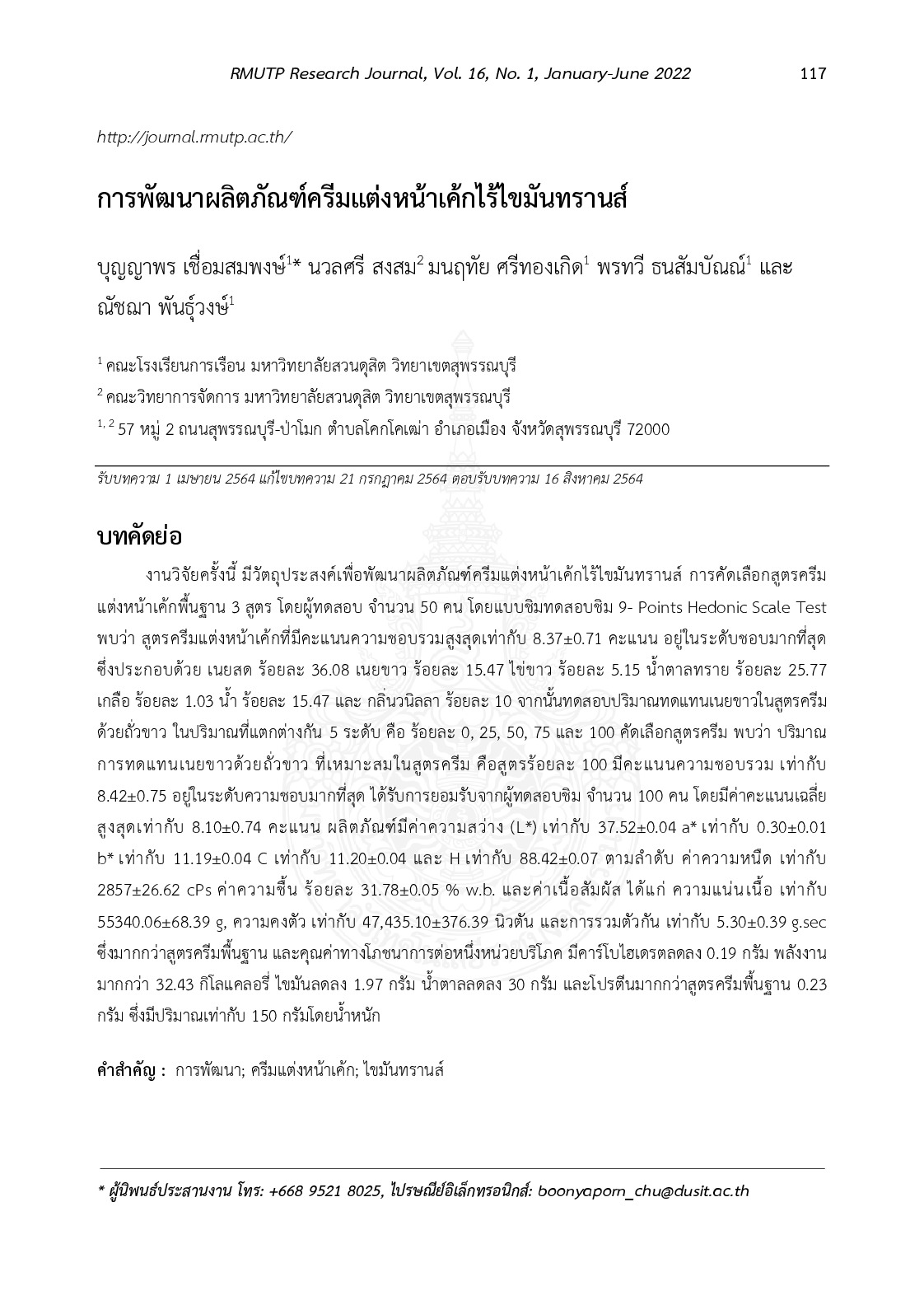
การพัฒนาผลิตภัณฑ์ครีมแต่งหน้าเค้กไร้ไขมันทรานส์
The objective of this research was to study the development of cake decorated cream without trans fat. selection of buttercream using as a standards recipe from 3 formulas 50 tasters by 9 Point Hedonic Scales Test. The formula using buttercream had 8.37±0.71 points at very like level was composed of butter 36.08 % shortening 15.47 % white egg 5.15 % sugar 25.77 % salt 1.03 % water 15.47 % and vanilla 10 %. Then substitute shortening with white kidney bean at 0 25 50 75 100 %. The 100% white kidney bean recipe was the highest acceptable 8.42±0.75 points at the very like level. The acceptance test with 100 consumers was 8.10±0.74 score at very like. The color of products showed L* a* b* C and H were 37.52±0.04 0.30±0.01 11.19±0.04 11.20±0.04 88.42±0.07 respectively The Viscosity was 2857±26.62 cPs Moisture was 31.78±0.05 w.b. Texture (Firmness) was 55340.06±68.39 g Consistency was 47435.10±376.39 N. and Cohesiveness was 5.30±0.39 g.sec which more than the standard recipe and nutritive values per one serving. Carbohydrates decrease at 0.19 gram Energy increase at 32.43 kilocalories Fat decrease at 1.97 gram Sugar decrease at 30 gram and more protein than the standard recipe with 0.23 gram. per serving at 150 g.
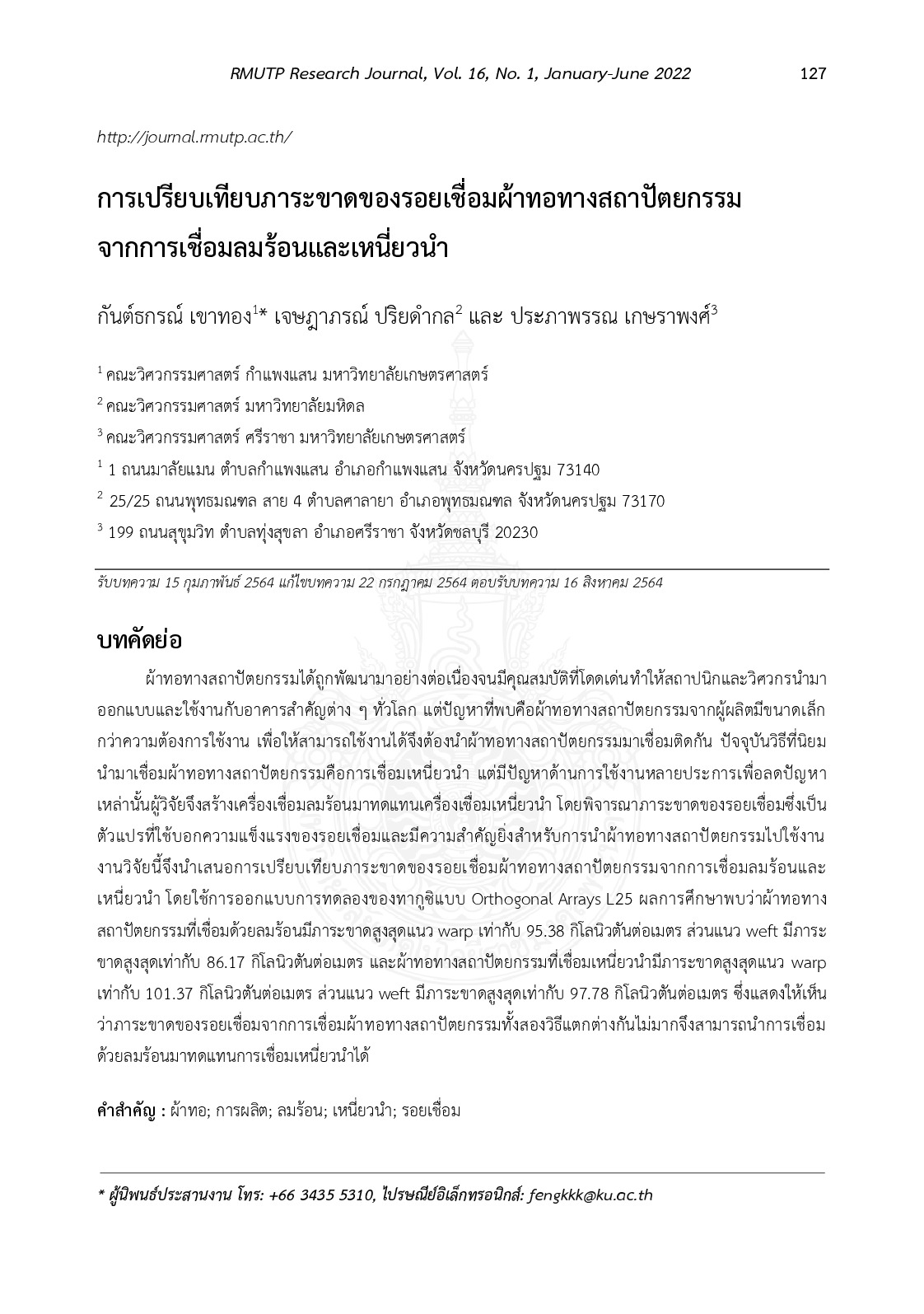
การเปรียบเทียบภาระขาดของรอยเชื่อมผ้าทอทางสถาปัตยกรรมจากการเชื่อมลมร้อนและเหนี่ยวนำ
Architectural fabrics were continuously developed on their unique performance. Architects and Engineers designed them for the application of important buildings around the world despite the symptom that Architectural fabric sizes from manufactures are smaller than the application sizes. Recently although the well-known method used to weld Architectural fabrics to enlarge their size is the high frequency welding there were some application issues. To mitigate those issues the researcher created the hot air welding to replace the high frequency welding in consideration on the failing loads of welded seams which are variable factors of the failing loads to indicate the weld strength and it is crucial for the Architectural fabric application. This research presents the comparison of failing load of weld seams between the hot air welding and high frequency welding by the test of Taguchis Orthogonal arrays L25 method. The test results demonstrated that Architectural fabrics welded by the hot air welding has the highest failing loads of wrap equal to 95.38 kN/m and the highest failing loads of weft at 86.17 kN/m. Conversely Architectural fabrics welded by the high frequency welding has the highest failing loads of wrap equal to 101.37 kN/m and the highest failing loads of weft at 97.78 kN/m. Based on a forementioned results there is no significant difference from both welding methods and thus concluded that the hot air welding could be used to replace the high frequency welding method.
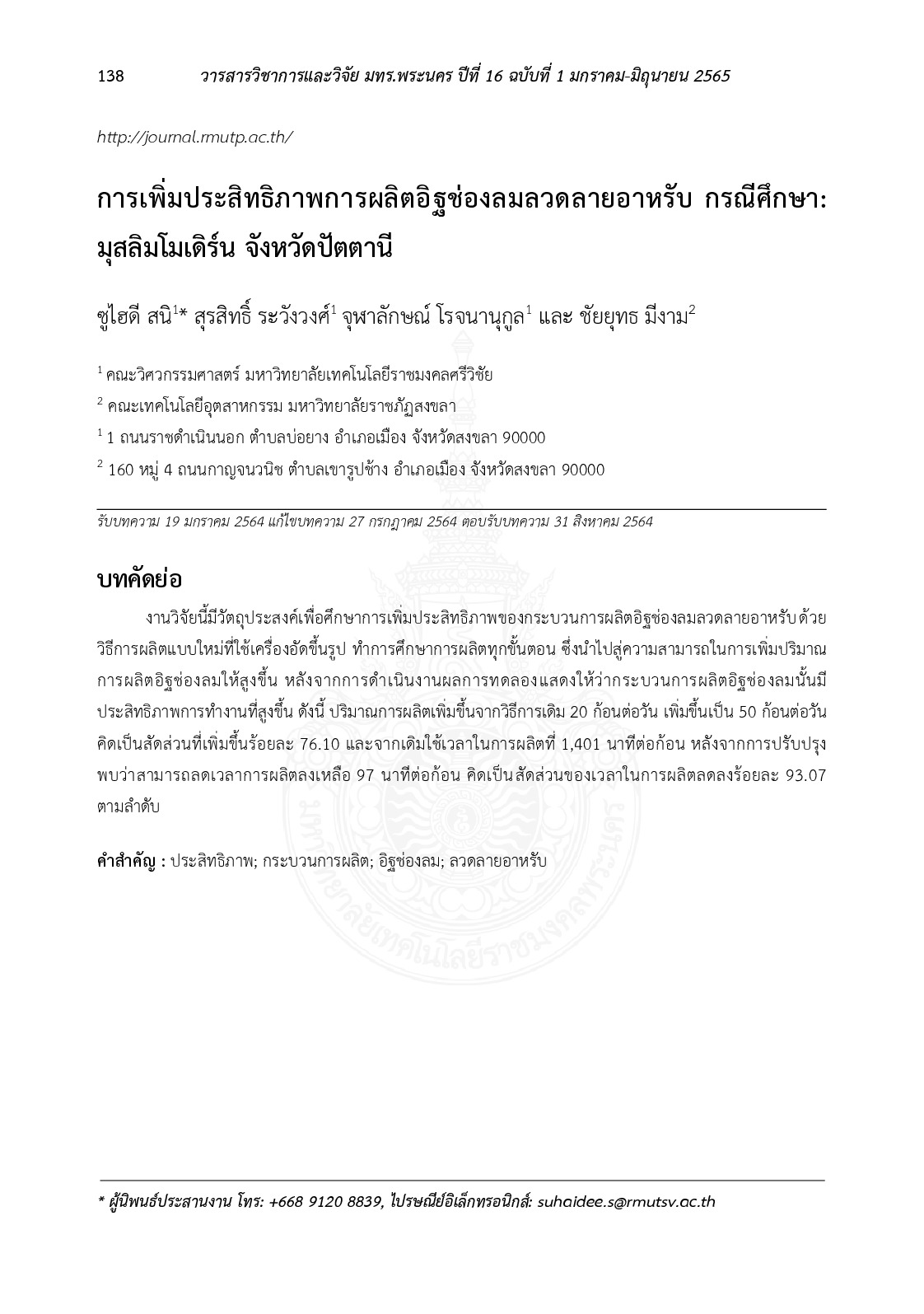
การเพิ่มประสิทธิภาพการผลิตอิฐช่องลมลวดลายอาหรับ การณีศึกษา : มุสลิมโมเดิร์น์ จังหวัดปัตตานี
The objective of this study is to improve the efficiency in manufacturing process of Arabian-style ventilation bricks with a new production method that uses a machine. The study focuses on all steps of productions in order to increase productivity. After the experiment the study shows that the improvement of ventilation brick manufacturing includes the increase in production volume from 20 pieces per day to 50 pieces per day representing an increase of 76.19 percent; and the decrease in production cycle time originally from 1401 minutes per piece to 97 minutes per piece representing a decrease of 93.07 percent respectively.
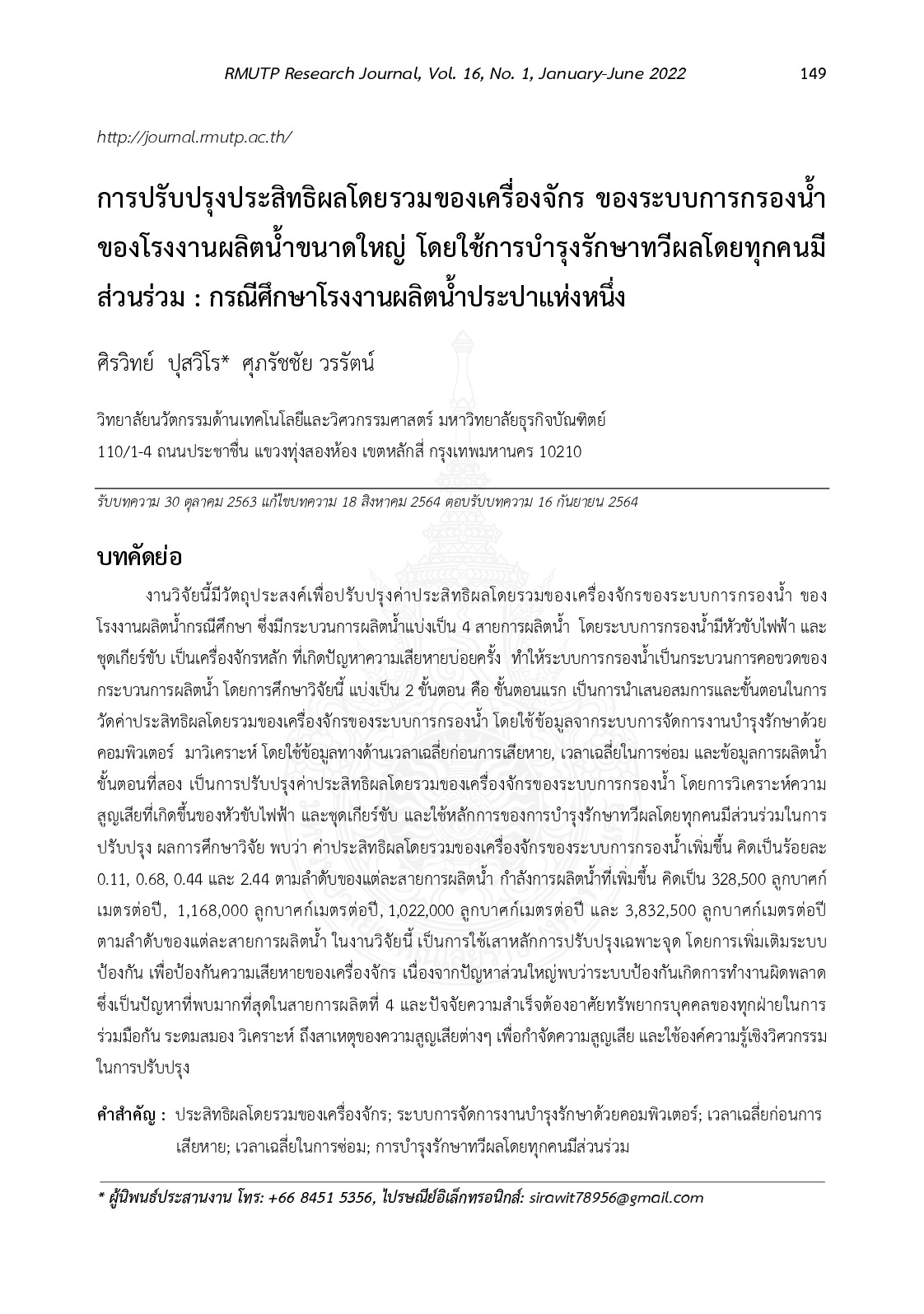
การปรับปรุงประสิทธิผลโดยรวมของเครื่องจักร ของระบบการกรองน้ำของโรงงานผลิตน้ำขนาดใหญ่ โดยใช้การบำรุงรักษาทวีผลโดยทุกคนมีส่วนร่วม : กรณีศึกษาโรงงานผลิตน้ำประปาแห่งหนึ่ง
This research objective is to improve the overall equipment effectiveness of the water filtration systems in the case study of the Water Treatment Plant which divides the water production into 4 production lines. The water filtration system has an electric actuator and gear is the main machine in the water filtration system. An electric actuator and gear have more machine breakdowns. That makes the water filtration system is the bottleneck of the water production process. This research study is divided into two steps: the first step is the presentation of the equation and the steps to measure the Overall Equipment Effectiveness of the water filtration system. The equation used data from the computer maintenance management system to analysis on mean time between failure data (MTBF) mean time to repair data (MTTR) and water production process data. The results can be improved the overall equipment effectiveness of the water filtration system increased to 0.11% 0.68% 0.44% and 2.44% respectively in each production process line. And increased Quantity of Filtration Water increased to 328500 m3/year 1168000 m3/year 1022000 m3/year and 3832500 m3/year respectively in each production process line. In this research used the pillar of focus improvement. By adding a protection system to prevent machine breakdown because of the most of the problems are found that the protection system malfunctions. This is the most problem in the 4th And then used engineering knowledge to improve water production and the success factor are required a human resources of all parties to cooperate brainstorm and analyze the causes of various losses in order to eliminate them.
อิทธิพลของรูปแบบความเร็วอากาศอบแห้งต่อการอบแห้งข้าวเปลือก
The objective of this research was to study the influence of drying air velocity characteristics on paddy drying. The pneumatic dryer prototype was used in this study. Test drying 15 kg of Hom Pathum paddy at 22 – 25% initial wet basis moisture content was tested drying under the drying air temperature 80OC until its moisture is 14% wet basis with the two drying air velocity characteristics. The first characteristic of drying air velocity is constant at 12.80 m/s and another is reduced velocity every 15 minutes throughout the test process from 12.80 - 8.44 m/s. Drying in a vertical tube with a diameter of 3.81 cm and height 1 m for study the drying behavior drying rate (DR) specific energy consumption (SEC) and thermal efficiency of drying. The results showed that drying with constant air velocity gives a shorter time higher drying rate lower primary SEC consumption and higher thermal efficiency than drying with reducing air velocity.