จำนวน Repository ( 3611 )
The study on high temperature degradation of AISI 1020 low carbon steel in the carburization state
This research was aimed to study the high temperature degradation of AISI 1020 carbon steel pipe under the carburizing atmosphere. This environment was prepared by a mix of powdered charcoal and CaCO3 catalysts and then simulated at temperature of 1000C for 1 2 and 4 hours. The variation in the weight of the aged steel specimens was obtained by the measured metal loss at various working periods. The light optical microscope was used to observe the microstructural changes of aged steel samples. The results revealed that the prolonged operating period decreases the weight of samples and the degradation occurs on the outer surface of the pipes. The study also indicated the microstructural difference between the inner and outer wall of the steel pipe which is resulted from the changes in chemical compositions during the carburizing process.
เครื่องสไลด์กล้วยตามแนวยาวและขวาง
This research was developed from the old version of the banana slicing machine for slices a banana in sheet-form longitudinal axis only by designed constructed and tested a new version of the banana slicing machine for slices a banana in sheet-form longitudinal and horizontal axis in flat-shape and curly-shape and adjustable sheet-thickness at between 1-2 mm. The new version of the machine would consist of a pressure plate over the feeding channel. The feeding channel could support for 5 fruits of a banana in the longitudinal laying and support for 10 fruits in the horizontal laying. The blade was installed on a drum and the tray was inserted under the drum for finished products. Electric gear-motor was used to drive the drum. The overall dimensions of the machine ware 0.56m (width) 0.64m (Length) 1.38m (High). The experimental was sliced by the machine at 1.5 mm thick in flat-shape and curly-shape can be summarized; the average rate of slide was 167 kg/hr. The average tolerances of sliced was ±0.02 mm the average deviations percentage of sliced was ±1.05 and the average power consumption of the machine was 0.23 kWh. The machines were used by targeted communities with production costs of about 4.78 million baht/year will lead a net profit to 5.97 million baht/year and the payback period of about 0.82 years.
การลดของเสียในกระบวนการผลิต กรณีศึกษา : โรงงานดาเดียร์เซรามิกในจังหวัดลำปาง
The objective of this research is to reduce waste in the production ceramics of Dadear Ceramics Factory in Lampang Province. The 7 quality control tools (7 QC Tools) were implemented including Check sheet Graph Pareto diagram and Fishbone diagram were used in analyze problem and solve the problems. It was found that most of the wastes come from burning ceramics process. The kilns and wheelbarrow has been used for a long time furthermore the equipment and parts were damaged from lack of maintenance. The non-standard of product arrangement method into the furnace were the cause of waste. Thus the researcher were improve wheelbarrow into the kilns and design a fixture to help worker to product arrangement. The results of the research which geathering data from quality inspection department. Then comparing data before the improvement (between September to December 2013) and after the improvement (between November 2014 to February 2015) the wastes are reduced from 8.97% to 0.29%. The result of improving is very efficiency because it can reduce the wastes to 8.68%.
การพัฒนารถไฟฟ้าพลังงานแสงอาทิตย์ต้นแบบสำหรับการแข่งขัน
The objective of this paper is to construct the solar car prototype. The car uses flexible solar panels with the battery as a power source. Thereafter the performance of the solar car is tested in the actual condition. This solar car’s body was developed by fiberglass and the internal structure was made from the steel. This car uses the 2 kW brushless DC motor to be the prime mover and the motor is driven by the regenerative dc converter. The power sources are 480 watts of the flexible solar panel with a charger to charge power to four of 12V 33Ah battery. The total weight of the solar car is 173 kg. The solar car’s weight including driver is about 233.4 kg. The solar car test drive is on 10 km distance. The result found that the car has: (1) the average speed is equal to 45.98km/h by using only battery (2) the average speed is equal to 51 km/h when the battery is combined with solar panels. This knowledge should be applied to develop the next version of the solar racing car.
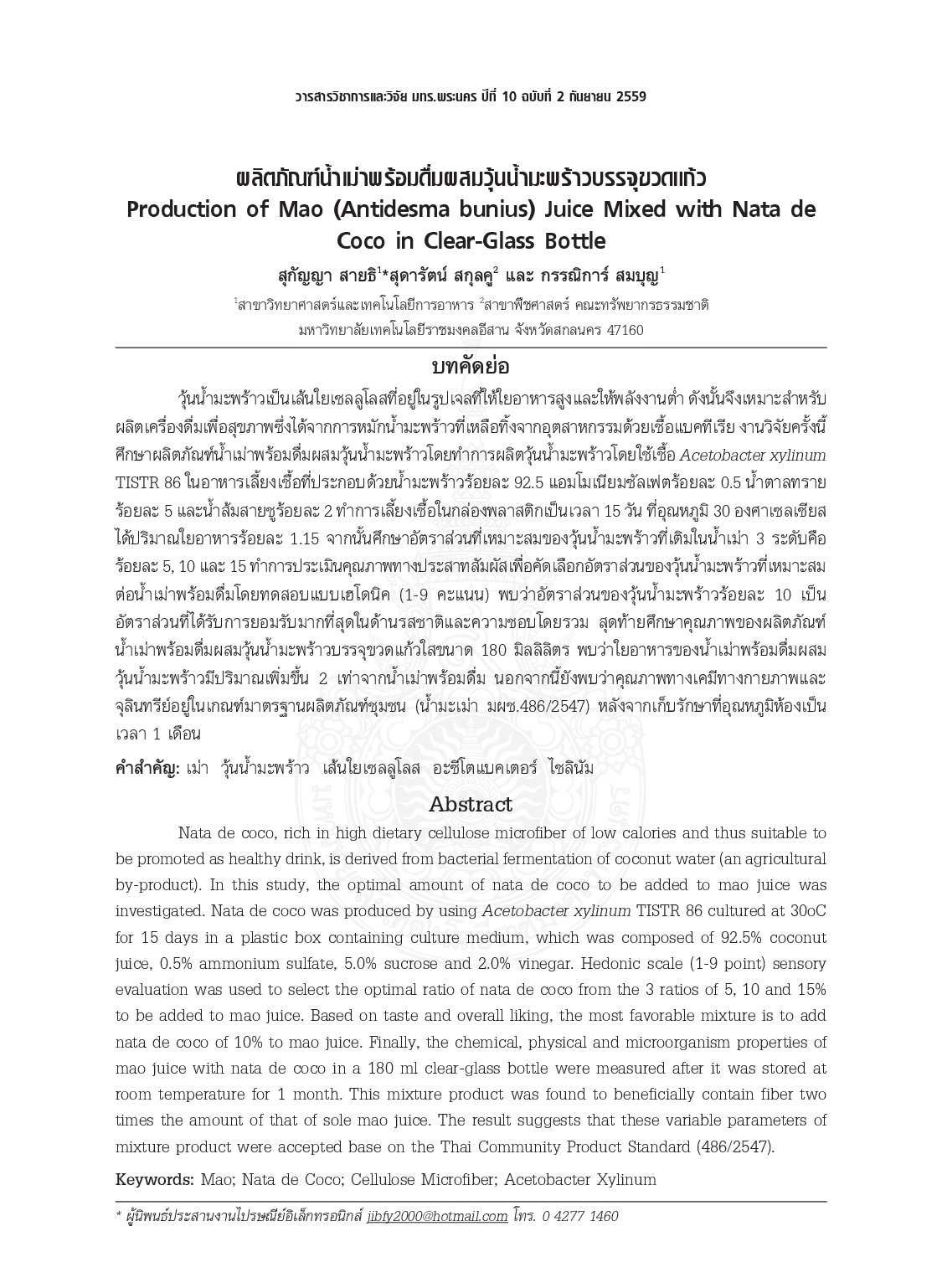
ผลิตภัณฑ์น้ำเม่าพร้อมดื่มผสมวุ้นน้ำมะพร้าวบรรจุขวดแก้ว
Nata de coco rich in high dietary cellulose microfiber of low calories and thus suitable to be promoted as healthy drink is derived from bacterial fermentation of coconut water (an agricultural by-product). In this study the optimal amount of nata de coco to be added to mao juice was investigated. Nata de coco was produced by using Acetobacter xylinum TISTR 86 cultured at 30oC for 15 days in a plastic box containing culture medium which was composed of 92.5% coconut juice 0.5% ammonium sulfate 5.0% sucrose and 2.0% vinegar. Hedonic scale (1-9 point) sensory evaluation was used to select the optimal ratio of nata de coco from the 3 ratios of 5 10 and 15% to be added to mao juice. Based on taste and overall liking the most favorable mixture is to add nata de coco of 10% to mao juice. Finally the chemical physical and microorganism properties of mao juice with nata de coco in a 180 ml clear-glass bottle were measured after it was stored at room temperature for 1 month. This mixture product was found to beneficially contain fiber two times the amount of that of sole mao juice. The result suggests that these variable parameters of mixture product were accepted base on the Thai Community Product Standard (486/2547).