จำนวน Repository ( 3611 )
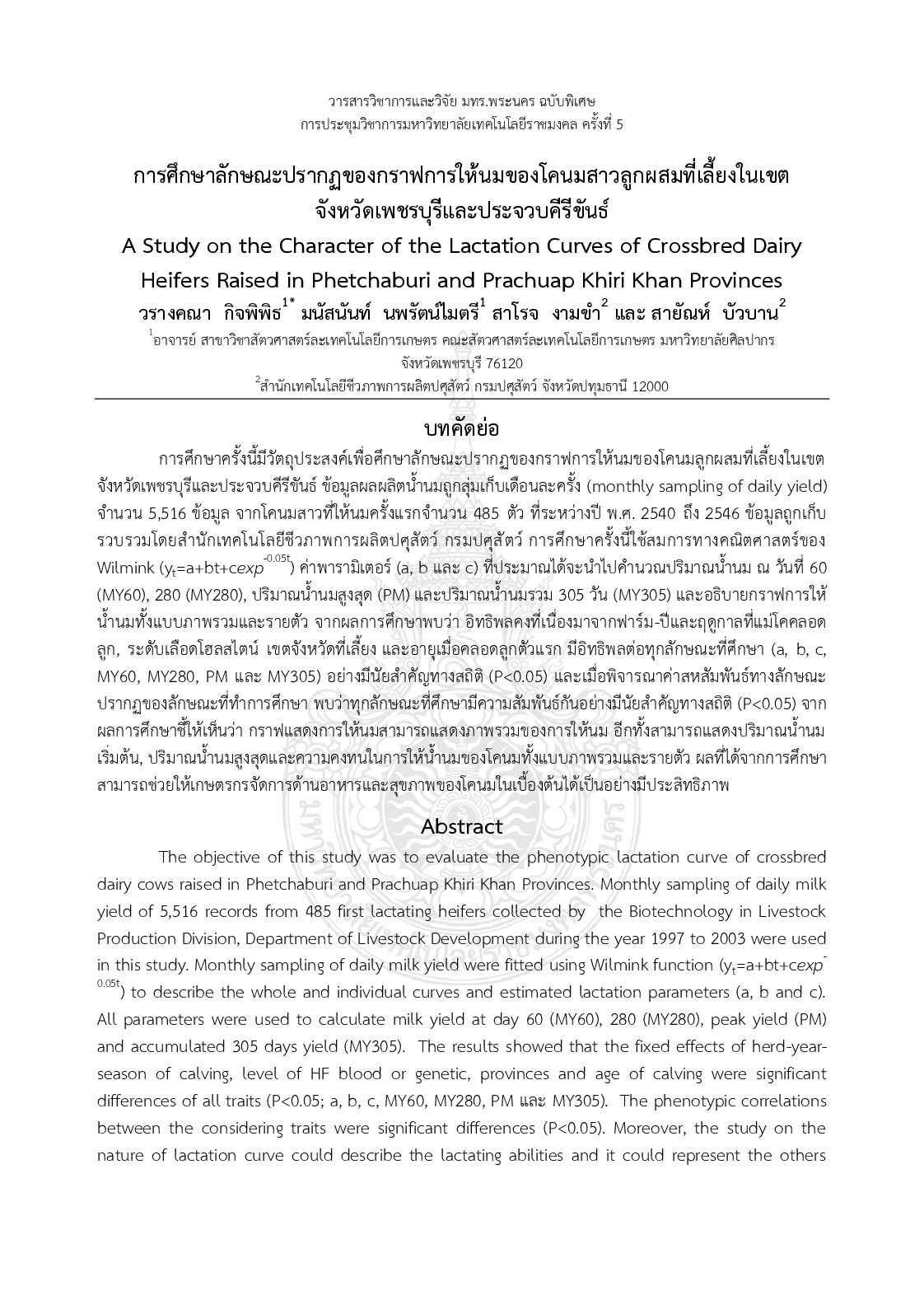
A study on the character of the lactation curves of crossbred dairy heifers raised in phetchaburi and prachuap khiri khan provinces
The objective of this study was to evaluate the phenotypic lactation curve of crossbred dairy cows raised in Phetchaburi and Prachuap Khiri Khan Provinces. Monthly sampling of daily milk yield of 5516 records from 485 first lactating heifers collected by the Biotechnology in Livestock Production Division Department of Livestock Development during the year 1997 to 2003 were used in this study. Monthly sampling of daily milk yield were fitted using Wilmink function (yt=a+bt+cexp-0.05t) to describe the whole and individual curves and estimated lactation parameters (a b and c). All parameters were used to calculate milk yield at day 60 (MY60) 280 (MY280) peak yield (PM) and accumulated 305 days yield (MY305). The results showed that the fixed effects of herd-year-season of calving level of HF blood or genetic provinces and age of calving were significant differences of all traits (P<0.05; a b c MY60 MY280 PM และ MY305). The phenotypic correlations between the considering traits were significant differences (P<0.05). Moreover the study on the nature of lactation curve could describe the lactating abilities and it could represent the others important traits in lactation curve. Therefore these results could guide the farmers to manage their farm and feeding the cattle to be more effective.

Nutritive values evaluation of moringa leaves meal for broiler feed ingredient
Nutritive values moringa leaves meal were evaluated and compared with luecaena leaves meal which has similar chemical compositions in order to use moringa leaves meal as broiler chicken feed ingredient. Thirty 3-week old chickens were divided into 3 groups of 10 birds (5 males 5 females) each. Each chicken was randomly fed with experimental diet that was composed with cassava powder (for endogenous nitrogen analysis) powdered moringa Leaves meal and powdered luecaena Leaves meal. The chickens were raised individually in metabolic cage where feed and water were provided ad libitum and both feed intake and feces weight were recorded. Experimental diets and excreta were sampled and subjected to proximate analysis for chemical compositions and gross energy. T-test comparison was used for statistical analysis. Results indicated that nutrients utilization of moringa Leaves meal (utilization percentage of dry matter organic matter protein crude fiber nitrogen free extract energy and metabolizable energy) were higher than those of luecaena Leaves meal (P<0.01). However there was no statistical difference (P>0.05) between moringa Leaves meal and luecaena Leaves meal in utilization percentage of ether extract. Moreover usable energy of moringa leaves meal was also higher than that of luecaena leaves meal (p<0.01). Therefore moringa Leaves meal could be one of potential feedstuffs for use in broiler diet production.
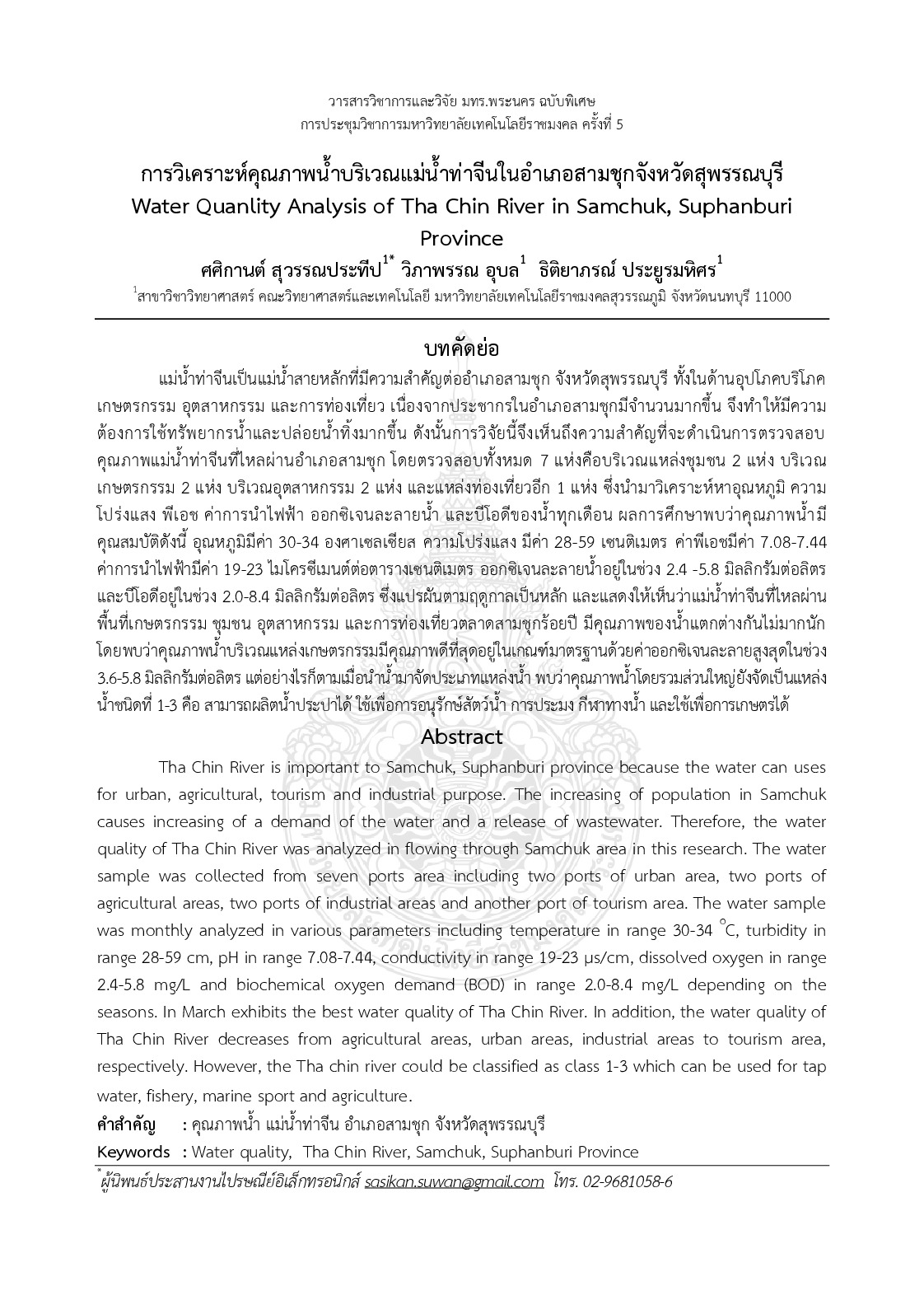
Water quanlity analysis of tha chin river in samchuk, suphanburi province
Tha Chin River is important to Samchuk Suphanburi province because the water can uses for urban agricultural tourism and industrial purpose. The increasing of population in Samchuk causes increasing of a demand of the water and a release of wastewater. Therefore the water quality of Tha Chin River was analyzed in flowing through Samchuk area in this research. The water sample was collected from seven ports area including two ports of urban area two ports of agricultural areas two ports of industrial areas and another port of tourism area. The water sample was monthly analyzed in various parameters including temperature in range 30-34 oC turbidity in range 28-59 cm pH in range 7.08-7.44 conductivity in range 19-23 s/cm dissolved oxygen in range 2.4-5.8 mg/L and biochemical oxygen demand (BOD) in range 2.0-8.4 mg/L depending on the seasons. In March exhibits the best water quality of Tha Chin River. In addition the water quality of Tha Chin River decreases from agricultural areas urban areas industrial areas to tourism area respectively. However the Tha chin river could be classified as class 1-3 which can be used for tap water fishery marine sport and agriculture.
The dominant feature of khao wong glutinous rice kalasin province for geographical indications
The objective of this research was to study the dominant feature of Khao Wong glutinous rice Kalasin province for geographical indications. The effect of three cultivated areas of glutinous rice variety (RD6) consisting of Khao Wong Huai Mek and Kong Chai districts was investigated along with their physicochemical textural properties and thermal properties. For the effect of different cultivated areas on glutinous rice properties the significant effect of different cultivated areas on chemical compounds viscosity and textural properties was observed (p?0.05). There was no significant effect of cultivated areas on amylose content (p>0.05). The highest protein and ash contents and the lowest setback hardness and chewiness values were found in the sample cultivated in Khao Wong district area. The aroma compounds analysis of rice samples revealed that methanecarboxylic acid was observed in glutinous rice cultivated in all studied areas. Whereas the highest content of 122-Trimethylcyclopropylamine was found in the sample cultivated at Khao Wong and Kong Chai districts. In addition the highest content of 2-cis-9-octadecenyloxyethanol was observed in glutinous rice cultivated at Huai Mek district.
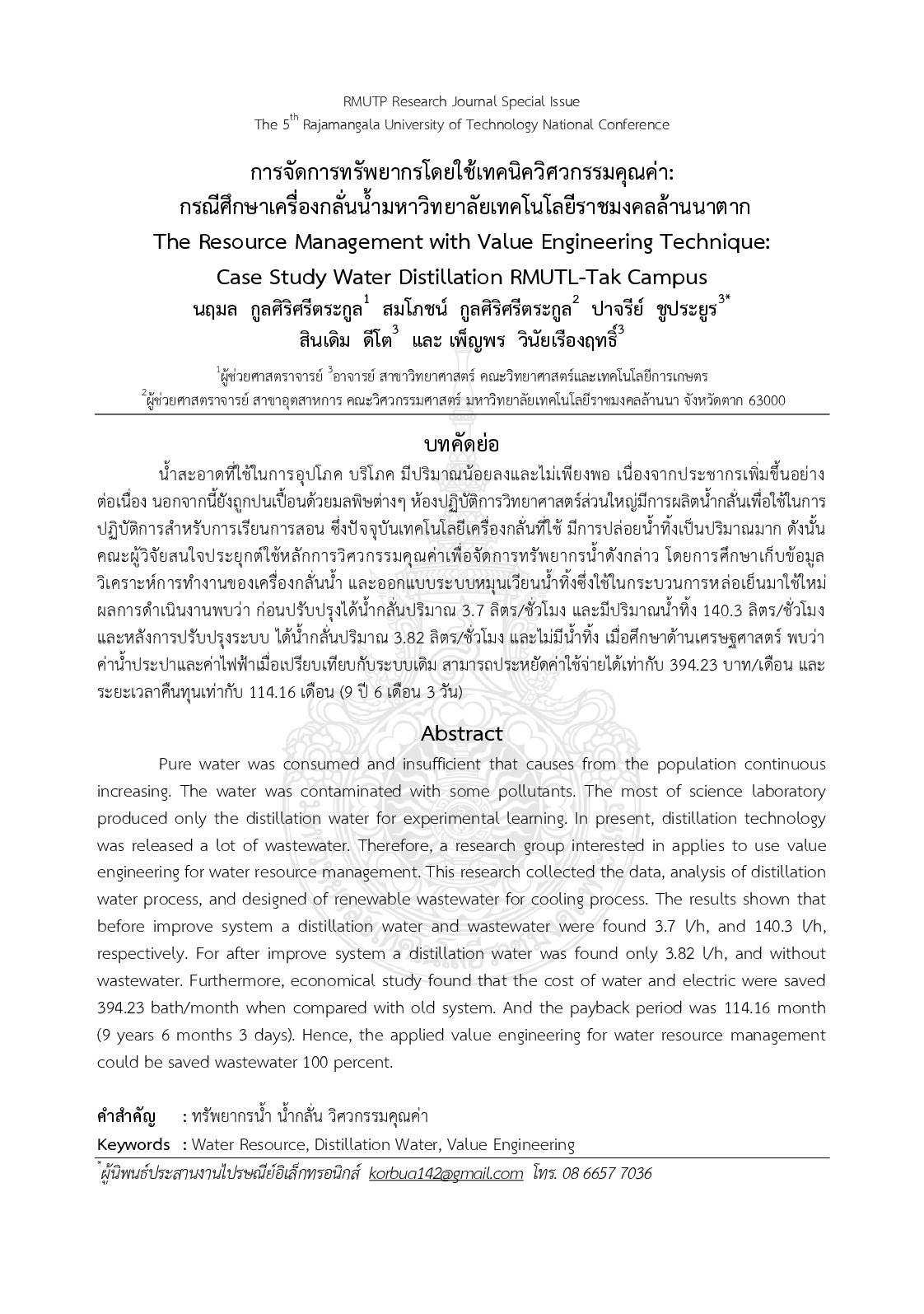
The resource management with value engineering technique: case study water distillation RMUTL-tak campus
Pure water was consumed and insufficient that causes from the population continuous increasing. The water was contaminated with some pollutants. The most of science laboratory produced only the distillation water for experimental learning. In present distillation technology was released a lot of wastewater. Therefore a research group interested in applies to use value engineering for water resource management. This research collected the data analysis of distillation water process and designed of renewable wastewater for cooling process. The results shown that before improve system a distillation water and wastewater were found 3.7 l/h and 140.3 l/h respectively. For after improve system a distillation water was found only 3.82 l/h and without wastewater. Furthermore economical study found that the cost of water and electric were saved 394.23 bath/month when compared with old system. And the payback period was 114.16 month (9 years 6 months 3 days). Hence the applied value engineering for water resource management could be saved wastewater 100 percent.